
Thyroid hormone secretion and synthesis
Reading File
Now let me search the medical library for thyroid hormone synthesis and secretion content, running parallel searches:
Finding Sources
Finding Sources
Excellent results. Let me now read the most comprehensive sources in parallel:
Reading File
Reading File
Reading File
Now let me fetch the key diagrams and read more detailed content from Ganong and Costanzo:
Loading Image
Loading Image
Loading Image
Reading File
I now have comprehensive content from multiple authoritative textbooks. Let me also fetch the feedback regulation diagram and read the Costanzo regulation details:
Loading Image
Reading File
Hinenglish mai bata
Bilkul! Ab main aapko Thyroid Hormone Synthesis aur Secretion Hinglish mein explain karta hoon - saari information jo humne abhi collect ki hai textbooks se.
🦋 Thyroid Hormone - Synthesis & Secretion
(Ganong's Physiology, Costanzo Physiology, Lippincott Pharmacology se)
📍 Pehle Samjho - Thyroid Gland Kya Hai?
Thyroid gland mein follicles hote hain - ek layer of thyrocytes (epithelial cells) jo ek lumen ko surround karti hain. Us lumen mein thyroglobulin (Tg) bhara hota hai - yahi thyroid hormone ka storage form hai.
⚙️ SYNTHESIS - Step by Step
Step 1️⃣ - Iodide Uptake (I⁻ ka andar aana)
- Blood se iodide (I⁻) thyrocyte ke andar aata hai ek special transporter ke through
- Ye transporter hai NIS - Sodium-Iodide Symporter
- Ye 2 Na⁺ ke saath ek baar mein 1 I⁻ transport karta hai (secondary active transport)
- Iodide plasma se 20-40x zyada concentrate hota hai thyroid mein
- TSH is process ko stimulate karta hai
- NIS salivary glands, gastric mucosa, placenta mein bhi hota hai - lekin wahan TSH se affect nahi hota
Step 2️⃣ - Thyroglobulin (Tg) ki Synthesis
- Thyrocytes thyroglobulin banate hain - ek bada glycoprotein (2 subunits se bana)
- Isme 123 tyrosine residues hote hain
- Lekin sirf 4-8 tyrosines hi normally thyroid hormones mein incorporate hoti hain
- Tg ko exocytosis ke through colloid mein secrete kiya jata hai
Step 3️⃣ - Organification (Iodination of Tyrosine)
- Thyrocyte ki apical membrane par Pendrin channel se I⁻ colloid mein release hota hai
- Wahan Thyroid Peroxidase (TPO) enzyme iodide ko oxidize karke reactive iodine (I₂) banata hai - H₂O₂ ki help se
- Ye reactive iodine Tg ke tyrosine residues se react karta hai
- Result:
- MIT - Monoiodotyrosine (ek iodine laga)
- DIT - Diiodotyrosine (do iodine lage)
💊 Clinical Point: PTU (Propylthiouracil) aur Methimazole - dono TPO ko block karte hain → hormone synthesis ruk jati hai
Step 4️⃣ - Coupling (MIT + DIT ka milna)
Ye bhi TPO enzyme hi karta hai - colloid mein:
| Combination | Product |
|---|---|
| DIT + DIT | T4 (Thyroxine) + alanine |
| MIT + DIT | T3 (Triiodothyronine) + alanine |
| DIT + MIT | Reverse T3 (rT3) + alanine |
Normal thyroid distribution: MIT 3%, DIT 33%, T4 35%, T3 7%
Step 5️⃣ - Storage
- T3 aur T4 thyroglobulin se bound rehte hain colloid mein
- Colloid ek reservoir hai - agar aap 2 mahine tak bilkul bhi iodine na lo, tab bhi circulating thyroid hormone level normal rahega!
🚀 SECRETION - Hormones Ka Release
Colloid Endocytosis
- Jab hormones ki zaroorat hoti hai → TSH signal milta hai
- Thyrocytes colloid ko endocytosis se andar le aate hain
- Lysosomes Tg ko proteolysis se tod dete hain
- Free T4 aur T3 cytosol mein release hote hain → phir capillaries mein enter karte hain
Kitna secrete hota hai (per day)?
| Hormone | Daily Secretion |
|---|---|
| T4 | ~80 µg (103 nmol) |
| T3 | ~4 µg (7 nmol) |
| rT3 | ~2 µg (3.5 nmol) |
MIT aur DIT secrete nahi hote - inhe iodotyrosine deiodinase deiodinate kar deta hai aur iodine recycle ho jata hai
🔄 REGULATION - HPT Axis
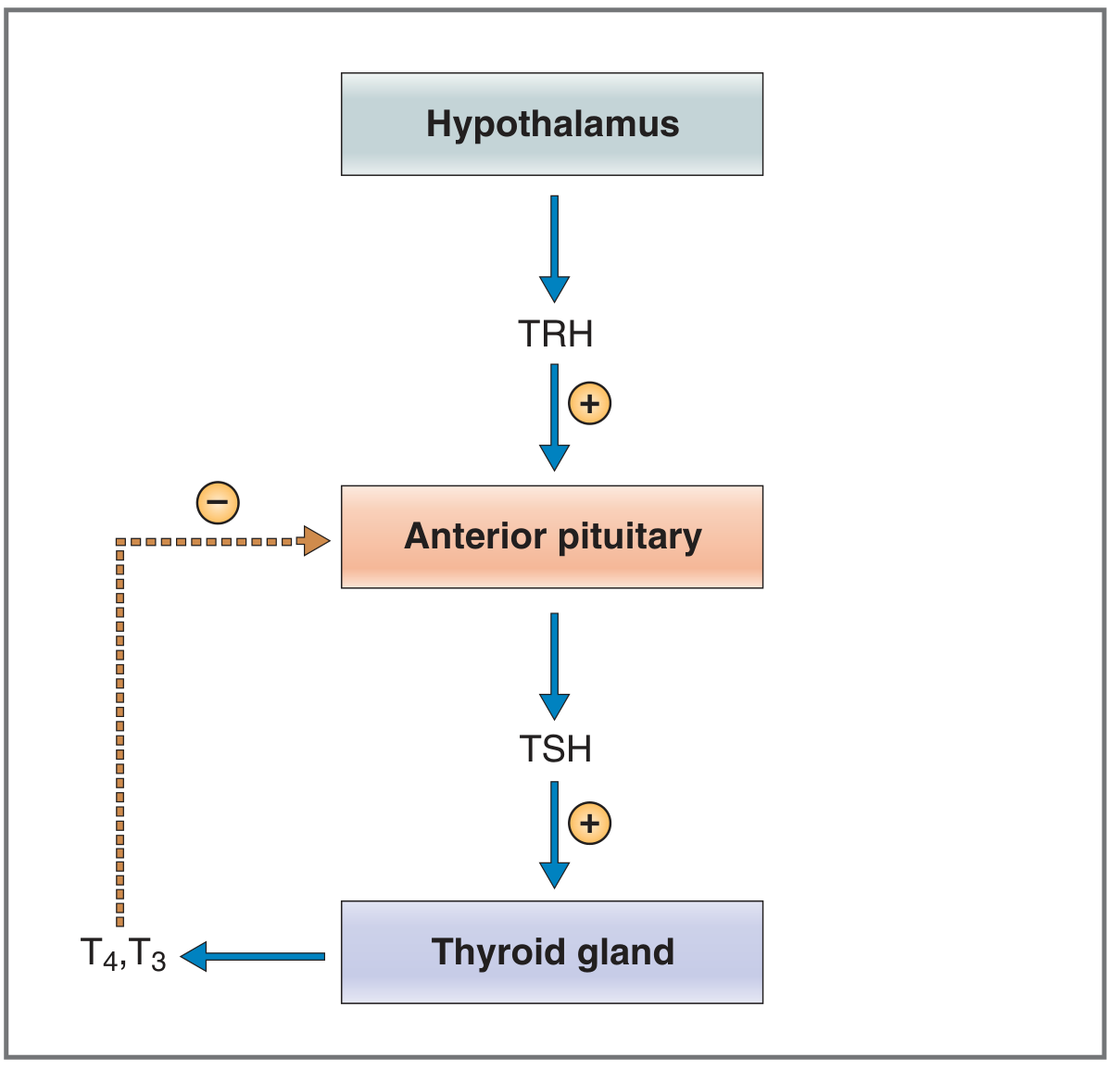
Hypothalamus → Pituitary → Thyroid → Feedback
-
Hypothalamus → TRH (Thyrotropin-Releasing Hormone) release karta hai
- TRH ek tripeptide hai, paraventricular nuclei se
- Anterior pituitary ke thyrotrophs par act karta hai
-
Anterior Pituitary → TSH (Thyroid-Stimulating Hormone) release karta hai
- TSH ek glycoprotein hai
- Thyroid ke har step ko stimulate karta hai: I⁻ uptake, oxidation, organification, coupling, endocytosis, proteolysis - sab kuch!
- TSH ka second messenger: cAMP (Gs protein coupled)
- TSH se thyroid mein hypertrophy + hyperplasia bhi hoti hai
-
Negative Feedback:
- High T3/T4 → Pituitary par TRH receptor down-regulate ho jata hai
- Feedback free T3 se hoti hai (kyunki pituitary mein deiodinase hota hai jo T4→T3 convert karta hai)
- Result: steady TSH → steady thyroid hormone secretion
⚠️ Stimulatory vs Inhibitory Factors
| ✅ Stimulate Karte Hain | ❌ Inhibit Karte Hain |
|---|---|
| TSH | I⁻ deficiency |
| Thyroid-stimulating immunoglobulins (Graves disease mein) | Excess iodide (Wolff-Chaikoff effect) |
| Increased TBG (pregnancy mein) | Perchlorate, Thiocyanate (NIS block) |
| PTU, Methimazole (TPO block) | |
| Decreased TBG (liver disease mein) |
🩺 T4 vs T3 - Important Points
- Thyroid mostly T4 secrete karta hai (80 µg/day) - jo less active hai
- Target tissues mein 5'-deiodinase T4 ko T3 mein convert karta hai (outer ring se 1 iodine hata ke) - active form
- Reverse T3 (rT3) - inner ring se iodine hatne se banta hai - inactive
- Starvation mein: 5'-deiodinase inhibit hoti hai (brain mein nahi) → BMR kam hota hai → energy bachti hai
🧬 Transport in Blood
- Circulating T3/T4 mostly Thyroxine-Binding Globulin (TBG) se bound rahte hain
- Sirf free hormones biologically active hain
- Sirf free hormones feedback mein participate karte hain
- TBG ka kaam: hormones ko degradation se protect karna, uniform tissue distribution
🔑 Yaad Rakhne Wali Key Points
- NIS = iodide uptake (TSH stimulated)
- TPO = organification + coupling (PTU/Methimazole block karte hain)
- MIT + DIT → T3; DIT + DIT → T4
- Colloid = hormone reservoir (2 mahine ka buffer)
- T4 prohormone hai, T3 active form hai
- Free T3 negative feedback deta hai pituitary par
- Wolff-Chaikoff effect = excess iodide synthesis temporarily block karta hai
- Graves disease = TSH receptor antibodies → hyperthyroidism
Sources: Ganong's Review of Medical Physiology 26e, Costanzo Physiology 7e, Lippincott Illustrated Reviews Pharmacology
This is a shared conversation. Sign in to Orris to start your own chat.