
Give everything about HYSTERESIS Reference Miller's, stoeltings and all pharmacology standard textbooks Give for 10 marks question and add images where ever required
Reading File
Finding Sources
Finding Sources
Searching Images
hysteresis loop plasma concentration effect anesthesia pharmacokinetic pharmacodynamic
Reading File
Reading File
Searching Images
counterclockwise hysteresis loop drug concentration effect
Reading File
Reading File
Hysteresis in Anesthesia Pharmacology — 10 Mark Answer
1. Definition
Hysteresis refers to the time delay (lag) between changes in plasma drug concentration and the corresponding changes in drug effect. It occurs because the plasma is usually not the actual site of drug action (the "biophase" or effect site), and additional time is needed for the drug to move from plasma to the effect site, penetrate tissue, bind its receptor, and trigger the intracellular events that produce the observed effect - Miller's Anesthesia, 10th ed.
In simple terms: the same plasma concentration can produce two different effects (depending on whether concentration is rising or falling), or the same effect can correspond to two different plasma concentrations.
2. Why Hysteresis Occurs
- Time required for drug to diffuse from central (plasma) compartment to the effect site (biophase)
- Time required, once at the effect site, to bind receptor and produce a measurable pharmacologic response
- Applies to essentially all IV anesthetic drugs (propofol, opioids, NMBAs, benzodiazepines) because plasma ≠ site of action (brain, neuromuscular junction, etc.)
3. Graphical Demonstration — The Hysteresis Loop
If plasma concentration is plotted against measured effect over time (e.g., propofol concentration vs Bispectral Index/BIS), the points do not fall on a single curve — they trace a loop:
- Ascending limb (rising concentration): effect lags behind concentration - effect is less than what the concentration alone would predict
- Descending limb (falling concentration): effect again lags - effect is greater than what current plasma concentration alone would predict
This produces a counterclockwise hysteresis loop (the typical pattern for most anesthetic/sedative-hypnotic and opioid drugs where the effect site is deeper than plasma, e.g., the brain).
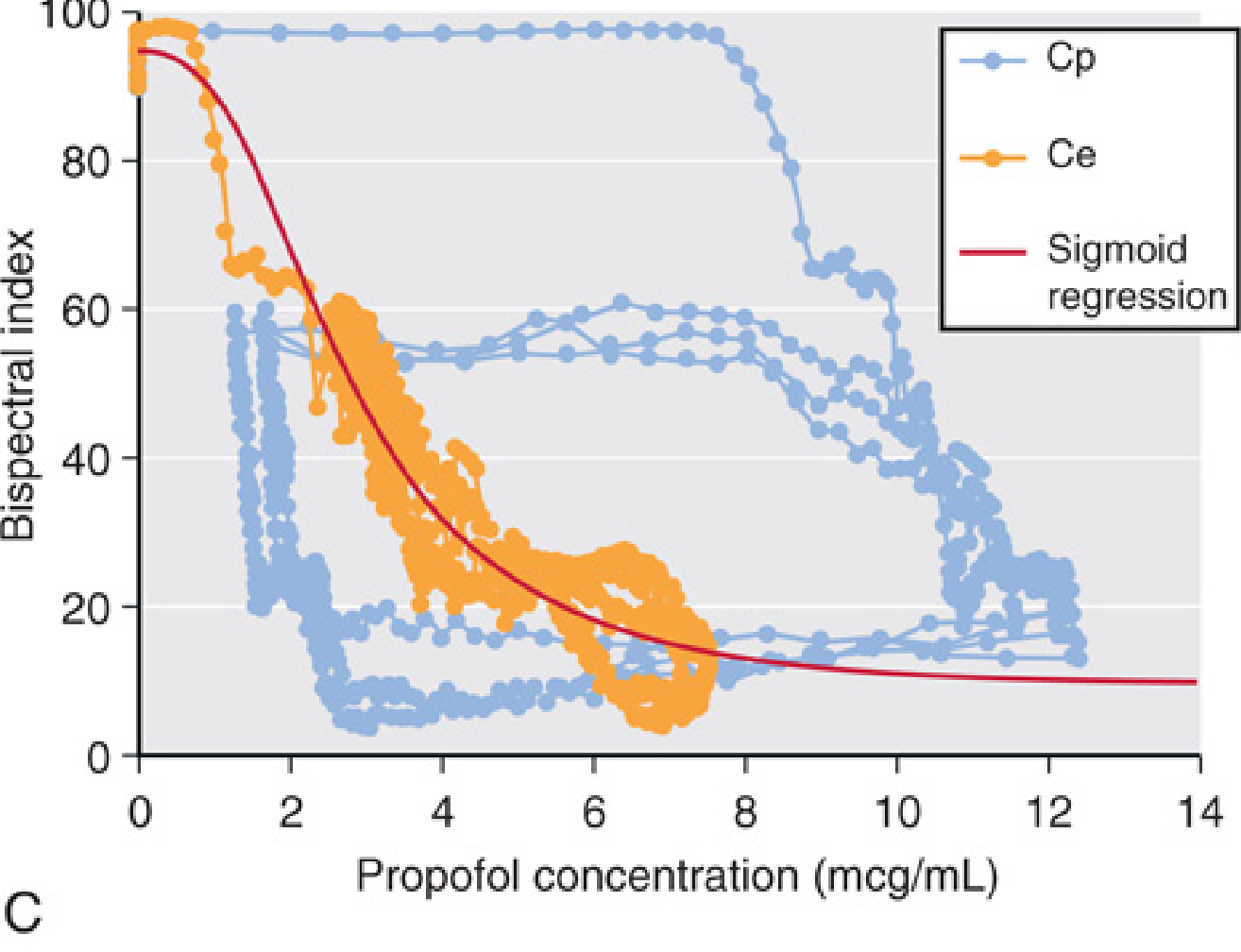
Reference example (Miller's, Soehle et al.): during two periods of constant-rate propofol infusion, plasma concentration and BIS were measured simultaneously. A clear delay was seen between the plasma concentration time-course and the BIS time-course - the same plasma concentration corresponded to different BIS values depending on whether concentration was rising or falling.
4. Modeling Hysteresis — The Effect-Compartment (Sheiner/Hull) Model
To "collapse" the hysteresis loop into a single concentration-effect relationship, pharmacokineticists add a theoretical effect-site (biophase) compartment linked to the central (plasma) compartment by first-order kinetics:
dCe/dt = k_eo × (Cp − Ce)
Key points (Miller's/Stoelting's):
- k1e - rate constant for drug movement from central compartment → effect site
- k_eo - effect-site elimination (equilibration) rate constant; describes how fast the effect site equilibrates with plasma
- The effect compartment has no real volume and holds a negligible amount of drug - it is a mathematical construct, not an anatomical space
- At steady state (constant infusion long enough), plasma concentration = effect-site concentration
- t1/2 keo = time for effect-site concentration to reach 50% of a step-change in plasma concentration - this quantifies how fast (or slow) equilibration/onset occurs
- Fast keo (short t1/2 keo): e.g., alfentanil, remifentanil - rapid onset/offset, small hysteresis
- Slow keo (long t1/2 keo): e.g., morphine - slow onset, large hysteresis lag
Once effect-site concentration (Ce) is calculated, plotting Ce vs effect (instead of Cp vs effect) collapses the loop into a single sigmoidal curve - typically described by the Hill equation (sigmoid Emax model):
Effect = E0 + (Emax × Ce^γ) / (Ce^γ + C50^γ)
where C50 = effect-site concentration producing 50% of maximal effect, and γ (gamma) is the steepness of the curve.
5. Clinical Examples
| Drug/Monitor | Effect measured | Hysteresis significance |
|---|---|---|
| Propofol | BIS / spectral edge / OAA/S sedation score | Onset/offset lag of ~1.5-2 min after peak plasma level |
| Opioids (fentanyl, remifentanil) | Analgesia / respiratory depression | Peak respiratory depression lags peak plasma level by several minutes; basis for TCI dosing to effect-site target |
| Neuromuscular blockers (rocuronium, cisatracurium) | T1% twitch height (EMG) | Effect-site (NMJ) equilibration much slower than plasma decline |
| Target-controlled infusion (TCI) pumps | - | Modern TCI systems target effect-site concentration, not plasma concentration, specifically to account for hysteresis and avoid overshoot/delay in achieving desired clinical effect |
6. Clinical Significance / Why It Matters (Exam Focus)
- Explains why peak drug effect does not coincide with peak plasma concentration during induction (bolus dosing)
- Explains apparent "delayed awakening despite falling plasma levels" during emergence - effect-site concentration lags behind falling plasma levels
- Basis for effect-site targeted TCI (e.g., propofol/remifentanil pumps) - dosing algorithms adjust infusion rate to reach a target effect-site concentration rather than plasma concentration, reducing overshoot and improving titration
- Explains inter-individual and inter-drug variability in onset/offset times independent of context-sensitive half-time
- Important when correlating drug levels with clinical monitors (BIS, twitch height) - a single concentration cannot be interpreted without knowing whether it is on the rising or falling limb
7. Other Uses of the Term "Hysteresis" (brief, for completeness across textbooks)
The word is also used in other physiological contexts, worth a one-line mention in a comprehensive answer:
- Respiratory physiology (Murray & Nadel's, West's): the lung pressure-volume (compliance) curve shows hysteresis - a higher driving (opening) pressure is needed during inspiration than the pressure that maintains the same volume during expiration, due to surfactant behavior and tissue viscoelastic ("stress adaptation") properties.
- Cardiology (pacemakers): "pacemaker hysteresis" is a programmed feature that allows the intrinsic heart rate to fall below the programmed pacing rate before pacing is triggered, to preserve the patient's own rhythm.
- Ophthalmology: "corneal hysteresis" (Ocular Response Analyzer) - the difference between two intraocular pressure readings taken during rapid corneal deformation and recovery, reflecting viscoelastic energy absorption of the cornea (used in glaucoma/keratoconus risk assessment).
These are distinct applications of the same general physical principle (a lagging, path-dependent response) but the pharmacokinetic-pharmacodynamic hysteresis described above (plasma vs effect-site concentration) is what is asked about in anesthesia pharmacology 10-mark exams.
8. Summary (Exam Answer Frame)
- Define hysteresis - lag between plasma concentration and effect
- Explain mechanism - biophase/effect-site delay
- Draw/describe the counterclockwise hysteresis loop (Cp vs effect)
- Explain modeling - effect-compartment model, k_eo, t1/2 keo, Hill equation, C50
- Give clinical examples - propofol-BIS, opioids, NMBAs
- State clinical relevance - TCI effect-site targeting, induction/emergence timing
Key References: Miller's Anesthesia, 10th ed. (Ch. 16 - Pharmacokinetic/Pharmacodynamic Principles; Ch. 23 - Intravenous Anesthetics/Biophase); Stoelting's Pharmacology and Physiology in Anesthetic Practice (Pharmacokinetic-Pharmacodynamic modeling chapters); Sheiner LB & Hull CJ - original effect-compartment model papers.
This is a shared conversation. Sign in to Orris to start your own chat.