


cc994912-67ab-4e02-b3c3-4b242ca36f9d.jpeg
be5968ad-a708-46cb-bb06-298bda811689.jpeg
Explain
Reading File
The images show textbook pages on lipoprotein metabolism and hypolipidaemic drugs (specifically statins). Let me search the medical library for detailed content while analyzing the images.
Finding Sources
Finding Sources
Reading File
Finding Sources
Reading File
Finding Sources
Reading File
Loading Image
Now I have everything needed for a thorough explanation. Here is a complete breakdown of the textbook content shown in the images:
Lipoprotein Metabolism & Hypolipidaemic Drugs
Part 1 - Lipoprotein Transport Pathways
Lipoproteins are particles that carry fats (lipids) through the bloodstream. The key players are chylomicrons, VLDL, IDL, LDL, and HDL.
A. Exogenous Pathway - Chylomicrons (Dietary Fat)
- Dietary triglycerides (TGs) and cholesterol are absorbed in the intestine, packaged into chylomicrons, and enter the blood via the thoracic duct (lymph system).
- In capillaries, endothelium-bound lipoprotein lipase (LPL) hydrolyses the TGs into free fatty acids - these pass into muscle (as energy) and fat cells (re-stored as TGs).
- The remaining particle shrinks into a chylomicron remnant (Chy. rem.) - it is rich in cholesterol ester (CHE) and low in TG.
- Liver cells have apoprotein receptors that recognize the remnant's surface apoproteins (especially Apo E), so the remnant is engulfed and digested by the liver.
- Liberated free cholesterol is either stored in liver cells after re-esterification, incorporated into a different lipoprotein, or excreted in bile as cholesterol or bile acids.
B. Endogenous Pathway - VLDL → IDL → LDL
This diagram from Lippincott's Biochemistry shows the process clearly:
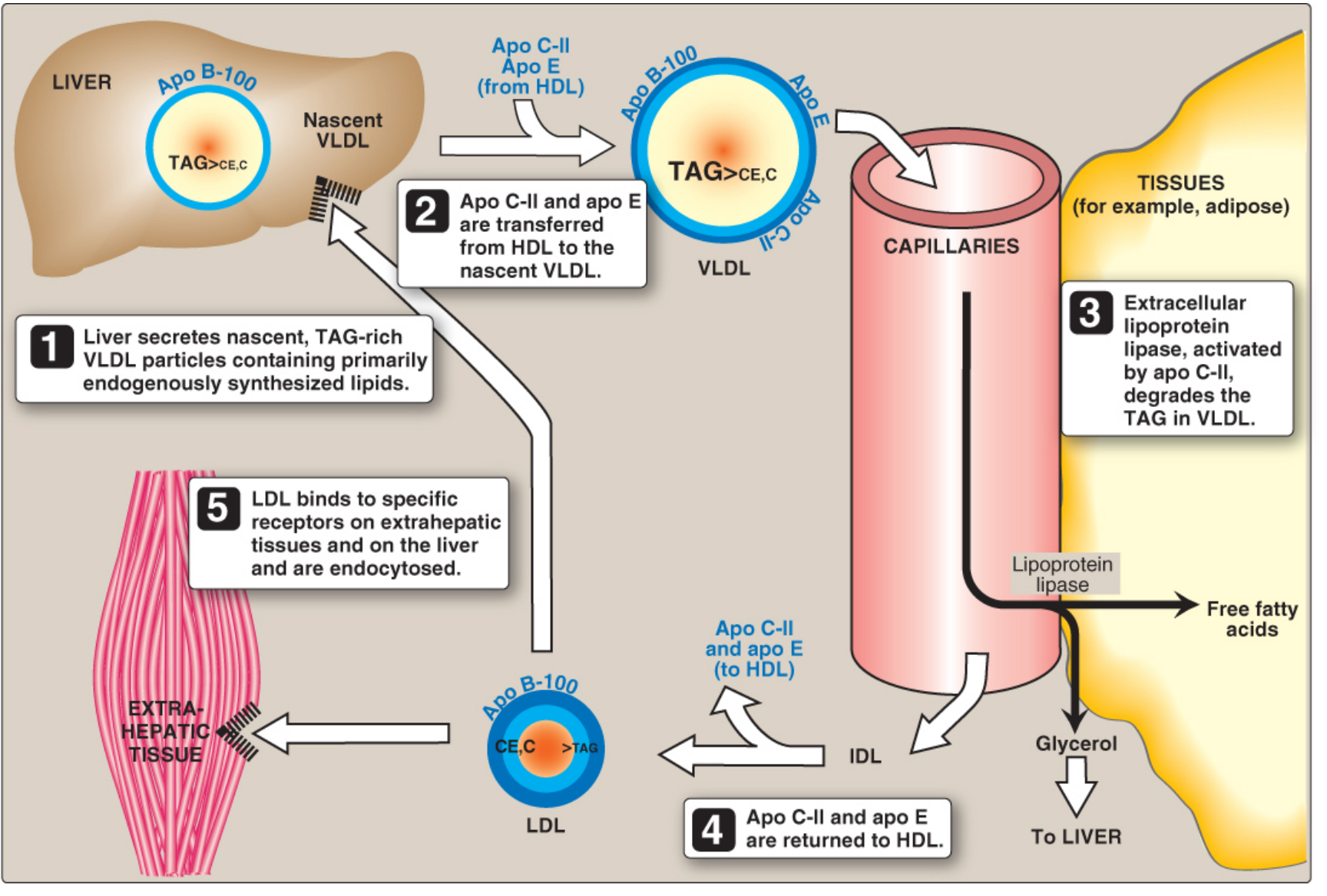
Step by step:
- Liver secretes VLDL - mainly containing TG and some CHE, along with Apo B-100.
- In blood, Apo C-II and Apo E are transferred to VLDL from HDL, making it functional.
- LPL acts on VLDL at capillary endothelium (same as chylomicrons). TGs are hydrolysed - fatty acids go to adipose tissue and muscle. Apo C-II and E are returned to HDL.
- IDL (Intermediate Density Lipoprotein) is formed - it now contains more CHE than TG.
- About half of IDL is taken back up by liver via LDL receptors (using Apo E as the ligand).
- The remaining IDL loses its TGs further and becomes LDL.
- LDL (low-density lipoprotein) contains only CHE - essentially all TG has been removed.
- LDL circulates in plasma for a long time.
- Its uptake into liver and other tissues depends on the cell's need for cholesterol.
- The rate of LDL uptake is regulated by the rate of LDL receptor synthesis in that tissue.
C. Reverse Cholesterol Transport - HDL
- When cell membranes are degraded, the released cholesterol is rapidly incorporated into HDL.
- HDL esterifies this cholesterol using the enzyme LCAT (lecithin:cholesterol acyltransferase).
- The cholesteryl esters are then transferred back to VLDL or IDL via CETP (cholesteryl ester transfer protein), completing the cycle.
- This reverse transport from tissues back to the liver is why HDL is protective against atherosclerosis.
D. Cholesterol Synthesis in the Body
Cholesterol is also synthesized endogenously via:
HMG-CoA → mevalonate (catalysed by HMG-CoA reductase - the rate-limiting step)
E. Fate of Excess Lipoproteins
- Excess lipoproteins in plasma are phagocytosed by macrophages for disposal.
- When too many lipoproteins are phagocytosed, cholesterol is deposited in:
- Arterial walls → atheromas (plaques causing coronary artery disease)
- Skin/tendons → xanthomas
Part 2 - Hyperlipoproteinaemias (Raised Blood Lipid Levels)
Raised levels of VLDL, IDL, LDL, and chylomicrons are atherogenic (cause plaque formation), while raised HDL is protective (removes cholesterol from tissues).
Causes:
i) Secondary (more common):
- Diabetes mellitus
- Myxoedema (hypothyroidism)
- Chronic alcoholism
- Nephrotic syndrome
- Drugs: corticosteroids, oral contraceptives, beta-blockers
ii) Primary - genetic/familial disorders of lipoprotein metabolism
Part 3 - Hypolipidaemic Drugs: Statins (HMG-CoA Reductase Inhibitors)
Statins are the most effective and best tolerated class of lipid-lowering drugs.
Mechanism of Action:
- Statins competitively inhibit HMG-CoA reductase, the enzyme that converts HMG-CoA to mevalonate (the rate-limiting step of cholesterol synthesis).
- Reduced intracellular cholesterol synthesis triggers a compensatory increase in LDL receptor expression on liver cells.
- More LDL receptors means more LDL is cleared from the blood via receptor-mediated uptake.
- Over the long term, statins reduce both LDL cholesterol and IDL levels substantially.
- By inhibiting HMG-CoA reductase, they also reduce the body's own cholesterol production pathway.
In summary: Statins work by blocking the cholesterol factory (HMG-CoA reductase), which forces the liver to pull more LDL out of the blood via upregulated LDL receptors - reducing plasma LDL.
Key Terms Summary
| Term | Full Name | Main Lipid Content | Function |
|---|---|---|---|
| Chylomicron | - | TG (~90%) | Carries dietary fat from gut to tissues |
| VLDL | Very Low Density Lipoprotein | Mainly TG | Carries endogenous fat from liver to tissues |
| IDL | Intermediate Density Lipoprotein | TG + CHE | VLDL remnant; cleared by liver or becomes LDL |
| LDL | Low Density Lipoprotein | Only CHE | Delivers cholesterol to tissues; atherogenic if high |
| HDL | High Density Lipoprotein | Phospholipid | Reverse cholesterol transport; cardioprotective |
| LPL | Lipoprotein Lipase | - | Hydrolyses TGs in VLDL and chylomicrons |
| LCAT | Lecithin:Cholesterol Acyltransferase | - | Esterifies cholesterol in HDL |
| HMG-CoA reductase | - | - | Rate-limiting enzyme in cholesterol synthesis; statin target |
Sources: Lippincott's Illustrated Reviews: Biochemistry 8th Ed; Goodman & Gilman's Pharmacological Basis of Therapeutics
This is a shared conversation. Sign in to Orris to start your own chat.