

inbound5702930795909730307.jpg
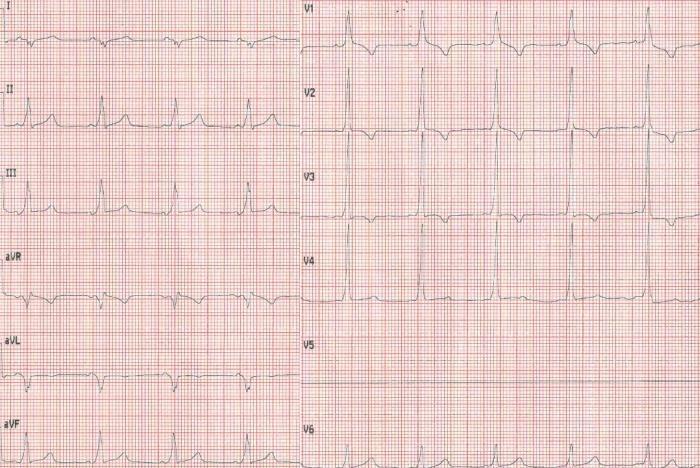
find the ecg abnormality
Reading File
Now let me analyze this ECG carefully and search the medical library for relevant content in parallel.
Finding Sources
Searching the Web
ECG interpretation delta wave pre-excitation WPW pattern features
Finding Sources
Searching Images
WPW Wolff-Parkinson-White ECG delta wave short PR wide QRS
Reading File
Loading Image
Based on my systematic analysis of the ECG image you provided, here is a detailed interpretation:
ECG Analysis
Machine parameters: Heart Rate 90 bpm | 6-channel + 1 rhythm | 10 mm/mV | 25 mm/sec
Primary Abnormality: Wolff-Parkinson-White (WPW) Pattern / Ventricular Pre-excitation
The ECG shows the classic triad of WPW:
| Feature | Finding |
|---|---|
| PR interval | Short (< 120 ms) — visible across leads I, II, III, aVF |
| Delta wave | Slurred, slow upstroke at the beginning of the QRS complex — most visible in inferior and precordial leads |
| QRS duration | Widened (> 120 ms) due to pre-excitation of ventricular myocardium |
Mechanism
In WPW, an accessory pathway (Bundle of Kent) bypasses the AV node and directly connects atrial to ventricular myocardium. This causes:
- Early ventricular activation → short PR (no AV nodal delay)
- Slow initial conduction through non-specialized myocardium → delta wave (slurred upstroke)
- Fusion of pre-excited and normal His-Purkinje activation → wide QRS
This is confirmed by Braunwald's Heart Disease: "Sinus rhythm ECG showing a short PR interval and delta wave classic for Wolff-Parkinson-White syndrome (WPW)."
Accessory Pathway Localization (from delta wave polarity)
- The delta waves appear upright in the inferior leads (II, III, aVF) and have a pattern consistent with a right anteroseptal or left-sided accessory pathway — but formal localization requires the full 12-lead precordial views (V1–V6), which are not shown in this 6-channel strip.
Secondary ST-T Changes
- Discordant ST-T changes (ST depression / T-wave inversion in some leads) — these are secondary repolarization abnormalities due to abnormal depolarization, NOT primary ischemia.
Clinical Significance
⚠️ Important: WPW predisposes to:
- AVRT (AV re-entrant tachycardia) — the most common arrhythmia
- Pre-excited atrial fibrillation — potentially life-threatening (very short R-R intervals can degenerate to ventricular fibrillation)
- Sudden cardiac death (rare but possible)
Management: Electrophysiology (EP) study + radiofrequency catheter ablation of the accessory pathway is curative. Avoid AV-nodal blocking agents (digoxin, verapamil, diltiazem) if pre-excited AF is suspected, as they can accelerate conduction down the accessory pathway.
Here is a reference WPW ECG from the medical literature for comparison:
Source: Braunwald's Heart Disease, p. 512
This is a shared conversation. Sign in to Orris to start your own chat.