
Dialyzer reaction about indication sign symptoms and their management, give me in poster form
dialyzer reaction types signs symptoms management hemodialysis
mkdir -p /home/daytona/workspace/dialyzer-poster
~/dialyzer-poster/poster.js
const pptxgen = require("pptxgenjs");

const pres = new pptxgen();
pres.layout = "LAYOUT_WIDE"; // 13.3 x 7.5 inches — landscape poster
pres.title = "Dialyzer Reaction - Clinical Reference Poster";

// ─── Colour Palette ────────────────────────────────────────────────
const NAVY      = "0D2B5E";   // dominant dark background
const TEAL      = "1ABC9C";   // accent green
const RED       = "E74C3C";   // Type A danger
const ORANGE    = "E67E22";   // Type B warning
const BLUE_CARD = "1A3A6B";   // card backgrounds
const PURPLE    = "7B4FD4";   // pyrogenic / misc
const WHITE     = "FFFFFF";
const LIGHT_GRAY= "D5E8F5";   // very light blue-grey text
const YELLOW    = "F1C40F";   // highlight

const slide = pres.addSlide();

// ─── BACKGROUND ────────────────────────────────────────────────────
slide.addShape(pres.ShapeType.rect, {
  x: 0, y: 0, w: 13.3, h: 7.5,
  fill: { color: NAVY }
});

// ─── TOP HEADER BAR ────────────────────────────────────────────────
slide.addShape(pres.ShapeType.rect, {
  x: 0, y: 0, w: 13.3, h: 0.85,
  fill: { color: TEAL }
});

// Title
slide.addText("DIALYZER REACTIONS", {
  x: 0.15, y: 0.0, w: 9.0, h: 0.85,
  fontSize: 30, bold: true, color: WHITE,
  fontFace: "Calibri", valign: "middle", align: "left",
  charSpacing: 4, margin: 0
});

// Subtitle badge
slide.addShape(pres.ShapeType.rect, {
  x: 9.3, y: 0.12, w: 3.7, h: 0.6,
  fill: { color: NAVY }, line: { color: WHITE, width: 1.2 },
  rounding: 0.08
});
slide.addText("Indications | Signs & Symptoms | Management", {
  x: 9.3, y: 0.12, w: 3.7, h: 0.6,
  fontSize: 7.5, color: LIGHT_GRAY, align: "center", valign: "middle",
  fontFace: "Calibri", margin: 0
});

// ─── OVERVIEW ROW (thin band) ──────────────────────────────────────
slide.addShape(pres.ShapeType.rect, {
  x: 0, y: 0.85, w: 13.3, h: 0.42,
  fill: { color: "142249" }
});
slide.addText([
  { text: "Definition: ", options: { bold: true, color: TEAL } },
  { text: "Adverse reactions occurring during haemodialysis attributed to the dialyzer membrane, sterilants, or dialysate contamination. Classified as ", options: { color: LIGHT_GRAY } },
  { text: "Type A (Anaphylactic/Anaphylactoid)", options: { bold: true, color: RED } },
  { text: " and ", options: { color: LIGHT_GRAY } },
  { text: "Type B (Mild / Complement-mediated)", options: { bold: true, color: ORANGE } },
  { text: " — plus Pyrogenic reactions.", options: { color: LIGHT_GRAY } }
], {
  x: 0.2, y: 0.85, w: 12.9, h: 0.42,
  fontSize: 8.5, fontFace: "Calibri", valign: "middle", margin: 0
});

// ═══════════════════════════════════════════════════════════════════
// ─── TYPE A CARD ───────────────────────────────────────────────────
// ═══════════════════════════════════════════════════════════════════
const cardY = 1.32;
const cardH = 5.85;

// Card background
slide.addShape(pres.ShapeType.rect, {
  x: 0.15, y: cardY, w: 4.0, h: cardH,
  fill: { color: BLUE_CARD },
  line: { color: RED, width: 2.5 },
  shadow: { type: "outer", blur: 6, offset: 2, angle: 45, color: "000000", opacity: 0.4 }
});

// Card header
slide.addShape(pres.ShapeType.rect, {
  x: 0.15, y: cardY, w: 4.0, h: 0.52,
  fill: { color: RED }
});
slide.addText("⚠  TYPE A  —  ANAPHYLACTIC / ANAPHYLACTOID", {
  x: 0.15, y: cardY, w: 4.0, h: 0.52,
  fontSize: 10, bold: true, color: WHITE, align: "center", valign: "middle",
  fontFace: "Calibri", margin: 0
});

// Onset badge
slide.addShape(pres.ShapeType.rect, {
  x: 0.35, y: cardY + 0.58, w: 3.6, h: 0.34,
  fill: { color: "3D0A0A" }, line: { color: RED, width: 0.8 }
});
slide.addText("ONSET: Within first 5–10 min of dialysis start", {
  x: 0.35, y: cardY + 0.58, w: 3.6, h: 0.34,
  fontSize: 8, bold: true, color: YELLOW, align: "center", valign: "middle",
  fontFace: "Calibri", margin: 0
});

// Cause
slide.addText("CAUSE", {
  x: 0.35, y: cardY + 1.02, w: 3.6, h: 0.26,
  fontSize: 8.5, bold: true, color: TEAL, fontFace: "Calibri", valign: "middle", margin: 0
});
slide.addText([
  { text: "• IgE-mediated hypersensitivity to ", options: { color: LIGHT_GRAY } },
  { text: "ethylene oxide (ETO)", options: { bold: true, color: WHITE } },
  { text: " sterilant\n• Complement activation via AN69 membrane\n• ACE inhibitor use + AN69 (bradykinin-mediated)\n• Bioincompatible cellulosic membranes", options: { color: LIGHT_GRAY } }
], {
  x: 0.35, y: cardY + 1.28, w: 3.6, h: 0.85,
  fontSize: 7.8, fontFace: "Calibri", valign: "top", margin: 0
});

// Signs & Symptoms
slide.addShape(pres.ShapeType.line, {
  x: 0.35, y: cardY + 2.16, w: 3.6, h: 0, line: { color: RED, width: 0.8, dashType: "dash" }
});
slide.addText("SIGNS & SYMPTOMS", {
  x: 0.35, y: cardY + 2.22, w: 3.6, h: 0.26,
  fontSize: 8.5, bold: true, color: TEAL, fontFace: "Calibri", valign: "middle", margin: 0
});
slide.addText([
  { text: "Skin:   ", options: { bold: true, color: ORANGE } },
  { text: "Pruritus, urticaria, angioedema\n", options: { color: LIGHT_GRAY } },
  { text: "Resp:  ", options: { bold: true, color: ORANGE } },
  { text: "Cough, sneezing, wheezing, dyspnoea, laryngeal oedema\n", options: { color: LIGHT_GRAY } },
  { text: "GI:     ", options: { bold: true, color: ORANGE } },
  { text: "Nausea, vomiting, abdominal cramps, diarrhoea\n", options: { color: LIGHT_GRAY } },
  { text: "CVS:  ", options: { bold: true, color: ORANGE } },
  { text: "Hypotension → anaphylactic shock → cardiac arrest\n", options: { color: LIGHT_GRAY } },
  { text: "Other: ", options: { bold: true, color: ORANGE } },
  { text: "Fever, chills, chest pain, 'sense of impending doom'", options: { color: LIGHT_GRAY } }
], {
  x: 0.35, y: cardY + 2.50, w: 3.6, h: 1.30,
  fontSize: 7.6, fontFace: "Calibri", valign: "top", margin: 0
});

// Management
slide.addShape(pres.ShapeType.line, {
  x: 0.35, y: cardY + 3.84, w: 3.6, h: 0, line: { color: RED, width: 0.8, dashType: "dash" }
});
slide.addText("MANAGEMENT", {
  x: 0.35, y: cardY + 3.90, w: 3.6, h: 0.26,
  fontSize: 8.5, bold: true, color: TEAL, fontFace: "Calibri", valign: "middle", margin: 0
});
slide.addText([
  { text: "1. STOP dialysis immediately — DO NOT return blood\n", options: { bold: true, color: RED } },
  { text: "2. Epinephrine (adrenaline) if anaphylaxis\n", options: { color: LIGHT_GRAY } },
  { text: "3. IV antihistamines (chlorpheniramine)\n", options: { color: LIGHT_GRAY } },
  { text: "4. IV corticosteroids (hydrocortisone)\n", options: { color: LIGHT_GRAY } },
  { text: "5. O₂ supplementation / airway support\n", options: { color: LIGHT_GRAY } },
  { text: "6. IV saline for hypotension\n", options: { color: LIGHT_GRAY } },
  { text: "7. Monitor vitals; escalate if unresponsive", options: { color: LIGHT_GRAY } }
], {
  x: 0.35, y: cardY + 4.18, w: 3.6, h: 1.25,
  fontSize: 7.6, fontFace: "Calibri", valign: "top", margin: 0
});


// ═══════════════════════════════════════════════════════════════════
// ─── TYPE B CARD ───────────────────────────────────────────────────
// ═══════════════════════════════════════════════════════════════════
const bX = 4.35;

slide.addShape(pres.ShapeType.rect, {
  x: bX, y: cardY, w: 4.0, h: cardH,
  fill: { color: BLUE_CARD },
  line: { color: ORANGE, width: 2.5 },
  shadow: { type: "outer", blur: 6, offset: 2, angle: 45, color: "000000", opacity: 0.4 }
});

slide.addShape(pres.ShapeType.rect, {
  x: bX, y: cardY, w: 4.0, h: 0.52,
  fill: { color: ORANGE }
});
slide.addText("⚡  TYPE B  —  MILD / COMPLEMENT-MEDIATED", {
  x: bX, y: cardY, w: 4.0, h: 0.52,
  fontSize: 10, bold: true, color: WHITE, align: "center", valign: "middle",
  fontFace: "Calibri", margin: 0
});

// Onset badge
slide.addShape(pres.ShapeType.rect, {
  x: bX + 0.2, y: cardY + 0.58, w: 3.6, h: 0.34,
  fill: { color: "3D1A00" }, line: { color: ORANGE, width: 0.8 }
});
slide.addText("ONSET: 15–30 min after dialysis start", {
  x: bX + 0.2, y: cardY + 0.58, w: 3.6, h: 0.34,
  fontSize: 8, bold: true, color: YELLOW, align: "center", valign: "middle",
  fontFace: "Calibri", margin: 0
});

// Cause
slide.addText("CAUSE", {
  x: bX + 0.2, y: cardY + 1.02, w: 3.6, h: 0.26,
  fontSize: 8.5, bold: true, color: TEAL, fontFace: "Calibri", valign: "middle", margin: 0
});
slide.addText([
  { text: "• Complement activation by dialyzer membrane\n", options: { color: LIGHT_GRAY } },
  { text: "• C3a & C5a anaphylatoxins generated\n", options: { color: LIGHT_GRAY } },
  { text: "• Pulmonary leukostasis (WBC aggregation)\n", options: { color: LIGHT_GRAY } },
  { text: "• Unsubstituted cellulosic membranes (first use)\n", options: { color: LIGHT_GRAY } },
  { text: "• Cytokine release (less immunologic than Type A)", options: { color: LIGHT_GRAY } }
], {
  x: bX + 0.2, y: cardY + 1.28, w: 3.6, h: 0.85,
  fontSize: 7.8, fontFace: "Calibri", valign: "top", margin: 0
});

// S&S
slide.addShape(pres.ShapeType.line, {
  x: bX + 0.2, y: cardY + 2.16, w: 3.6, h: 0, line: { color: ORANGE, width: 0.8, dashType: "dash" }
});
slide.addText("SIGNS & SYMPTOMS", {
  x: bX + 0.2, y: cardY + 2.22, w: 3.6, h: 0.26,
  fontSize: 8.5, bold: true, color: TEAL, fontFace: "Calibri", valign: "middle", margin: 0
});
slide.addText([
  { text: "• Chest pain / discomfort\n", options: { color: LIGHT_GRAY } },
  { text: "• Back pain (mild–moderate)\n", options: { color: LIGHT_GRAY } },
  { text: "• Dyspnoea (pulmonary leukostasis)\n", options: { color: LIGHT_GRAY } },
  { text: "• Nausea & vomiting\n", options: { color: LIGHT_GRAY } },
  { text: "• Mild hypotension (less common)\n", options: { color: LIGHT_GRAY } },
  { text: "• Symptoms usually resolve spontaneously", options: { bold: true, color: YELLOW } }
], {
  x: bX + 0.2, y: cardY + 2.50, w: 3.6, h: 1.10,
  fontSize: 7.8, fontFace: "Calibri", valign: "top", margin: 0
});

// Management
slide.addShape(pres.ShapeType.line, {
  x: bX + 0.2, y: cardY + 3.64, w: 3.6, h: 0, line: { color: ORANGE, width: 0.8, dashType: "dash" }
});
slide.addText("MANAGEMENT", {
  x: bX + 0.2, y: cardY + 3.70, w: 3.6, h: 0.26,
  fontSize: 8.5, bold: true, color: TEAL, fontFace: "Calibri", valign: "middle", margin: 0
});
slide.addText([
  { text: "1. Continue dialysis (symptoms usually abate)\n", options: { color: LIGHT_GRAY } },
  { text: "2. Supplemental O₂\n", options: { color: LIGHT_GRAY } },
  { text: "3. Analgesics for chest/back pain (paracetamol)\n", options: { color: LIGHT_GRAY } },
  { text: "4. Reduce blood flow rate\n", options: { color: LIGHT_GRAY } },
  { text: "5. Trendelenburg position if hypotensive\n", options: { color: LIGHT_GRAY } },
  { text: "6. Switch to synthetic high-flux membrane\n", options: { color: LIGHT_GRAY } },
  { text: "7. Reprocessed / substituted cellulosic dialyzer on next session", options: { color: LIGHT_GRAY } }
], {
  x: bX + 0.2, y: cardY + 3.98, w: 3.6, h: 1.30,
  fontSize: 7.6, fontFace: "Calibri", valign: "top", margin: 0
});

// ═══════════════════════════════════════════════════════════════════
// ─── PYROGENIC / MISC CARD ─────────────────────────────────────────
// ═══════════════════════════════════════════════════════════════════
const cX = 8.55;

slide.addShape(pres.ShapeType.rect, {
  x: cX, y: cardY, w: 4.6, h: cardH,
  fill: { color: BLUE_CARD },
  line: { color: PURPLE, width: 2.5 },
  shadow: { type: "outer", blur: 6, offset: 2, angle: 45, color: "000000", opacity: 0.4 }
});

slide.addShape(pres.ShapeType.rect, {
  x: cX, y: cardY, w: 4.6, h: 0.52,
  fill: { color: PURPLE }
});
slide.addText("🌡  PYROGENIC REACTIONS  &  PREVENTION", {
  x: cX, y: cardY, w: 4.6, h: 0.52,
  fontSize: 10, bold: true, color: WHITE, align: "center", valign: "middle",
  fontFace: "Calibri", margin: 0
});

// Pyrogenic section
slide.addText("PYROGENIC REACTION", {
  x: cX + 0.2, y: cardY + 0.60, w: 4.2, h: 0.26,
  fontSize: 8.5, bold: true, color: TEAL, fontFace: "Calibri", valign: "middle", margin: 0
});
slide.addText([
  { text: "Cause: ", options: { bold: true, color: ORANGE } },
  { text: "Endotoxin fragments crossing dialyzer membrane from contaminated dialysate/water → cytokine release\n", options: { color: LIGHT_GRAY } },
  { text: "Signs: ", options: { bold: true, color: ORANGE } },
  { text: "Fever, chills, rigors, headache, hypotension (in severe cases)\n", options: { color: LIGHT_GRAY } },
  { text: "Rx: ", options: { bold: true, color: ORANGE } },
  { text: "Assess haemodynamic stability • IV fluids if hypotensive • Stop ultrafiltration • Discontinue dialysis • Blood cultures if infective source suspected • Antipyretics", options: { color: LIGHT_GRAY } }
], {
  x: cX + 0.2, y: cardY + 0.90, w: 4.2, h: 1.15,
  fontSize: 7.6, fontFace: "Calibri", valign: "top", margin: 0
});

// Divider
slide.addShape(pres.ShapeType.line, {
  x: cX + 0.2, y: cardY + 2.10, w: 4.2, h: 0, line: { color: PURPLE, width: 0.8, dashType: "dash" }
});

// Prevention
slide.addText("PREVENTION STRATEGIES", {
  x: cX + 0.2, y: cardY + 2.18, w: 4.2, h: 0.26,
  fontSize: 8.5, bold: true, color: TEAL, fontFace: "Calibri", valign: "middle", margin: 0
});
slide.addText([
  { text: "Type A Prevention:\n", options: { bold: true, color: RED } },
  { text: "• Rinse dialyzer thoroughly before first use (remove ETO)\n", options: { color: LIGHT_GRAY } },
  { text: "• Use gamma-ray or steam-sterilized dialyzers (avoid ETO)\n", options: { color: LIGHT_GRAY } },
  { text: "• Avoid unmodified AN69 in patients on ACE inhibitors\n", options: { color: LIGHT_GRAY } },
  { text: "• Patch-test sensitised patients\n\n", options: { color: LIGHT_GRAY } },
  { text: "Type B Prevention:\n", options: { bold: true, color: ORANGE } },
  { text: "• Use synthetic high-flux membranes (polysulfone, polyamide)\n", options: { color: LIGHT_GRAY } },
  { text: "• Automated dialyzer reprocessing / re-use\n", options: { color: LIGHT_GRAY } },
  { text: "• Avoid cellulosic membranes on first use\n\n", options: { color: LIGHT_GRAY } },
  { text: "Pyrogenic Prevention:\n", options: { bold: true, color: PURPLE } },
  { text: "• Use ultrapure, endotoxin-free water & dialysate\n", options: { color: LIGHT_GRAY } },
  { text: "• Regular microbial monitoring of water system\n", options: { color: LIGHT_GRAY } },
  { text: "• Avoid contaminated bicarbonate dialysate\n", options: { color: LIGHT_GRAY } },
  { text: "• Proper CVC care; avoid infected AV fistula cannulation", options: { color: LIGHT_GRAY } }
], {
  x: cX + 0.2, y: cardY + 2.46, w: 4.2, h: 2.55,
  fontSize: 7.6, fontFace: "Calibri", valign: "top", margin: 0
});

// Divider
slide.addShape(pres.ShapeType.line, {
  x: cX + 0.2, y: cardY + 5.06, w: 4.2, h: 0, line: { color: PURPLE, width: 0.8, dashType: "dash" }
});

// Drug-induced note
slide.addText("DRUG-INDUCED REACTIONS (Note)", {
  x: cX + 0.2, y: cardY + 5.14, w: 4.2, h: 0.24,
  fontSize: 8.5, bold: true, color: TEAL, fontFace: "Calibri", valign: "middle", margin: 0
});
slide.addText([
  { text: "• Iron dextran: ", options: { bold: true, color: YELLOW } },
  { text: "Anaphylactoid in 0.6–1% (high MW > low MW). Keep resuscitation ready.\n", options: { color: LIGHT_GRAY } },
  { text: "• Heparin: ", options: { bold: true, color: YELLOW } },
  { text: "Rare hypersensitivity → switch formulation (pork↔beef) or use LMWH\n", options: { color: LIGHT_GRAY } },
  { text: "• Contaminated heparin: ", options: { bold: true, color: YELLOW } },
  { text: "Oversulfated chondroitin sulfate outbreak — vigilance required", options: { color: LIGHT_GRAY } }
], {
  x: cX + 0.2, y: cardY + 5.40, w: 4.2, h: 0.74,
  fontSize: 7.4, fontFace: "Calibri", valign: "top", margin: 0
});

// ─── COMPARISON TABLE ──────────────────────────────────────────────
// Quick comparison banner at bottom
slide.addShape(pres.ShapeType.rect, {
  x: 0, y: 7.22, w: 13.3, h: 0.28,
  fill: { color: "0A1E47" }
});
slide.addText([
  { text: "Sources: ", options: { bold: true, color: TEAL } },
  { text: "Harrison's Principles of Internal Medicine 22E (2025) • Comprehensive Clinical Nephrology 7th Ed • Brenner & Rector's The Kidney, 2-Vol Set", options: { color: LIGHT_GRAY } }
], {
  x: 0.2, y: 7.22, w: 13.0, h: 0.28,
  fontSize: 6.8, fontFace: "Calibri", valign: "middle", margin: 0
});

// ─── WRITE FILE ────────────────────────────────────────────────────
pres.writeFile({ fileName: "/home/daytona/workspace/dialyzer-poster/Dialyzer_Reaction_Poster.pptx" })
  .then(() => console.log("Poster created successfully."))
  .catch(err => console.error("Error:", err));
cd /home/daytona/workspace/dialyzer-poster && node poster.js
Dialyzer Reaction Poster
Presentation · PPTX
What the poster covers
🔴 TYPE A - Anaphylactic/Anaphylactoid (Red column)
- Cause: IgE-mediated hypersensitivity to ethylene oxide (ETO) sterilant; complement activation via AN69 membrane; ACE inhibitor + AN69 interaction
- Onset: Within the first 5-10 minutes
- Signs & Symptoms: Pruritus, urticaria, angioedema, wheezing, dyspnoea, abdominal cramps, hypotension, anaphylactic shock, cardiac arrest
- Management: STOP dialysis immediately - DO NOT return blood; Epinephrine, IV antihistamines, IV corticosteroids, O₂, IV saline
🟠 TYPE B - Mild/Complement-mediated (Orange column)
- Cause: C3a/C5a anaphylatoxin generation, pulmonary leukostasis, cytokine release from cellulosic membranes
- Onset: 15-30 minutes after start
- Signs & Symptoms: Chest pain, back pain, dyspnoea, nausea, mild hypotension - usually self-resolving
- Management: Continue dialysis; O₂; analgesics; reduce blood flow rate; switch to synthetic high-flux membrane
🟣 Pyrogenic Reactions & Prevention (Purple column)
- Endotoxin crossing dialyzer from contaminated dialysate
- Fever, chills, rigors, hypotension
- Management + comprehensive prevention strategies for all types
- Drug-induced reactions note (iron dextran, heparin)
I want poster form
A professional medical educational poster about Dialyzer Reactions in hemodialysis. The poster has a dark navy blue background with three clearly separated color-coded vertical columns: LEFT COLUMN (red border) - TYPE A ANAPHYLACTIC REACTION: - Bold red header "TYPE A — ANAPHYLACTIC / ANAPHYLACTOID" - Onset badge: "Within first 5-10 minutes" - CAUSE section: IgE-mediated hypersensitivity to ethylene oxide (ETO) sterilant, AN69 membrane + ACE inhibitors, bioincompatible cellulosic membranes - SIGNS & SYMPTOMS: Skin: pruritus, urticaria, angioedema | Respiratory: wheezing, dyspnoea, laryngeal edema | GI: nausea, vomiting, abdominal cramps | CVS: hypotension → anaphylactic shock → cardiac arrest | Fever, chills, "sense of doom" - MANAGEMENT (numbered red steps): 1. STOP dialysis - DO NOT return blood 2. Epinephrine 3. IV antihistamines 4. IV corticosteroids 5. Oxygen support 6. IV saline for hypotension MIDDLE COLUMN (orange border) - TYPE B MILD REACTION: - Bold orange header "TYPE B — MILD / COMPLEMENT-MEDIATED" - Onset badge: "15–30 minutes after start" - CAUSE: Complement activation → C3a & C5a, pulmonary leukostasis, cytokine release - SIGNS & SYMPTOMS: Chest pain, back pain, dyspnoea, nausea, mild hypotension — usually self-resolving - MANAGEMENT: Continue dialysis, oxygen, analgesics, reduce blood flow, switch to synthetic high-flux membrane RIGHT COLUMN (purple border) - PYROGENIC REACTIONS & PREVENTION: - Purple header "PYROGENIC REACTIONS & PREVENTION" - Pyrogenic cause: endotoxin from contaminated dialysate - Signs: fever, chills, rigors, hypotension - Treatment steps - Prevention table comparing Type A, B, and Pyrogenic prevention strategies TOP BANNER: Teal green header "DIALYZER REACTIONS — Indications | Signs & Symptoms | Management" BOTTOM: Dark bar with source citations from Harrison's Internal Medicine and Clinical Nephrology textbooks. Clean, clinical, high contrast, bold icons for each section, white text on dark backgrounds, color-coded system throughout
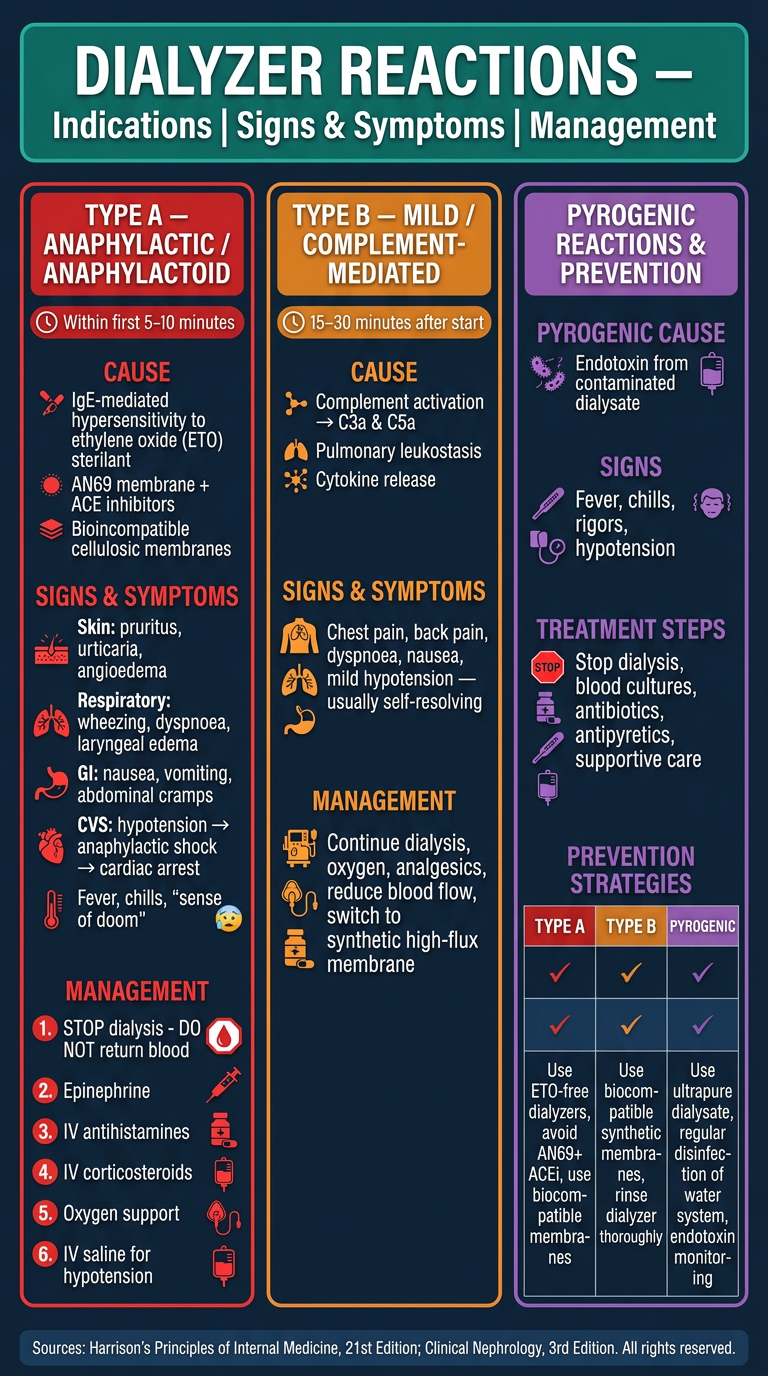
What's on the poster:
| Column | Type | Colour |
|---|---|---|
| Left | Type A - Anaphylactic/Anaphylactoid | 🔴 Red |
| Middle | Type B - Mild/Complement-mediated | 🟠 Orange |
| Right | Pyrogenic Reactions & Prevention | 🟣 Purple |
Dialyzer Reaction Poster
Presentation · PPTX
Summary
Dialyzer Reactions - Summary
What is a Dialyzer Reaction?
TYPE A — Anaphylactic/Anaphylactoid
| Onset | First 5–10 minutes |
| Cause | IgE hypersensitivity to ethylene oxide (ETO); AN69 + ACE inhibitors |
| Symptoms | Pruritus, urticaria, wheezing, dyspnoea, abdominal cramps, hypotension → shock |
| Management | STOP dialysis, DO NOT return blood; Epinephrine + antihistamines + corticosteroids + O₂ + IV saline |
TYPE B — Mild / Complement-Mediated
| Onset | 15–30 minutes |
| Cause | C3a/C5a complement activation; pulmonary leukostasis from cellulosic membranes |
| Symptoms | Chest pain, back pain, dyspnoea, mild nausea - usually self-resolving |
| Management | Continue dialysis; O₂; analgesics; switch to synthetic high-flux membrane |
Pyrogenic Reaction
| Cause | Endotoxin fragments from contaminated dialysate crossing the membrane |
| Symptoms | Fever, chills, rigors, headache, hypotension |
| Management | IV fluids, stop ultrafiltration, antipyretics, blood cultures if infection suspected |
Prevention at a Glance
- Type A: Rinse dialyzer before use; use gamma/steam sterilization; avoid ETO; avoid AN69 in ACE inhibitor patients
- Type B: Use synthetic high-flux membranes; reprocess dialyzers; avoid unsubstituted cellulosic membranes
- Pyrogenic: Ultrapure dialysate water; regular microbial monitoring; proper catheter care
Key rule: Type A = STOP immediately. Type B = can usually continue dialysis.