
Explain the root of upper respiratory tract & lower respiratory tract.
Reading File
Now let me search the medical library for content on upper and lower respiratory tract anatomy.
Finding Sources
Finding Sources
Finding Sources
Excellent finds. Let me read the most relevant sections in parallel — the anatomy section from Murray & Nadel's, the Fishman's Upper Respiratory Tract/Airway section, and the Murray & Nadel's disease sections.
Reading File
Reading File
Reading File
The Murray & Nadel anatomy chapter has rich content. Let me read the core anatomy section that covers airways, nose, pharynx, larynx (URT) and trachea, bronchi, lungs (LRT).
Reading File
Finding Sources
Finding Sources
Now let me read the specific detailed anatomy sections from Murray & Nadel's (the main anatomy chapter) and get images.
Reading File
Reading File
Searching Images
upper and lower respiratory tract anatomy diagram
I found a perfect anatomy diagram. Let me also read more of the Murray & Nadel airways section and get the Janeway's immunobiology description which precisely defines the boundary.
Reading File
Reading File
I now have comprehensive information from multiple authoritative textbooks. Let me also get the key Murray & Nadel airways section on the bronchial tree and alveoli structure.
Reading File
I now have all the information needed. Let me fetch the key diagram image and compose the comprehensive answer.
Loading Image
I now have everything needed for a comprehensive, well-structured answer. Here it is:
Respiratory Tract: Upper & Lower Divisions
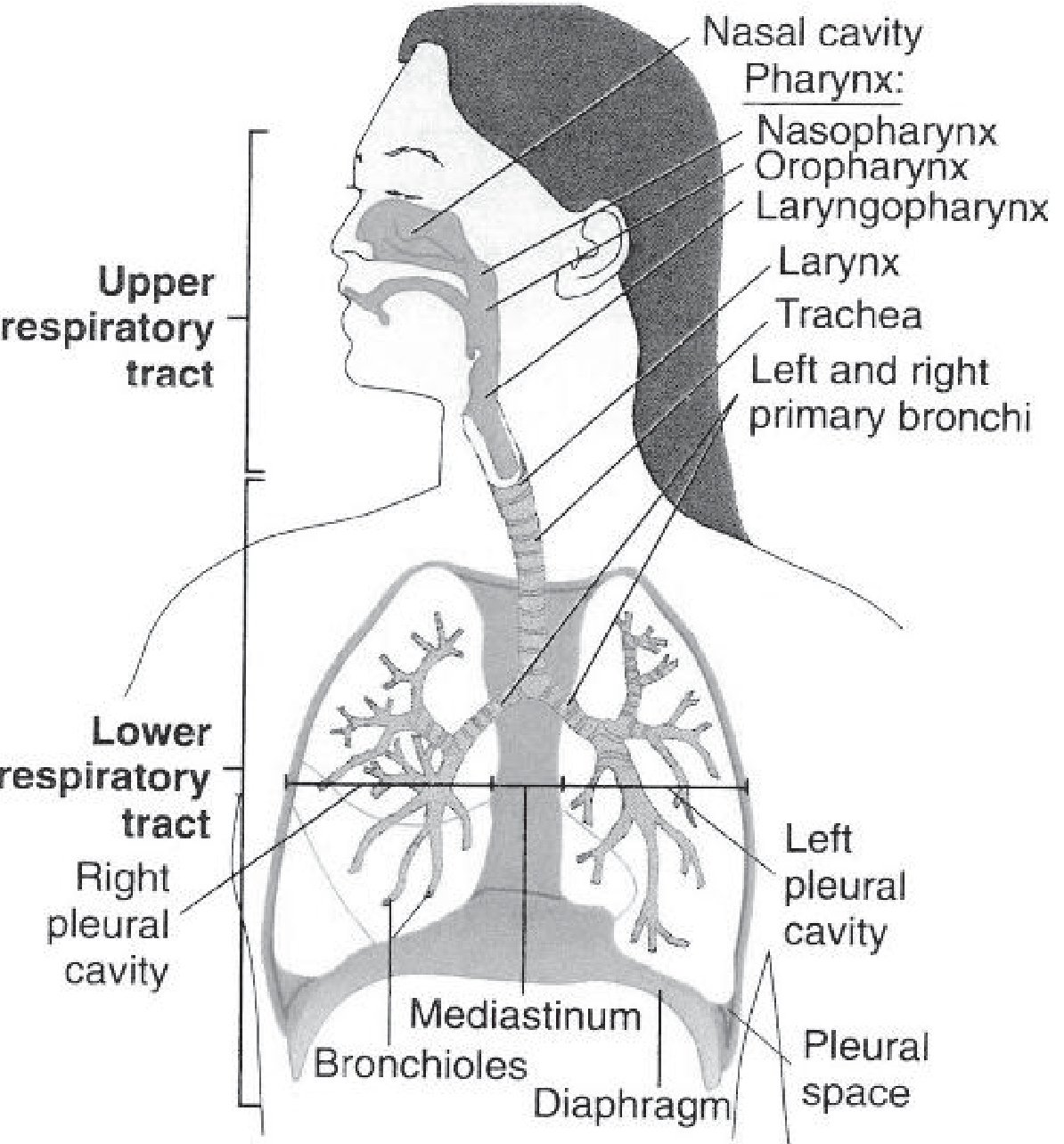
Dividing Landmark: The Vocal Cords
The respiratory tract is divided at the vocal cords (vocal folds) of the larynx. Everything above and including the larynx up to the vocal cords = Upper Respiratory Tract (URT); everything at and below the vocal cords = Lower Respiratory Tract (LRT).
"The upper respiratory tract—including the nose and nasal sinuses, pharynx, and larynx above the vocal cords... The lower respiratory tract includes the conducting airways—the larynx below the vocal cords, trachea, and branching bronchi and bronchioles—through which air is conducted in inspiration and expiration, as well as the respiratory airspaces, including alveoli, in which gas exchange between the inspired air and blood occurs." — Janeway's Immunobiology, 10e
Upper Respiratory Tract (URT)
Components
| Structure | Description |
|---|---|
| Nose & Nasal Cavity | External entry point; contains turbinates (conchae) that warm, humidify, and filter air |
| Paranasal Sinuses | Air-filled spaces (maxillary, frontal, ethmoid, sphenoid) draining into the nasal cavity |
| Pharynx | Divided into three parts: Nasopharynx (behind nasal cavity), Oropharynx (behind oral cavity), Laryngopharynx/Hypopharynx (above the larynx) |
| Larynx (above vocal cords) | Contains the epiglottis, arytenoid cartilages, and the vocal cords; guards airway entry |
The middle ear is connected to the URT via the Eustachian tube (auditory tube), which is why ear infections are classified with upper respiratory disease.
Key Functions of the URT
- Filtration: Hairs and mucus trap large particulates
- Conditioning: Warms and humidifies inspired air
- Defense: Mucociliary epithelium, lymphoid tissue (tonsils/adenoids = Waldeyer's ring)
- Microbiota: Colonized by commensal bacteria (facultative anaerobes predominate); acts as reservoir for potential pathogens
Epithelial Lining
The URT is lined by pseudostratified ciliated columnar epithelium (respiratory epithelium) with goblet cells. The cilia beat rhythmically to propel the mucus layer upward (the mucociliary escalator), clearing trapped debris toward the pharynx.
Airway Resistance
The nose alone accounts for up to 50% of total airway resistance during nasal breathing. During quiet mouth breathing, the mouth, pharynx, larynx, and trachea together contribute about 20% of total resistance. — Fishman's Pulmonary Diseases and Disorders
Lower Respiratory Tract (LRT)
Components
| Structure | Description |
|---|---|
| Larynx (below vocal cords) | Subglottic region; transitions to trachea |
| Trachea | Fibrocartilaginous tube ~12 cm long; supported by C-shaped hyaline cartilage rings (16–20 rings); bifurcates at the carina (T4–T5 level) |
| Primary (Main) Bronchi | Right and left; right bronchus is wider, shorter, and more vertical (explaining why aspirated objects more often enter the right lung) |
| Secondary (Lobar) Bronchi | Supply each lobe: 3 on right, 2 on left |
| Tertiary (Segmental) Bronchi | Supply bronchopulmonary segments (10 right, 8–10 left) |
| Bronchioles | Airways <1 mm diameter; no cartilage; smooth muscle regulates caliber |
| Terminal Bronchioles | Last purely conducting airway; ~150,000 in adult human |
| Respiratory Bronchioles | Transitional zone; some alveoli bud from walls |
| Alveolar Ducts & Alveoli | Site of gas exchange; ~300–500 million alveoli in adult lungs |
Bronchial Tree — Airway Generations
The human conducting airway has approximately 23 generations of branching (Weibel model):
- Generations 0–16: Conducting airways (trachea → terminal bronchioles)
- Generations 17–19: Respiratory bronchioles (transitional zone)
- Generations 20–23: Alveolar ducts and sacs
"More than 50% of all the lung's alveoli are located in the outer 30% of the lung radius (hilum to chest wall)." — Murray & Nadel's Textbook of Respiratory Medicine
Alveolar Structure
Two key epithelial cells line the alveoli:
- Type I pneumocytes (AT I): Thin, squamous; cover ~95% of alveolar surface area; facilitate gas exchange
- Type II pneumocytes (AT II): Cuboidal; produce surfactant (phospholipids + glycoproteins) that reduces surface tension and prevents alveolar collapse; serve as progenitor cells to repopulate Type I cells after injury
Alveolar macrophages patrol the airspaces, phagocytosing inhaled debris and pathogens.
Key Features of the LRT
- Normally sterile: No resident microbiota below the vocal cords
- Cartilage: Present in bronchi (not bronchioles); keeps airways patent
- Smooth muscle: Increases as cartilage decreases; regulates bronchiolar caliber (target of bronchodilators)
- Mucociliary escalator: Ciliated epithelium propels mucus upward at speeds sufficient to clear particles; coughing and sneezing accelerate clearance to ~100 mph
Cellular Composition of Airway Epithelium (Proximal → Distal)
- Proximal conducting airways (bronchi): Pseudostratified columnar epithelium with basal cells, ciliated cells, goblet cells, serous cells, submucosal glands
- Bronchioles: Goblet cells disappear; Club cells (formerly Clara cells) replace them — secretory cells producing lubricating serous product and antimicrobial factors (lysozyme); also serve as stem cells for distal airway regeneration
- Alveoli: Simple squamous (Type I) and cuboidal (Type II) epithelium
Summary Comparison
| Feature | Upper RT | Lower RT |
|---|---|---|
| Boundary | Nose → Larynx (above vocal cords) | Larynx (below cords) → Alveoli |
| Lining | Pseudostratified ciliated columnar (respiratory epithelium); squamous in oropharynx | Pseudostratified ciliated → simple columnar → squamous (alveoli) |
| Microbiota | Commensal colonization (facultative anaerobes) | Sterile under normal conditions |
| Cartilage | Laryngeal cartilages | Trachea + bronchi; absent in bronchioles |
| Primary function | Filter, warm, humidify air; phonation | Conduct air; gas exchange (O₂/CO₂) |
| Clinical diseases | Rhinitis, sinusitis, pharyngitis, tonsillitis, laryngitis, croup | Tracheitis, bronchitis, bronchiolitis, pneumonia, COPD, asthma |
Sources:
- Murray & Nadel's Textbook of Respiratory Medicine, Chapter 1: Anatomy
- Janeway's Immunobiology, 10e — Chapter 12, Mucosal Immunity of the Airways
- Tietz Textbook of Laboratory Medicine, 7th Ed. — Respiratory Tract Infections
- Fishman's Pulmonary Diseases and Disorders, 2-Vol Set — Airway Resistance
This is a shared conversation. Sign in to Orris to start your own chat.