
Why pellagra like symptoms are observed in maize consuming population
Maize (corn) is low in niacin (vitamin B3) and its precursor tryptophan, and the niacin present is largely bound in an unavailable form called niacintin - so populations relying heavily on maize without proper preparation develop pellagra (niacin deficiency), characterized by the "4 Ds": dermatitis, diarrhea, dementia, and death.
Searching sources...
Reading File
Searching the Web
pellagra maize corn niacin deficiency niacintin bound form
Now let me query the medical library for deeper textbook content on this topic.
Finding Sources
Finding Sources
Excellent results. Let me now read the most relevant textbook sections for detailed content.
Reading File
Reading File
Reading File
I now have very rich textbook content. Here is the complete, well-sourced answer:
Why Pellagra-Like Symptoms Occur in Maize-Eating Populations
Pellagra is niacin (vitamin B3) deficiency, classically presenting with the "4 Ds": dermatitis, diarrhea, dementia, and (if untreated) death. Maize-dependent populations are particularly vulnerable due to several overlapping mechanisms.
1. Niacin in Maize is Biologically Unavailable (Bound Form)
This is the most important factor. The niacin in untreated maize exists in a bound form - complexed to polysaccharides and peptides (historically called "niacintin"). Without alkaline hydrolysis (e.g., treatment with lime water), this bound niacin cannot be absorbed from the intestinal lumen.
"Corn and maize contain bound niacin, so without alkaline hydrolysis to release the niacin, it is unavailable for absorption."
- Fitzpatrick's Dermatology
This explains a striking historical observation: Mexican populations eating just as much maize had far lower rates of pellagra than other populations. Their traditional practice of nixtamalization - soaking and boiling maize in lime water (calcium hydroxide solution) - releases the bound niacin, making it bioavailable. Populations who adopted maize without this preparation technique developed endemic pellagra.
2. Maize is Deficient in Tryptophan
Niacin can also be synthesized endogenously from the essential amino acid tryptophan (60 mg tryptophan = 1 mg niacin equivalent). Maize proteins (mainly zein) are extremely low in tryptophan. This eliminates the body's compensatory pathway for niacin synthesis.
"Corn is a poor source of tryptophan, and the niacin in corn is bound and poorly available."
- Henry's Clinical Diagnosis and Management by Laboratory Methods
3. Excess Leucine - The Jowar/Maize Connection
A third mechanism was elucidated by Indian researchers, particularly Gopalan:
"Amino-acid imbalance caused by an excess of leucine is the cause of pellagra in both jowar and maize eaters. Excess of leucine appears to interfere in the conversion of tryptophan to niacin."
- Park's Textbook of Preventive and Social Medicine
Maize and jowar (sorghum) are both high in leucine. This excess leucine competitively inhibits the enzyme kynurenine hydroxylase in the tryptophan-to-niacin conversion pathway, further worsening niacin deficiency even when tryptophan is available.
4. Co-factor Deficiencies Compound the Problem
The conversion of tryptophan to niacin is a multi-step enzymatic process requiring cofactors including:
- Pyridoxal-5-phosphate (Vitamin B6)
- FAD (Vitamin B2/Riboflavin)
- Iron
Populations subsisting primarily on maize typically lack dietary diversity, leading to deficiencies in these cofactors, which further impairs niacin synthesis. Additionally, mold infestations (especially Fusarium species) on stored maize produce mycotoxins that aggravate the condition.
- Tietz Textbook of Laboratory Medicine
Summary: Why Maize is Pellagragenic
| Factor | Effect |
|---|---|
| Niacin bound as niacintin | Niacin not absorbed - unavailable |
| Low tryptophan in maize protein (zein) | Endogenous niacin synthesis impaired |
| High leucine content | Blocks tryptophan → niacin conversion |
| Cofactor deficiencies (B6, B2, Fe) | Further impairs biosynthetic pathway |
| Mycotoxins (Fusarium) | Aggravates deficiency |
Clinical Features of the Resulting Pellagra
- Dermatitis: Bilateral, symmetric, only on sun-exposed skin (dorsum of hands, lower legs, face, neck - sometimes called "Casal's necklace" on the neck). Photosensitivity is a hallmark.
- Diarrhea: Reflects widespread inflammation of intestinal mucosa, with glossitis, stomatitis, achlorhydria, and vaginitis.
- Dementia/Neuropsychiatric: Starts as fatigue, insomnia, apathy, progressing to confusion, disorientation, hallucinations, memory loss, and frank psychosis.
- Death: If untreated.
Why the Mexican Population Was Protected
The traditional Mesoamerican practice of nixtamalization (washing/soaking maize in alkaline lime/lye solution before grinding) chemically cleaves the niacintin complex, liberating free niacin. When Europeans adopted maize as a staple crop without adopting this preparation method, pellagra became epidemic across southern Europe, the American South, and parts of Africa and India.
- Fitzpatrick's Dermatology; Park's Textbook of Preventive and Social Medicine
The lesson: the problem was never maize itself, but the loss of the food processing knowledge that made it nutritionally adequate.
Enlist biochemical functions mediated by plp
PLP (pyridoxal phosphate) is the active coenzyme form of vitamin B6. It acts primarily as a cofactor in amino acid metabolism - transamination, decarboxylation, and several other reactions. It also plays roles in glycogen metabolism, heme synthesis, and neurotransmitter production.
Searching sources...
Finding Sources
Finding Sources
Finding Sources
Finding Sources
Excellent - I have key sources. Let me now read the detailed sections from the best textbooks.
Reading File
Reading File
Reading File
Now let me fetch the PLP reaction diagram and get deeper content on specific reactions.
Finding Sources
Loading Image
Finding Sources
Finding Sources
Finding Sources
Finding Sources
I now have comprehensive textbook data to construct a detailed, well-cited answer. Here it is:
Biochemical Functions Mediated by PLP (Pyridoxal Phosphate)
PLP is the active coenzyme form of vitamin B6 (formed by phosphorylation of pyridoxal). It is described as the "quintessential coenzyme of amino acid metabolism" - nearly every pathway involving amino acids requires PLP at at least one step. However, its functions extend well beyond amino acid metabolism.
"PLP is required for: transamination, deamination, decarboxylation, β-elimination, racemization, and γ-elimination. Almost all pathways involving amino acid metabolism will require PLP at one step."
- Basic Medical Biochemistry (Lieberman), 6e
Mechanism of Action
PLP acts as an electron sink. It forms a Schiff base (aldimine linkage) by covalently binding its aldehyde group (-CHO) to the ε-amino group of a lysine residue in the enzyme's active site. When a substrate amino acid enters, it displaces this lysine via a transaldimination reaction, forming an external aldimine with the substrate. The pyridine ring then stabilizes the developing carbanion by delocalizing electrons. Depending on which bond of the amino acid is broken, different reaction types result:
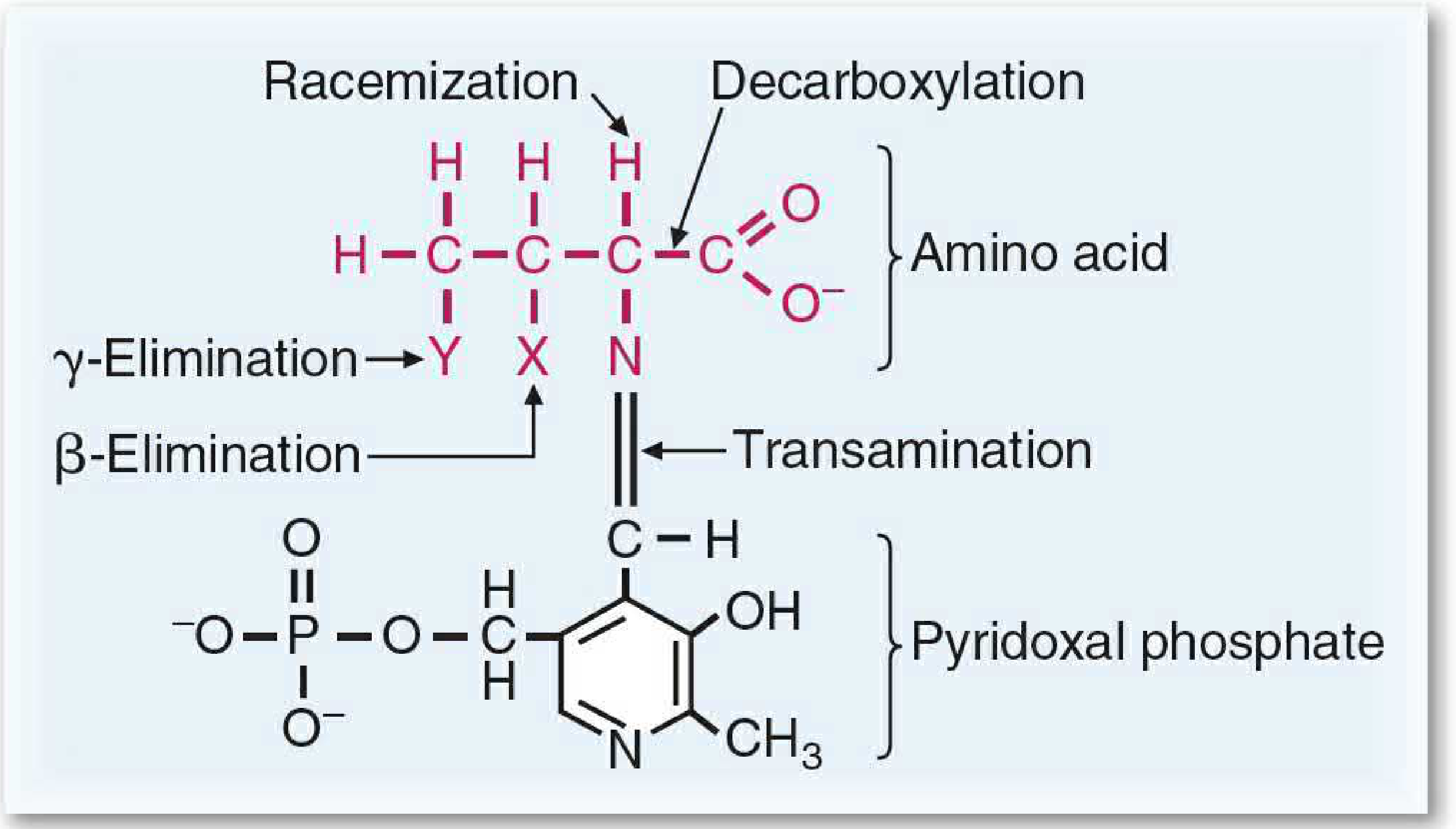
I. Amino Acid Metabolism Reactions
1. Transamination
The most important and ubiquitous PLP-dependent reaction. An amino group is transferred from an amino acid to an α-keto acid, converting PLP to PMP (pyridoxamine phosphate) and back.
- Key enzymes: Alanine aminotransferase (ALT), Aspartate aminotransferase (AST)
- Examples:
- Oxaloacetate + Glutamate ⇌ Aspartate + α-Ketoglutarate (AST)
- Pyruvate + Glutamate ⇌ Alanine + α-Ketoglutarate (ALT)
- These are critical for gluconeogenesis and amino acid catabolism
2. Deamination
Removal of an amino group without transfer, often yielding the corresponding keto acid + NH₃.
- Example: Serine → Pyruvate + NH₃ (catalyzed by serine dehydratase)
- Also: Threonine dehydratase, cysteine desulfhydrase
3. Decarboxylation
Removal of the α-carboxyl group of amino acids as CO₂, producing biogenic amines and neurotransmitters - a clinically critical function:
| Amino Acid | Product | Significance |
|---|---|---|
| Histidine | Histamine | Allergy, gastric acid secretion |
| Tryptophan | Serotonin (5-HT) | Mood, sleep, gut motility |
| DOPA | Dopamine | Motor control, reward pathway |
| Glutamate | GABA | Primary inhibitory neurotransmitter |
| Tyrosine | Tyramine | Vasoactive amine |
| Cysteine | Taurine | Bile acid conjugation |
- Biochemistry, Lippincott 8e
4. β-Elimination
Breaking the bond between the β-carbon and its substituent (X group). Examples:
- Serine → pyruvate (dehydratase reaction)
- Cystathionine β-synthase (transsulfuration pathway): homocysteine + serine → cystathionine
5. γ-Elimination
Breaking a bond at the γ-carbon position (one step further).
- Example: Cystathionine γ-lyase: cystathionine → cysteine + α-ketobutyrate + NH₃
- Together with β-elimination, these reactions constitute the transsulfuration pathway (homocysteine → cysteine)
6. Racemization
Interconversion of L- and D-amino acids. Important in:
- Bacterial cell wall synthesis (D-alanine production via alanine racemase)
- Not a major mammalian pathway but PLP-dependent in bacteria
II. Heme Biosynthesis
PLP is the cofactor for δ-aminolevulinate (ALA) synthase, the rate-limiting first enzyme in the heme biosynthetic pathway:
"Heme biosynthesis is initiated by the condensation of succinyl-CoA and glycine in a pyridoxal phosphate-dependent reaction catalyzed by mitochondrial δ-aminolevulinate synthase."
- Harper's Illustrated Biochemistry, 32e
Succinyl-CoA + Glycine → δ-Aminolevulinic acid (ALA)
- Occurs in mitochondria of erythroid precursors and hepatocytes
- PLP deficiency can therefore contribute to sideroblastic anemia (iron accumulates in mitochondria of erythroid precursors due to impaired heme synthesis)
III. Glycogen Metabolism
PLP is a structural and catalytic cofactor for glycogen phosphorylase (the enzyme that breaks down glycogen to glucose-1-phosphate):
"It is also the cofactor of glycogen phosphorylase, where the phosphate group (of PLP) is catalytically important."
- Harper's Illustrated Biochemistry, 32e
Uniquely here, the phosphate group of PLP (rather than the aldehyde group) participates in catalysis. PLP acts as an acid-base catalyst facilitating phosphorolysis of glycosidic bonds.
IV. Neurotransmitter Synthesis (Summary)
PLP-dependent decarboxylases produce the major neurotransmitters:
- DOPA decarboxylase → Dopamine (→ norepinephrine → epinephrine)
- Aromatic amino acid decarboxylase → Serotonin (from 5-hydroxytryptophan)
- Glutamate decarboxylase → GABA (gamma-aminobutyric acid)
Deficiency of PLP leads to seizures in neonates because of inadequate GABA synthesis.
V. Tryptophan → Niacin Conversion
PLP is required as a cofactor for kynureninase in the kynurenine pathway that converts tryptophan to niacin (NAD⁺). This is why:
- Excess leucine (which competes for PLP-dependent enzymes) impairs this conversion
- Isoniazid (INH), by depleting PLP, blocks this pathway and can cause both pellagra-like symptoms and peripheral neuropathy
VI. Steroid Hormone Modulation
PLP modulates the action of steroid hormones by a unique mechanism:
"Pyridoxal phosphate removes the hormone-receptor complex from DNA binding, terminating the action of the hormones. In vitamin B6 deficiency, there is increased sensitivity to estrogens, androgens, cortisol, and vitamin D."
- Harper's Illustrated Biochemistry, 32e
This mechanism may be relevant to hormone-dependent cancers (breast, uterus, prostate).
VII. One-Carbon Metabolism / Folate Cycle Interface
PLP is required by serine hydroxymethyltransferase (SHMT), which transfers a one-carbon unit from serine to tetrahydrofolate (THF):
Serine + THF → Glycine + 5,10-methylene-THF
This reaction feeds the folate cycle and is critical for nucleotide synthesis and methylation reactions.
Quick Summary Table
| Function | Reaction Type | Key Example/Product |
|---|---|---|
| Amino group transfer | Transamination | ALT, AST; gluconeogenesis |
| Amino group removal | Deamination | Serine → Pyruvate |
| Amine production | Decarboxylation | GABA, Dopamine, Serotonin, Histamine |
| Transsulfuration | β/γ-Elimination | Homocysteine → Cysteine |
| Glycogen breakdown | Phosphorolysis (PO₄ group) | Glycogen phosphorylase |
| Heme synthesis | Condensation | ALA synthase (succinyl-CoA + Glycine) |
| Tryptophan → Niacin | Kynureninase step | NAD⁺ synthesis |
| Steroid modulation | Receptor-DNA dissociation | Terminates hormone signaling |
| One-carbon metabolism | Carbon transfer | SHMT; feeds folate cycle |
Clinical significance: PLP deficiency (from poor diet, alcoholism, isoniazid therapy, oral contraceptives) manifests as peripheral neuropathy, sideroblastic anemia, seizures (GABA deficiency), glossitis, and dermatitis - reflecting the breadth of these biochemical functions.
- Basic Medical Biochemistry 6e; Lippincott Biochemistry 8e; Harper's Biochemistry 32e
This is a shared conversation. Sign in to Orris to start your own chat.