
Causes of hypothyroidism symptoms and treatment Harrison textbook
Reading File
Now let me search Harrison's for hypothyroidism content in parallel.
Finding Sources
Finding Sources
Searching PubMed
hypothyroidism treatment levothyroxine
Good - found Harrison's (ISBN 9781265977061). Now let me search directly in Harrison's for hypothyroidism sections.
Finding Sources
Excellent! Found exactly what I need. Now let me read the key sections in parallel - the causes table, autoimmune hypothyroidism, clinical hypothyroidism, subclinical hypothyroidism, and treatment sections.
Reading File
Reading File
Excellent content. Now let me get the autoimmune hypothyroidism section (symptoms/clinical features) and the rest of block 43 for more treatment details.
Reading File
Reading File
Now let me get the clinical features/symptoms section and the "Other causes" section.
Reading File
Now let me get the clinical features/symptoms section (around lines 3240-3266 in block 42).
Reading File
Loading Image
I now have comprehensive content from Harrison's. Let me also fetch the clinical features image and get the myxedema coma section.
Reading File
I now have all the material needed for a comprehensive answer. Let me compile it.
Hypothyroidism - Harrison's Principles of Internal Medicine, 22nd Edition (2025)
Chapter 395 - Weetman, Mandel & Jameson
Causes of Hypothyroidism
Primary Hypothyroidism (TABLE 395-1)
Iodine deficiency remains the most common cause worldwide. In iodine-sufficient areas, the leading causes are autoimmune disease and iatrogenic factors.
Autoimmune (most common in iodine-sufficient regions):
- Hashimoto's thyroiditis (goitrous form)
- Atrophic thyroiditis (end-stage autoimmune destruction)
Iatrogenic:
- Radioiodine (¹³¹I) treatment for hyperthyroidism
- Subtotal or total thyroidectomy
- External neck irradiation (for lymphoma or cancer)
Drugs:
- Iodine excess (including iodine-containing contrast media)
- Amiodarone
- Lithium
- Antithyroid drugs
- p-aminosalicylic acid
- Interferon-α and other cytokines
- Aminoglutethimide
- Tyrosine kinase inhibitors (e.g., sunitinib)
- Immune checkpoint inhibitors (e.g., ipilimumab, nivolumab, pembrolizumab)
Congenital hypothyroidism (~1 in 2000-4000 newborns):
- Thyroid dysgenesis (65%)
- Inborn errors of thyroid hormone synthesis/dyshormonogenesis (30%)
- TSH-R antibody-mediated (5%)
Infiltrative disorders: amyloidosis, sarcoidosis, hemochromatosis, scleroderma, cystinosis, Riedel's thyroiditis
Other: Iodine deficiency, overexpression of type 3 deiodinase in infantile hemangioma and other tumors
Transient causes:
- Silent thyroiditis (including postpartum thyroiditis)
- Subacute thyroiditis
- Withdrawal of thyroxine treatment in a euthyroid patient
- After ¹³¹I treatment or subtotal thyroidectomy for Graves' disease
Central (Secondary/Tertiary) Hypothyroidism:
- Pituitary or hypothalamic disease causing TSH or TRH deficiency
Pathogenesis of Autoimmune Hypothyroidism
The autoimmune process involves marked lymphocytic infiltration (CD8+ cytotoxic T cells predominate), local cytokine production (TNF, IL-1, IFN-γ), and complement-mediated cytotoxicity. TSH-receptor blocking antibodies are found in a minority. Genetic risk factors include HLA-DR3, DR4, DR5 and polymorphisms in PTPN22 and CTLA-4. Associated autoimmune conditions include type 1 diabetes, Addison's disease, pernicious anemia, and vitiligo. High iodine intake, low selenium, and early childhood hygiene ("hygiene hypothesis") increase risk.
Clinical Features / Symptoms (TABLE 395-3)
Onset is typically insidious - patients may not notice symptoms until euthyroidism is restored.
Skin and Appendages:
- Dry skin, decreased sweating, thinning of epidermis
- Nonpitting myxedema (due to glycosaminoglycan accumulation)
- Puffy face with edematous eyelids, pretibial nonpitting edema
- Pallor with yellow tinge (carotene accumulation)
- Dry, brittle hair; diffuse alopecia; thinning of outer third of eyebrows
- Retarded nail growth
Metabolic/GI:
- Weight gain (modest, mainly fluid retention)
- Constipation
- Poor appetite
Cardiovascular:
- Bradycardia, reduced stroke volume
- Diastolic hypertension (increased peripheral resistance)
- Pericardial effusion (up to 30% of patients)
- Cool extremities (blood diverted from skin)
Neurological/Psychiatric:
- Fatigue, lethargy, slow thinking
- Depression, dementia (in severe/prolonged cases)
- Cerebellar ataxia, peripheral neuropathy
- Delayed deep tendon reflexes ("hung-up" reflexes)
- Carpal tunnel syndrome
Respiratory:
- Dyspnea (pleural effusion, impaired respiratory muscles, sleep apnea)
Reproductive:
- Oligomenorrhea, amenorrhea, or menorrhagia (early stage)
- Decreased libido, infertility, increased miscarriage risk
- Elevated prolactin - may cause galactorrhea
Other:
- Conductive or sensorineural deafness
- Anemia (normocytic or macrocytic)
- Elevated creatine phosphokinase, cholesterol, triglycerides
In children: slow growth, delayed facial/dental maturation, myopathy with muscle swelling, delayed puberty (or rarely precocious puberty).
Laboratory Evaluation
- TSH is the best screening test; elevated TSH confirms primary hypothyroidism
- Free T4 (FT4) confirms clinical hypothyroidism when TSH is elevated
- Free T3 is normal in ~25% - not indicated for diagnosis
- TPO and thyroglobulin (Tg) antibodies present in >95% of autoimmune hypothyroidism
- Other findings: elevated CK, elevated cholesterol/triglycerides, normocytic or macrocytic anemia
Diagnostic Algorithm (Figure 395-2)
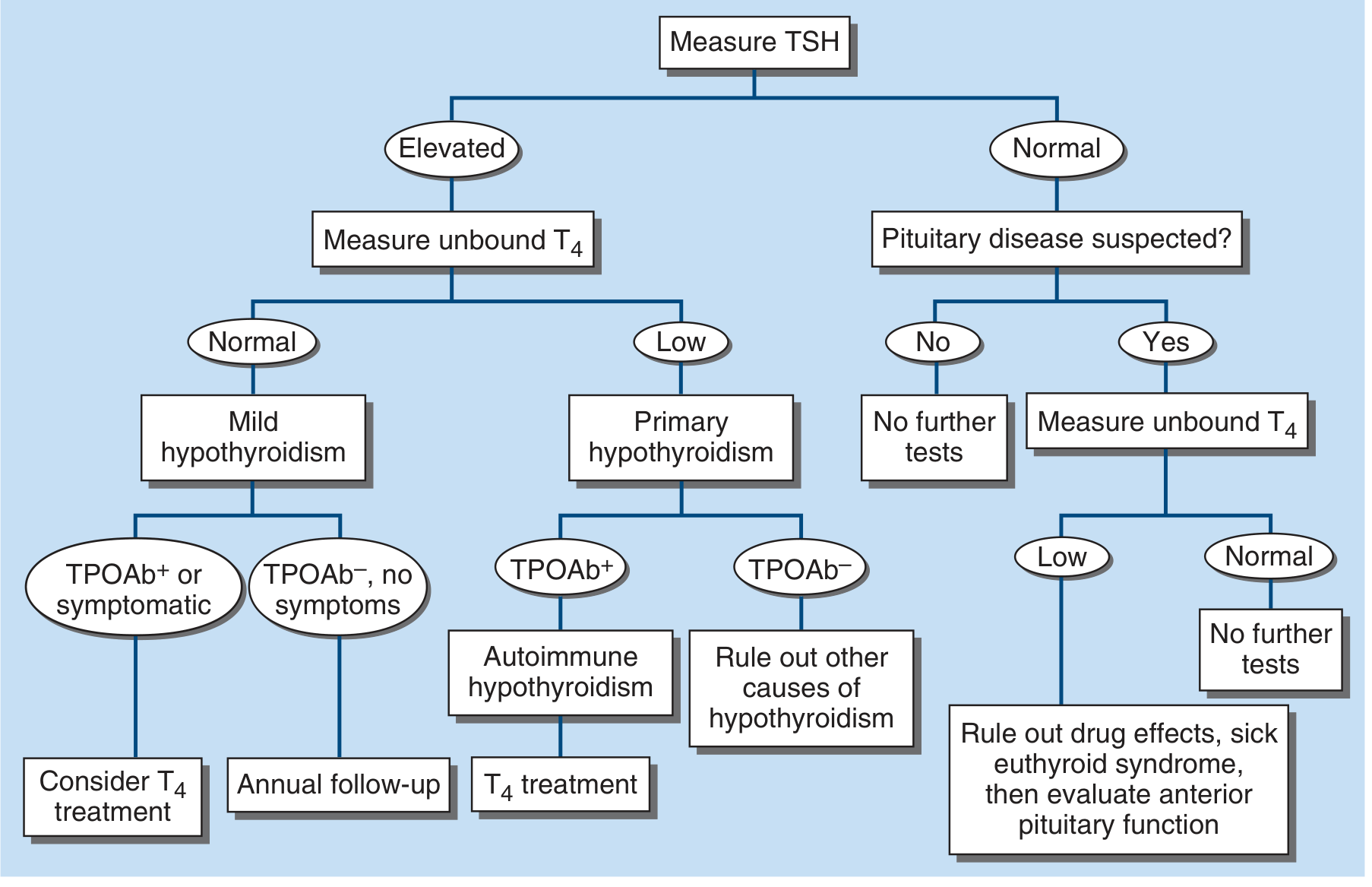
Treatment
Clinical (Overt) Hypothyroidism
- Standard replacement: Levothyroxine (LT4) 1.6 μg/kg body weight/day (typically 100-150 μg/day), taken at least 30 minutes before breakfast
- After Graves' disease treatment, autonomous residual function often means lower doses needed (typically 75-125 μg/day)
- Starting dose in adults under 60 without cardiac disease: 50-100 μg/day
- Goal: TSH in the normal range, ideally the lower half of the reference range
- Recheck TSH 6-8 weeks after starting or changing dose
- Adjust in 12.5-25 μg increments (upward if TSH high; downward if TSH suppressed)
- Clinical relief may take several months even after TSH normalizes
- Once stable: annual TSH monitoring
Causes of increased LT4 requirements to consider:
- Poor adherence (most common with TSH >normal on ≥200 μg/day)
- Malabsorption (celiac disease, post-bowel surgery, H. pylori gastritis)
- Oral estrogens or SERMs
- Drug interactions reducing T4 absorption/metabolism: bile acid sequestrants, ferrous sulfate, calcium carbonate, proton pump inhibitors
Note on combination therapy: About 10-15% of patients have persistent symptoms despite normal TSH on LT4. Desiccated thyroid extract (USP) is not recommended (non-physiologic T3:T4 ratio). LT4 + liothyronine (T3) combination benefit has not been confirmed in prospective studies; T3 monotherapy is not appropriate long-term due to short half-life and fluctuating levels.
Subclinical Hypothyroidism
LT4 is recommended when:
- TSH >10 mIU/L
- Patient is pregnant or wishes to conceive
Annual monitoring is appropriate for most other patients. A treatment trial may be considered in young/middle-aged symptomatic patients or those with cardiovascular risk. Confirm TSH elevation is sustained over 3 months before treating. Starting dose: LT4 25-50 μg/day.
Special Populations
Elderly: Require ~20% less thyroxine. In elderly with coronary artery disease, start LT4 12.5-25 μg/day with increments every 2-3 months.
Pregnancy:
- Confirm thyroid function immediately after pregnancy is confirmed
- Monitor every 4 weeks during the first half of pregnancy; every 6-8 weeks after 20 weeks
- Target TSH <2.5 mIU/L (lower half of trimester-specific range)
- LT4 dose increases ~45% in athyroic women; less in Hashimoto's with residual function
- As soon as pregnancy is confirmed: increase from once-daily to 9 doses per week
- Return to pre-pregnancy dose after delivery
- Separate LT4 from prenatal vitamins and iron supplements
Myxedema Coma
A severe, life-threatening emergency with 20-40% mortality despite treatment.
Triggers: sedatives, anesthetics, antidepressants, pneumonia, heart failure, MI, GI bleeding, stroke, sepsis, cold exposure
Treatment:
- IV LT4: 200-400 μg bolus (loading dose), then 1.6 μg/kg/day IV (reduced 25% vs oral)
- Consider adding IV or NG liothyronine: loading dose 5-20 μg, then 2.5-10 μg every 8 hours
- IV hydrocortisone 50 mg every 6 hours (impaired adrenal reserve)
- Ventilatory support; glucose/hypertonic saline if hyponatremia/hypoglycemia
- Broad-spectrum antibiotics (pending exclusion of infection)
- Passive rewarming only (active external warming only if temp <30°C - risk of cardiovascular collapse)
- Avoid sedatives; reduce all medication doses (impaired drug metabolism)
Recent Evidence Note
A 2026 meta-analysis (PMID: 40579157) in J Clin Endocrinol Metab found that liothyronine-containing regimens are associated with reduced risk of dementia and mortality - this may eventually influence guidelines on combination therapy. A 2025 network meta-analysis (PMID: 39290156) reviewed patient treatment preferences. These are emerging data and do not yet supersede Harrison's recommendation that LT4 monotherapy remains the standard of care.
Source: Harrison's Principles of Internal Medicine, 22nd Edition (2025, McGraw Hill Medical), Chapter 395, pp. 3072-3075.
This is a shared conversation. Sign in to Orris to start your own chat.