
Urinary system of histology
Reading File
Now let me search the library for urinary system histology content in parallel.
Finding Sources
Finding Sources
Finding Sources
Finding Sources
Finding Sources
Finding Sources
Finding Sources
Finding Sources
Excellent! Found the key sections. Now let me read both textbooks in parallel.
Reading File
Reading File
I have very rich content from both histology textbooks. Let me now read more from Junqueira's (specifically the detailed nephron/tubule sections) and also fetch some of the key images.
Reading File
Reading File
I now have comprehensive content from both textbooks. Let me fetch a few key images to include.
Loading Image
Loading Image
Now I have all the information I need from both Junqueira's and the other histology textbook. Let me now compile a comprehensive, well-organized answer.
Histology of the Urinary System
Sources: Junqueira's Basic Histology, 17e | Histology: A Text and Atlas with Correlated Cell and Molecular Biology
Overview
The urinary system consists of the paired kidneys, paired ureters, the urinary bladder, and the urethra. The kidneys are the functional core - they maintain homeostasis by:
- Regulating water, electrolyte, and acid-base balance
- Excreting metabolic waste products and drugs
- Secreting renin (blood pressure regulation) and erythropoietin (RBC production)
- Converting vitamin D prohormone to active calcitriol
- Performing gluconeogenesis during fasting
The kidneys receive approximately 25% of cardiac output, reflecting their intensive filtration role.
1. Kidney - Gross Histological Organization
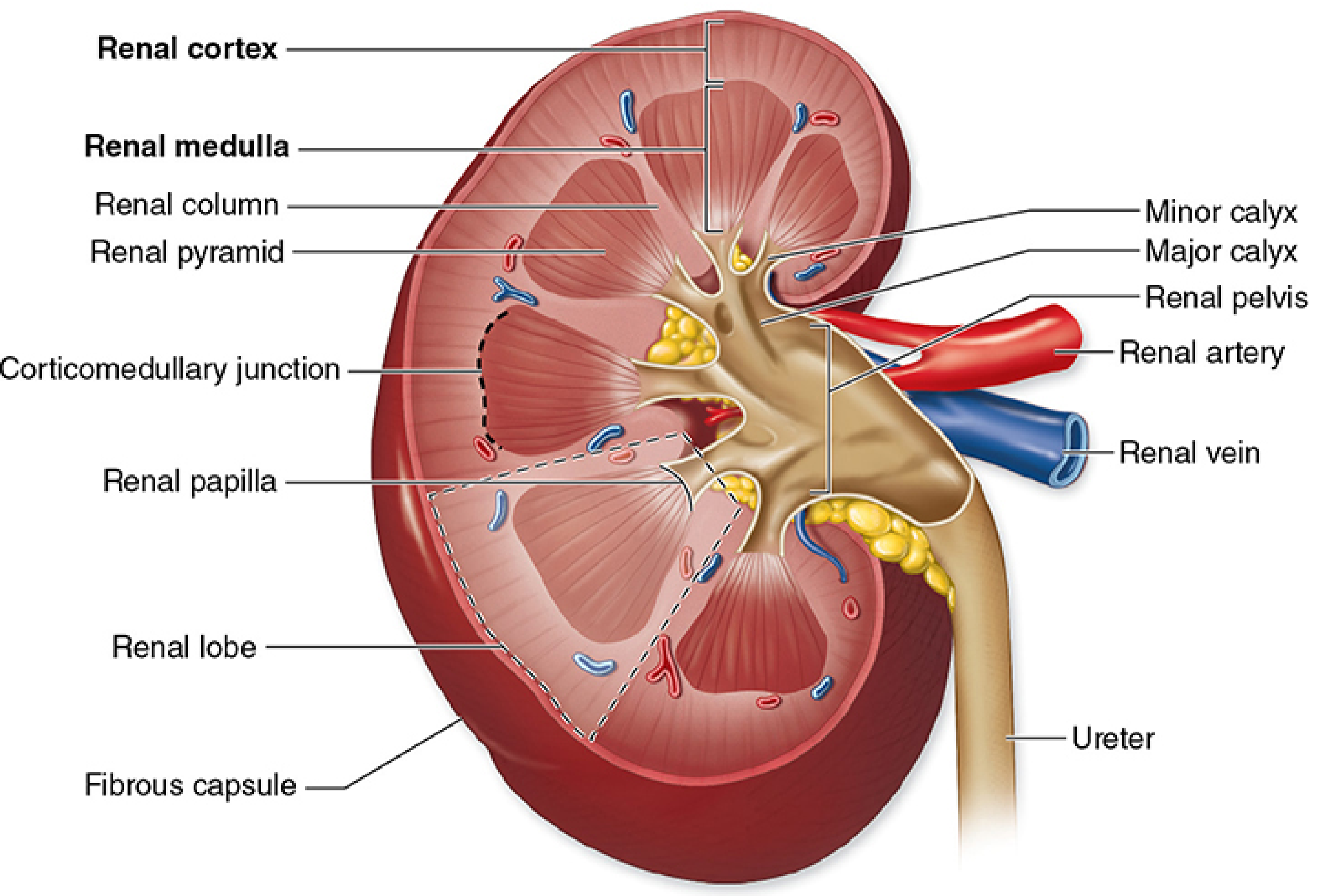
Each kidney (~12 cm long) is covered by a fibrous capsule and has two distinct zones:
| Zone | Features |
|---|---|
| Renal Cortex | Outer region; darker on staining; contains renal corpuscles, PCT, DCT |
| Renal Medulla | Inner region; divided into 8-12 renal pyramids; contains loops of Henle and collecting ducts |
- Renal columns (of Bertin): cortical tissue extending between pyramids
- Renal lobe: one pyramid + its associated cortical tissue
- Renal lobule: a medullary ray + surrounding cortical labyrinth
- Renal papilla: apex of each pyramid, which inserts into a minor calyx
- Hilum: concave medial border where artery enters, vein/ureter/lymphatics exit
2. Blood Supply (Critical for Function)
The vascular arrangement is unique and functionally important:
- Renal artery → interlobar arteries → arcuate arteries (at corticomedullary junction) → interlobular arteries → afferent arterioles
- Afferent arterioles supply glomerular capillaries
- Drained by efferent arterioles (not venules) - maintaining HIGH hydrostatic pressure for filtration
- Efferent arterioles from cortical nephrons → peritubular capillaries
- Efferent arterioles from juxtamedullary nephrons → long vasa recta (loops into medulla, essential for concentrating urine)
3. The Nephron
Each kidney contains ~1.25 million nephrons - the functional units. Each nephron has:
- Renal corpuscle
- Proximal convoluted tubule (PCT)
- Loop of Henle
- Distal convoluted tubule (DCT)
- Connecting tubule → Collecting duct
Types of Nephrons:
| Type | Location of Corpuscle | Loop Length |
|---|---|---|
| Cortical nephrons (85%) | Outer/mid cortex | Short loop, stays in cortex/outer medulla |
| Juxtamedullary nephrons (15%) | Deep cortex near medulla | Long loop, extends deep into medulla |
4. Renal Corpuscle
The renal corpuscle is the filtration unit, composed of:
Glomerulus
A tuft of fenestrated capillaries (~50 loops) enclosed in Bowman's capsule. The vascular pole = where afferent and efferent arterioles enter/exit. The urinary pole = where filtrate exits into the PCT.
Bowman's Capsule
- Parietal layer: simple squamous epithelium; continuous with the proximal tubule at the urinary pole
- Visceral layer: podocytes - highly specialized cells that wrap around capillaries
Podocytes
These have a complex architecture:
- Large primary processes that curve around capillaries
- Short interdigitating secondary processes (pedicels)
- Between pedicels: narrow filtration slits (slit pores), covered by thin filtration slit diaphragms (composed of nephrin protein)
The Glomerular Filtration Barrier (3 layers):
- Fenestrated capillary endothelium - pores ~70-100 nm; negatively charged; allows passage of small molecules
- Fused basal lamina (330 nm thick) - type IV collagen + laminin + heparan sulfate; acts as main size and charge barrier
- Filtration slit diaphragms between pedicels - final selective barrier
Mesangium
- Mesangial cells: modified smooth muscle cells located between glomerular capillaries
- Functions: structural support, phagocytosis of trapped proteins/debris, regulation of GFR by contraction, secretion of cytokines
- Surrounded by mesangial matrix (type IV collagen, fibronectin)
Juxtaglomerular Apparatus (JGA)
Located at the vascular pole, consisting of:
- Macula densa: a plaque of tall, closely packed epithelial cells in the thick ascending limb (TAL) where it contacts the afferent arteriole; acts as a flow/NaCl sensor
- Juxtaglomerular (granular) cells: modified smooth muscle cells in the afferent arteriole wall; contain renin-secreting granules; secrete renin in response to low blood pressure or low NaCl
- Extraglomerular mesangial cells (lacis cells): between macula densa and glomerulus; role in signal transduction
5. Proximal Convoluted Tubule (PCT)
- Location: cortex (most prominent tubule in cortical sections)
- Epithelium: simple cuboidal to low columnar
- Brush border (abundant microvilli, ~1 µm long) greatly increases apical surface area
- Abundant mitochondria (basal striations) power active transport
- Large interdigitating basolateral folds - increase basolateral membrane area
- Lumen appears narrow and irregular due to brush border
- Nucleus: large, round, centrally placed; cytoplasm is eosinophilic
Functions of PCT:
- Reabsorbs 100% of glucose and amino acids
- Reabsorbs ~65-70% of filtered Na+, Cl-, water
- Reabsorbs all small proteins (pinocytosis → lysosomal degradation)
- Secretes H+, organic acids (uric acid, drugs)
6. Loop of Henle (Nephron Loop)
Three segments with distinct histology:
| Segment | Epithelium | Location | Function |
|---|---|---|---|
| Thin descending limb | Simple squamous | Medulla | Permeable to water; countercurrent |
| Thin ascending limb | Simple squamous | Medulla | Impermeable to water; Na+ exits |
| Thick ascending limb (TAL) | Simple cuboidal/columnar | Medulla → cortex | Active NaCl reabsorption (NKCC2 cotransporter) |
- Thin segments have flat nuclei that bulge into the lumen and are easy to confuse with capillaries (but have no RBCs)
- The TAL is impermeable to water - dilutes the filtrate and generates the medullary concentration gradient
- TAL extends into cortex as the distal straight tubule
7. Distal Convoluted Tubule (DCT)
- Location: cortex (returns to its parent glomerulus)
- Epithelium: simple cuboidal
- No brush border (distinguishes it from PCT; lumen appears wider)
- Fewer mitochondria than PCT; less eosinophilic
- Basal striations still present (basolateral infoldings)
- Responds to aldosterone (increases Na+ reabsorption)
- Responds to PTH (increases Ca2+ reabsorption)
How to distinguish PCT vs DCT in cortex:
| Feature | PCT | DCT |
|---|---|---|
| Brush border | Present (prominent) | Absent |
| Lumen | Narrow, irregular | Wider, cleaner |
| Cytoplasm | More eosinophilic | Paler |
| Cell height | Taller | Shorter/cuboidal |
8. Collecting Ducts and Collecting Tubules
- Arise from the connecting tubule; pass from cortex into medulla
- Lined by simple cuboidal epithelium (cortical); becomes simple columnar in medulla
- Two cell types:
- Principal cells (light cells): pale cytoplasm; respond to ADH (water channels/aquaporin-2 insertion) and aldosterone (Na+ reabsorption)
- Intercalated cells (dark cells): abundant mitochondria; regulate acid-base balance (secrete H+ or HCO3-)
- Cell borders are distinct ("cobblestone" appearance)
- Multiple collecting ducts merge to form ducts of Bellini, which drain at the area cribrosa of the renal papilla
9. Interstitial Cells
The renal interstitium contains:
- Type I interstitial cells (fibroblast-like): in cortex and medulla; produce prostaglandins; in medulla, store lipid droplets and have antihypertensive function
- Type II and III interstitial cells (pericyte-like): near blood vessels
10. Ureter
Wall layers (from inside out):
- Mucosa: transitional epithelium (urothelium) + lamina propria (loose CT with lymphocytes, blood vessels)
- Muscularis: inner longitudinal + outer circular smooth muscle (upper 2/3); inner longitudinal + middle circular + outer longitudinal (lower 1/3, near bladder)
- Adventitia: loose CT blending with surrounding tissue
The lumen is star-shaped in cross-section due to longitudinal mucosal folds.
11. Urinary Bladder
Transitional Epithelium (Urothelium)
- Stratified; 4-6 cell layers thick when relaxed; thins to 2-3 layers when distended
- Three layers:
- Basal layer: stem cells attached to basement membrane
- Intermediate layer: cells of variable thickness; can differentiate to replace surface cells
- Superficial (umbrella/dome) cells: large polyhedral cells (25-250 µm); often binucleated; bulge into lumen
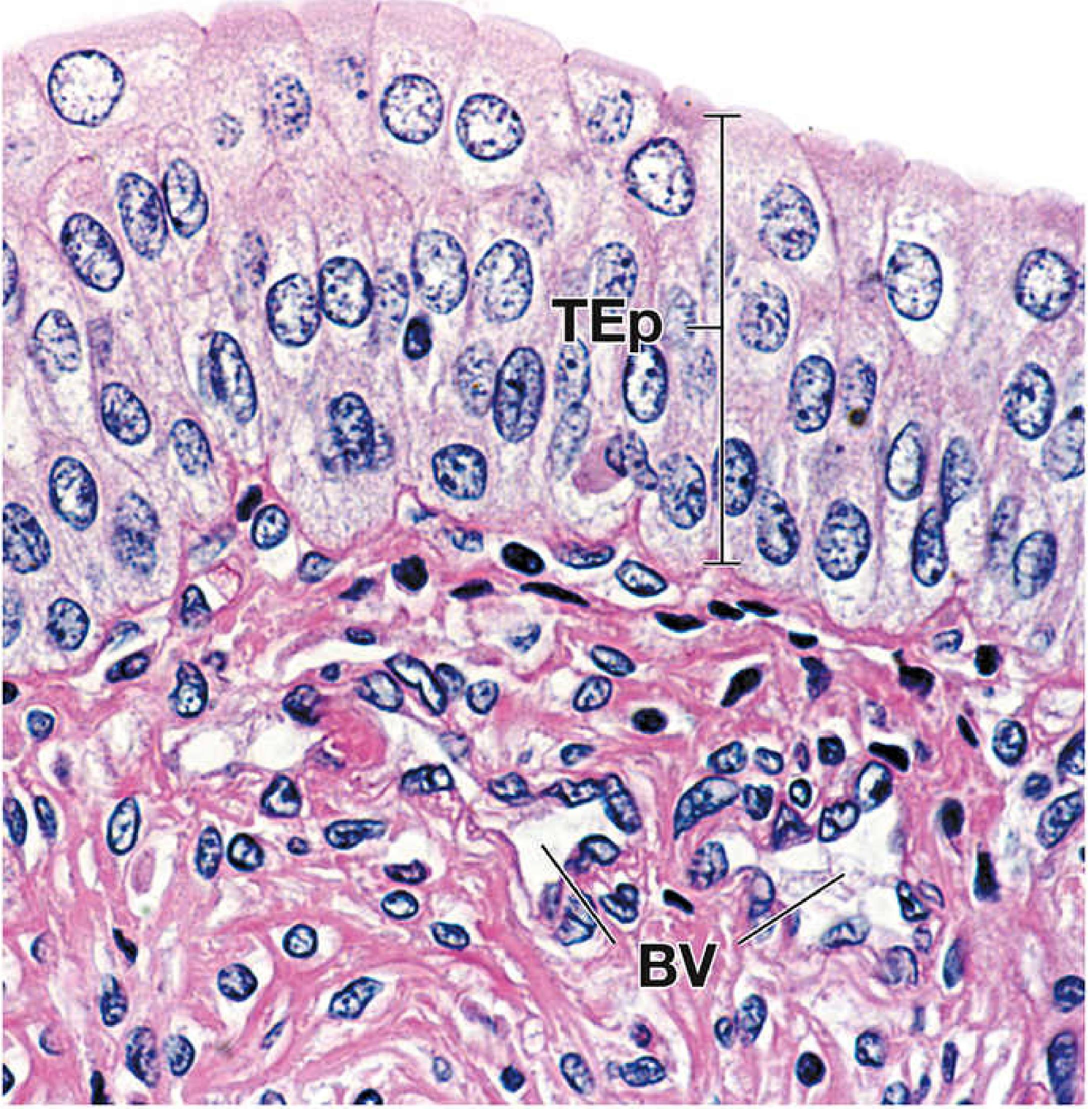
Special features of umbrella cells:
- Fusiform vesicles (discoid vesicles): unique cytoplasmic vesicles that fuse with apical membrane during bladder distension, adding extra membrane area
- Asymmetric unit membranes (AUM): thickened lipid-rich apical plaques (uroplakins) making the epithelium essentially impermeable to urine
Bladder Wall Layers:
- Mucosa: transitional epithelium + lamina propria
- Submucosa: dense irregular CT
- Muscularis (detrusor muscle): three interlacing layers of smooth muscle (inner longitudinal, middle circular, outer longitudinal) - these merge at the bladder neck as the internal urethral sphincter
- Serosa/Adventitia: peritoneum covers the superior surface; elsewhere = adventitia
12. Urethra
| Feature | Male | Female |
|---|---|---|
| Length | ~20 cm | ~4 cm |
| Epithelium | Transitional (prostatic) → pseudostratified columnar → stratified squamous (distal) | Transitional → stratified squamous |
| Glands | Glands of Littre (mucous) in spongy urethra | Paraurethral glands (Skene's) |
| Sphincters | Internal (smooth, involuntary) + external (skeletal, voluntary) | Same arrangement |
Quick Summary Table
| Structure | Epithelium | Key Histological Feature |
|---|---|---|
| Glomerulus | Podocytes (visceral) + squamous (parietal) | Filtration slit diaphragms, fenestrated capillaries |
| PCT | Simple cuboidal with brush border | Microvilli, abundant mitochondria, eosinophilic |
| Thin loop | Simple squamous | Flat nuclei, narrow lumen |
| TAL/DST | Simple cuboidal | No brush border, basal striations |
| DCT | Simple cuboidal | No brush border, paler than PCT |
| Collecting duct | Simple cuboidal/columnar | Principal + intercalated cells |
| Ureter | Transitional (4-5 layers) | Star-shaped lumen, 3 muscle layers (distal) |
| Bladder | Transitional (4-6 layers) | Umbrella cells with fusiform vesicles |
| Urethra | Variable (transitional → squamous) | Glands of Littre (male) |
Junqueira's Basic Histology - Text and Atlas, 17e, Ch. 19 | Histology: A Text and Atlas with Correlated Cell and Molecular Biology, Ch. 20
This is a shared conversation. Sign in to Orris to start your own chat.