
Hii
Hey there! How can I help you today?
Inguinal hernia
Reading File
This is a broad topic. Let me search the medical library for comprehensive coverage.
Searching sources...
Finding Sources
Searching PubMed
"inguinal hernia" AND repair
Good hits. Let me read the most comprehensive surgical sources in parallel.
Reading File
Reading File
Reading File
Good content from Schwartz and Bailey & Love. Let me read more of Bailey & Love for the clinical/surgical detail, and also pull the Current Surgical Therapy section.
Reading File
Reading File
Good. Let me get more Bailey & Love content on clinical features, classification, and surgical management, plus fetch the key anatomical diagram.
Reading File
Loading Image
Excellent. Let me get the surgical management details and complications.
Reading File
Reading File
Reading File
Reading File
Reading File
Reading File
I now have comprehensive information. Here is the complete structured answer:
Inguinal Hernia
Definition
An inguinal hernia is a protrusion of peritoneum (and potentially abdominal contents) through a weakness in the inguinal region. It is the most common hernia in men, occurring roughly 10 times more often in males than females. - Bailey and Love's Short Practice of Surgery 28th Ed., p.1086
Anatomy of the Inguinal Canal
The inguinal canal is an oblique passage through the lower abdominal wall with four walls:
| Wall | Structure |
|---|---|
| Anterior | External oblique aponeurosis |
| Posterior | Transversalis fascia |
| Roof | Conjoint tendon (internal oblique + transversus abdominis) |
| Floor | Inguinal (Poupart's) ligament |
- Deep inguinal ring - defect in transversalis fascia, midway between ASIS and pubic tubercle; the inferior epigastric vessels lie just medial to it
- Superficial inguinal ring - inverted V-shaped gap in external oblique aponeurosis
- Contents in males: testicular artery, veins, lymphatics, vas deferens, cremasteric muscle; ilioinguinal, iliohypogastric, and genital branch of genitofemoral nerves
- Contents in females: round ligament
Hesselbach's triangle (site of direct hernia) is bounded by:
- Laterally: inferior epigastric vessels
- Medially: lateral edge of rectus abdominis
- Inferiorly: inguinal ligament
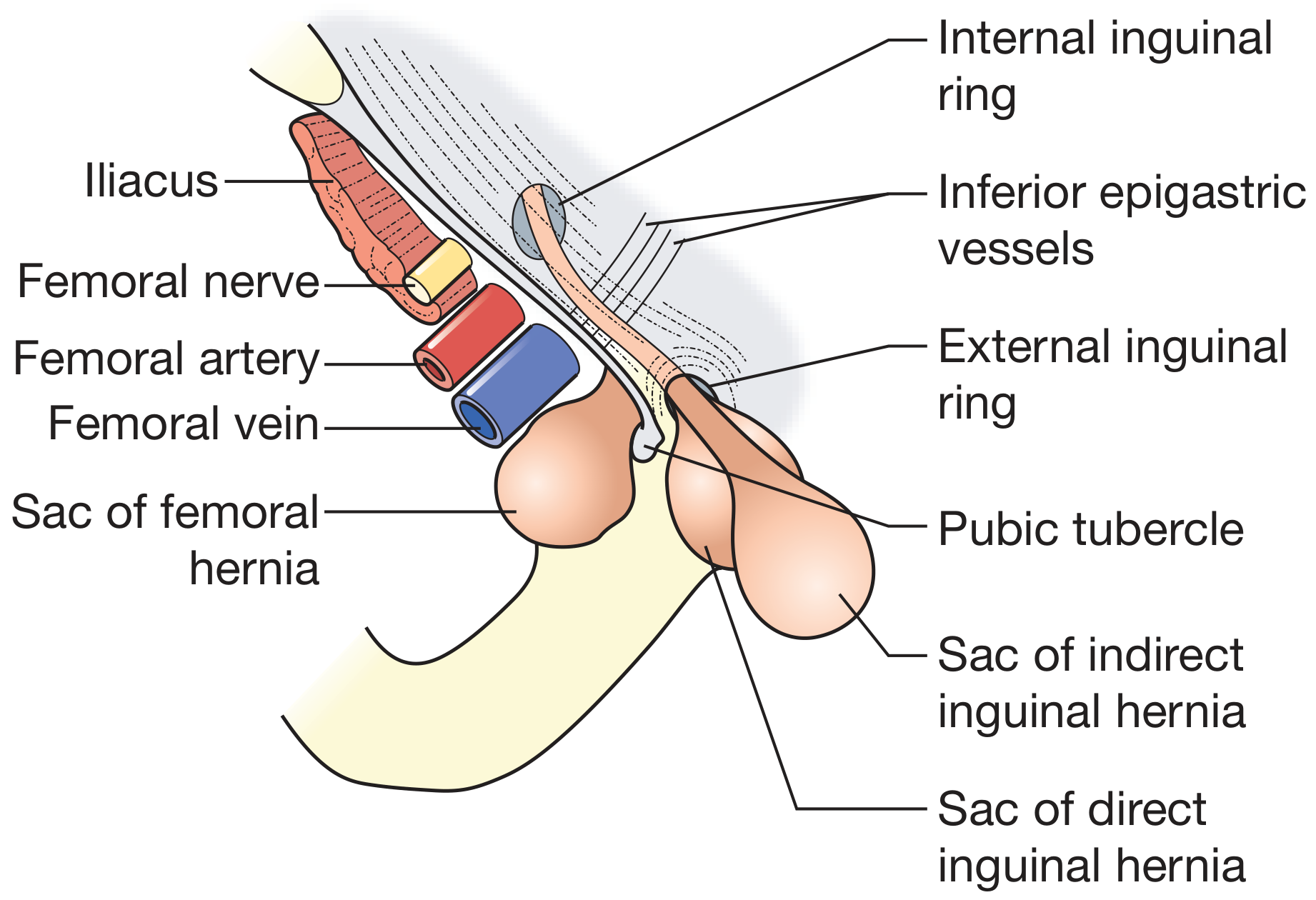
Types
1. Indirect (Lateral) Inguinal Hernia
- Enters through the deep inguinal ring, passes along the inguinal canal, exits through the superficial ring - can descend into the scrotum
- Lies lateral to the inferior epigastric vessels
- Sac lies superior and medial to the pubic tubercle
- Can be congenital (due to patent processus vaginalis) or acquired
- All pediatric hernias are of this type
- More prone to strangulation due to narrow neck
2. Direct (Medial) Inguinal Hernia
- Passes directly through the posterior wall of the inguinal canal through Hesselbach's triangle
- Lies medial to the inferior epigastric vessels
- Usually acquired, more common in elderly men
- Broadly based - less likely to strangulate
- The bladder can be pulled into a direct hernia (sliding hernia component)
3. Sliding Hernia
- Retroperitoneal fat pushed into the canal; as more tissue enters, peritoneum is pulled along to form the sac secondarily
- Sigmoid colon may descend on the left; caecum on the right
- Caution during repair: bowel may form part of the sac itself
4. Pantaloon Hernia
- Both lateral and medial hernias present simultaneously in the same patient
Classification (European Hernia Society)
- P or R - Primary or Recurrent
- L, M, or F - Lateral, Medial, or Femoral
- 1, 2, 3 - Defect size in fingerbreadths (<1.5 cm, 1.5-4.5 cm, >4.5 cm)
Example: A primary indirect hernia with a 3 cm defect = PL2
Epidemiology / Risk Factors
- Male sex (M:F = 10:1)
- Right side more common than left
- Premature infants (failure of processus vaginalis closure before birth)
- Family history, chronic cough, straining, heavy lifting, obesity
- 50% lifetime risk of contralateral hernia after unilateral presentation
Clinical Features
| Feature | Indirect | Direct |
|---|---|---|
| Age | Any (congenital in infants, also young adults) | Usually elderly |
| Shape | Elliptical, descends into scrotum | Round/hemispherical, rarely scrotal |
| Deep ring pressure test | Controlled (held back) | Not controlled - reappears medially |
| Reducibility | Often reducible | Usually reducible |
| Strangulation risk | Higher | Lower |
Symptoms: Groin swelling (often reducible on lying down), dragging ache, discomfort on straining/coughing.
Examination:
- Swelling appears on standing or coughing (cough impulse)
- Can get above the swelling (differentiates from scrotal swelling)
- Transillumination negative (unlike hydrocele)
- Deep ring pressure test distinguishes indirect (controlled) from direct (not controlled)
Complications of Hernia
- Reducible - contents return spontaneously or on pressure
- Irreducible (incarcerated) - contents cannot be returned, no vascular compromise yet
- Obstructed - bowel lumen occluded (may have no vascular compromise)
- Strangulated - vascular compromise of hernia contents; surgical emergency; edematous, tender, erythematous; absent cough impulse; signs of bowel obstruction and systemic toxicity
- ~5% of inguinal hernias present as emergencies
- ~20% of emergency cases require bowel resection
Differential Diagnosis
- Femoral hernia (below and lateral to pubic tubercle)
- Lymph node (inguinal lymphadenopathy)
- Hydrocele (transilluminates, can get above it)
- Saphena varix (disappears on lying, bluish, thrill on coughing)
- Psoas abscess (fluctuant, may have back pain)
- Lipoma of cord
- Undescended testis
- Femoral artery aneurysm
Investigations
- Usually clinical - no investigations required in most cases
- Ultrasound: useful for uncertain diagnosis, especially occult hernias; patient examined standing and with Valsalva
- CT / MRI: for complex cases, obese patients, suspected complications; may miss hernias if patient is supine
- Herniography rarely used now
Management
Conservative
- Watchful waiting is safe for asymptomatic direct hernias, especially in elderly patients who decline surgery
- Trusses are not recommended (uncomfortable, ineffective long-term, can cause complications)
- Patients should seek early advice if hernia enlarges or becomes symptomatic
Surgical - Pediatric (Herniotomy)
- In children, simply excise and close the sac (herniotomy) - no floor repair needed
- Performed promptly because incarceration risk is high in infants due to narrow internal ring
Surgical - Adult Open Techniques
| Operation | Description |
|---|---|
| Bassini repair (1890) | Sutures conjoint tendon to inguinal ligament - historical gold standard |
| Shouldice repair | Multi-layer continuous suture of transversalis fascia; low recurrence; preferred suture repair |
| Desarda repair | Strip of external oblique aponeurosis used to reinforce posterior wall; physiological support |
| Maloney darn | Nylon darn reinforces inguinal ligament |
| Lichtenstein repair | Tension-free flat polypropylene mesh (8×15 cm) placed over posterior wall, wrapped around cord at deep ring; most common open repair worldwide |
Surgical - Laparoscopic/Minimally Invasive
| Technique | Description |
|---|---|
| TEP (Totally Extraperitoneal) | Dissects extraperitoneal plane without entering peritoneum; mesh placed preperitoneally |
| TAPP (Transabdominal Preperitoneal) | Enters peritoneal cavity first, incises peritoneum above hernia to access preperitoneal space; mesh placed |
Both place a large mesh (10×15 cm or more) covering Hesselbach's triangle, deep inguinal ring, and femoral canal.
Advantages of laparoscopic over open:
- Less post-operative and chronic pain
- Faster return to activity
- Fewer wound complications
- Preferred for bilateral hernias and recurrences after open surgery
A 2024 Cochrane review confirmed that TAPP and TEP have comparable outcomes with no significant difference in recurrence or complications. - Andresen & Rosenberg, Cochrane 2024
Emergency Surgery
- Principles same as elective
- Mesh use acceptable even in contaminated field if antibiotics given
- ~20% require bowel resection; may need conversion to laparotomy
Complications of Repair
| Timing | Complication |
|---|---|
| Early | Bleeding/haematoma, urinary retention, femoral nerve blockade (from local anaesthetic) |
| Intermediate | Seroma, wound infection |
| Late | Chronic pain (most common; up to 20% after open mesh repair; neuralgic pain from nerve injury/irritation), recurrence (<5% at 5 years in specialist centres), testicular ischaemia/atrophy (rare but serious) |
Chronic pain persisting >3 months affects up to 20% of patients after groin hernia repair. It is less common and less severe after laparoscopic repair. Risk factors: female sex, young age, painful pre-op hernia, chronic pain syndromes, psychological factors. - Bailey and Love, p.1091
Mesh complications (mesh plug): can solidify (meshoma) and migrate/erode into the bladder or adjacent structures - mesh plugs are not recommended by EHS 2018 guidelines.
Pediatric Inguinal Hernia (Special Points)
- Male:female = 10:1; right > left (due to later testicular descent on right)
- All are indirect (patent processus vaginalis)
- Premature infants at highest risk (processus vaginalis not yet closed)
- High risk of incarceration in infants (narrow inguinal ring)
- An incarcerated hernia can usually be reduced with gentle pressure (sometimes light sedation); if not reducible or strangulated - emergency operation
- Treatment is prompt herniotomy (not hernioplasty) - Schwartz's Principles of Surgery 11th Ed., p.1771
Recent Evidence
- Robotic repair: A 2024 systematic review (PMID 37985490) shows robotic-assisted inguinal hernia repair is feasible and safe, but no clear superiority over standard laparoscopic repair; cost remains a barrier.
- TAPP vs TEP: The 2024 Cochrane review (PMID 38963034) found no clinically meaningful difference between TAPP and TEP for recurrence, chronic pain, or complications.
- Emergency hernia: A 2025 EAST practice management guideline (PMID 40671180) addresses management of incarcerated/strangulated inguinal hernias requiring urgent surgery.
This is a shared conversation. Sign in to Orris to start your own chat.