
hypothalamus anatomy phyisology with daigram
Reading File
Finding Sources
Finding Sources
Reading File
Reading File
Reading File
Reading File
Loading Image
Loading Image
Reading File
Loading Image
Reading File
I now have rich material from two authoritative textbooks. Let me compile the full answer.
Hypothalamus: Anatomy & Physiology
Anatomical Location & Gross Anatomy
The hypothalamus is part of the diencephalon, named for its position underneath the thalamus ("hypo" = below). It weighs only about 4 grams - less than 1% of total brain mass - yet governs nearly every major homeostatic process.
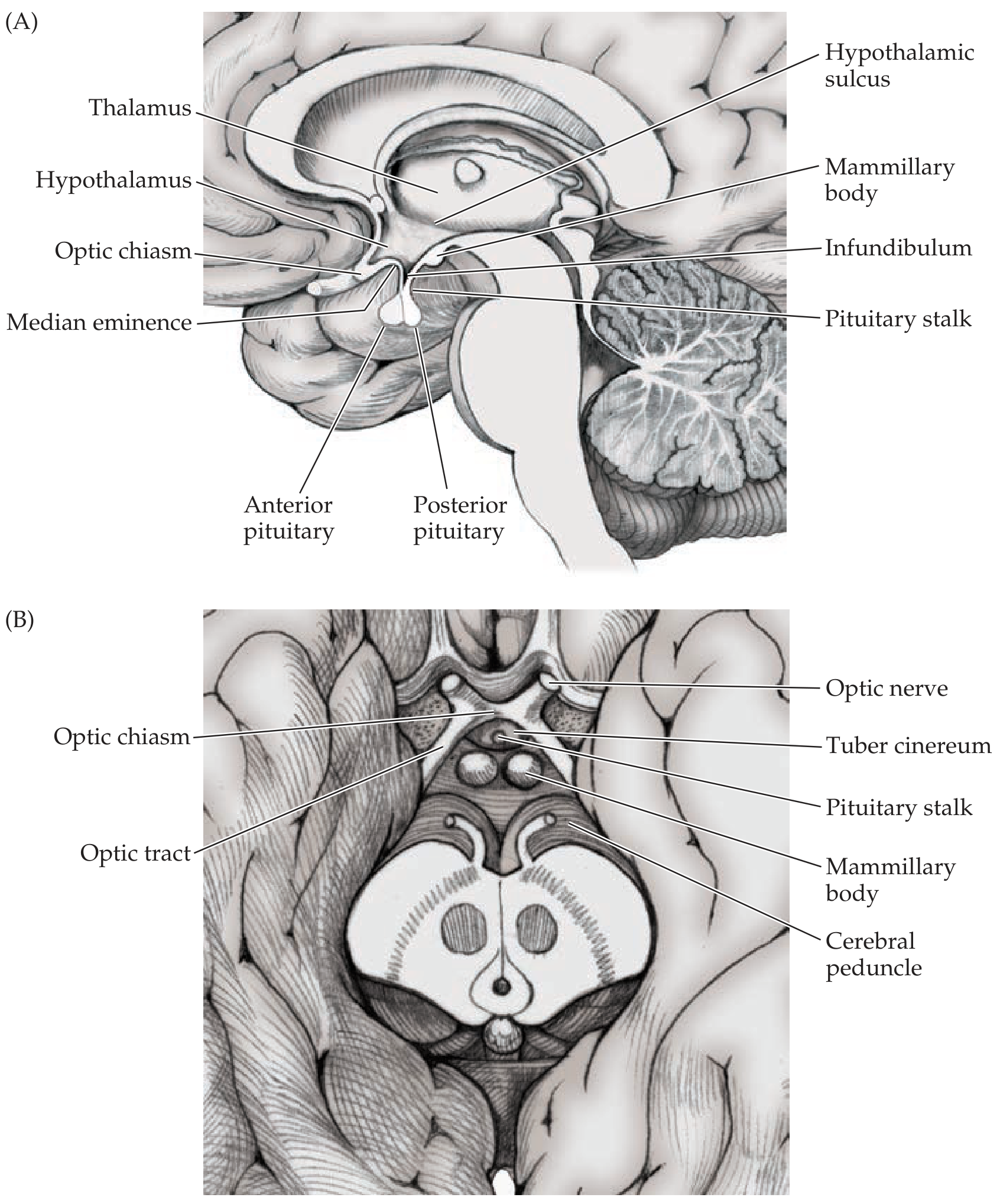
Key anatomical landmarks:
- Forms the walls and floor of the inferior third ventricle
- Separated from the thalamus by the hypothalamic sulcus (a shallow groove on the third ventricle wall)
- On the ventral brain surface: visible posterior to the optic chiasm
- Tuber cinereum ("gray protuberance") - a bulge between the optic chiasm and mammillary bodies
- Mammillary bodies - paired structures forming the posterior portion
- Infundibulum - arises from tuber cinereum, continues as the pituitary stalk
- Median eminence - anterior infundibulum; where hypothalamic releasing factors enter the portal vessels
Hypothalamic Nuclei (Medial Area)
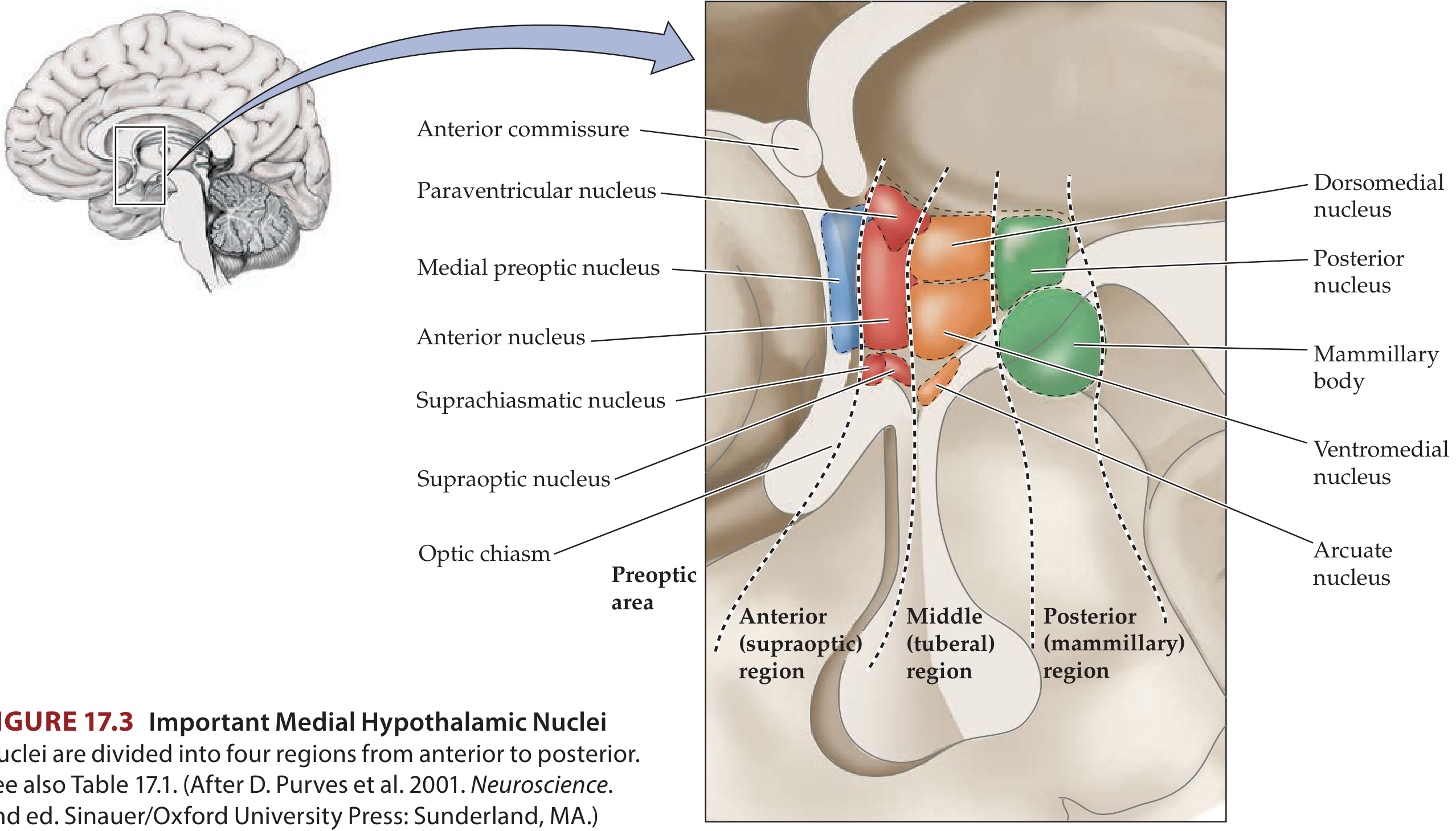
The medial hypothalamic area is organized into four regions (anterior to posterior):
| Region | Key Nuclei |
|---|---|
| Preoptic area (telencephalic origin) | Medial preoptic nucleus, Lateral preoptic nucleus |
| Anterior (Supraoptic) region | Anterior hypothalamic nucleus, Supraoptic nucleus, Paraventricular nucleus, Suprachiasmatic nucleus |
| Middle (Tuberal) region | Arcuate nucleus, Ventromedial nucleus, Dorsomedial nucleus |
| Posterior (Mammillary) region | Medial/Intermediate/Lateral mammillary nuclei, Posterior hypothalamic nucleus |
There is also a lateral hypothalamic area on each side (not shown in medial diagrams), especially important for thirst and hunger.
Functional Map of Nuclei
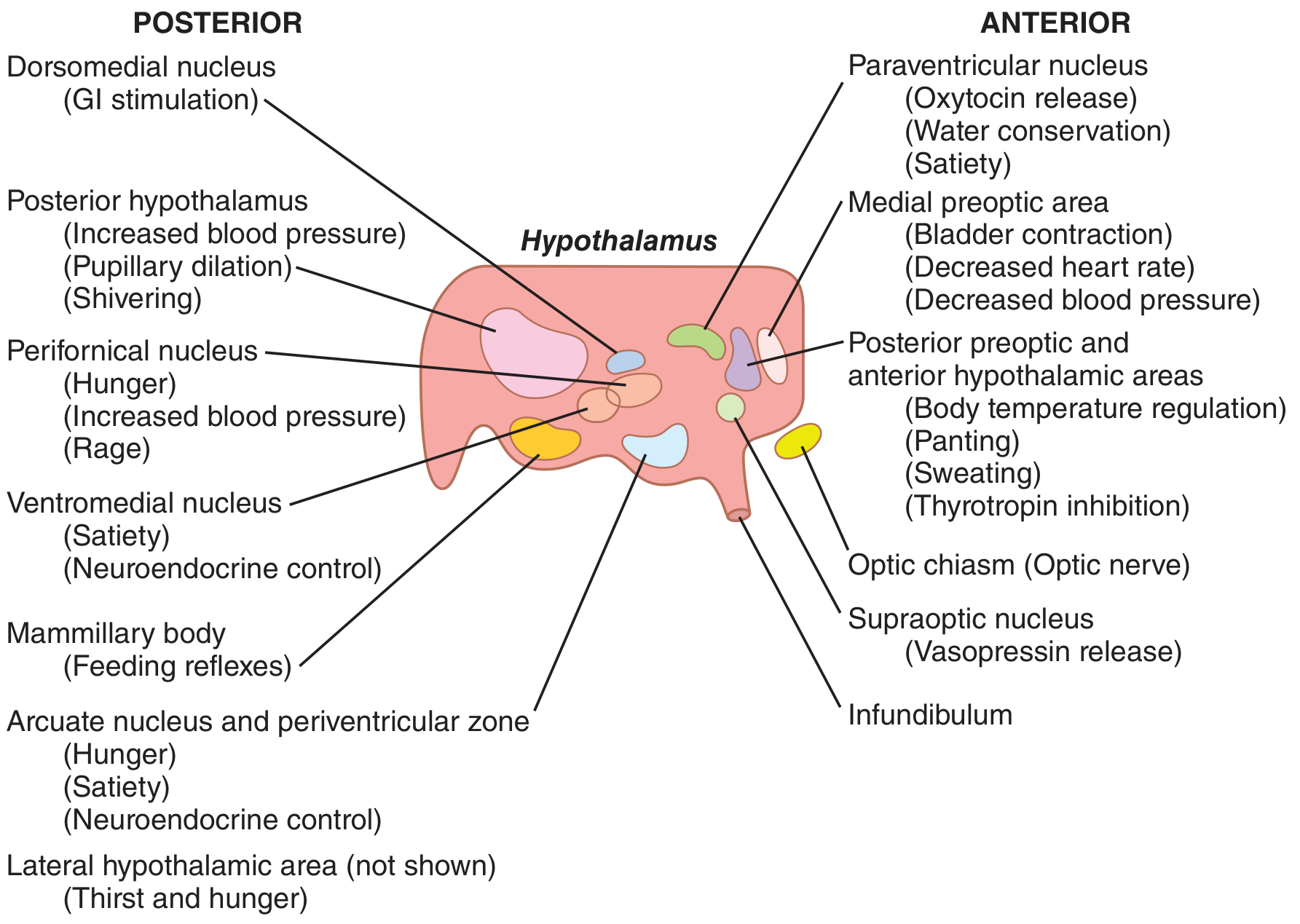
| Nucleus / Region | Function |
|---|---|
| Supraoptic nucleus | Vasopressin (ADH) release |
| Paraventricular nucleus | Oxytocin release, water conservation, satiety |
| Suprachiasmatic nucleus | Master circadian clock |
| Ventromedial nucleus | Satiety, neuroendocrine control |
| Arcuate nucleus + periventricular zone | Hunger/satiety, neuroendocrine control (GnRH, GHRH, etc.) |
| Dorsomedial nucleus | GI stimulation |
| Posterior hypothalamus | Increased BP, pupillary dilation, shivering |
| Perifornical nucleus | Hunger, increased BP, rage |
| Mammillary bodies | Feeding reflexes |
| Medial preoptic area | Bladder contraction, decreased HR and BP |
| Posterior preoptic / anterior hypothalamic area | Body temperature regulation, panting, sweating, thyrotropin inhibition |
| Lateral hypothalamic area | Thirst and hunger |
Physiology: Major Control Functions
1. Neuroendocrine Control (Hypothalamic-Pituitary Axis)
The hypothalamus controls the pituitary via two routes:
- Anterior pituitary: Hypothalamic neurons release releasing and inhibiting hormones into the hypophyseal portal system at the median eminence. These include:
- TRH (thyrotropin-releasing hormone)
- CRH (corticotropin-releasing hormone)
- GHRH / somatostatin (growth hormone)
- GnRH (gonadotropin-releasing hormone)
- Dopamine (inhibits prolactin)
- Posterior pituitary: Neurons in the supraoptic and paraventricular nuclei project axons directly into the posterior pituitary, releasing oxytocin and vasopressin (ADH) into systemic circulation.
2. Autonomic Nervous System
Descending autonomic fibers originate mainly from the paraventricular nucleus (also dorsomedial nucleus and lateral/posterior hypothalamus). They travel via the medial forebrain bundle and dorsolateral brainstem to synapse on:
-
Preganglionic parasympathetic nuclei (brainstem + sacral cord)
-
Preganglionic sympathetic neurons in the intermediolateral cell column (T1-L2)
-
Posterior/lateral hypothalamus stimulation → sympathetic (increased BP, HR, pupil dilation)
-
Preoptic area stimulation → parasympathetic (decreased HR, BP)
3. Temperature Regulation
The posterior preoptic and anterior hypothalamic area detects body temperature. When temperature rises, it triggers sweating and panting (heat loss). When temperature falls, the posterior hypothalamus triggers shivering and vasoconstriction.
4. Hunger & Satiety
- Ventromedial nucleus - "satiety center": bilateral destruction causes hyperphagia and obesity
- Lateral hypothalamic area and perifornical nucleus - "feeding center": destruction causes anorexia
- Arcuate nucleus - responds to leptin, ghrelin; integrates appetite signals
5. Thirst & Water Balance
- Supraoptic nucleus secretes ADH in response to increased plasma osmolarity or decreased blood volume
- Osmoreceptors near the supraoptic nucleus monitor plasma osmolarity
- Lateral hypothalamic area drives thirst behavior
6. Circadian Rhythms
The suprachiasmatic nucleus (SCN) receives direct photic input from retinal ganglion cells via the retinohypothalamic tract. It acts as the master biological clock, synchronizing sleep-wake cycles, hormone release (melatonin, cortisol), and temperature cycling.
7. Emotional Behavior & Limbic Integration
The hypothalamus sits at the center of the limbic system, with two-way communication to:
- Hippocampus, amygdala, cingulate gyrus, septal nuclei
- Prefrontal cortex (orbitofrontal area)
- Brainstem reticular formation (via the medial forebrain bundle)
Output signals travel: (1) down to the brainstem autonomic centers, (2) up to the thalamus and limbic cortex, and (3) into the infundibulum to control pituitary secretion.
Summary Mnemonic: "TAN HATE"
| Letter | Function |
|---|---|
| T | Temperature regulation |
| A | Autonomic control |
| N | Neuroendocrine (pituitary axis) |
| H | Hunger / satiety |
| A | ADH / thirst |
| T | Time (circadian rhythms) |
| E | Emotional behavior |
Sources:
- Neuroanatomy through Clinical Cases, 3rd Edition - pp. 822-824 (Blumenfeld)
- Guyton & Hall Textbook of Medical Physiology - pp. 733-734 (Chapters 59, 76)
why prolactin increses in person
Reading File
Finding Sources
Finding Sources
Reading File
Reading File
Reading File
Excellent - I have comprehensive data from three authoritative sources. Here is the full answer:
Why Does Prolactin Increase? (Hyperprolactinemia)
The Core Mechanism First
Prolactin is unique among pituitary hormones - it is under tonic inhibition by dopamine from the hypothalamus. Dopamine (also called Prolactin Inhibiting Factor, PIF) continuously suppresses lactotroph cells in the anterior pituitary.
Key principle: Anything that reduces dopamine action on lactotrophs OR directly stimulates prolactin secretion will raise prolactin levels.
Categories of Causes
1. Physiological (Normal) Causes
These are expected, non-pathological elevations:
| Cause | Mechanism |
|---|---|
| Pregnancy | High estrogen stimulates lactotroph proliferation and prolactin secretion |
| Breastfeeding / Nipple stimulation | Neural reflex via suckling inhibits dopamine release |
| Sleep | Prolactin surges during deep sleep |
| Stress | Physical and psychological stress raises prolactin |
| Exercise | Transient elevation |
| Sexual intercourse / orgasm | Temporary physiologic rise |
| Seizures | Postictal prolactin rise (used diagnostically) |
2. Pathological - Pituitary Tumor (Most Common Pathologic Cause)
- Prolactinoma - a benign lactotroph adenoma of the anterior pituitary. It is the most common hormone-secreting pituitary tumor (~50% of all pituitary adenomas). Prolactin secretion is proportional to tumor size - very high levels (>200 µg/L) strongly suggest prolactinoma.
- Other pituitary tumors (non-prolactinoma) - any suprasellar mass can compress the pituitary stalk, blocking dopamine delivery to lactotrophs, causing a moderate rise (up to ~2000 mU/L). This is called the "stalk effect."
3. Loss of Dopamine Inhibition ("Stalk Effect")
Any damage to the dopaminergic neurons or pituitary stalk interrupts dopamine delivery:
- Head trauma
- Craniopharyngioma or other suprasellar masses
- Infiltrative disease (sarcoidosis, lymphoma)
- Surgical disruption
4. Drugs (Very Common Cause - Must Always Be Excluded)
These block dopamine receptors on lactotrophs or deplete dopamine:
| Drug Class | Examples |
|---|---|
| Antipsychotics | Haloperidol, risperidone, phenothiazines (chlorpromazine) |
| Antiemetics | Metoclopramide, domperidone |
| Antidepressants | SSRIs, MAOIs, tricyclic antidepressants |
| Antihypertensives | Methyldopa, reserpine, verapamil, atenolol |
| Opioids | Morphine, codeine |
| Others | Cocaine, amphetamines, marijuana, cimetidine |
| Herbal supplements | Fenugreek, anise, fennel, thistle |
5. Systemic Diseases
| Disease | Mechanism |
|---|---|
| Hypothyroidism | Elevated TRH (thyrotropin-releasing hormone) directly stimulates prolactin secretion from the anterior pituitary |
| Chronic renal failure | Impaired metabolic clearance of prolactin from circulation |
| Cushing's disease | Hypercortisolism associated with galactorrhea |
| Acromegaly (GH excess) | GH-secreting tumors can co-secrete prolactin; also stalk compression |
| Liver cirrhosis | Impaired clearance |
6. Chest Wall Pathology
Abnormal stimulation of the chest wall sends neural signals that mimic suckling:
- Chest surgery or trauma
- Herpes zoster (shingles) affecting the chest
- Burns to chest wall
Clinical Consequences of High Prolactin
High prolactin suppresses GnRH from the hypothalamus → reduces LH and FSH → hypogonadism:
| In Women | In Men |
|---|---|
| Amenorrhea / irregular periods | Loss of libido |
| Galactorrhea (milk discharge) | Erectile dysfunction |
| Infertility | Gynecomastia (rarely) |
| Hirsutism, acne | Reduced testosterone |
| Osteoporosis (long-term) | Infertility |
Quick Diagnostic Approach
Raised prolactin found
        |
Check medications first (most common reversible cause)
        |
If on no offending drugs → MRI pituitary
        |
Prolactin >200 µg/L → likely prolactinoma
Prolactin 20-200 µg/L → consider stalk compression, hypothyroidism, renal failure
        |
Check TFTs (thyroid function) and renal function
Sources:
- Tintinalli's Emergency Medicine: A Comprehensive Study - Table 104-1
- Robbins, Cotran & Kumar Pathologic Basis of Disease - p. 737
- Scott-Brown's Otorhinolaryngology Head & Neck Surgery - p. 3735-3771
somatomedin fetal role
Finding Sources
Finding Sources
Reading File
Finding Sources
Reading File
Finding Sources
Reading File
Finding Sources
Reading File
Finding Sources
Reading File
I now have comprehensive textbook content. Here is the complete answer:
Somatomedins (IGF-1 & IGF-2): Role in the Fetus
What Are Somatomedins?
Somatomedins are a family of insulin-like growth factors (IGFs) that mediate the growth-promoting effects of growth hormone (GH). In humans, two circulating somatomedins exist:
| IGF-1 (Somatomedin C) | IGF-2 (MSA - Multiplication Stimulating Activity) | |
|---|---|---|
| Amino acids | 70 | 67 |
| Source | Liver and other tissues | Diverse tissues |
| Regulated by | GH (after birth), nutrition | Unknown (largely GH-independent) |
| Plasma levels | 10-700 ng/mL (peaks at puberty) | 300-800 ng/mL (constant postnatally) |
| Major role | Skeletal & cartilage growth (postnatal) | Fetal growth (prenatal) |
| Plasma binding proteins | Yes | Yes |
The Key Fetal Distinction: GH-Independent Growth
"Secretion of IGF-I is independent of growth hormone before birth but is stimulated by growth hormone after birth."
- Ganong's Review of Medical Physiology, 26th Ed.
This is the critical physiological principle:
- In the fetus, GH is largely unimportant for growth
- Fetal growth is driven primarily by IGF-2 (and to some extent IGF-1), both acting independent of GH
- After birth, GH becomes the dominant driver, signaling the liver to produce IGF-1
Specific Fetal Roles
1. IGF-2 - The Primary Fetal Growth Factor
- IGF-2 is the dominant somatomedin in fetal life
- Produced by diverse fetal tissues (liver, placenta, kidney, brain, muscle)
- Drives cell proliferation across essentially all fetal organs
- When IGF-2 is overexpressed in human fetuses, several organs grow out of proportion to the rest of the body - especially the tongue, muscles, kidneys, heart, and liver (this is the basis of Beckwith-Wiedemann syndrome)
- In adults, IGF-2 gene expression is confined to only the choroid plexus and meninges - it essentially "switches off" after fetal life
- IGF-2 levels are decreased in fetal growth restriction (FGR/IUGR)
2. IGF-1 - Supporting Fetal Growth via Placenta
- IGF-1 is an important modulator of fetal growth even before birth
- In pregnancy, IGF-1 levels may be regulated in part by placental GH (a variant of pituitary GH, not controlled by the pituitary-hypothalamic axis)
- Fetal cord plasma IGF-1 levels positively correlate with:
- Birth weight
- Fetal length
- Gestational diabetes (elevated IGF-1)
- IGF-1 and IGF-2 are also implicated in the pathogenesis of pre-eclampsia
3. Role in Placenta
- IGF-II and IGF-I receptors in the placenta regulate cell proliferation
- The placenta produces IGFs to help divert maternal resources for fetal growth and cellular differentiation
- Key processes regulated: glucose and amino acid transport, DNA synthesis, cell replication, RNA and protein synthesis
- IGFs act in autocrine and paracrine modes within placental tissue
Receptor Mechanism in the Fetus
| Receptor | Structure | Action |
|---|---|---|
| IGF-1 receptor | Similar to insulin receptor; uses same intracellular signaling | Cell proliferation, growth |
| IGF-2 receptor (mannose-6-phosphate receptor) | Distinct structure | Targets acid hydrolases to intracellular organelles; regulates IGF-2 availability |
Postnatal Transition
After birth:
- GH becomes essential - hypophysectomized animals show severe growth retardation
- IGF-1 rises throughout childhood, peaks at puberty (age 13-17), then declines in old age
- IGF-2 levels remain constant throughout postnatal life but are no longer the primary growth driver
- IGF-2 gene expression switches off in nearly all adult tissues
Clinical Relevance of Fetal IGF Disruption
| Condition | IGF Disturbance | Result |
|---|---|---|
| Beckwith-Wiedemann syndrome | IGF-2 overexpression (imprinting defect on chr 11p15) | Macroglossia, organomegaly, macrosomia, hypoglycemia |
| Fetal growth restriction (IUGR) | Reduced IGF-1 and IGF-2 | Low birth weight, small for gestational age |
| Silver-Russell syndrome | IGF-2 underexpression | Growth restriction, asymmetry |
| Pre-eclampsia | Altered IGF-1 and IGF-2 levels | Placental dysfunction |
Summary
FETUS:
   IGF-2 (dominant) → GH-independent → drives cell proliferation in all organs
   IGF-1 (supporting) → partly regulated by placental GH → correlates with birth weight
   Both act via placenta in autocrine/paracrine fashion

AFTER BIRTH:
   GH → liver → IGF-1 → bone/cartilage growth → peaks at puberty
   IGF-2 → constant levels, minor role
Sources:
- Ganong's Review of Medical Physiology, 26th Ed. - pp. 333-334
- Creasy & Resnik's Maternal-Fetal Medicine: Principles and Practice - pp. 225-226 (Placenta and Growth Factors)
This is a shared conversation. Sign in to Orris to start your own chat.