
Vibrant sound bridge in detail from standard ENT textbook in most simplified manner and make me memorise the whole for my university ent exam
Reading File
Now let me search the medical library for Vibrant Soundbridge content in parallel.
Finding Sources
Finding Sources
Finding Sources
Excellent! Found dedicated sections in three major ENT textbooks. Let me read all three in parallel now.
Reading File
Reading File
Reading File
I have rich data. Let me now read the remaining Cummings section and fetch the key diagram image in parallel.
Reading File
Reading File
Loading Image
I now have all the information needed from three major ENT textbooks (Cummings, Shambaugh, Scott-Brown's). Let me also quickly read the remaining Cummings section on outcomes and complications.
Reading File
I now have everything I need. Let me compile a comprehensive, exam-ready study guide.
Vibrant Soundbridge (VSB) - Complete ENT Exam Guide
Sources: Cummings Otolaryngology, Shambaugh Surgery of the Ear, Scott-Brown's Otorhinolaryngology
THE DEVICE AT A GLANCE (The "What")
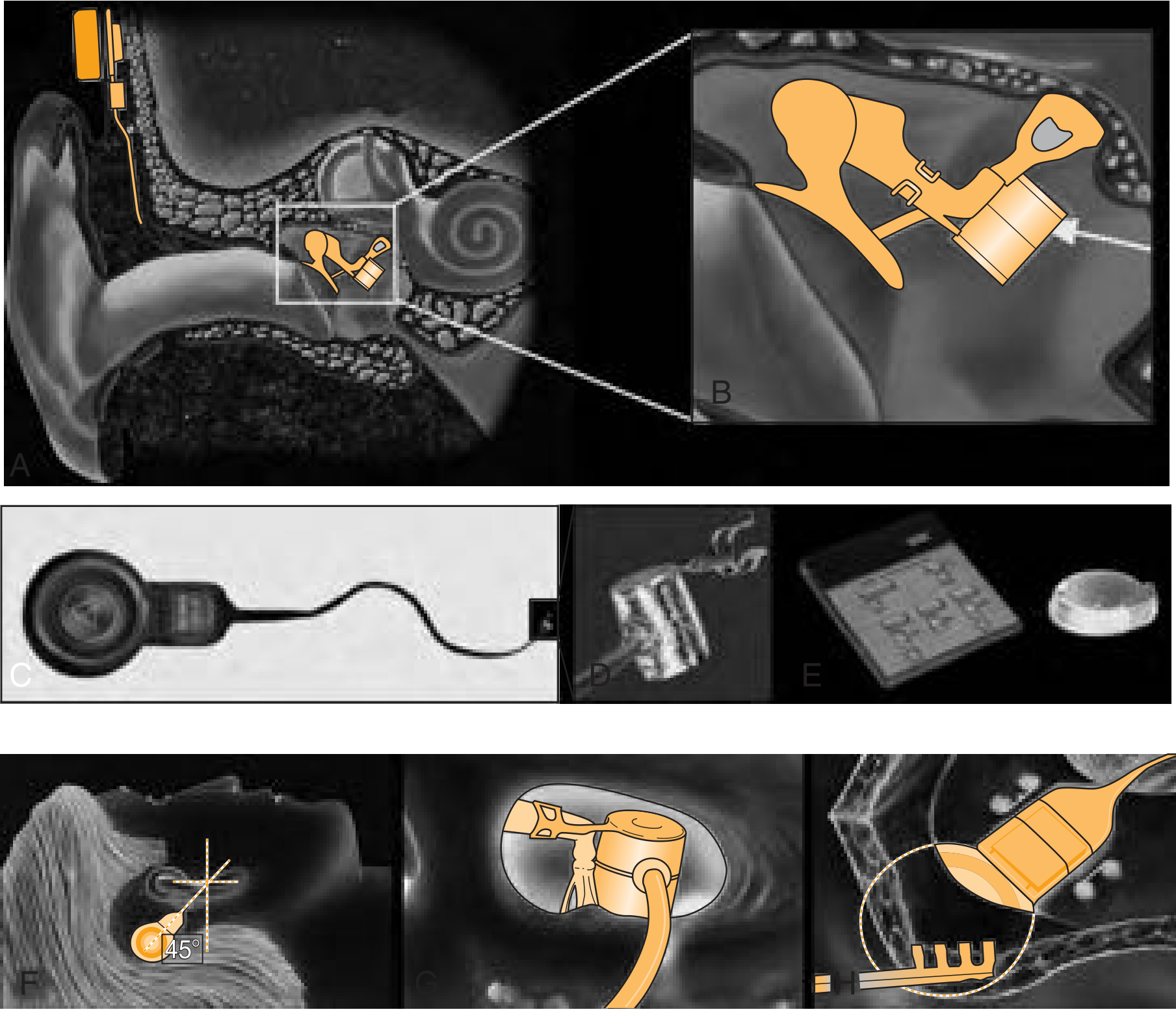
Fig. 159.3 from Cummings - External processor + inductive link + VORP attached to incus (B); internal implant (C); FMT actuator (D); programming unit (E); retromastoid placement like CI (F,H); facial recess approach (G)
1. IDENTITY & CLASSIFICATION
| Feature | Detail |
|---|---|
| Full name | Vibrant Soundbridge (VSB) |
| Type | Semi-implantable active middle ear hearing device |
| Manufacturer | Symphonix Corp (original) → bought by MED-EL GmbH, Innsbruck, Austria (2002) |
| First introduced | 1997 |
| Europe CE approval | 1998 |
| US FDA approval | 2000 |
| Patients implanted worldwide | >8,000 |
Memory hook: "Semi = inside + outside. MED-EL bought it in 2002 after Symphonix went bankrupt."
2. COMPONENTS (The "Parts") - KEY FOR EXAM
External Part (worn like a hearing aid BTE):
- Microphone
- Audio processing electronics
- Magnet (holds it to skin)
- Telemetry transmitter
- Zinc-air battery (675 size)
Internal Part - the VORP (Vibrating Ossicular Reconstruction Prosthesis):
This is the implanted component. Remember its 5 sub-parts:
"R-C-D-Cl-FMT" = Receiving coil - Conductor link - Demodulator - Clip (titanium) - Floating Mass Transducer
- Receiving coil - receives signal from external processor
- Conductor link - wire connecting coil to FMT
- Demodulator - safety feature that limits maximum power output (prevents overstimulation)
- Titanium clip - physically attaches FMT to incus
- FMT (Floating Mass Transducer) - the actual vibrating element; contains a small electromagnetic coil + enclosed magnet
3. HOW IT WORKS (Signal Flow)
SOUND → External microphone → Audio processing →
Transmitter coil (external) → [TRANSCUTANEOUS TELEMETRY LINK] →
Receiving coil (internal) → Demodulator → Conductor link →
FMT vibrates (electromagnetic induction) → Incus vibrates →
Ossicular chain → Cochlea → HEARING
Key mechanism: The FMT current causes the magnet inside it to vibrate by electromagnetic induction. The FMT is clipped to the long process of the incus - so it directly shakes the ossicular chain. No air conduction amplification - it's direct mechanical stimulation.
Memory trick: "FMT = Floating Mass Transducer - it floats and vibrates, shaking the incus directly."
4. SURGICAL APPROACH
- Transmastoid facial recess approach (same approach as cochlear implant surgery)
- The VORP is crimped onto the long process of the incus (same care as stapedectomy crimping - too tight = incus ischemia, too loose = poor vibration)
- Internal receiver placed in a bony trough in the retrosigmoid bone (a few cm behind the ear - just like a cochlear implant receiver)
Memory trick: "Same approach as CI surgery - facial recess. VORP goes on incus long process."
5. INDICATIONS (Selection Criteria)
| Criterion | Requirement |
|---|---|
| Hearing loss type | Moderate to severe SNHL |
| PTA thresholds | Up to 70 dB PTA |
| Middle ear | Normal anatomy |
| Word recognition | ≥50% using recorded material |
| Pathology | Absence of retrocochlear or central involvement |
| Age | ≥18 years |
| Extra indication | Medical contraindication or intolerance to conventional hearing aid |
Memory trick: "70 dB, 50% words, no retrocochlear, 18+, normal middle ear."
Extended Indications (Vibroplasty - newer, especially in Europe):
When the FMT is placed NOT on the incus but at alternative sites:
- Round window membrane (most common non-traditional site)
- Stapes superstructure
- Stapes footplate / oval window
- Combined with ossicular prosthesis (e.g., for otosclerosis)
- CE marked also for conductive and mixed hearing loss (adults 2008, children 2009)
6. CLINICAL OUTCOMES (Phase III FDA Trial - 53 patients)
- Residual hearing change: <10 dB PTA (implantation is safe for residual hearing)
- Functional gain: statistically significant improvement at ALL frequencies; >10 dB improvement especially at 2, 4, 6 kHz
- Speech recognition (NU-6): No significant difference vs. conventional hearing aids
- Satisfaction scores (PHAP + HDSS questionnaires): Significantly better with VSB than hearing aids
- Vibroplasty (round window FMT): Functional gain of 28-55 dB
- FMT on stapes/oval window: Gains of 30-35 dB
Bottom line from systematic review (Tysome et al., 643 patients): Middle ear implants are safe, functional gain at least as good as hearing aids, better satisfaction and quality of life.
7. COMPLICATIONS & DRAWBACKS
| Issue | Detail |
|---|---|
| Incus erosion | Ischemia at titanium clip attachment site |
| Limited output | FMT size restricted by confined middle ear space |
| Revision surgery | 16 revisions; 12/16 achieved adequate performance after revision; causes = fibrosis, malpositioning, inadequate fixation |
| Skin flap necrosis | ~1% rate |
| MRI compatibility | VORP contains magnet → MRI caution |
MRI Compatibility:
- Early models: NOT approved for MRI
- VORP 503 model: Approved for 1.5T MRI only (NOT 3T)
8. COMPARISON: VSB vs. CONVENTIONAL HEARING AID
| Feature | Conventional HA | Vibrant Soundbridge |
|---|---|---|
| Amplification type | Acoustic (sound in ear canal) | Direct mechanical (ossicular chain) |
| Occlusion effect | Yes | No |
| Acoustic feedback | Yes (common) | No/minimal |
| Speech in noise | Similar | Slightly better (some studies) |
| Patient satisfaction | Baseline | Higher |
| High-frequency gain | Limited | Better, especially 2-6 kHz |
| Reversibility | Fully reversible | Partially reversible |
MEMORY FRAMEWORK - "VIBRANT" Mnemonic
Use this to recall everything in the exam:
V - VORP is the implant (Vibrating Ossicular Reconstruction Prosthesis)
I - Incus long process = attachment site (FMT clipped here)
B - Behind the ear - external processor worn BTE; receiver in retrosigmoid bone
R - Receiving coil + Demodulator = internal components; Round window = vibroplasty site
A - Approved: Europe 1998, USA 2000; Age ≥18; up to 70 dB PTA
N - No occlusion, No feedback = advantages over conventional HA
T - Transmastoid facial recess = surgical approach; Telemetry link = external-internal coupling
I - Incus long process = attachment site (FMT clipped here)
B - Behind the ear - external processor worn BTE; receiver in retrosigmoid bone
R - Receiving coil + Demodulator = internal components; Round window = vibroplasty site
A - Approved: Europe 1998, USA 2000; Age ≥18; up to 70 dB PTA
N - No occlusion, No feedback = advantages over conventional HA
T - Transmastoid facial recess = surgical approach; Telemetry link = external-internal coupling
QUICK EXAM FLASHCARD
Q: What type of device is the VSB?
A: Semi-implantable active middle ear hearing device
Q: What is the FMT?
A: Floating Mass Transducer - electromagnetic vibrating element clipped to incus long process
Q: What does the demodulator do?
A: Limits maximum power output - prevents overstimulation (safety feature)
Q: Indications?
A: Moderate-severe SNHL, PTA ≤70 dB, word recognition ≥50%, normal ME anatomy, age ≥18, no retrocochlear pathology
Q: Surgical approach?
A: Transmastoid, facial recess approach; VORP crimped to incus; receiver in retrosigmoid bony trough
Q: MRI safety?
A: VORP 503 = 1.5T only; NOT 3T; early models = no MRI
Q: What is vibroplasty?
A: Placement of FMT at alternative sites (round window, oval window, stapes) for conductive/mixed HL
Q: Key advantage over hearing aids?
A: No occlusion effect, no acoustic feedback, better patient satisfaction, better high-frequency gain
Q: Who made it originally?
A: Symphonix Corporation; sold to MED-EL GmbH in 2002
ONE-LINE SUMMARY (for exam opener)
"The Vibrant Soundbridge is a semi-implantable active middle ear hearing device by MED-EL that uses a VORP containing a Floating Mass Transducer (FMT) clipped to the long process of the incus to directly drive the ossicular chain, indicated for moderate-to-severe SNHL up to 70 dB PTA in patients ≥18 years who cannot tolerate conventional hearing aids, implanted via a transmastoid facial recess approach."
Cummings Otolaryngology, p. 3055-3057 | Shambaugh Surgery of the Ear, p. 574-575 | Scott-Brown's Otorhinolaryngology Vol 2, p. 9133
National programme for prevention and control of deafness. Discuss the components and strategies adopted to meet the objectives of the program. In simplified manner
Reading File
Quick answer: The National Programme for Prevention and Control of Deafness (NPPCD) is India's government initiative launched in 2006-07 to address the massive burden of hearing disability. Its core components include service delivery at district level, training of healthcare workers, community awareness, newborn hearing screening, and provision of hearing aids. Let me search the textbooks for the full details.
Searching sources...
Finding Sources
Finding Sources
Searching the Web
NPPCD National Programme Prevention Control of Deafness India components objectives strategies
Good. Let me now search the ENT textbooks with different terms and also extract the Karnataka NHM page for full component details.
Finding Sources
Finding Sources
Reading Web Page
https://nhm.karnataka.gov.in/32/national-programme-for-the-p…
Excellent! Park's Textbook has it. Let me read those sections now.
Reading File
Reading File
Good. Let me now search for the dedicated NPPCD section in Park's that gives the full programme details.
Finding Sources
Reading File
Now let me search for the dedicated full NPPCD chapter in Park's and also look at other ENT-specific textbooks.
Finding Sources
Finding Sources
I have enough from Park's + the NHM/MOHFW sources. Let me compile a comprehensive, exam-ready answer now.
National Programme for Prevention and Control of Deafness (NPPCD)
Complete Exam Guide - Simplified & Structured
Sources: Park's Textbook of Preventive & Social Medicine | NHM/MoHFW Government of India
BACKGROUND - "Why was it needed?"
- India has one of the world's largest burdens of hearing disability
- WHO estimates ~63 million Indians suffer from significant auditory impairment
- ~6% of India's population has disabling hearing loss
- Most deafness is preventable or treatable (CSOM, wax, otitis media, noise exposure)
- Ministry of Health & Family Welfare launched NPPCD in January 2007 (pilot phase)
- Pilot: 25 districts in 11 States/UTs
- Currently: implemented in 558 districts across 36 States and UTs
Memory: "2007, 25 districts, now 558 districts"
LONG-TERM GOAL
Reduce total disease burden of hearing impairment and deafness by 25% of the existing burden by the end of the 12th Five Year Plan
OBJECTIVES (5 Main - EASY to remember)
Number them with the mnemonic "PRIME-D":
| # | Objective |
|---|---|
| 1 | Prevent avoidable hearing loss due to disease or injury |
| 2 | Right time - Early identification, diagnosis & treatment of ear problems |
| 3 | Institutional capacity - Develop capacity of district hospitals, CHCs, PHCs |
| 4 | Manpower - Develop human resources for ear care |
| 5 | Educate - Promote public awareness through IEC strategies |
| + | Diversify - Strengthen inter-sectoral linkages for rehabilitation |
Written out fully:
- To prevent avoidable hearing loss on account of disease or injury
- Early identification, diagnosis and treatment of ear problems responsible for hearing loss and deafness
- To medically rehabilitate persons of all age groups suffering with deafness
- To strengthen inter-sectoral linkages for continuity of rehabilitation for persons with deafness
- To develop institutional capacity for ear care services - equipment, materials, training
- To develop human resources for ear care services
- To promote public awareness through IEC strategies with special emphasis on prevention of deafness
- To strengthen service delivery for ear care
COMPONENTS OF NPPCD
COMPONENT 1: SERVICE DELIVERY (at each level of health system)
The programme works at 3 levels of healthcare:
a) Sub-Centre / ASHA / ANM Level (Community Level):
- House-to-house survey to detect cases of hearing impairment and deafness
- Referral of detected cases to higher centres
- Awareness activities (IEC) in the community
b) PHC (Primary Health Centre) Level:
- Early detection of hearing impairment and deafness + referral
- Basic diagnosis and treatment of common ear diseases (wax, otomycosis, otitis externa, ear discharge)
- IEC services for prevention and early detection
c) CHC (Community Health Centre) Level:
- Early detection of cases + referral
- Basic diagnosis and treatment of common ear diseases
- Awareness generation through IEC strategies
- Greater community participation in primary prevention
d) District Hospital Level - MAIN SURGICAL CENTRE:
The district level gets dedicated support as the backbone of NPPCD:
Equipment provided:
- Headlight
- Ear specula
- Ear syringe
- Otoscope
- Jobson Horne probe
- Tuning fork (512 Hz)
- Noise maker (for newborn screening)
- Audiometer
Human Resources (posted at District Hospital):
- 1 ENT Surgeon
- 1 Audiologist/Speech Therapist
- 1 Audiometric Assistant (trained)
Services at District Hospital:
- Screening for hearing loss
- Diagnosis and treatment of ear diseases
- Ear surgeries (myringoplasty, tympanoplasty, BERA, etc.)
- Hearing aid fitting and follow-up
- Newborn hearing screening
- Referral for cochlear implant (where applicable)
COMPONENT 2: HUMAN RESOURCE DEVELOPMENT (Training)
Training is given at 4 levels:
| Level Trained | What they are trained to do |
|---|---|
| ASHAs / ANMs | Screen for deafness in community; referral; IEC activities |
| Medical Officers (PHC/CHC) | Diagnosis & treatment of common ear diseases; basic audiometry |
| ENT Specialists | Advanced surgical skills; supervision |
| Audiologists | Pure tone audiometry, hearing aid fitting, BERA, newborn screening |
Key training content:
- Identification of hearing impairment
- Ear examination techniques
- Common ear diseases and their management
- Referral criteria
- Use of basic audiometric equipment
COMPONENT 3: AWARENESS GENERATION (IEC - Information, Education, Communication)
Target audience: General public, at-risk groups, school children, pregnant women, parents of newborns
Messages spread:
- Ear hygiene
- Dangers of noise exposure
- Early detection of hearing loss in children
- Availability of free treatment services
- Prevention of ear infections (CSOM)
- Harmful effects of traditional ear-cleaning practices
Methods used:
- Community meetings
- School health programmes
- Mass media (TV, radio, print)
- ASHA-level counselling
- National Ear Care Day - observed annually on 1st March
COMPONENT 4: NEWBORN HEARING SCREENING
- Screening of all newborns for hearing impairment using Noise Makers / OAE
- BERA (Brainstem Evoked Response Audiometry) for confirmatory diagnosis
- Early intervention so children don't miss critical language development window
- Critical window: First 3 years of life
Screening protocol:
- Noise maker test at birth
- OAE (Otoacoustic Emission) by 1 month
- BERA by 3 months if OAE fails
- Fitting of hearing aid/cochlear implant by 6 months (if confirmed)
COMPONENT 5: REHABILITATION
- Hearing aid provision - through synergy between NPPCD (MoHFW) and ADIP Scheme (Ministry of Social Justice & Empowerment)
- ADIP = Assistance to Disabled Persons scheme
- Free hearing aids to eligible persons
- Speech therapy - for children with hearing loss
- Special education referral
- Cochlear implant programme (for severe-profound SNHL in children)
- Linkage with ALIMCO (Artificial Limbs Manufacturing Corporation of India) for hearing aid supply
COMPONENT 6: INTER-SECTORAL COORDINATION
NPPCD works with:
- Ministry of Social Justice & Empowerment - ADIP scheme for free hearing aids
- Ministry of Education - inclusion of hearing-impaired children in schools
- ALIMCO - supply of hearing aids
- NIHH (National Institute for the Hearing Handicapped, now renamed) - training and rehabilitation
- National Trust - welfare of persons with disability
- State Governments - implementation at ground level
STRATEGIES ADOPTED TO MEET OBJECTIVES
| Strategy | Details |
|---|---|
| District as the unit | Each district hospital is the nodal centre for ear care delivery |
| 3-tier delivery | PHC → CHC → District Hospital (step-up referral system) |
| Task-shifting | ANMs and ASHAs trained for screening at community level |
| Newborn screening | Universal hearing screening to detect early and intervene in time |
| Free services | Free diagnosis, free drugs, free hearing aids (via ADIP synergy) |
| IEC campaigns | Behaviour change communication at all levels |
| Capacity building | Equipment + trained manpower at every district hospital |
| Rehabilitation focus | Not just treatment - social rehabilitation through ADIP + NIHH |
| Integration with NHM | NPPCD integrated under National Health Mission (NHM) for implementation |
SERVICES AT EACH LEVEL (Simplified Table)
| Level | Screening | Treatment | Surgery | Hearing Aid | Rehab |
|---|---|---|---|---|---|
| ASHA/Sub-centre | House survey | - | - | - | IEC |
| PHC | Yes | Common ear diseases | - | - | Referral |
| CHC | Yes | Ear diseases + IEC | - | - | Referral |
| District Hospital | Full audiometry + OAE/BERA | Full ENT | Yes (tympanoplasty, etc.) | Fitting | Speech therapy |
KEY FACTS FOR EXAM (Quick Points)
- Launched: January 2007 (pilot), expanded to all states by 2017
- Pilot coverage: 25 districts, 11 States
- Current coverage: 558 districts, 36 States/UTs
- Under: Ministry of Health & Family Welfare, Government of India
- Integrated under: National Health Mission (NHM)
- National Ear Care Day: 1st March every year
- Free hearing aids via: ADIP Scheme (Ministry of Social Justice)
- Long-term target: Reduce deafness burden by 25% (12th Five Year Plan)
- Rehabilitative partner: NIHH + ALIMCO
- Surgical goal: Tympanoplasty/myringoplasty for CSOM, the most common preventable cause
MEMORY MNEMONIC - "NPPCD = 5 S's"
Screen (community-level detection by ASHAs)
Service (diagnosis & treatment at PHC/CHC/DH)
Skill (training of healthcare workers)
Sensitize (IEC/awareness for public)
Support (rehabilitation, hearing aids via ADIP)
Service (diagnosis & treatment at PHC/CHC/DH)
Skill (training of healthcare workers)
Sensitize (IEC/awareness for public)
Support (rehabilitation, hearing aids via ADIP)
ONE-LINE EXAM OPENER
"NPPCD is India's national health programme launched in January 2007 under the Ministry of Health & Family Welfare, currently covering 558 districts, aimed at preventing avoidable hearing loss, ensuring early detection and treatment, and rehabilitating the hearing-impaired through a 3-tier health system, trained human resources, IEC campaigns, newborn screening, and inter-sectoral linkage with the ADIP scheme for free hearing aid provision."
Sources: Park's Textbook of Preventive & Social Medicine, p. 1001 & 1004 | NHM Karnataka / MoHFW NPPCD guidelines | Ministry of Health & Family Welfare Annual Report 2025-26
This is a shared conversation. Sign in to Orris to start your own chat.