
mereonidazole
I'll look up metronidazole from the medical library right away.
Searching sources...
Reading File
Finding Sources
Finding Sources
Good results. Now let me pull the detailed content from the most authoritative pharmacology and microbiology sources in parallel.
Reading File
Reading File
Reading File
Excellent content. Let me get more from the Goodman & Gilman section (ADME, adverse effects, clinical uses) and the Harriet Lane pediatric dosing.
Reading File
Reading File
I have rich content. Let me get the toxicities/contraindications section and the Harriet Lane pediatric dosing continuation, then compile the full answer.
Reading File
Reading File
I need to get the toxicities/adverse effects section which was cut off. Let me read it from the Goodman & Gilman:
Reading File
I now have all the information needed for a thorough answer. Let me fetch the structural image to include visually.
Loading Image
Here is a complete pharmacology summary of Metronidazole (note: you likely meant "metronidazole" - a common 5-nitroimidazole antimicrobial).
Metronidazole
Class: 5-Nitroimidazole | Antiprotozoal + Anaerobic Antibacterial
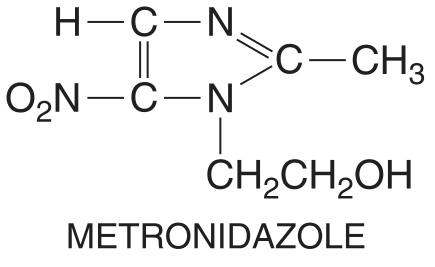
Mechanism of Action
Metronidazole is a prodrug - it requires reductive activation of its nitro group by susceptible organisms. Anaerobic and microaerophilic pathogens (e.g., T. vaginalis, E. histolytica, G. lamblia, anaerobic bacteria) contain electron transport components (like PFOR - pyruvate-ferredoxin oxidoreductase) with a sufficiently negative redox potential to donate electrons to metronidazole. This generates a highly reactive nitro radical anion that kills organisms via radical-mediated mechanisms that target DNA.
Aerobic organisms cannot activate the drug - hence metronidazole has no significant activity against aerobic or facultatively anaerobic bacteria.
Oxygen competes with metronidazole for electrons, which explains why it does not work against aerobes and why hypoxia enhances activity. - Goodman & Gilman's, Ch. 18
Spectrum of Activity
| Category | Organisms |
|---|---|
| Protozoa | Trichomonas vaginalis, Entamoeba histolytica, Giardia lamblia |
| Anaerobic gram-negative bacilli | Bacteroides fragilis, other Bacteroides spp. |
| Anaerobic gram-positive bacilli | Clostridium spp. (including C. difficile) |
| Microaerophilic bacteria | Helicobacter pylori, Campylobacter spp. |
| NOT active against | Aerobic organisms, nonsporulating gram-positive bacilli |
Resistance
Clinical resistance is documented in T. vaginalis, G. lamblia, and anaerobic bacteria. Mechanisms include:
- Impaired oxygen-scavenging → elevated local O₂ → decreased drug activation
- Lowered levels of PFOR and ferredoxin
- Decreased uptake of the drug
- Rapid elimination of cytotoxic metabolites before DNA damage can occur
Higher doses can overcome some resistance. - Medical Microbiology 9e, p. 205; Goodman & Gilman's
Pharmacokinetics (ADME)
| Parameter | Detail |
|---|---|
| Routes | Oral, IV, intravaginal, topical |
| Oral bioavailability | Complete and rapid absorption |
| Volume of distribution | Approximates total body water |
| Protein binding | < 20% |
| t½ (plasma) | ~8 hours |
| Metabolism | Hepatic oxidation of side chains; two main metabolites (hydroxy metabolite t½ ~12 h, ~50% activity) |
| Excretion | >75% in urine (mostly as metabolites); ~10% unchanged |
| CSF penetration | Excellent (penetrates most body fluids and tissues) |
| Placental transfer | Crosses placenta |
Urine may turn reddish-brown due to unidentified drug-derived pigments. Metabolism is induced by phenobarbital, rifampin, prednisone, and inhibited by cimetidine. - Goodman & Gilman's, p. 1335
Therapeutic Uses & Dosing
Trichomoniasis
- Preferred: 2 g orally as a single dose (both partners treated)
- Alternative: 500 mg BID x 7 days
- Cures >90% of cases
Amebiasis (symptomatic)
- Adult: 750 mg PO TID x 7-10 days (or 500 mg IV q6h)
- Child: 35-50 mg/kg/day in 3 divided doses x 7-10 days (max 750 mg/dose)
- Always follow with a luminal amebicide (paromomycin, iodoquinol, or diloxanide furoate) - E. histolytica persists after metronidazole alone
Giardiasis
- Adult: 250 mg PO TID x 5 days
- Child: 15-30 mg/kg/day ÷ TID x 5-7 days (max 750 mg/24 hr)
- Note: Not FDA-approved for giardiasis in the US, but widely used
Amebic Liver Abscess / Extraintestinal Amebiasis
- 750 mg TID x 10 days - cures >95% of uncomplicated liver abscesses
- Tinidazole 2 g/day x 5 days is an alternative
Anaerobic Bacterial Infections
- Adult (IV): 30 mg/kg/24 hr ÷ q6-8 hr; max 4 g/24 hr; load with 15 mg/kg IV over 1 hour
- Infant/Child (PO): 30-50 mg/kg/24 hr ÷ q8h; max 2250 mg/24 hr
Bacterial Vaginosis
- 500 mg PO BID x 7 days, OR
- Vaginal gel 0.75%: 1 applicatorful QHS x 5 days
- Vaginal gel 1.3%: single-dose at bedtime
H. pylori Eradication
- Part of quadruple regimens (PPI + amoxicillin + metronidazole + bismuth x 14 days)
C. difficile Infection (CDI)
- Historically used, but vancomycin is now preferred - clinical data shows vancomycin superior (OR 1.58; 95% CI 1.04-2.40) - Sleisenger & Fordtran's
Neonatal Dosing (Harriet Lane)
| PMA | Dose |
|---|---|
| 24-25 wk | 7.5 mg/kg q24h |
| 26-27 wk | 10 mg/kg q24h |
| 28-33 wk | 7.5 mg/kg q12h |
| 34-40 wk | 7.5 mg/kg q8h |
| >40 wk | 7.5 mg/kg q6h |
Adverse Effects
| System | Effect |
|---|---|
| GI (most common) | Nausea, metallic taste, dry mouth, vomiting, diarrhea, abdominal distress |
| Neurological | Headache, dizziness, vertigo; rarely encephalopathy, convulsions, ataxia, incoordination |
| Peripheral nervous system | Numbness, paresthesias (drug must be withdrawn; reversal may be slow/incomplete) |
| Urological | Dysuria, cystitis, sense of pelvic pressure |
| Hypersensitivity | Urticaria, flushing, pruritus; rarely Stevens-Johnson syndrome |
Drug Interactions
| Interaction | Effect |
|---|---|
| Alcohol | Disulfiram-like reaction: flushing, vomiting, headache, abdominal distress (avoid during and 3 days after therapy) |
| Disulfiram | Confusional/psychotic states - avoid combination |
| Warfarin | Metronidazole prolongs prothrombin time - monitor INR |
| Lithium | Can precipitate CNS signs of lithium toxicity |
| Phenobarbital/Rifampin | Induce metronidazole metabolism - reduced drug levels |
| Cimetidine | Inhibits metabolism - increased metronidazole levels |
| CNS disease | Use cautiously - potential neurotoxicity |
Special Populations
- Pregnancy: First trimester use is generally not advised; used cautiously later in pregnancy for trichomoniasis (symptomatic cases)
- Hepatic impairment: Reduce dose in severe hepatic disease
- Breastfeeding: Drug is excreted in breast milk
Formulations Available
- Tablets: 250 mg, 500 mg
- Capsules: 375 mg
- Oral suspension: 50 mg/mL
- IV: 5 mg/mL ready-to-use (contains 28 mEq Na/g drug)
- Topical gel (0.75%, 1%), lotion (0.75%), cream (0.75%, 1%) - for rosacea
- Vaginal gel (0.75%, 1.3%)
Brand names: Flagyl, MetroGel, MetroLotion, MetroCream, Vandazole, Nuvessa, Noritate
Sources: Goodman & Gilman's Pharmacological Basis of Therapeutics, 14e; Katzung's Basic & Clinical Pharmacology, 16e; Medical Microbiology 9e; The Harriet Lane Handbook, 23e; Sleisenger & Fordtran's Gastrointestinal and Liver Disease
This is a shared conversation. Sign in to Orris to start your own chat.