
Gall stone causes
Reading File
Now let me search the medical library and PubMed in parallel for gallstone causes.
Finding Sources
Searching PubMed
gallstone cholelithiasis pathogenesis risk factors
Reading File
Reading File
I now have comprehensive content from Robbins Pathology. Let me fetch the gallstone image to include it in the answer.
Loading Image
Here is a thorough, textbook-based explanation of gallstone causes.
Gallstones (Cholelithiasis) - Causes & Pathogenesis
Gallstones affect 10-20% of adults in Western countries, with roughly 1 million new cases diagnosed annually in the US alone. There are two main types, each with distinct causes.
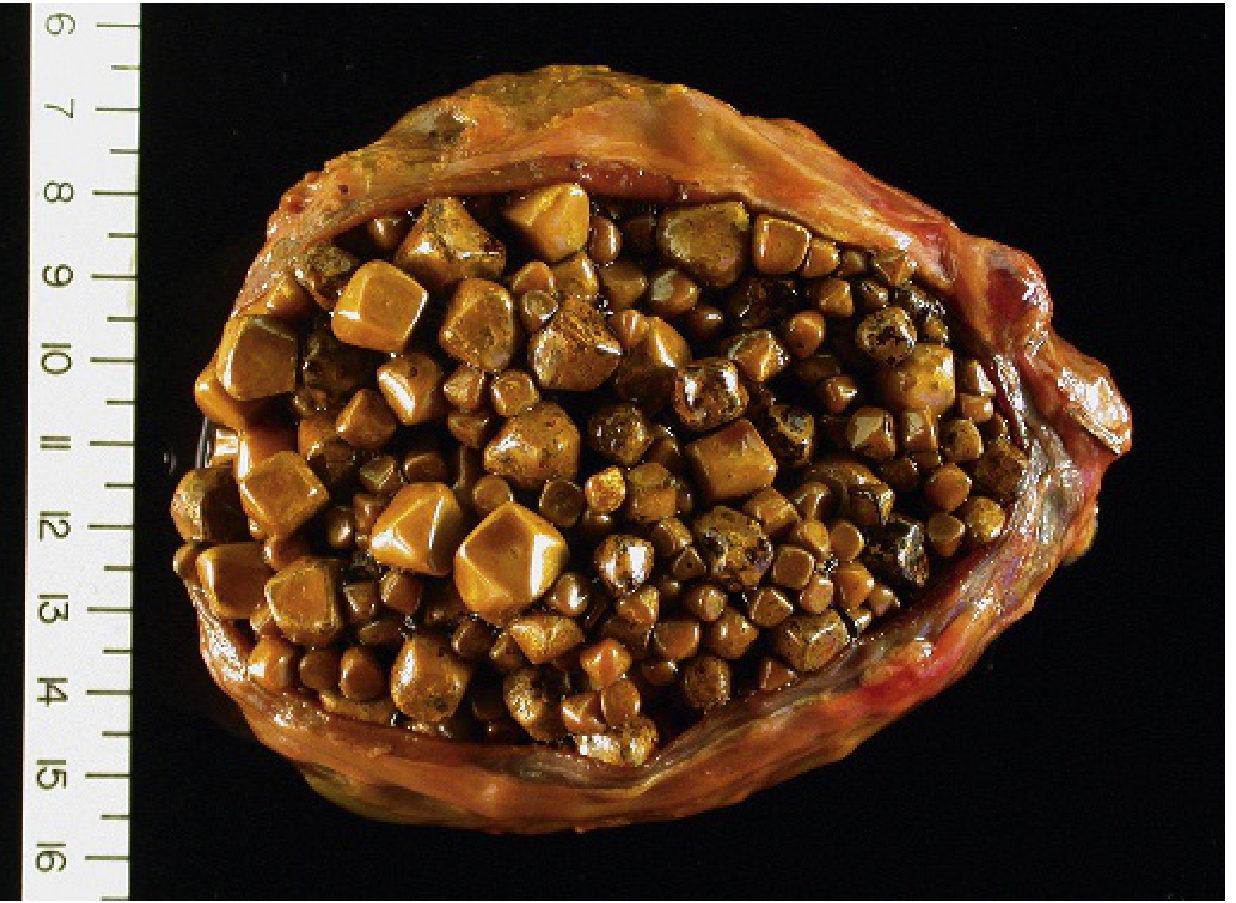
Type 1: Cholesterol Stones (80% in Western countries)
Core Mechanism
Bile is the body's only significant route for eliminating excess cholesterol, either as free cholesterol or as bile salts. Cholesterol is kept water-soluble by aggregation with bile salts and lecithins. When cholesterol exceeds the solubilizing capacity of bile (supersaturation), it can no longer stay dispersed and crystallizes out of solution. Gallbladder hypomotility (stasis) then promotes crystal nucleation, and mucus hypersecretion traps crystals, encouraging their aggregation into stones.
Risk Factors for Cholesterol Stones
| Risk Factor | Mechanism |
|---|---|
| Age | Prevalence < 5% under 40 years; rises to 25-30% over 80 years |
| Female sex | Women are twice as likely as men at all ages |
| Estrogen / Female hormones | Estrogens increase hepatic cholesterol uptake and synthesis, causing excess biliary secretion of cholesterol |
| Oral contraceptives | Same estrogen-driven mechanism |
| Pregnancy | Elevated estrogen + progesterone-induced gallbladder stasis |
| Obesity & metabolic syndrome | Strongly associated with increased biliary cholesterol secretion |
| Rapid weight loss | Increases hepatic cholesterol output into bile |
| Gallbladder stasis / hypomotility | Seen with prolonged fasting, total parenteral nutrition (TPN), pregnancy, diabetes, and spinal cord injury - promotes crystal nucleation |
| Inborn disorders of bile acid metabolism | Impaired synthesis or secretion of bile salts reduces cholesterol solubilization |
| Dyslipidemia syndromes | Elevated plasma cholesterol increases biliary cholesterol |
| Heredity | ~25% of cholelithiasis risk is genetic; family history significantly raises risk |
Notable ethnic predisposition: Native Americans (Pima, Hopi, Navajo) have a prevalence approaching 50%, while Asian populations have much lower rates (3-4%).
Type 2: Pigment Stones (predominant in non-Western populations)
Core Mechanism
Pigment stones are made up of insoluble calcium bilirubinate salts. They form when bile contains a high concentration of unconjugated bilirubin. Unconjugated bilirubin precipitates with calcium to form these stones.
Risk Factors for Pigment Stones
| Risk Factor | Mechanism |
|---|---|
| Chronic hemolytic anemias (sickle cell disease, hereditary spherocytosis, thalassemia) | Increased red cell destruction generates excess unconjugated bilirubin |
| Biliary tract infections (liver flukes - Clonorchis sinensis, bacterial cholangitis) | Bacterial glucuronidases hydrolyze conjugated bilirubin back to unconjugated form |
| Cirrhosis | Reduced bile salt synthesis impairs solubilization of bilirubin |
| Crohn disease (ileal involvement) | Altered enterohepatic cycling of bilirubin; increased bilirubin concentration in bile |
| Ileal resection or bypass | Same mechanism as Crohn disease - loss of bile salt reabsorption |
| Cystic fibrosis with pancreatic insufficiency | Impaired bile acid metabolism and biliary dysfunction |
Memory Aid: The "5 F's" of Cholesterol Gallstones
A classic clinical mnemonic for risk factors:
- Fat (obesity)
- Female
- Fertile (pregnancy / oral contraceptives)
- Forty (age > 40)
- Fair (historically used for higher-risk ethnic groups in Western populations)
Summary Table
| Feature | Cholesterol Stones | Pigment Stones |
|---|---|---|
| Composition | Crystalline cholesterol monohydrate | Calcium bilirubinate salts |
| Prevalence in West | 80-90% | 10-20% |
| Location | Gallbladder only | Anywhere in biliary tree |
| Key cause | Bile supersaturation with cholesterol | Excess unconjugated bilirubin |
| Color | Pale yellow to gray-white | Black (sterile bile) or brown (infected bile) |
| Radiology | Mostly radiolucent | Black stones 50-75% radiopaque; brown stones radiolucent |
Source: Robbins & Kumar Basic Pathology (Robbins Pathology), pp. 630-631
Gall stone paper published regarding Lith 1 or Lith 2 gene in mice
The Lith1 and Lith2 loci are quantitative trait loci (QTLs) identified in mouse models of cholesterol gallstone susceptibility, originally mapped in inbred strains like C57BL/6J fed a lithogenic diet. Key genes at Lith1 include Abcb11 (Bsep) and Abcg5/Abcg8 transporters.
Searching sources...
Searching PubMed
Lith1 Lith2 gallstone mice quantitative trait loci
Searching PubMed
gallstone susceptibility gene locus mice lithogenic
Good. Now let me get the abstracts of the most relevant papers - the original Lith1/Lith2 mapping studies and the key review.
Reading Article
PMID: 11074014
Reading Article
PMID: 12974501
Reading Article
PMID: 20478482
Reading Article
PMID: 12949731
Now let me get details on the Lith1/Lith2 mucin paper and the Lammert 2002 paper which is also highly relevant:
Reading Article
PMID: 12395324
Reading Article
PMID: 15191694
I now have a thorough picture of the Lith gene literature. Here is a comprehensive, well-cited summary:
Lith1 and Lith2 Genes in Mouse Gallstone Research
Background
Cholesterol gallstone susceptibility in mice is a complex polygenic trait. The breakthrough in mapping these genes came from crossing gallstone-susceptible and gallstone-resistant inbred mouse strains on a lithogenic diet (1% cholesterol + 0.5% cholic acid + 15% butterfat), then using Quantitative Trait Locus (QTL) analysis to identify chromosomal regions linked to stone formation.
The Landmark Lith1 and Lith2 Discovery Paper
Paigen B, Schork NJ, Svenson KL, et al. (2000)
"Quantitative trait loci mapping for cholesterol gallstones in AKR/J and C57L/J strains of mice." Physiological Genomics. PMID: 11074014
This is the primary paper that identified and named Lith1 and Lith2:
- Cross used: Gallstone-susceptible C57L/J × gallstone-resistant AKR/J - backcross of 231 male F1 × AKR mice
- Diet: Lithogenic diet for 8 weeks; mice were genotyped at ~20 cM intervals
- Lith1: Mapped near marker D2Mit56 on chromosome 2 - the major locus; confirmed by constructing a congenic strain AK.L-Lith1s
- Lith2: Mapped near marker D19Mit58 on chromosome 19 - confirmed by congenic strain AK.L-Lith2s
- Additional suggestive loci were found on chromosomes 6, 7, 8, 10, and X
Expansion of the Lith Gene Map (Lith1 through Lith5+)
Wittenburg H, Lyons MA, Paigen B, Carey MC (2003)
"Mapping cholesterol gallstone susceptibility (Lith) genes in inbred mice." Digestive and Liver Disease. PMID: 12974501
This review summarized progress through the first five Lith loci (Lith1-Lith5) and outlined the QTL-to-gene pipeline:
- QTL mapping in susceptible × resistant crosses
- Congenic strain construction to confirm loci
- Positional cloning of candidate genes
- Knockout/knockin mouse validation
- Human ortholog identification (mouse-human genome homology is exceptionally close)
Lith Genes Controlling Mucin, Crystallization, and Stone Formation
Lammert F, Wang DQ-H, Wittenburg H, et al. (2002)
"Lith genes control mucin accumulation, cholesterol crystallization, and gallstone formation in A/J and AKR/J inbred mice." Hepatology. PMID: 12395324
- Used A/J × AKR/J cross (225 backcross mice)
- Identified Lith3 on chromosome 17
- Discovered a mucin locus on chromosome 15 harboring Glycam1 (expressed in gallbladder epithelium) - the first biliary mucin gene linked to a Lith QTL
- Showed Lith loci co-localize with QTLs controlling cholesterol crystal formation
FXR and ABCG5/ABCG8 Identified as Lith Gene Candidates
Wittenburg H, Lyons MA, Li R, et al. (2003)
"FXR and ABCG5/ABCG8 as determinants of cholesterol gallstone formation from quantitative trait locus mapping in mice." Gastroenterology. PMID: 12949731
- Used PERA/Ei × I/LnJ intercross
- Identified Lith7 (chromosome 10) - candidate gene: FXR (Nr1h4, the nuclear bile salt receptor)
- Identified Lith8 (chromosome 4) - candidate gene: SHP1 (Nr0b2, small heterodimer partner)
- Identified Lith9 (chromosome 17) - colocalizes with ABCG5/ABCG8 (canalicular cholesterol transporter); higher expression in susceptible PERA/Ei mice correlates with higher biliary cholesterol
Comprehensive Review of All Lith Genes
Wang HH, Portincasa P, Afdhal NH, Wang DQ-H (2010)
"Lith genes and genetic analysis of cholesterol gallstone formation." Gastroenterology Clinics of North America. PMID: 20478482
This is the most thorough review available, covering:
- The full panel of identified Lith genes (Lith1 through ~Lith13+)
- QTL analysis methodology
- Candidate genes at each locus
- Pathway from mouse Lith genes to human LITH gene discovery
Summary Table: Key Lith Loci
| Locus | Chromosome | Mouse Strains Used | Candidate Gene(s) | Key Paper |
|---|---|---|---|---|
| Lith1 | Chr 2 | C57L/J × AKR/J | Under investigation | Paigen 2000 (PMID 11074014) |
| Lith2 | Chr 19 | C57L/J × AKR/J | Under investigation | Paigen 2000 (PMID 11074014) |
| Lith3 | Chr 17 | A/J × AKR/J | - | Lammert 2002 (PMID 12395324) |
| Lith7 | Chr 10 | PERA/Ei × I/LnJ | FXR (Nr1h4) | Wittenburg 2003 (PMID 12949731) |
| Lith8 | Chr 4 | PERA/Ei × I/LnJ | SHP1 (Nr0b2) | Wittenburg 2003 (PMID 12949731) |
| Lith9 | Chr 17 | PERA/Ei × I/LnJ | ABCG5/ABCG8 | Wittenburg 2005 (PMID 16151694) |
Clinical Relevance
The mouse Lith gene program was designed as a "road map" to discover orthologous human LITH genes. Because mouse-human genome homology is very high, once mouse Lith genes are positionally cloned, their human counterparts can be tested in susceptible populations. Notably, human ABCG5/ABCG8 polymorphisms have subsequently been shown to influence gallstone risk, validating this animal-to-human translational approach.
This is a shared conversation. Sign in to Orris to start your own chat.