
I have anatomy exam tomorrow she gave some questions to prepare
Please share the questions your professor gave you, and I'll help you prepare!
Urogenital system 1. Urinary organs: functional significance, departments.
Reading File
Finding Sources
Finding Sources
Reading File
Finding Sources
Loading Image
Finding Sources
I have all the information needed. Here is a comprehensive answer for your exam:
Urinary Organs: Functional Significance & Departments
Functional Significance
The urinary system performs several vital functions:
- Urine formation — the kidneys filter blood plasma, producing an ultrafiltrate that is then concentrated into urine
- Excretion of metabolic waste — removes nitrogen-containing compounds, drugs, and toxins from the body
- Homeostasis — regulates water and electrolyte balance, blood pH, and blood pressure (via renin secretion and erythropoietin production)
- Urine transport and storage — conducts urine from the kidneys to the outside via a series of hollow organs
- Voiding — controlled expulsion of urine through the urethra
Departments (Organs) of the Urinary System
The urinary organs are classically divided into two functional groups:
Group 1 — Urine-Forming Organ
| Organ | Role |
|---|---|
| Kidneys (paired) | Filter blood, form urine; located retroperitoneally at T12–L3 |
Group 2 — Urine-Excreting Organs (Urinary Passages)
| Organ | Role |
|---|---|
| Renal pelvis (paired) | Collects urine from the collecting ducts within the kidney |
| Ureters (paired) | Transport urine from renal pelvis to bladder; ~25–30 cm long |
| Urinary bladder (unpaired) | Stores urine (capacity ~300–500 mL); located in subperitoneal space |
| Urethra | Conducts urine to the outside; female (~4 cm) vs. male (~20 cm) |
Topographic Arrangement
The organs lie entirely outside the peritoneum:
- Retroperitoneal space — kidneys + proximal/larger part of ureters; bounded by the vertebral column, quadratus lumborum, and psoas major muscles
- Subperitoneal space (lesser pelvis) — distal ureters + urinary bladder + female urethra
- The male urethra exits the lesser pelvis and continues through the penis
Key Diagram
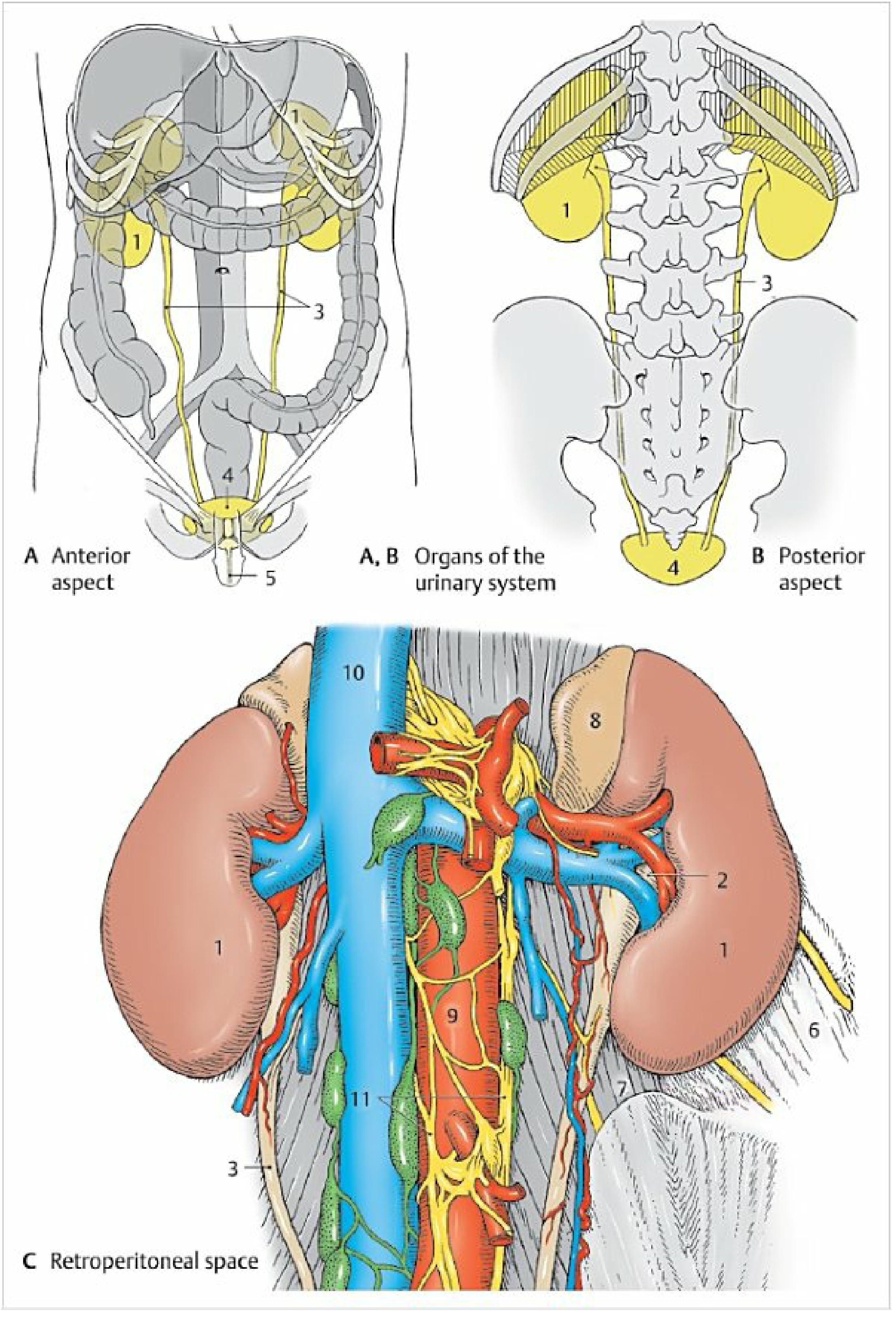
Quick Summary for the Exam
The urinary system = 1 urine-forming organ (kidney) + 4 urine-conducting/storing organs (renal pelvis → ureter → bladder → urethra). All lie extraperitoneally — kidneys retroperitoneal, bladder + distal ureter subperitoneal.
— Color Atlas of Human Anatomy Vol. 2 – Internal Organs, p. 385–386
Kidney: external structure, topography, fixing apparatus.
Finding Sources
Finding Sources
Finding Sources
Reading File
Finding Sources
That was a TB chapter — not what I need. Let me search the anatomy atlas directly.
Finding Sources
Finding Sources
Reading File
Reading File
Reading File
Reading File
Loading Image
Loading Image
Here is the full answer for your exam:
Kidney: External Structure, Topography & Fixing Apparatus
1. External Structure
Shape & Size
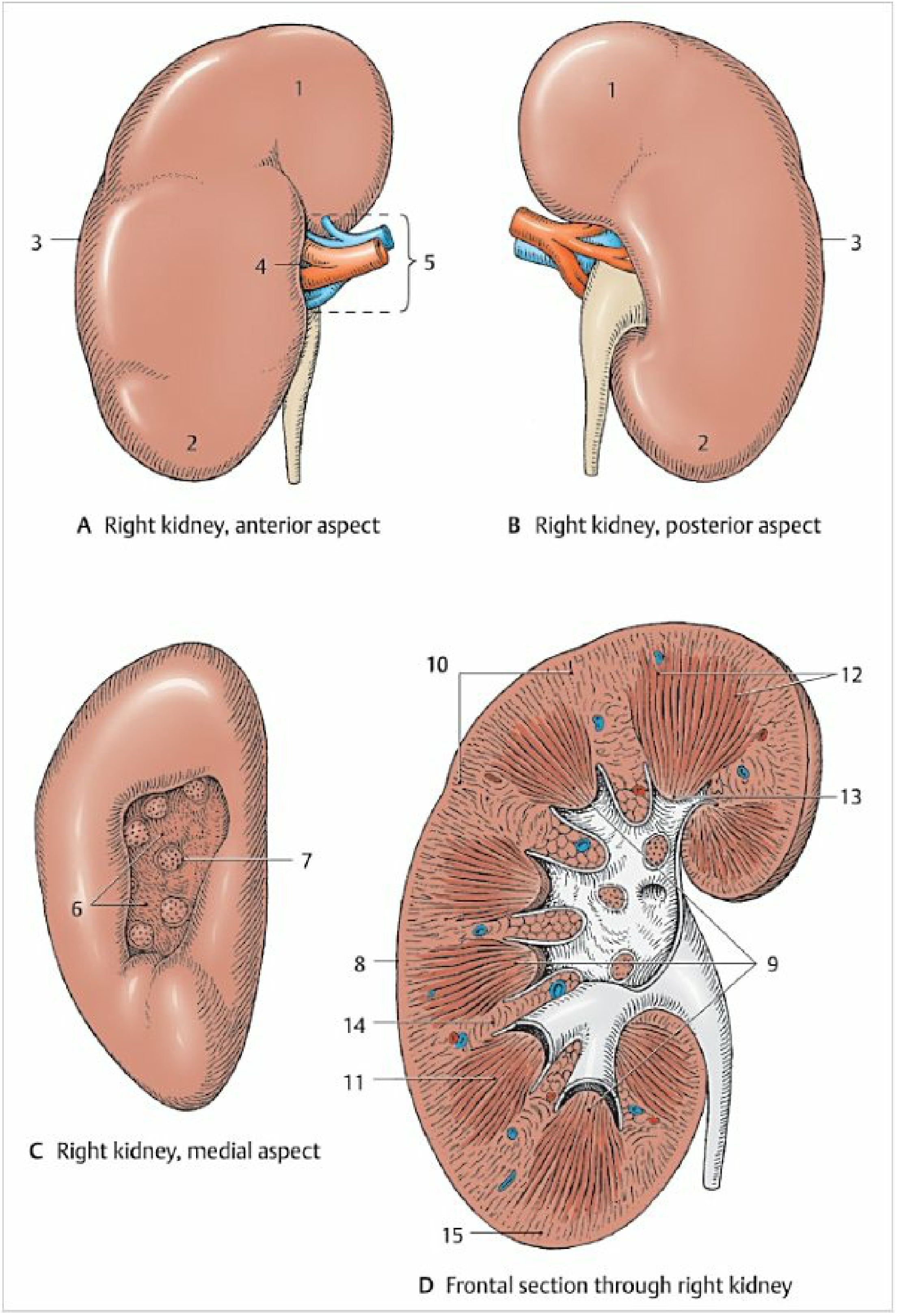
- Bean-shaped organ with a smooth surface in adults
- Dimensions: 10–12 cm long × 5–6 cm wide × 4 cm thick
- Weight: 120–300 g per kidney; the right kidney is usually slightly smaller than the left
Surfaces & Borders
| Feature | Description |
|---|---|
| Anterior surface | Faces forward |
| Posterior surface | Faces the posterior abdominal wall |
| Convex lateral border | Continuous with both poles |
| Concave medial border | Bears the hilum |
Hilum
- A vertical depression on the medial border
- Transmits (from anterior to posterior): renal vein → renal artery → renal pelvis (plus lymphatics and nerves)
- Leads inward to the renal sinus — a fat-filled cavity surrounded by parenchyma, containing the renal pelvis, calyces, vessels, and nerves
- Projecting into the renal sinus are renal papillae (7–14 in humans), remnants of the multilobar fetal kidney
Poles
- Superior pole — wide, capped by the adrenal gland
- Inferior pole — more conical/pointed
Fibrous Capsule
- Covers the entire surface of the kidney
- Made of tough collagen fibers
- Loosely attached to parenchyma → peels off easily from a healthy kidney (useful clinical sign; in disease, adhesion indicates inflammation or scarring)
Diagram — External & Internal Structure
2. Topography
Position in the Body
- Lie retroperitoneally in the lumbar gutters, on either side of the vertebral column
- Long axes are directed upward and medially (if extended, the lines would intersect superiorly)
- Vertebral level:
- Superior pole: T12
- Hilum: L1
- Inferior pole: L3
- Right kidney sits ~half a vertebra lower than the left (displaced by the liver)
- Position changes with respiration (descend ~3 cm on inspiration) and posture (lower when erect)
Posterior Relations
- The 12th rib crosses diagonally over the upper-middle third of the kidney's posterior surface
- Between the kidney and the 12th rib lies the costodiaphragmatic pleural recess (→ risk of pneumothorax in renal surgery)
- Running between kidney and posterior wall (parallel to 12th rib): subcostal nerve (T12), iliohypogastric nerve (L1), ilio-inguinal nerve (L1)
Anterior Relations
| Side | Anterior Relations |
|---|---|
| Right | Adrenal gland (superior pole), liver, right colic flexure, duodenum (near hilum), IVC |
| Left | Adrenal gland (superior pole), stomach, pancreas, left colic flexure, aorta (near hilum) |
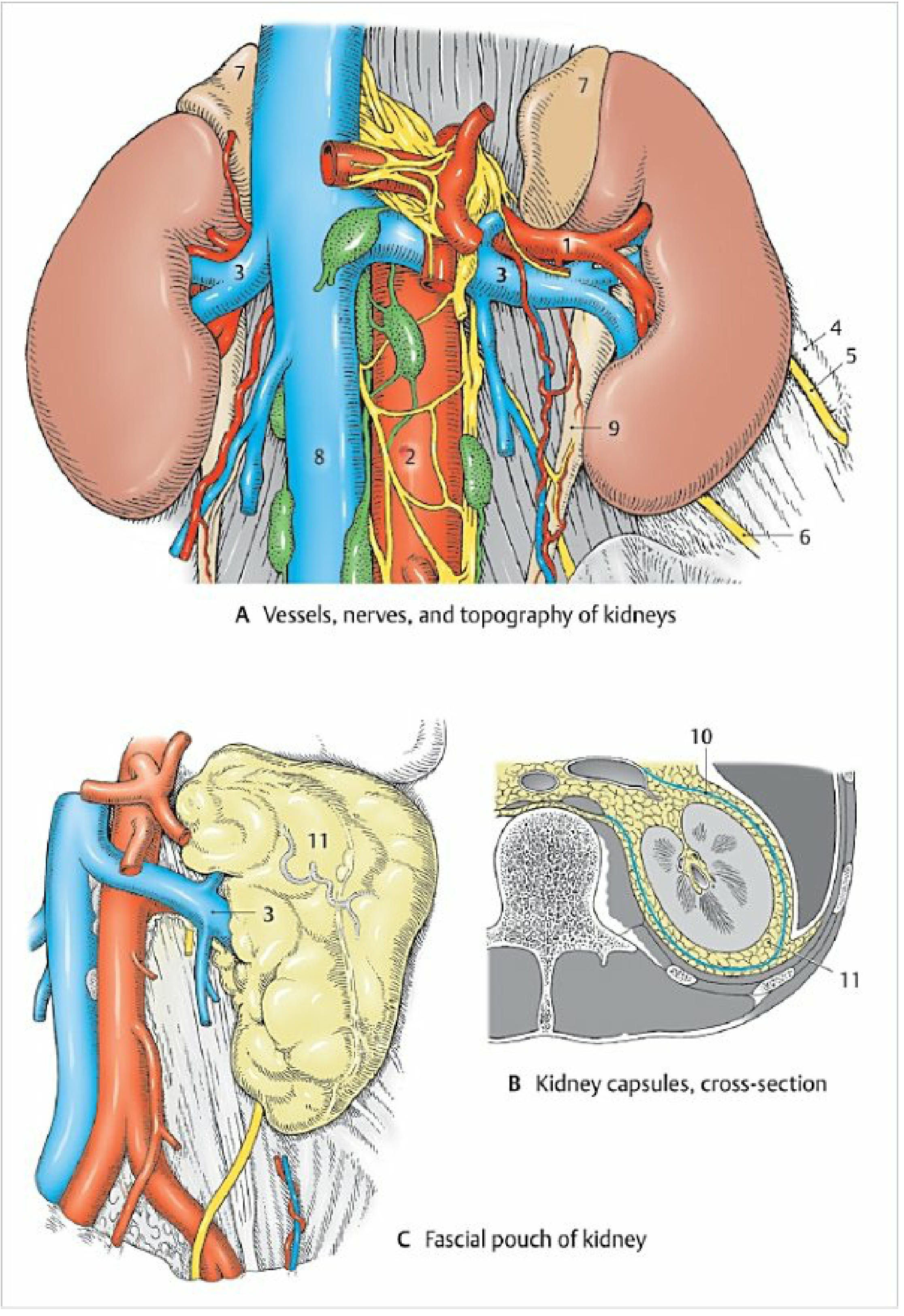
3. Fixing Apparatus (Capsules of the Kidney)
The kidney is held in position by three layers of coverings, working together:
Layer 1 — Fibrous Capsule (innermost)
- Directly envelops the renal parenchyma
- Provides shape and protection
Layer 2 — Perirenal Fat Capsule (adipose capsule)
- A thick layer of perinephric fat surrounding the fibrous capsule
- Critical for fixation — cushions and holds the kidney in its bed
- Varies with nutritional status; can be absent in severely emaciated individuals
- Loss of this layer → "floating kidney" (nephroptosis) — the kidney descends toward the pelvis
Layer 3 — Renal Fascia (Gerota's fascia) — outermost
- A fibrous fascial pouch with:
- Thin anterior layer
- Thick posterior layer
- The two layers are fused at the superior and lateral borders, enclosing the kidney and adrenal gland together
- Medial side: open (no barrier between the two sides)
- Inferior side: only loosely closed by fat (explains why infections/fluid can track inferiorly)
Additional Fixing Factors
- Renal vessels — the renal pedicle anchors the kidney to the great vessels
- Intra-abdominal pressure from surrounding organs
- Adjacent peritoneum providing indirect support
Diagrams — Topography & Fixing Apparatus
Quick Summary for the Exam
External structure: bean-shaped, smooth surface, covered by fibrous capsule; medial border has hilum → leads to renal sinus. Size 10–12 × 5–6 × 4 cm.Topography: retroperitoneal, T12–L3, right lower than left; 12th rib crosses posterior surface; right relates to liver/duodenum/IVC; left to stomach/pancreas/aorta.Fixing apparatus: 3 layers — fibrous capsule → perirenal fat (loss = nephroptosis) → renal fascia (Gerota's fascia, open medially and inferiorly); plus renal pedicle and intra-abdominal pressure.
— Color Atlas of Human Anatomy Vol. 2 – Internal Organs, pp. 387–400
The internal structure of the kidney. Nephron. Blood vessels of the kidney, venous and lymphatic outflow, innervation
Reading File
Finding Sources
Reading File
Your credits are exhausted. Your daily credits reset tomorrow, or you can purchase a top-up for more.
The internal structure of the kidney. Nephron. Blood vessels of the kidney, venous and lymphatic outflow, innervation
Your credits are exhausted. Your daily credits reset tomorrow, or you can purchase a top-up for more.
This is a shared conversation. Sign in to Orris to start your own chat.