
Tell about dengue
Reading File
Now let me search the medical library and web in parallel for comprehensive dengue coverage.
Finding Sources
Searching the Web
dengue fever pathophysiology clinical features management 2025
Searching PubMed
dengue fever
Now let me read the most authoritative sources - Harrison's (2025) and Robbins Pathology in parallel:
Reading File
Reading File
Reading File
Let me read more of the Red Book content (treatment/diagnosis) and check the Andrews dermatology section for the rash:
Reading File
Reading File
I now have rich, authoritative content from multiple textbooks. Let me fetch the dengue rash image from Andrews' dermatology:
Loading Image
I now have comprehensive information from multiple authoritative textbooks. Here is a complete, detailed overview of dengue:
Dengue
What Is Dengue?
Dengue is the most prevalent arthropod-borne viral disease worldwide, infecting an estimated 400 million people each year, of whom 100 million are symptomatic and approximately 40,000 die from severe disease. It is caused by four closely related RNA viruses (DENV-1, DENV-2, DENV-3, DENV-4), all belonging to the Flaviviridae family, genus Flavivirus. Historically called "breakbone fever" for its intense myalgias and arthralgias, it remains one of the greatest re-emerging infectious disease threats for over 3 billion people globally.
- Robbins Pathologic Basis of Disease, p. 336
- Harrison's Principles of Internal Medicine 22E, p. 3901
Epidemiology
- Transmission: Primarily via the bite of Aedes aegypti mosquitoes; less commonly A. albopictus and A. polynesiensis. Humans are the main amplifying host.
- Other transmission routes (rare): Vertical (transplacental/perinatal, ~20% rate, higher near delivery), blood/organ donation, breastfeeding, needlestick injuries. Sexual transmission is possible but rare.
- Geographic distribution: Endemic across the tropical belt - South and Central America, Mexico, Africa, South and Southeast Asia, the Pacific Islands. Climate change has expanded the Aedes vector habitat into parts of southern Europe (France, Italy, Spain) and the southern United States (Texas, Florida, Hawaii).
- High-risk populations: Infants, pregnant women, patients with chronic conditions (asthma, sickle cell disease, diabetes), and those experiencing a second dengue infection with a different serotype.
- Incubation period: 3-14 days in humans. Mosquitoes have an extrinsic incubation of 8-12 days and remain infectious for life thereafter.
Red Book 2021, p. 521-522; Andrews' Diseases of the Skin, p. [Andrews block 5]
Virology & Pathogenesis
There are four distinct serotypes (DENV-1 through 4). Infection with one serotype confers lifelong immunity against that serotype, plus a short period of cross-protection (1-3 years) against the other three. After this window, infection with a different serotype is the main trigger for severe dengue.
The key immunopathological mechanism is antibody-dependent enhancement (ADE):
- Cross-reactive but non-neutralizing antibodies from the first infection bind the new serotype virus.
- Instead of neutralizing it, these antibodies facilitate uptake into monocytes/macrophages via Fc receptors.
- This amplifies viral replication, triggers massive cytokine release, and increases vascular permeability - the hallmark of severe dengue.
- Severe dengue is more likely with DENV-2 than other serotypes, and also occurs in infants carrying maternal antibodies against dengue.
Robbins Pathologic Basis of Disease, p. 336; Red Book 2021, p. 521
Clinical Phases
Dengue follows three distinct clinical phases after the incubation period:
1. Febrile Phase (Days 1-3 to 7)
Sudden-onset high fever (often 39-40°C), lasting 2-7 days, with:
- Severe myalgias, arthralgias, bone pain ("breakbone fever")
- Headache, retro-orbital pain
- Facial flushing, injected oropharynx
- Nausea, vomiting
- Macular or maculopapular rash (in ~50% of patients)
- Lab findings: leukopenia, thrombocytopenia (platelets <100,000 in 50%), elevated liver transaminases (~3x normal)
2. Critical Phase (Around Defervescence, Days 3-7)
- A rise in vascular permeability coincides with defervescence - this is the danger window.
- Clinically significant plasma leakage lasts 24-48 hours.
- Warning signs at this stage: persistent vomiting, severe abdominal pain, mucosal bleeding, difficulty breathing, early shock, rapid drop in platelets with rising hematocrit (hemoconcentration).
- Patients without severe disease begin to recover; those with plasma leakage can develop pleural effusion, ascites, and hypovolemic shock.
3. Recovery Phase
- Gradual reabsorption of leaked fluid, hemodynamic stabilization.
- Complete recovery typically within 7-10 days.
Red Book 2021, p. 520; Andrews' Diseases of the Skin
WHO Classification of Dengue Severity (2009)
| Category | Criteria |
|---|---|
| Dengue without warning signs | Fever + ≥2 of: nausea/vomiting, rash, aches/pains, leukopenia, positive tourniquet test |
| Dengue with warning signs | Above + any: abdominal pain/tenderness, persistent vomiting, clinical fluid accumulation (ascites/pleural effusion), mucosal bleeding, lethargy/restlessness, liver enlargement >2 cm |
| Severe dengue | Severe plasma leakage leading to shock or respiratory distress; severe bleeding; severe organ involvement (AST/ALT ≥1000 IU/L, impaired consciousness, cardiac/organ failure) |
Less common manifestations include myocarditis, pancreatitis, hemophagocytic lymphohistiocytosis, acute meningoencephalitis, and post-dengue ADEM.
Red Book 2021, p. 520
The Characteristic Rash
About 50% of dengue patients develop a skin eruption. In 90% of those, it appears between days 3-5, often coinciding with defervescence.
- Distribution: generalized (50%), extremities only (30%), trunk only (20%)
- Morphology: macular or morbilliform, usually confluent
- Classic pattern: "islands of white in a sea of red" - small spared islands of normal skin within the erythema (visible in the image below)
- Usually asymptomatic or mildly pruritic
- Petechiae may be present; frank cutaneous hemorrhage suggests DHF/DSS
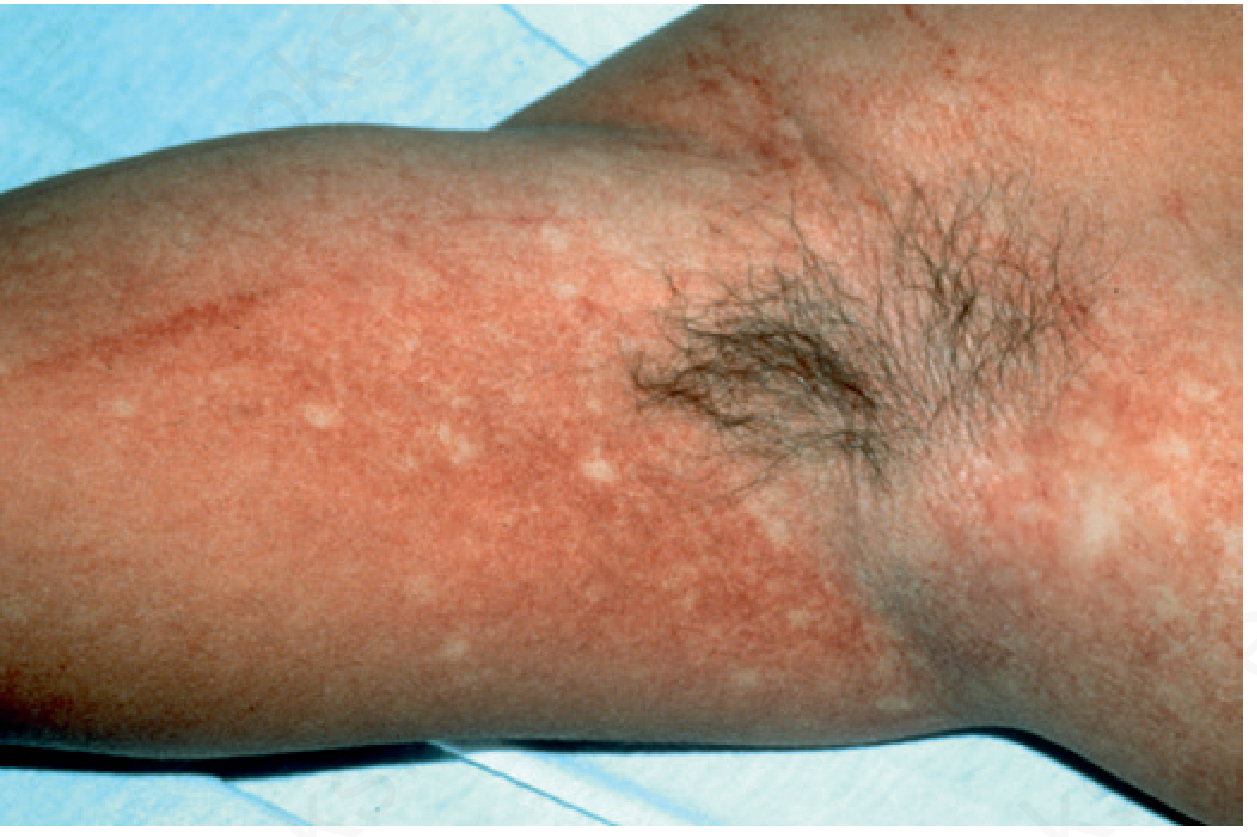
Tourniquet test: Inflate blood pressure cuff, hold 5 minutes, wait 2 minutes - count petechiae. ≥10 per square inch is positive, suggesting dengue.
Diagnosis
Laboratory confirmation uses a combined virological + serological approach on a single serum sample:
| Test | Window | Notes |
|---|---|---|
| RT-PCR (dengue RNA) | Febrile phase to day 7-10 | Gold standard for early disease |
| NS1 antigen EIA | Febrile phase to day 7-10 | Rapid, practical |
| IgM antibody (EIA) | From day 3-5; 99% positive by day 10 | Can cross-react with Zika, other flaviviruses |
| IgG antibody | Elevated for life | Fourfold rise between acute and convalescent (>15 days) confirms recent infection |
Testing for both NS1 antigen and IgM on a single sample from the first 10 days of illness identifies ≥90% of primary and secondary dengue cases.
Red Book 2021, p. 522-523
Treatment
There is no specific antiviral therapy for dengue. Management is supportive:
Febrile Phase
- Maintain hydration (oral or IV fluids)
- Paracetamol (acetaminophen) for fever and pain
- Strictly avoid: aspirin, ibuprofen, other NSAIDs, and salicylates - these increase bleeding risk
Critical Phase
- Close monitoring for warning signs of shock and plasma leakage
- IV fluid resuscitation for dehydration and shock
- Monitor hematocrit, platelet count, and hemodynamic status
- Watch for fluid overload (a real risk in recovery)
- Platelet transfusions for refractory severe thrombocytopenia with bleeding
Outcome
- With early recognition and intensive supportive care, mortality from severe dengue can be reduced from 5-10% to <1%
Red Book 2021, p. 523
Prevention & Vaccination
- Vector control is the primary prevention strategy: eliminating standing water, using mosquito nets and repellents (DEET), screens, and wearing long clothing. Even Singapore - with rigorous mosquito surveillance - cannot fully prevent outbreaks, as Aedes can breed in mere millimeters of water.
- Wolbachia biocontrol: Intentional release of Wolbachia-infected mosquitoes (which reduce viral replication) has reduced dengue cases by 95-97% in densely populated areas of Colombia - a novel approach with potential for wider scale-up.
- Vaccines: Several dengue vaccines exist, but use is complex. There is ongoing concern that vaccination in dengue-naive individuals could prime them for ADE-mediated severe disease upon natural infection. Current licensed vaccines (e.g., Dengvaxia) are recommended only for previously infected (seropositive) individuals.
Robbins Pathologic Basis of Disease, p. 336; Harrison's 22E, p. 3901-3902
Recent Evidence (2025)
A 2025 systematic review (PMID: 41037858) in the Journal of Infection and Public Health provides an updated synthesis of dengue pathogenesis, diagnosis, and management, confirming the continued relevance of ADE as the central mechanism in severe disease and the supportive-only nature of treatment. A separate 2025 meta-analysis (PMID: 41160032) in the Journal of the American Heart Association highlights cardiovascular complications of dengue as an emerging concern, including myocarditis and arrhythmias.
Summary table:
| Feature | Detail |
|---|---|
| Causative agent | DENV 1-4 (Flaviviridae) |
| Vector | Aedes aegypti (primary) |
| Incubation | 3-14 days |
| Key symptom triad | High fever, severe myalgia, morbilliform rash |
| Hallmark lab | Thrombocytopenia + leukopenia + raised transaminases |
| Danger sign | Rising hematocrit + falling platelets at defervescence |
| Severe disease mechanism | Antibody-dependent enhancement (second serotype) |
| Treatment | Supportive only; no antivirals; avoid NSAIDs/aspirin |
| Mortality (treated) | <1% with early aggressive fluid management |
This is a shared conversation. Sign in to Orris to start your own chat.