
Carpal tunnel syndrome examination and findings
Reading File
Now let me search the medical library and PubMed in parallel for carpal tunnel syndrome examination findings.
Finding Sources
Searching PubMed
"carpal tunnel syndrome"[MeSH Terms] AND diagnosis
Excellent results. Let me now read the most comprehensive sources in parallel - Campbell's Orthopaedics, Firestein's Rheumatology, and the Neurology textbook.
Reading File
Reading File
Reading File
I have rich content. Let me now get the rest of Campbell's provocative tests section and also fetch the key images.
Reading File
Finding Sources
Let me now get the Bailey & Love examination section, the CTS-6 scoring table from Campbell's, and also look for images.
Reading File
Reading File
Finding Sources
Now let me get the CTS-6 scoring table and fetch the key anatomy/clinical images in parallel.
Reading File
Finding Sources
Loading Image
Let me get the flick sign content and the Localization in Neurology section for more detail, plus fetch the wrist brace image and look for a carpal tunnel anatomy image.
Reading File
Finding Sources
I now have comprehensive content to construct a detailed, well-organized answer. Let me also look for an ultrasound/imaging section quickly.
Finding Sources
Reading File
I have more than enough to write a thorough, well-cited answer now. Let me also fetch the ultrasound image to include it visually.
Loading Image
I now have all the information needed for a comprehensive answer. Here is the full structured response:
Carpal Tunnel Syndrome - Examination and Findings
Anatomy of the Carpal Tunnel
The carpal tunnel is bounded by the carpal bones arching dorsally, the hook of hamate and pisiform medially, and the scaphoid tubercle and trapezial ridge laterally. The "roof" (palmar aspect) is formed by the flexor retinaculum - comprising deep forearm fascia proximally, the transverse carpal ligament (TCL) over the wrist, and the aponeurosis between thenar and hypothenar muscles distally. The median nerve is the most palmar structure in the tunnel, with the nine long flexor tendons lying dorsal to it. Carpal tunnel pressure >20-30 mmHg impedes epineurial blood flow and impairs nerve function. - Campbell's Operative Orthopaedics 15e, 2026
Symptoms (History)
The classic symptom constellation consists of: - Firestein & Kelley's Textbook of Rheumatology
- Nocturnal paresthesias - the cardinal symptom; pain/tingling waking patient at night
- Numbness or paresthesia in the thumb, index, middle, and radial half of ring fingers (median nerve distribution)
- "Flick sign" - patient spontaneously demonstrates a "shaking out" or flicking movement of the wrist when asked what they do at night for symptom relief; positive when this movement is demonstrated - Localization in Clinical Neurology 8e
- Forearm and elbow pain that is diffuse, poorly localized, and aching in nature; occasionally proximal shoulder pain
- Weakness or clumsiness of the hand
- Symptoms typically aggravated by sustained wrist flexion/extension (driving, holding a phone, typing)
Important note on sensory distribution: The palmar cutaneous branch leaves the median nerve proximal to the flexor retinaculum and supplies the thenar eminence skin. Therefore, sensory loss in CTS affects the distal thumb, index, and middle fingers but NOT the thenar eminence skin - an important diagnostic point distinguishing CTS from a more proximal median nerve lesion. - Bradley and Daroff's Neurology in Clinical Practice
Clinical Examination Findings
Inspection
- Thenar atrophy - wasting of the abductor pollicis brevis (APB) and opponens pollicis; this is a late/advanced sign seen with prolonged, severe compression - Bailey and Love's Short Practice of Surgery 28e
- Thenar atrophy reported in about half of patients who eventually require surgery - Campbell's
Motor Testing
- Weakness of thumb abduction (APB - abductor pollicis brevis) - most reliable motor sign
- Opponens pollicis weakness - often underestimated as patients recruit long flexor tendons during testing
- The lumbricals to fingers 1-2 are also innervated by the median nerve distally but are less clinically obvious
Sensory Testing
- Decreased sensation (hypoesthesia) in the thumb, index, middle, and radial ring finger
- Two-point discrimination >5 mm is an objective, quantifiable finding - one of the most useful physical examination maneuvers for diagnosis - Tintinalli's Emergency Medicine
- Sensory loss limited to fingertips is more common; may even be restricted to one side of a digit due to fascicular arrangement
- Thenar eminence skin sensation is preserved (palmar cutaneous branch exits proximal to the tunnel)
Provocative Tests
1. Phalen's Test (Wrist Flexion Test)
- Method: Hold the wrist in complete flexion (90°) for 30-60 seconds
- Positive: Reproduction of numbness or tingling in the median nerve distribution
- Sensitivity: ~74%; false-positive rate ~25%
- Most sensitive of the standard provocative tests
- Bradley and Daroff's Neurology in Clinical Practice; Campbell's Operative Orthopaedics 15e
2. Tinel's Sign (Nerve Percussion Test)
- Method: Light percussion over the median nerve at the volar wrist
- Positive: Tingling radiating into the hand in the median distribution
- Most specific but least sensitive of the standard tests
- Firestein & Kelley's Textbook of Rheumatology; Localization in Clinical Neurology 8e
3. Durkan's Carpal Compression Test (Most Accurate)
- Method: Direct pressure applied with thumbs (or a manometer-attached atomizer bulb) over the carpal tunnel for 30 seconds, with wrist in neutral position
- Positive: Reproduction of paresthesias
- Sensitivity: 87%; Specificity: 90% - more sensitive and specific than either Tinel or Phalen
- Considered the most sensitive provocative test when wrist is in neutral position - Campbell's; Miller's Review of Orthopaedics 9e; Bailey and Love's 28e
4. Gilliat-Wilson Cuff Compression Test
- A blood pressure cuff inflated above systolic pressure aggravates median paresthesias and pain
- Localization in Clinical Neurology 8e
5. Hyperextension of the Wrist (Reverse Phalen)
- May also aggravate paresthesias, though less commonly tested
- Localization in Clinical Neurology 8e
CTS-6 Diagnostic Scoring Tool
A validated clinical scoring tool that competes with electrodiagnostic testing in accuracy: - Campbell's Operative Orthopaedics 15e (Table 82.1)
| Finding | Points |
|---|---|
| Numbness predominantly in median nerve distribution | 3.5 |
| Nocturnal symptoms | 4 |
| Thenar atrophy or weakness | 5 |
| Positive Phalen test | 5 |
| Loss of two-point discrimination (>5 mm) | 4.5 |
| Positive Tinel sign | 4 |
Score ≥12 = positive for CTS
- Sensitivity 95% (vs. 91% for EMG/NCS or ultrasound)
- Specificity 91% (vs. 83% for EMG/NCS; 94% for ultrasound)
- Higher scores correlate with EMG/NCS severity
Investigations
Electrodiagnostic Studies (Gold Standard Confirmation)
Nerve conduction velocities (NCV) and EMG: - Campbell's Operative Orthopaedics 15e
- Distal motor latency >4.5 ms = abnormal
- Sensory latency >3.5 ms = abnormal
- EMG may show: increased insertional activity, positive sharp waves, fibrillations at rest, decreased motor recruitment, complex repetitive discharges
- NCS: reported ~90% sensitive and ~60% specific
- Caveat: Studies can be normal in symptomatic patients and abnormal in asymptomatic patients
- Not a predictor of functional recovery after release
- Most useful in atypical presentations, before surgery in compensable injury claims, and to exclude proximal lesions (adding EMG of cervical paraspinals and H-reflex/F-wave testing helps differentiate CTS from cervical radiculopathy or thoracic outlet syndrome)
Ultrasound
Focal nerve enlargement measured as cross-sectional area (CSA) is the primary ultrasound finding. CSA >10-13 mm² at the carpal tunnel inlet indicates entrapment: - Bradley and Daroff's Neurology in Clinical Practice
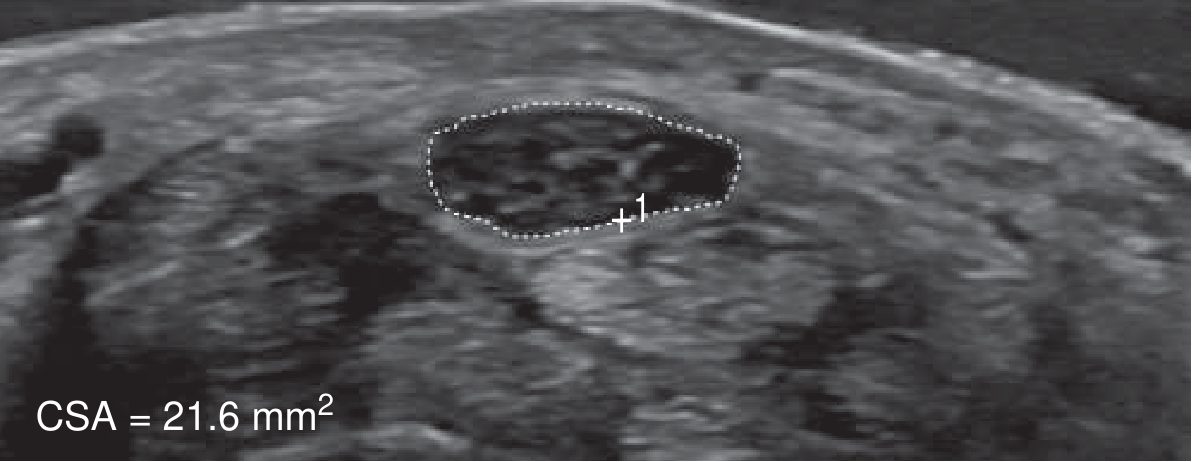
Ultrasound at the carpal tunnel inlet: hypoechoic enlarged median nerve, CSA = 21.6 mm² (well above the normal threshold of 10-13 mm²). - Bradley and Daroff's Neurology in Clinical Practice
Screening Blood Tests
All patients should have screening bloods: - Bradley and Daroff's Neurology in Clinical Practice
- Fasting glucose (diabetes)
- TFTs - hypothyroidism
- Rheumatoid factor / anti-CCP
- Consider: serum ACE (sarcoidosis), IGF-1 (acromegaly), serum protein electrophoresis (amyloid, myeloma)
Associated Conditions (Box 82.2)
| Category | Examples |
|---|---|
| Fluid/metabolic | Pregnancy, hypothyroidism, renal failure, hemodialysis, menopause |
| Inflammatory | Rheumatoid arthritis, gout, tenosynovitis |
| Autoimmune | Amyloidosis, SLE, scleroderma |
| Structural | Colles/scaphoid fracture, lunate dislocation, osteophytes, acromegaly |
| External | Vibration, repetitive forceful flexion, direct pressure |
Differential Diagnosis
- Cervical disc disease / radiculopathy (C6-C7)
- Thoracic outlet syndrome
- Diabetic or other peripheral neuropathies
- Pronator teres syndrome (proximal median nerve entrapment)
- Inflammatory conditions / autoimmune disorders
Key differentiator: Sensory loss sparing the thenar eminence skin (preserved palmar cutaneous branch) and nocturnal symptoms are highly suggestive of CTS over more proximal lesions.
Summary of Exam Findings by Severity
| Stage | Findings |
|---|---|
| Early | Nocturnal paresthesias, positive Phalen/Tinel/Durkan, normal sensation and strength |
| Intermediate | Decreased sensation, intermittent weakness, positive flick sign |
| Advanced/Late | Thenar atrophy, persistent sensory loss, loss of two-point discrimination, absent Phalen/Tinel (severe fibrosis), constant numbness |
Thenar atrophy, severe sensory loss, and active denervation on needle EMG are indications for surgical carpal tunnel release. - Bradley and Daroff's Neurology in Clinical Practice
This is a shared conversation. Sign in to Orris to start your own chat.