
Seminoma for xm
I'll read the medical library skill first, then search for seminoma content.
Reading File
Now let me search the library for seminoma content in parallel.
Finding Sources
Finding Sources
Excellent results. Now let me read the key sections in parallel - the main seminoma sections from Bailey & Love, Campbell Walsh, and Smith & Tanagho.
Reading File
Reading File
Reading File
Good content retrieved. Now let me read the clinical staging, management, and contrasting seminoma vs NSGCT sections from Campbell Walsh, plus the staging/management from Smith & Tanagho.
Reading File
Reading File
Reading File
Now let me fetch the key images and also read the staging/markers/radiology section from Campbell Walsh.
Loading Image
Loading Image
Reading File
I now have comprehensive content. Let me compile the full answer.
Seminoma
Definition and Overview
Seminoma is the most common type of testicular germ cell tumor (GCT), accounting for approximately 50-56% of all testicular GCTs. It arises from germ cell neoplasia in situ (GCNIS) - undifferentiated germ cells located basally within the seminiferous tubules. It is considered the common precursor for all other NSGCT subtypes.
- Peak incidence: 4th-5th decade of life (older average age than NSGCT)
- Seldom occurs in childhood, young adults, or patients over 70
Gross & Histological Features
Gross appearance:
- Soft, tan-to-white, diffuse or multinodular mass
- Homogeneous, pinkish-cream cut surface
- Necrosis may be present but is usually focal (less prominent than other GCTs)
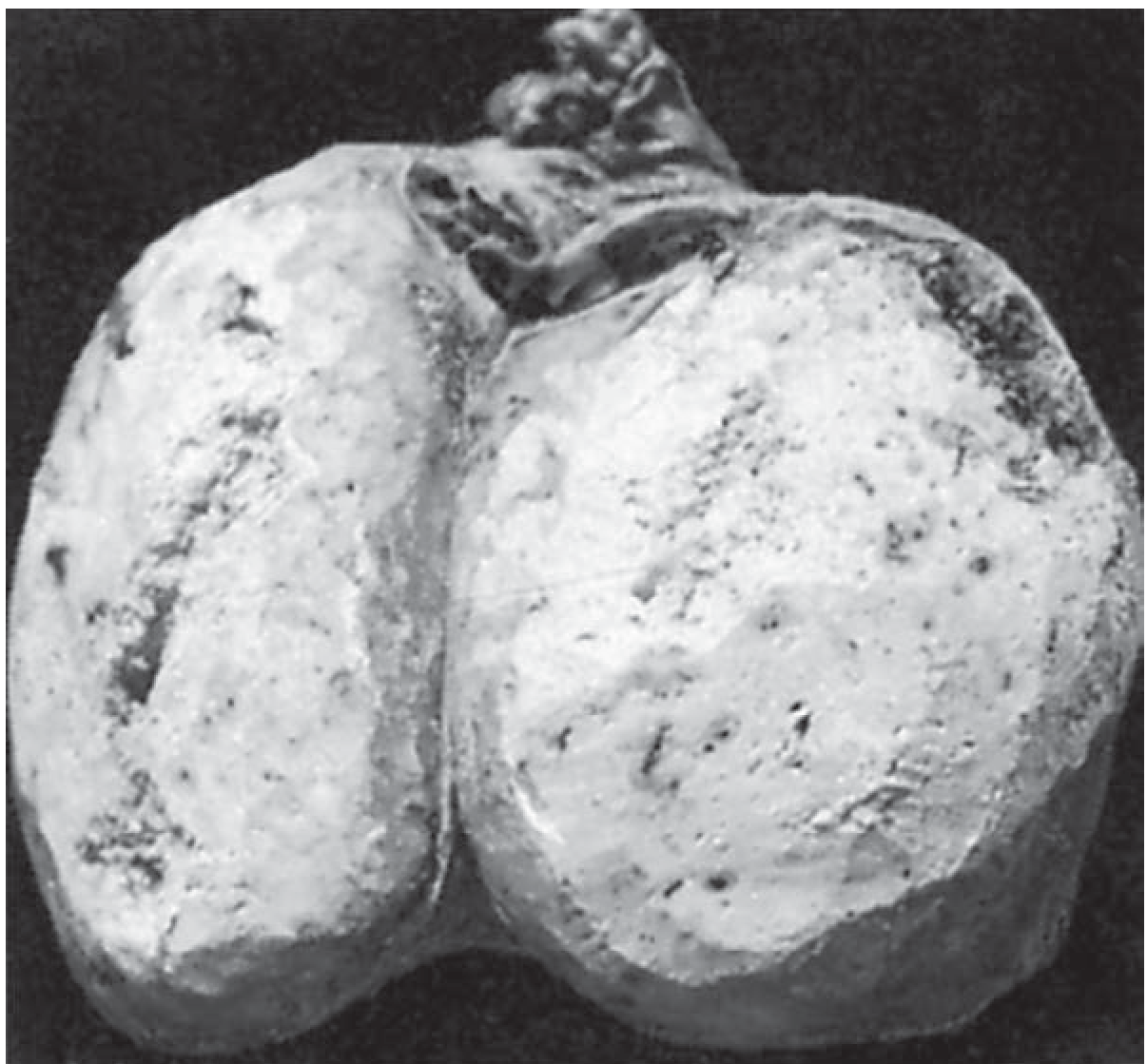
Histology:
- Sheets of polygonal cells with clear cytoplasm and large, rounded nuclei with prominent acidophilic nucleoli
- Cells divided into nests by fibrovascular septae containing lymphocytes
- Active lymphocytic infiltration suggests good host response and better prognosis
- Syncytiotrophoblasts (hCG-positive) present in ~15% of cases - no clear prognostic significance
- Lymphocytic infiltrates and granulomatous reactions are often seen; associated with increased incidence of sarcoidosis
Immunohistochemistry:
| Marker | Seminoma |
|---|---|
| CD30 | Negative |
| CD117 (c-kit) | Positive |
| PLAP (Placental Alkaline Phosphatase) | Strongly Positive |
| OCT 3/4 | Positive |
| AFP | Negative |
Subtypes
1. Classic Seminoma (85%)
- Most common subtype; 4th decade
- Coalescing gray nodules grossly
- Monotonous sheets of large cells with clear cytoplasm and densely staining nuclei
- ~15% have syncytiotrophoblastic elements (with corresponding mild hCG elevation)
2. Anaplastic Seminoma (5-10%)
- Requires ≥3 mitoses per high-power field
- Higher degree of nuclear pleomorphism
- Tends to present at a higher stage
- No worse prognosis when stage is controlled for - no longer considered a distinct biologic entity
3. Spermatocytic Seminoma / Spermatocytic Tumor (1%)
- Renamed "spermatocytic tumor" in 2016 WHO classification - now considered a distinct entity, NOT a true seminoma
- Does NOT arise from GCNIS; not associated with cryptorchidism or bilaterality; no i(12p)
- Peak incidence: 6th decade
- Three cell types: small lymphocyte-like cells, medium cells with dense eosinophilic cytoplasm, large mono/multinucleated cells
- Virtually benign - only 3 documented cases of metastasis; cured by orchiectomy alone
Tumor Markers
| Marker | Seminoma |
|---|---|
| AFP (alpha-fetoprotein) | Always negative - AFP elevation = NSGCT component present |
| hCG (beta) | Mildly elevated in ~15% (from syncytiotrophoblasts) |
| LDH | May be elevated; used in staging |
Key rule: An elevated AFP in a patient with apparent seminoma means the tumor must be treated as an NSGCT, regardless of histology.
Staging (TNM / AJCC)
Seminoma typically presents at an early stage:
- CS I: ~80-85% of cases
- CS II: ~10%
- CS III: ~5%
(Compare with NSGCT which presents as roughly 33/33/33.)
Metastatic Spread
- Spreads primarily via lymphatics to para-aortic lymph nodes near the origin of the gonadal vessels
- Contralateral para-aortic nodes may also be involved
- Inguinal nodes only affected if scrotal skin is involved
- Haematogenous spread is uncommon (vs. NSGCT)
- Lower incidence of occult retroperitoneal metastasis in CS I: 10-15% (vs. 25-35% for NSGCT)
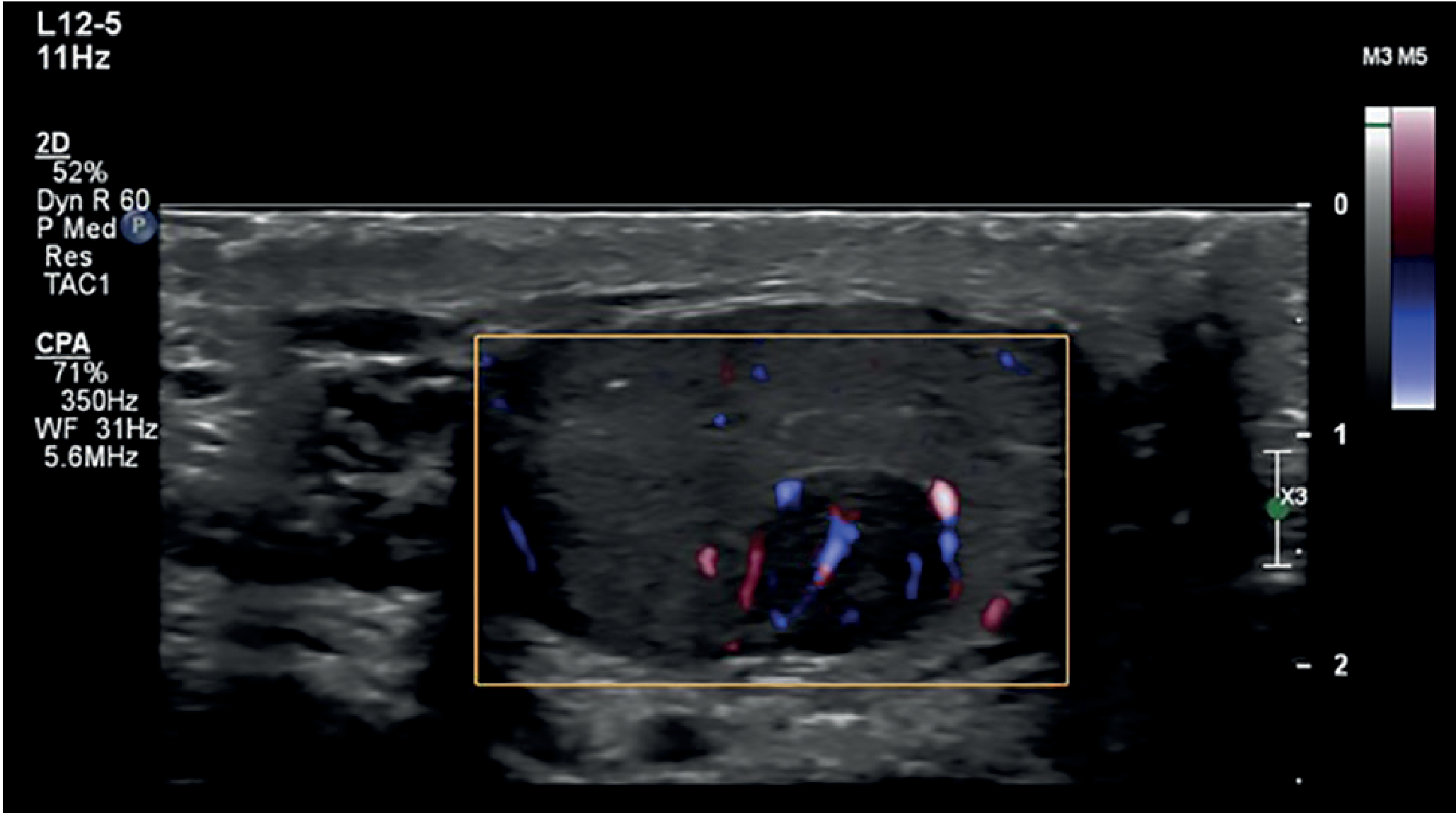
Seminoma vs. NSGCT - Key Differences
| Feature | Seminoma | NSGCT |
|---|---|---|
| Peak age | 4th-5th decade | 3rd decade |
| Stage at diagnosis | Mostly CS I (85%) | Evenly distributed |
| Occult mets in CS I | 10-15% | 25-35% |
| AFP elevation | Never | Common |
| Radiosensitivity | Exquisitely sensitive | Not used (except brain mets) |
| Chemo sensitivity | Excellent | Excellent |
| IGCCCG poor risk | Does NOT exist | Exists (~10%) |
| Advanced disease good risk | >90% | ~56% |
| Post-chemo teratoma risk | Very low | High |
| Relapse after RT (systemic) | 1-4% | - |
Management
Initial Step - All Testicular Tumors
Radical inguinal orchiectomy (NOT scrotal approach - risk of altering lymphatic drainage)
Clinical Stage I Seminoma
Three accepted options (all have ~99% long-term survival):
1. Surveillance (preferred)
- ~80% are cured by orchiectomy alone
- Surveillance duration: up to 10 years (slow growth rate)
- Schedule: H&P + tumor markers every 3-6 months (year 1) → every 6-12 months (years 2-3) → annually to year 10
- Imaging: abdominal/pelvic CT each visit + CXR as indicated
- Preferred to avoid long-term toxicity of RT/chemo
2. Primary Radiotherapy
- Retroperitoneal ± ipsilateral pelvic ("dog-leg" configuration)
- Dose: 25-35 Gy in 15-20 fractions
- Long-term cancer-specific survival approaches 100%
- PFS 95-97%
- In-field recurrence <1%
- Most common relapse sites: thorax and left supraclavicular fossa
- Risks: SMN (secondary malignant neoplasm) risk ~18% at 25 years; late GI toxicity; oligospermia in 8%
3. Single-agent Carboplatin chemotherapy
- Less neurotoxicity, ototoxicity, and nephrotoxicity than cisplatin
- Long-term SMN and cardiovascular risk not fully characterized
- Non-inferior to radiotherapy in randomized trials for disease control
Clinical Stage IIA-IIB Seminoma
- Radiotherapy or chemotherapy
- Low-volume retroperitoneal disease: retroperitoneal irradiation, 5-year survival ~87%
High-Stage / Bulky Seminoma (CS IIC-III)
Chemotherapy is primary treatment:
- Good-risk: 3 cycles BEP (bleomycin + etoposide + cisplatin) or 4 cycles EP
- Intermediate-risk: 4 cycles BEP
- No "poor risk" IGCCCG category exists for seminoma - >90% of advanced seminoma is classified as good risk
Post-chemotherapy residual masses:
- Residual masses <3 cm → usually fibrosis (~90%); observation
- Residual masses >3 cm well-circumscribed → ~40% harbor residual seminoma → FDG-PET scan
- PET positive → consider PC-RPLND (post-chemotherapy retroperitoneal lymph node dissection)
- PET negative → observation
Relapsed Seminoma
- Chemo-naive relapse (after surveillance or primary RT): cisplatin-based chemotherapy; salvage approaches 100% for bulky/systemic relapse
- Post-chemotherapy relapse: VeIP x4 (vinblastine, ifosfamide, cisplatin) → 83% complete response; ~53% durable remission; high-dose chemotherapy (HDCT) also evaluated
Key Points Summary
- Seminoma = most common testicular GCT; arises from GCNIS; AFP always negative
- Histology: clear cytoplasm, fibrovascular septae with lymphocytes; PLAP+ / CD117+ / CD30-
- Three subtypes - classic (85%), anaplastic (5-10%), spermatocytic tumor (now distinct entity, benign)
- Spreads via lymphatics to para-aortic nodes; haematogenous spread uncommon
- Exquisitely radiosensitive; very chemosensitive (platin-based)
- CS I (85% at diagnosis) - surveillance preferred; RT and carboplatin are alternatives
- Advanced disease: BEP chemotherapy; post-chemo masses >3 cm need PET then consider PC-RPLND
- No IGCCCG poor-risk category; >90% of metastatic seminoma is good-risk
- Risk of NSGCT transformation (~10-15% at relapse sites) must always be considered
Sources: Campbell Walsh Wein Urology, p. 2254-2268 | Bailey & Love's Surgery, 28th ed., p. 1591 | Smith & Tanagho's General Urology, 19th ed., p. 392-395
This is a shared conversation. Sign in to Orris to start your own chat.