
Jvp final year mbbs harrison ref
Reading File
JVP (Jugular Venous Pulse) is a key exam topic for final year MBBS. Let me pull the Harrison's content right away.
Searching sources...
Finding Sources
Finding Sources
Found Harrison's 22E content. Let me read the full JVP section from Harrison's now.
Reading File
Finding Sources
Excellent content found. Let me read more of this block for the complete waveform descriptions and clinical correlates.
Reading File
I have all the Harrison's content needed. Let me also fetch the JVP waveform image for visual clarity.
Loading Image
I now have everything needed for a complete, exam-focused answer. Here is the full Harrison's-referenced JVP guide for final year MBBS:
Jugular Venous Pulse (JVP) - Harrison's 22E Reference
What is JVP?
The JVP is the single most important bedside measurement from which to estimate volume status. It reflects right atrial pressure and provides a non-invasive window into the right heart.
- Use internal jugular vein (IJV) - preferred because the external jugular vein is valved and not directly in line with the SVC and right atrium
- The external jugular can still discriminate high vs. low CVP but is less reliable
How to Measure JVP
- Patient positioned at 30-45° incline
- Identify the top of the jugular venous pulsation column
- Measure vertical distance from the sternal angle (angle of Louis)
- Normal: <4.5 cm above the sternal angle at 30°
- Abnormal: >4.5 cm at 30°
Key point from Harrison's: The sternal angle method systematically underestimates CVP. Use it to distinguish normal from elevated - not for precise quantification. The clavicle is an easier reference: venous pulsations above the clavicle in the sitting position are clearly abnormal (the clavicle-to-right atrium distance is at least 10 cm).
Convert cmH₂O to mmHg: 1.36 cmH₂O = 1.0 mmHg
The JVP Waveform
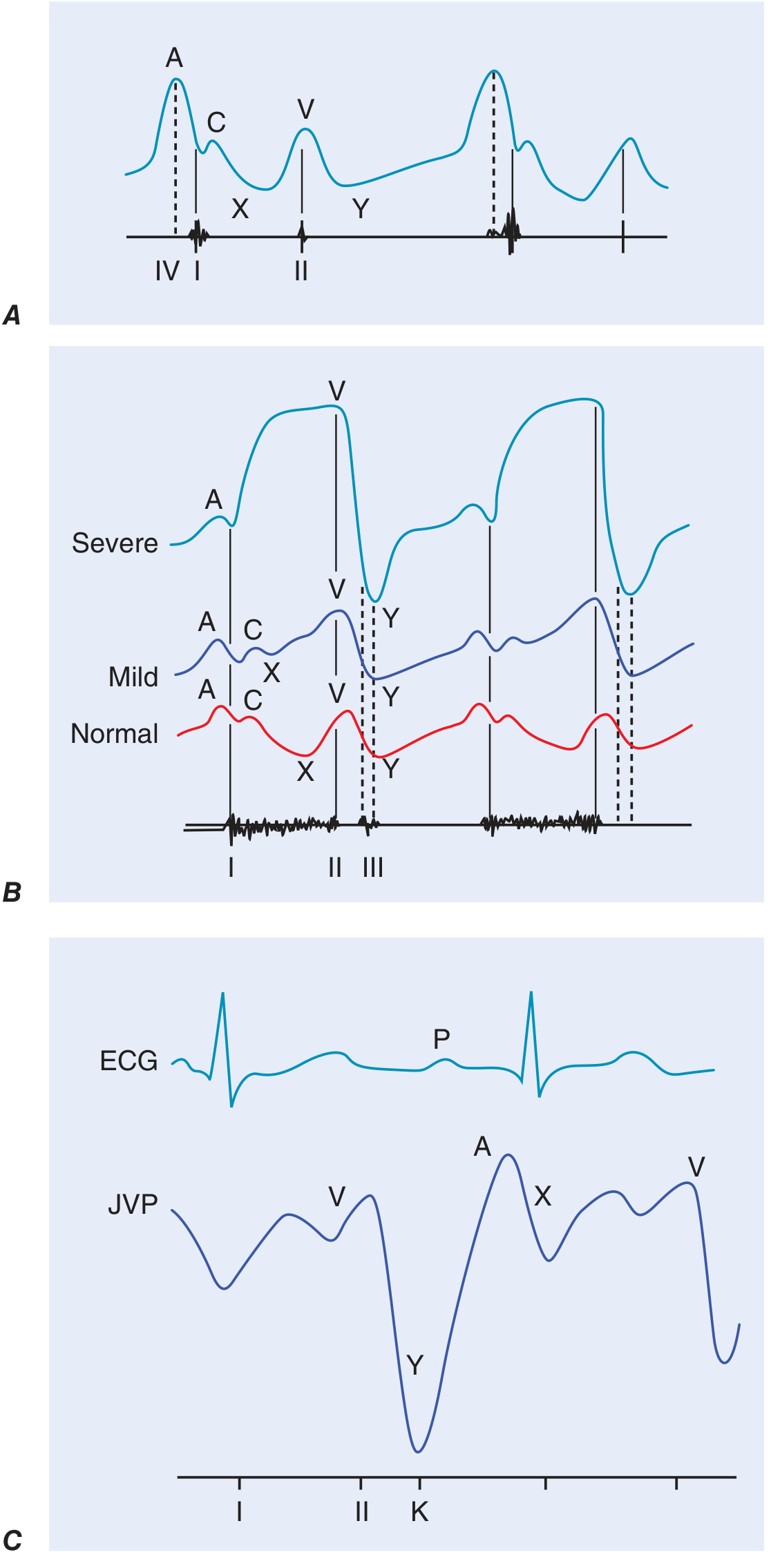
Panel A: Normal JVP with prominent A wave (reduced RV compliance). Panel B: Progression of TR from normal → mild → severe (ventricularized waveform). Panel C: JVP in constrictive pericarditis showing rapid Y descent (K descent).
Waves and Their Meanings
| Component | Physiological Basis | Timing | Key Point |
|---|---|---|---|
| a wave | Right atrial presystolic contraction | After P wave on ECG, just before S1 | Due to RA contraction |
| c wave | Closed tricuspid valve pushed into RA during early ventricular systole | Between a and v | Interrupts the x descent |
| x descent | Fall in RA pressure after tricuspid valve opens | After a wave | Atrial relaxation + tricuspid opening |
| v wave | Atrial filling (atrial diastole) during ventricular systole | During ventricular systole | Represents passive filling of RA |
| y descent | Opening of tricuspid valve, blood flows into RV | After v wave peak | Rapid fall when TR severe |
JVP vs. Carotid Pulse: How to Distinguish
| Feature | JVP | Carotid Pulse |
|---|---|---|
| Waveform | Biphasic (in sinus rhythm) | Monophasic |
| Palpability | Not easily palpable | Easily palpable |
| Obliteration | Obliterated with light pressure | Cannot be obliterated |
| Posture/Inspiration | Changes (falls on inspiration normally) | No change |
Abnormal JVP Waveforms - High-Yield Table
| Finding | Cause | Mechanism |
|---|---|---|
| Prominent / Large a wave | Reduced RV compliance, pulmonary stenosis, pulmonary hypertension, tricuspid stenosis | RA must contract harder against resistance |
| Cannon a wave | AV dissociation (VT, complete heart block, ventricular pacing) | RA contracts against a closed tricuspid valve |
| Absent a wave | Atrial fibrillation | No organized atrial contraction |
| Large v wave | Tricuspid regurgitation (TR) | Retrograde flow from RV into RA during systole |
| "Ventricularized" waveform | Severe TR | c and v waves merge; waveform resembles RV pressure curve |
| Blunted / slow y descent | Tricuspid stenosis, cardiac tamponade | Obstruction to RV inflow; slow emptying of RA |
| Rapid y descent | Constrictive pericarditis, severe TR, ASD | Rapid early diastolic filling |
Special Signs
Kussmaul's Sign
- Definition: Rise (or failure to fall) in JVP with inspiration (opposite of normal)
- Normal response: JVP falls with inspiration (due to reduced intrathoracic pressure)
- Classically associated with: Constrictive pericarditis
- Also seen in: Restrictive cardiomyopathy, massive pulmonary embolism, RV infarction, advanced LV systolic heart failure, post-cardiac surgery
Abdominojugular (Hepatojugular) Reflux
- Technique: Firm continuous pressure over right upper quadrant for >15 seconds
- Positive result: Sustained rise of >3 cm in JVP during abdominal compression
- Wait 10 seconds before assessing (allows respiratory artifacts and abdominal tensing to subside)
- Patients must NOT hold their breath (Valsalva-like maneuver invalidates the test)
- Clinical significance: Predicts pulmonary artery wedge pressure >15 mmHg in heart failure
Clinical Correlations (Exam Favorites)
| Condition | JVP Finding |
|---|---|
| Heart failure (right-sided) | Elevated JVP + peripheral edema |
| Cardiac tamponade | Elevated JVP + blunted y descent (x descent prominent) |
| Constrictive pericarditis | Elevated JVP + Kussmaul's sign + rapid/prominent y descent |
| Tricuspid regurgitation | Large cv wave (ventricularized) |
| Tricuspid stenosis | Large a wave + slow y descent |
| Pulmonary hypertension | Large a wave (from RV hypertrophy/reduced compliance) |
| VT (vs. SVT) | Cannon a waves → identifies AV dissociation → VT origin |
| Atrial fibrillation | Absent a wave |
| RV infarction | Elevated JVP + clear lungs + hypotension (triad) |
| Nephrotic/hypoalbuminemia | Peripheral edema without elevated JVP |
Quick Memory Aid: "acvxy"
a - Atrial contraction (presystolic)
c - Closure of tricuspid (early systole)
v - Venous filling (late systole)
x - fall after a (atrial relaxation)
y - fall after v (tricuspid opens, RV filling)
c - Closure of tricuspid (early systole)
v - Venous filling (late systole)
x - fall after a (atrial relaxation)
y - fall after v (tricuspid opens, RV filling)
Descents go down: x descent = fall after a; y descent = fall after v.
Summary: Most Testable Points
- IJV preferred over EJV for JVP assessment
- Measurement reference: sternal angle; >4.5 cm at 30° = abnormal
- Cannon a wave = AV dissociation (VT marker at bedside)
- No a wave = AF
- Large v wave = TR; severe TR → ventricularized waveform
- Slow y descent = Tamponade or TS; Rapid y = Constrictive pericarditis
- Kussmaul's sign: JVP rises on inspiration - classic for constrictive pericarditis
- Abdominojugular reflux: positive if JVP rises >3 cm; predicts PAWP >15 mmHg
- Elevated JVP + edema = volume overload (HF, constrictive pericarditis)
- Edema without elevated JVP = hypoalbuminemia, venous/lymphatic obstruction
- Harrison's Principles of Internal Medicine, 22nd Edition (2025), Chapter 246: Cardiovascular Examination, p. 1904
This is a shared conversation. Sign in to Orris to start your own chat.