
What is a dental plaque
Dental plaque is a soft, sticky film of bacteria that forms on tooth surfaces and along the gumline. It develops when bacteria in the mouth mix with food particles and saliva to create a biofilm. If not removed by brushing and flossing, plaque hardens into tartar (calculus), which can only be removed by a dental professional. Plaque is the primary cause of tooth decay (caries) and gum disease (gingivitis and periodontitis).
Searching sources...
Reading File
Searching the Web
dental plaque biofilm formation composition
Finding Sources
Reading File
Reading File
Loading Image
Here is a thorough explanation of dental plaque, drawing from authoritative medical microbiology textbooks.
Dental Plaque
Definition
Dental plaque is an adherent deposit (biofilm) that forms on the tooth surface, composed almost entirely of bacteria derived from the normal flora of the mouth. It is the most prevalent and densest of all human biofilms. - Sherris & Ryan's Medical Microbiology, 8th Ed.
How Plaque Forms - Stages
Plaque formation happens in stages and layers, at two levels:
Level 1 - Anatomic Location (relative to the gumline)
- Supragingival plaque - forms above the gumline; this is the earliest type
- Subgingival plaque - extends below the gumline as plaque matures; more dangerous for periodontal disease
Level 2 - Layering Within the Plaque
Step 1: The Acquired Pellicle Forms
Before any bacteria attach, a thin organic film called the dental pellicle coats the tooth surface. It is composed of proteins and glycoproteins (statherin, proline-rich proteins, salivary mucins, alpha-amylase, salivary agglutinin) derived from saliva and other oral secretions. Bacteria attach to the pellicle - NOT directly to the mineralized tooth enamel.
Step 2: Early Colonizers Attach (Hours)
Mainly Gram-positive bacteria that use ionic, hydrophobic, and lectin-like surface interactions to stick to the pellicle:
- Streptococcus sanguis (the prototype early colonizer)
- S. mutans, S. mitis, S. salivarius, S. oralis, S. gordonii
- Lactobacillus species
- Actinomyces species
Step 3: Late Colonizers Arrive (2-4 days)
If undisturbed, Gram-negative anaerobes appear and bind to the early colonizers:
- Fusobacterium nucleatum (key bridging organism)
- Porphyromonas gingivalis
- Prevotella species
- Veillonella species
- Treponema denticola (anaerobic spirochete)
- More Actinomyces species
Step 4: Mature Biofilm
The bacteria produce high-molecular-weight extracellular glucan polymers (mainly by S. mutans) that act like cement, binding the biofilm together. Quorum sensing and complex metabolic cross-feeding occur between species. Mature dental plaque contains an estimated 300-400 bacterial species.
Diagram of Dental Plaque Biofilm Formation
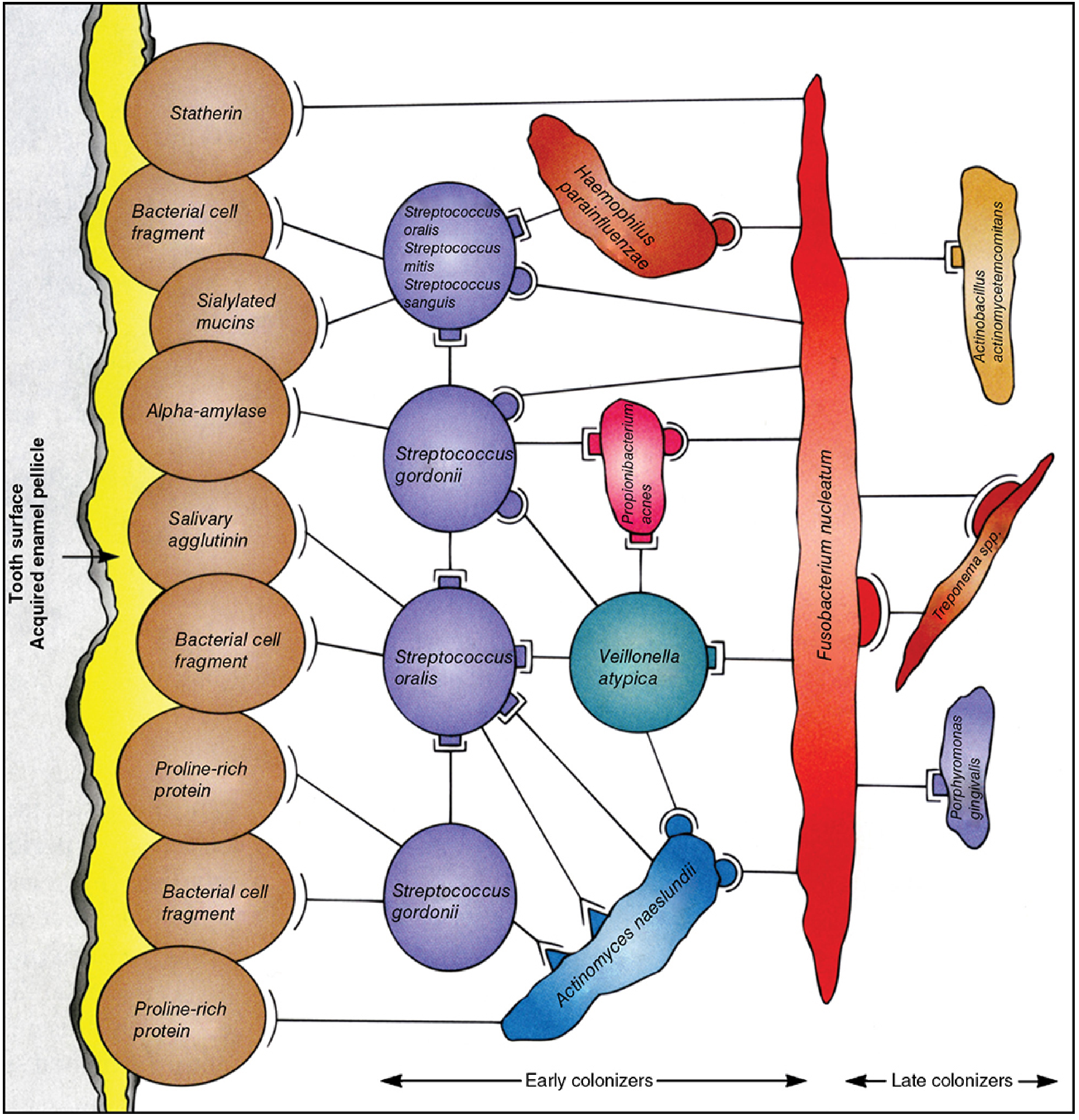
FIGURE: Dental plaque biofilm. Early colonizers (streptococci, Actinomyces) bind to the acquired enamel pellicle. Fusobacterium nucleatum acts as a bridge for late colonizers (Porphyromonas, Treponema) to join the biofilm.
Why the Biofilm Structure Matters
The biofilm state gives plaque bacteria major survival advantages:
- Protection from antimicrobials - bacteria inside biofilms are far more resistant to antibiotics and antiseptic rinses than free-floating bacteria
- Nutrient optimization - organisms share metabolic products (e.g., Veillonella consumes lactic acid produced by streptococci)
- Quorum sensing - bacteria communicate chemically to coordinate behavior and growth
- Physical shield - the glucan/polysaccharide matrix protects the community from host immune responses
What Plaque Causes
| Disease | Mechanism |
|---|---|
| Dental caries (tooth decay) | Plaque bacteria (especially S. mutans) ferment dietary sugars → produce acids → demineralize enamel → cavity formation |
| Gingivitis | Plaque accumulation at the gumline triggers gingival inflammation |
| Periodontitis | Mature subgingival plaque (with Gram-negative anaerobes) causes destruction of the bone and connective tissue supporting the teeth |
| Dental calculus (tartar) | Plaque that is not removed becomes mineralized by calcium and phosphate in saliva → hardened deposit that can only be removed by a dental professional |
Key Takeaways
- Dental plaque is a structured, multi-species biofilm - not just a random collection of bacteria
- It begins with the pellicle, then is colonized in a predictable sequence from Gram-positive early colonizers to Gram-negative anaerobic late colonizers
- Sugar intake is the primary fuel for acid production by plaque bacteria, directly driving caries
- Disruption through daily brushing and flossing is the most effective way to prevent plaque-related diseases
Sources: Sherris & Ryan's Medical Microbiology, 8th Edition; Jawetz, Melnick & Adelberg's Medical Microbiology, 28th Edition
This is a shared conversation. Sign in to Orris to start your own chat.