
Adult basic life support
Reading File
Searching sources...
Finding Sources
Finding Sources
Searching PubMed
"basic life support" AND "cardiopulmonary resuscitation" AND guidelines
Good - found strong sources. Let me pull the core content from Tintinalli's (the dedicated BLS section) and Braunwald's, plus the BLS algorithm image.
Reading File
Reading File
Reading File
Reading File
Loading Image
Reading File
Reading File
Reading File
I now have comprehensive content from the textbooks. Let me compile the full answer.
Adult Basic Life Support (BLS)
AHA 2020 Guidelines - C-A-B Sequence
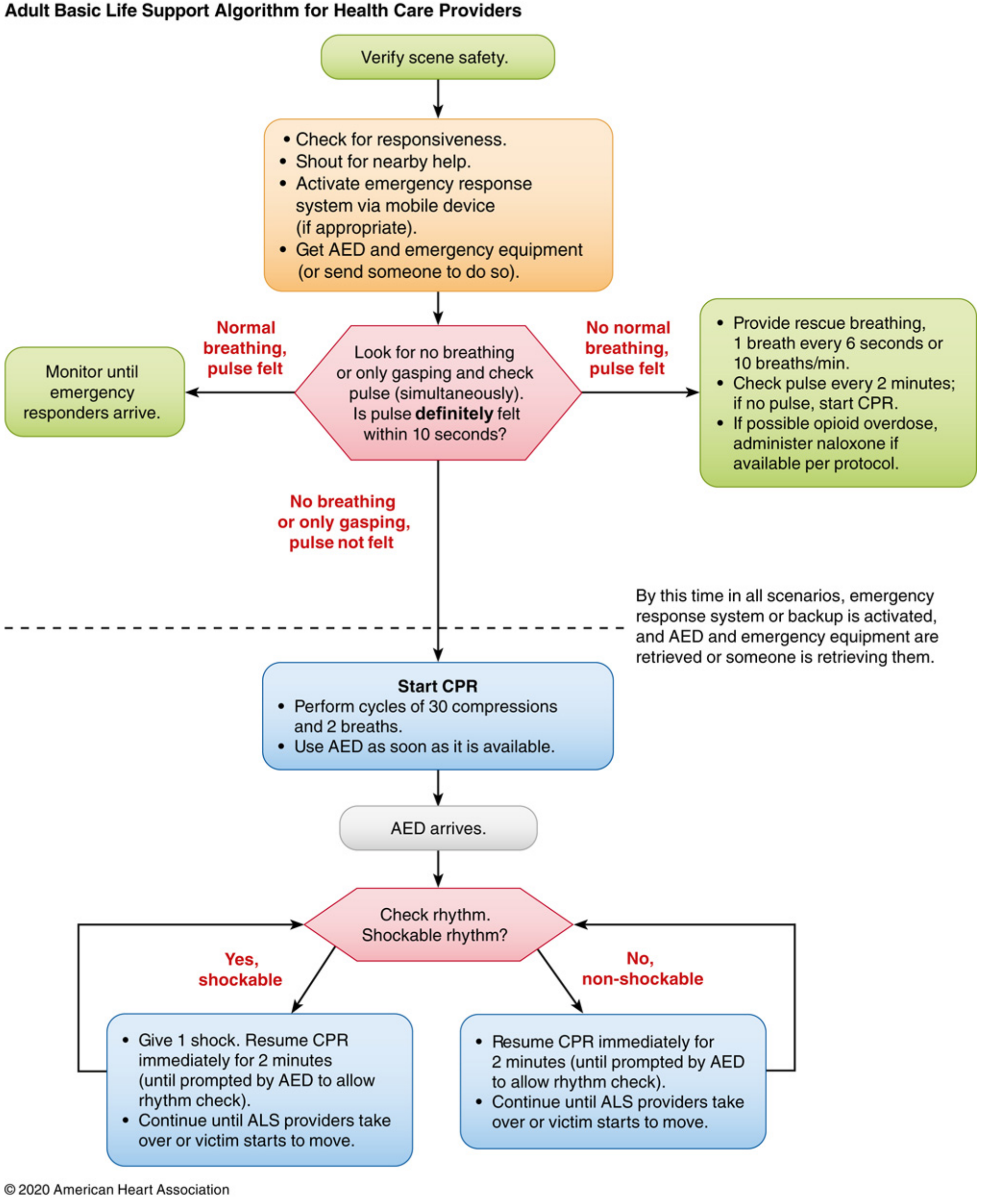
Fig. BLS Health Care Provider Adult Cardiac Arrest Algorithm - 2020 update. (From Miller's Anesthesia, 10e)
Overview
Adult BLS is the foundation of resuscitation for sudden cardiac arrest (SCA). The 2020 AHA Guidelines shifted the sequence from A-B-C (Airway-Breathing-Circulation) to C-A-B (Circulation-Airway-Breathing), prioritizing chest compressions because blood flow - not arterial oxygen content - is the limiting factor for oxygen delivery to the coronary and cerebral circulation during CPR.
Out-of-hospital SCDs affect approximately 380,000 people per year in the United States, with an additional 200,000 in-hospital cardiac arrests. - Braunwald's Heart Disease, 15th Ed
Step-by-Step Algorithm
1. Verify Scene Safety
Ensure the environment is safe before approaching the victim.
2. Check Responsiveness
- Tap shoulders firmly and shout "Are you okay?"
- Shout for nearby help
- Activate the emergency response system via mobile device
- Get an AED and emergency equipment (or send someone)
3. Simultaneously Assess Breathing and Pulse (max 10 seconds)
Look for no breathing or only gasping, and check the carotid pulse simultaneously.
| Finding | Action |
|---|---|
| Normal breathing + pulse felt | Monitor; wait for emergency responders |
| No normal breathing + pulse felt | Rescue breathing: 1 breath every 6 seconds (10/min); check pulse every 2 minutes; if opioid overdose suspected, administer naloxone |
| No breathing or only gasping + no pulse | Start CPR immediately |
4. Start CPR - 30:2 Ratio
- Perform 30 chest compressions followed by 2 rescue breaths
- Continue cycles until AED arrives
High-Quality Chest Compressions
| Parameter | Specification |
|---|---|
| Hand position | Lower half of sternum, heel of hand |
| Rate | 100-120 compressions/minute |
| Depth | At least 2 inches (5 cm); no more than 2.4 inches (6 cm) |
| Recoil | Allow full chest recoil after each compression |
| Interruptions | Minimize; no pause > 10 seconds |
| Compression fraction | > 60% of total resuscitation time |
Full chest recoil allows the heart to refill during diastole. Leaning on the chest between compressions reduces venous return and coronary perfusion pressure.
Rescue Breaths
- Each breath delivered over 1 second
- Enough volume to produce visible chest rise
- If advanced airway (e.g., endotracheal tube or SGA) is in place: give 1 breath every 6 seconds (10/min) asynchronously with continuous compressions
Compression-Only CPR
For untrained bystanders or when rescue breaths cannot be delivered, compression-only (hands-only) CPR is acceptable for adult cardiac arrest of cardiac etiology, as survival rates are similar to conventional CPR in the early minutes. Trained rescuers should still provide both compressions and breaths, especially in asphyxiation-related arrests. - Miller's Anesthesia, 10e
AED Use
When the AED arrives:
- Power on and attach pads (anterior-lateral or anterior-posterior placement)
- Analyze rhythm - minimize CPR interruption
- Shockable rhythm (VF / pulseless VT)?
- Yes - deliver 1 shock, then immediately resume CPR for 2 minutes before next rhythm check
- No - resume CPR immediately for 2 minutes; continue until ALS providers arrive or victim starts to move
Defibrillation energies should be increased stepwise until VF is terminated. If VF recurs after successful conversion, use the previously successful energy level. - Miller's Anesthesia, 10e
Shock first vs. CPR first:
- If AED is immediately available for a witnessed arrest: use the AED as soon as possible
- If AED is not immediately available or the arrest is unwitnessed: begin CPR while the defibrillator is retrieved, and shock as soon as it is ready
Special Situations
Opioid Overdose
Patients with known or suspected opioid ingestion who are in cardiac or respiratory arrest should receive IV, IM, or intranasal naloxone in addition to standard BLS care. - Miller's Anesthesia, 10e
Foreign Body Airway Obstruction (Choking) - Adult
- Conscious patient who cannot cough/speak/breathe: perform abdominal thrusts (Heimlich maneuver) repeatedly until the object is expelled or the patient becomes unconscious
- Unconscious patient: start CPR; each time the airway is opened for ventilation, look for the object and remove it if visible
Ventricular Assist Device (VAD) Patients
- Continuous-flow LVADs create a physiologic state of hemodynamically stable pulseless electrical activity - assess tissue perfusion, not just the pulse
- Total artificial hearts (TAHs) are refractory to chest compressions, antiarrhythmic drugs, and electrical therapy; vasopressors are contraindicated (increase afterload, cause collapse)
Chain of Survival (Out-of-Hospital)
- Recognition and activation of the emergency response system
- Immediate high-quality CPR
- Rapid defibrillation
- Advanced resuscitation (ACLS) by EMS and medical providers
- Post-cardiac arrest care
- Recovery
Why C-A-B Instead of A-B-C?
In most adult sudden cardiac arrests (especially those from a primary cardiac cause like VF), there is sufficient oxygen in the lungs and bloodstream at the time of arrest to sustain vital organs for several minutes. Blood flow is the bottleneck, not oxygen content. Delaying compressions to open an airway and deliver rescue breaths reduces coronary perfusion pressure and worsens outcomes. Starting with 30 compressions before the first breath ensures minimal delay in circulation. - Miller's Anesthesia, 10e; Tintinalli's Emergency Medicine
Key Points Summary
| Feature | Value |
|---|---|
| Sequence | C-A-B |
| Compression rate | 100-120/min |
| Compression depth | 2-2.4 inches (5-6 cm) |
| Compression:breath ratio | 30:2 (no advanced airway) |
| Ventilation rate (advanced airway) | 10 breaths/min |
| Pulse/rhythm check interval | Every 2 minutes |
| Maximum CPR pause | < 10 seconds |
| Opioid overdose adjunct | Naloxone |
Sources: Miller's Anesthesia 10e, Braunwald's Heart Disease 15e, Tintinalli's Emergency Medicine, based on the AHA 2020 CPR & ECC Guidelines.
This is a shared conversation. Sign in to Orris to start your own chat.