
How to give stomach wash
Gastric lavage (stomach wash) is a procedure used to empty stomach contents, most often after poisoning or drug overdose. The key steps are: pass a large-bore orogastric tube (36-40 Fr in adults), confirm placement, instill 200-300 mL of warm saline per cycle, then drain by gravity or suction, and repeat until the effluent runs clear.
Searching sources...
Reading File
Finding Sources
Finding Sources
Reading File
Reading File
Reading File
Reading File
Reading File
Loading Image
Here is a complete, textbook-based guide to performing a stomach wash (gastric lavage):
Stomach Wash (Gastric Lavage) - Complete Procedure
Indications
- Patient presents within 3 hours of poison/drug ingestion (most effective window)
- Can still be performed if gastric emptying is delayed (e.g., sustained-release medications)
- Beyond 6-12 hours, still indicated for: salicylates, tricyclics, carbamazepine, barbiturates
Equipment Needed
| Item | Specification |
|---|---|
| Gastric lavage tube (Ewald/Boas tube) | 36-40 Fr in adults (1 cm diameter, 1.5 m length) |
| Children's tube | 22-28 Fr (Ryle's tube) |
| Lubricant | Glycerin or Vaseline jelly |
| Lavage fluid | Warm saline (35°C) or plain water |
| Suction bulb/device | For aspirating stomach contents |
| Syringe (50 mL Toomey type) | For active lavage |
| Bite block or oral airway | To prevent biting |
| IV line + cardiac monitor | Continuous monitoring throughout |
| Activated charcoal (1 g/kg) | For post-lavage administration |
| PPE | Gloves, gown, eye protection |
If the patient is obtunded or at risk of airway compromise, have an endotracheal tube with cuff ready and consider intubation first.
Pre-Procedure Steps
- Obtain IV access and attach continuous cardiac monitor and pulse oximeter.
- Restrain hands of uncooperative patients.
- Give an IV antiemetic (e.g., promethazine) if needed - avoid sedating dose.
- Pre-measure the tube: estimate distance from nose/mouth, around the ear, to the mid-epigastrium. Mark this on the tube.
- Insert to ~50 cm in adults, ~25 cm in children.
- Larger holes may be cut at the tube tip to accommodate pill fragments.
Patient Positioning
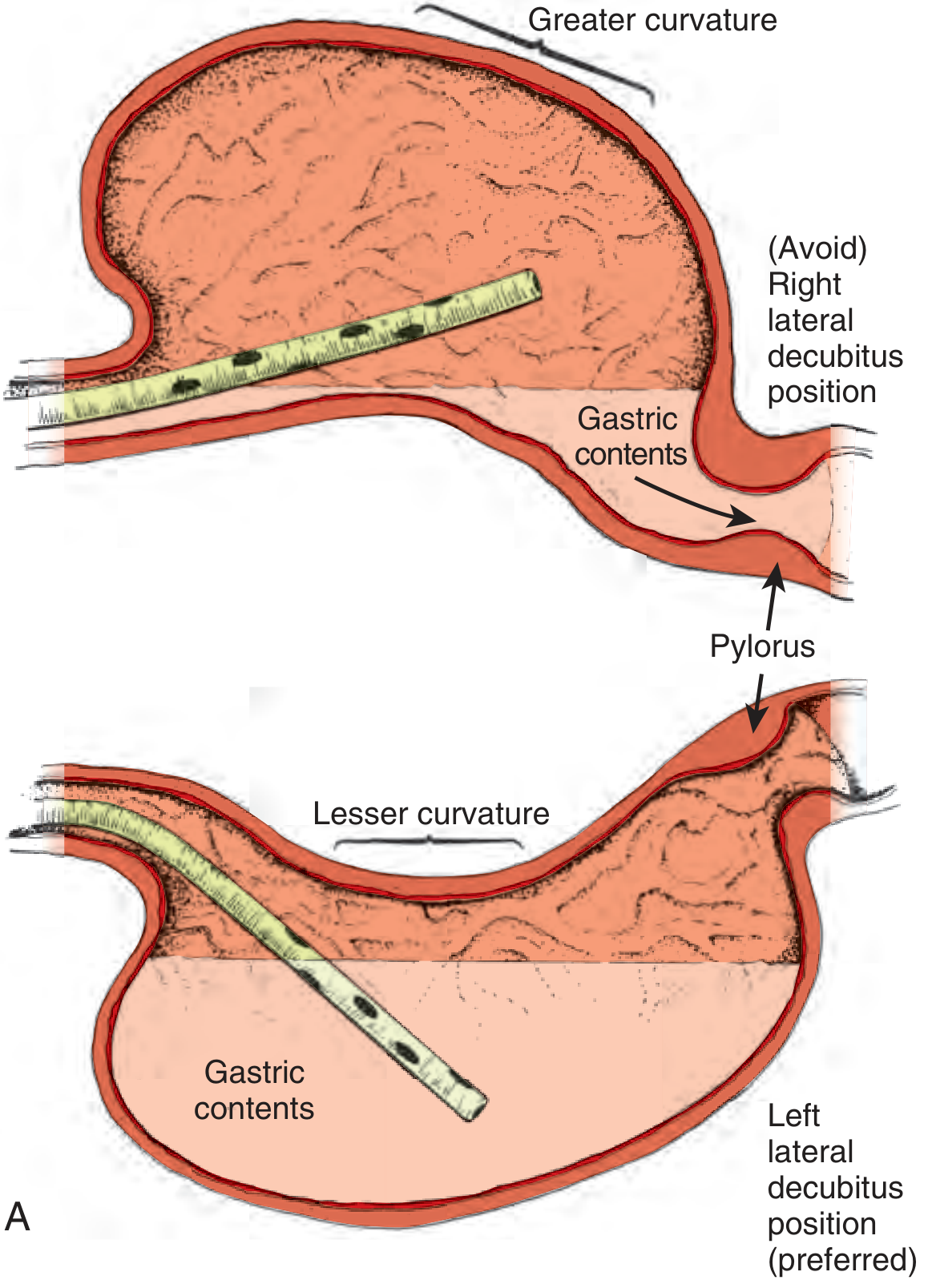
Place the patient in the left lateral decubitus (left lateral) position with the head tilted slightly downward (head over edge of bed, face down). This is the preferred and safest position.
- The left lateral position keeps gastric contents pooled away from the pylorus, preventing them from being pushed into the duodenum.
- The right lateral position must be avoided - it directs contents toward the pylorus and duodenum.
- If the patient is intubated/on a ventilator, supine is acceptable. An awake non-intubated patient should never be lavaged supine.
Step-by-Step Procedure
Step 1 - Tube insertion:
- Lubricate the tube well with glycerin or Vaseline.
- Pass the tube orally (orogastric route preferred over nasal; nasal route risks mucosal injury and limits tube diameter).
- Use a bite block to prevent tube damage.
- Once the tube enters the pharynx, tuck the chin to the chest to guide the tube into the esophagus.
- Pass gently to avoid pharyngeal injury.
Step 2 - Confirm placement:
- Auscultate over the epigastrium while instilling air.
- Aspirate gastric contents (confirms position).
- Alternatively, place the open end in a cup of water - if bubbles appear, the tube is in the trachea (reposition immediately).
- X-ray confirmation may be obtained if clinically uncertain.
Step 3 - Initial aspiration:
- Before starting lavage, aspirate all gastric contents by suction, repositioning the tube tip as needed.
- Preserve the first sample for chemical/toxicological analysis.
Step 4 - Lavage cycles:
- Instill 250-300 mL of warm saline (35°C) at a time in adults. Hold the funnel high for gravity-assisted flow.
- In children: use 10-15 mL/kg body weight of warm saline (not plain water - risk of hyponatremia and water intoxication).
- Do not use volumes >300 mL per cycle - larger volumes risk pushing contents into the duodenum.
- Aspirate/siphon the fluid out using the suction bulb or syringe.
- Repeat cycles until the effluent runs clear, colourless, and free of particulate matter.
Step 5 - Specific lavage fluids (for certain poisons, use instead of plain saline):
| Solution | Used for |
|---|---|
| Potassium permanganate 1:5000-1:10,000 | Alkaloids, salicylates (oxidizable poisons) |
| Sodium bicarbonate 5% | Acid ingestion neutralization |
| Tannic acid 4% | Alkaloids, metal salts |
| Sodium thiosulfate 25% | Cyanide poisoning |
| Calcium gluconate | Oxalate poisoning |
| Castor oil + warm water (1:2) | Carbolic acid / phenol group |
| Desferrioxamine (2 g/L water) | Iron poisoning |
Step 6 - Post-lavage:
- Administer activated charcoal slurry (1 g/kg) through the tube before removal - it adsorbs residual toxin.
- Leave a small quantity of specific antidote or activated charcoal in the stomach.
- Clamp the tube before withdrawing it to prevent aspiration of residual fluid.
Contraindications
Absolute:
- Corrosive poisoning (acid/alkali) - risk of perforation (exception: carbolic acid can be lavaged)
- Comatose/unconscious patient without airway protection
- Volatile poisons (risk of inhalation)
- Convulsant poisons
Relative:
- Depressed airway reflexes (unless intubated)
- Active vomiting
- Abnormal pharyngeal/GI anatomy
- Coagulopathy
- Large pill fragments or sharp foreign bodies
- Low-viscosity hydrocarbons (high aspiration risk)
- More than 60 minutes since ingestion of most toxins
- Infants and neonates
Complications
- Laryngeal spasm
- Aspiration pneumonitis (most serious - prevented by correct positioning and airway protection)
- Perforation of the stomach or esophagus
- Cardiac effects - sinus bradycardia, ST changes on ECG
- Hyponatremia/water intoxication (in children if plain water used instead of saline)
Sources:
- P C Dikshit Textbook of Forensic Medicine and Toxicology, pp. 434-435
- Roberts and Hedges' Clinical Procedures in Emergency Medicine, pp. 997-998
- Pfenninger and Fowler's Procedures for Primary Care, pp. 1416-1417
This is a shared conversation. Sign in to Orris to start your own chat.