
Whole physiology of liver related to drugs
-
Liver structure and blood supply
- Hepatic lobule, portal triad, sinusoidal blood flow
- Hepatocytes, Kupffer cells, stellate cells, bile canaliculi
- First-pass effect and hepatic extraction
-
Core liver functions affecting drugs
- Drug uptake from blood into hepatocytes
- Biotransformation, metabolism, and elimination
- Bile formation and biliary excretion
- Plasma-protein synthesis and drug binding
-
Phases of hepatic drug metabolism
- Phase I: oxidation, reduction, hydrolysis, mainly cytochrome P450 enzymes
- Phase II: conjugation, such as glucuronidation, sulfation, acetylation, glutathione conjugation
- Phase III: transporter-mediated secretion into bile or blood
-
Cytochrome P450 system
- Major isoenzymes: CYP3A4/5, CYP2D6, CYP2C9, CYP2C19, CYP1A2, CYP2E1
- Enzyme induction and inhibition
- Drug interactions and genetic variation
-
First-pass metabolism and bioavailability
- Gut-liver portal circulation
- High- versus low-extraction drugs
- Why routes such as sublingual, transdermal, and intravenous can bypass first-pass hepatic metabolism
-
Hepatic clearance and pharmacokinetics
- Hepatic blood flow
- Intrinsic metabolic capacity
- Protein binding
- Extraction ratio and the well-stirred model
- Half-life, clearance, and maintenance-dose changes
-
Biliary excretion and enterohepatic circulation
- Drug transporters, including P-glycoprotein and MRP systems
- Drugs/metabolites excreted in bile
- Intestinal reabsorption and prolonged drug action
-
Liver disease and drug dosing
- Effects of hepatitis, cirrhosis, cholestasis, and portal-systemic shunting
- Reduced metabolism, lower albumin, ascites, altered clearance
- Child-Pugh assessment and practical dose adjustment
-
Drug-induced liver injury
- Direct dose-related toxicity, such as acetaminophen overdose
- Idiosyncratic injury
- Hepatocellular, cholestatic, and mixed patterns of injury
With highlated parts in picture and discuss 1-5 points except 3rd one
liver lobule diagram portal triad central vein hepatic sinusoids bile canaliculi drug metabolism
An educational medical infographic showing a hepatic lobule cutaway for drug handling. Clearly label and highlight in bright yellow: portal triad, hepatic artery, portal vein, bile duct, sinusoidal blood flow toward central vein, hepatocytes, and bile canaliculi. Include simple directional arrows: orally absorbed drug from intestine enters portal vein, hepatocyte uptake and metabolism, then exits either through central vein into systemic circulation or through bile canaliculus into bile duct. Add a compact side panel labelled 'Liver functions relevant to drugs' with four highlighted numbered items: 1 Blood supply and first-pass entry, 2 Hepatocyte uptake and metabolism, 4 CYP450 drug interactions, 5 Biliary excretion and enterohepatic circulation. Exclude a section numbered 3. Accurate clean textbook anatomy, legible labels, white background.
liver drug metabolism
hepatic drug metabolism CYP enzyme induction inhibition biliary excretion pharmacology overview
Liver physiology related to drugs: Points 1, 2, 4 and 5
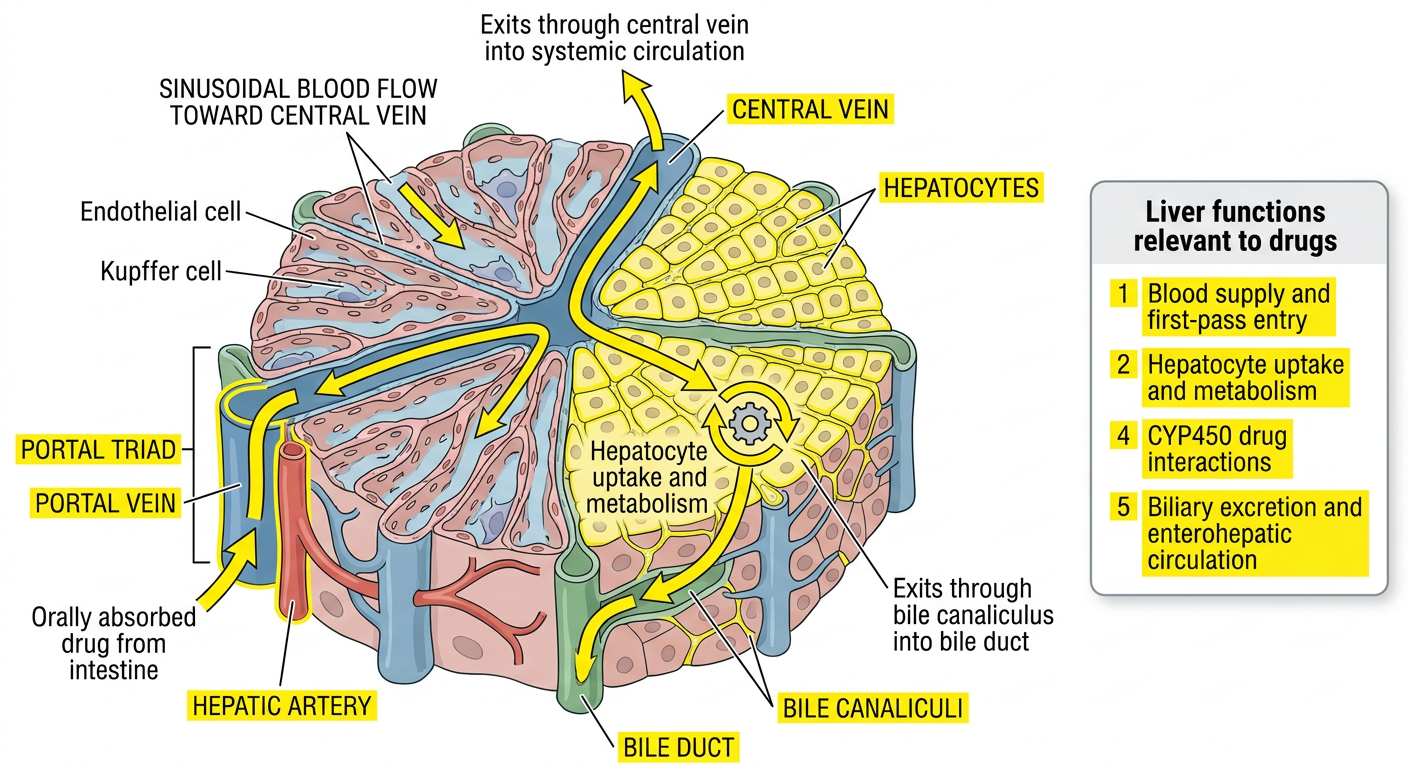
Reading the highlighted picture
- Portal vein: brings drug absorbed from the intestine to the liver.
- Hepatic artery: supplies oxygen-rich systemic arterial blood to hepatocytes.
- Sinusoids: low-pressure vascular channels in which blood contacts hepatocytes.
- Hepatocytes: principal cells that take up, chemically modify, store, or excrete drugs.
- Central vein: receives blood after it passes through liver sinusoids and drains it toward the systemic circulation.
- Bile canaliculi and bile duct: route by which certain drugs or metabolites are actively secreted into bile and reach the intestine.
1. Drug metabolism: Phase I and Phase II
A. Phase I reactions: functionalization
| Reaction | Main enzyme system | Example |
|---|---|---|
| Oxidation | Cytochrome P450 enzymes | Diazepam metabolism |
| Reduction | Reductases | Chloramphenicol reduction |
| Hydrolysis | Esterases/amidases | Aspirin hydrolysis |
- May inactivate a drug.
- May produce an active metabolite. For example, codeine is partly converted to morphine by CYP2D6.
- May activate a prodrug. For example, clopidogrel needs CYP-mediated activation.
- May generate a reactive toxic metabolite. Acetaminophen can form NAPQI, normally detoxified by glutathione.
B. Phase II reactions: conjugation
| Conjugation reaction | Conjugating substance | Example |
|---|---|---|
| Glucuronidation | Glucuronic acid | Morphine, bilirubin |
| Sulfation | Sulfate | Paracetamol metabolites |
| Acetylation | Acetyl-CoA | Isoniazid |
| Glutathione conjugation | Glutathione | Detoxification of NAPQI |
| Methylation | Methyl group | Some catechol compounds |
2. Cytochrome P450 system and drug interactions
Major clinically relevant CYP enzymes
| Enzyme | Important substrates/examples | Key issue |
|---|---|---|
| CYP3A4/5 | Midazolam, simvastatin, cyclosporine, many others | Handles a large proportion of drugs |
| CYP2D6 | Codeine, metoprolol, many antidepressants | Strong genetic variability |
| CYP2C9 | Warfarin, phenytoin, NSAIDs | Interaction risk with warfarin |
| CYP2C19 | Clopidogrel, omeprazole | Influences clopidogrel activation |
| CYP1A2 | Caffeine, theophylline, clozapine | Induced by cigarette smoke |
| CYP2E1 | Ethanol, acetaminophen pathway | Produces reactive metabolites |
Enzyme inhibition
- Clarithromycin or erythromycin can inhibit CYP3A.
- Azole antifungals, such as ketoconazole, can inhibit CYP3A.
- Ritonavir is a strong CYP3A inhibitor.
- Grapefruit can reduce intestinal CYP3A activity and increase exposure to some oral CYP3A substrates.
Enzyme induction
- Rifampicin
- Carbamazepine
- Phenytoin
- Phenobarbital
- Chronic cigarette smoking, mainly through CYP1A2 induction
4. Biliary excretion and enterohepatic circulation
Steps
- Drug is taken up from sinusoidal blood into the hepatocyte.
- It may undergo Phase I and/or Phase II metabolism.
- Transport proteins actively move it into bile canaliculi.
- Bile carries it through bile ducts to the intestine.
- It is eliminated in feces or may be reabsorbed.
Important transporters
- P-glycoprotein (P-gp/MDR1): pumps several drugs out of cells.
- MRP2: exports conjugated bilirubin and drug conjugates into bile.
- BCRP: transports some drugs and metabolites into bile.
Enterohepatic circulation
- Prolongs drug action and half-life.
- May produce multiple peaks in the concentration-time curve.
- Antibiotics can reduce gut bacteria and interrupt this recycling.
- Ethinylestradiol
- Morphine glucuronides
- Mycophenolate metabolites
- Some NSAIDs
5. Effect of liver disease on drug handling
Changes in cirrhosis or severe hepatic impairment
| Change | Drug-related consequence |
|---|---|
| Fewer functioning hepatocytes | Reduced metabolism of some drugs |
| Reduced hepatic blood flow | Reduced elimination of flow-dependent drugs |
| Portal-systemic shunting | More orally administered drug may escape hepatic processing |
| Low albumin | Higher free fraction of highly protein-bound drugs |
| Cholestasis | Reduced biliary excretion |
| Ascites and altered body composition | Altered volume of distribution |
| Reduced synthesis of clotting factors | Greater bleeding risk with anticoagulants |
Drugs needing particular caution
- Sedatives and opioids: may accumulate and worsen confusion or hepatic encephalopathy.
- Benzodiazepines: lorazepam, oxazepam, and temazepam are often preferred when a benzodiazepine is necessary because they mainly undergo glucuronidation.
- Warfarin: response can become unpredictable because both drug metabolism and clotting-factor synthesis are altered.
- NSAIDs: often avoided in advanced cirrhosis due to renal, bleeding, and ascites-related risks.
- Acetaminophen: can be used at reduced total daily doses in many patients with chronic liver disease, but dosing must be individualized and alcohol misuse increases risk.
- Drugs cleared in bile: accumulation may occur in cholestasis.
Practical principles
- Review all prescription, over-the-counter, herbal, and recreational substances.
- Start with a lower dose when appropriate.
- Titrate slowly and monitor effect, toxicity, liver tests, coagulation, mental state, and renal function.
- Avoid unnecessary hepatotoxic drugs and avoid multiple sedatives.
- Use formal prescribing guidance for the specific medicine rather than applying a universal dose reduction.