
Nephritis and edema
Reading File
Now let me search the medical library for nephritis and edema content in parallel.
Finding Sources
Finding Sources
Finding Sources
Finding Sources
Reading File
Reading File
Reading File
Reading File
Finding Sources
Reading File
Reading File
Reading File
Reading File
I now have comprehensive content from the authoritative nephrology textbooks. Let me fetch the key diagram and compile the full answer.
Loading Image
Loading Image
Here is a comprehensive overview of Nephritis and Edema, synthesized from authoritative nephrology textbooks (Comprehensive Clinical Nephrology 7th Ed., Brenner & Rector's The Kidney, Campbell-Walsh Urology, and others).
Nephritis and Edema
1. Overview: Nephritis vs. Nephrotic Syndrome
In renal disease, two major clinical syndromes produce edema, but through different mechanisms:
| Feature | Nephritic Syndrome | Nephrotic Syndrome |
|---|---|---|
| Proteinuria | Mild-moderate | Massive (>3.5 g/day adult; >40 mg/m²/h child) |
| Hematuria | Prominent (RBC casts) | Absent or minimal |
| Hypertension | Common | Variable |
| Edema | Present | Prominent (may reach anasarca) |
| Hypoalbuminemia | Mild | Severe |
| Mechanism of edema | Primary Na+ retention / ↑ capillary hydrostatic pressure | Underfill + overfill (see below) |
2. Glomerulonephritis (Nephritis) and Edema
Pathophysiology
In glomerulonephritis (GN), edema arises primarily from primary renal sodium retention - the kidney fails to excrete sodium despite a relatively suppressed RAAS. The mechanism is incompletely understood, but filtered proteases may cleave and activate the sodium channel ENaC in the collecting duct. This leads to:
- Increased blood volume
- Elevated capillary hydrostatic pressure
- Overflow of fluid into the interstitium
The typical clinical features include: malaise, headache, low-grade fever, gross hematuria with RBC casts, proteinuria, edema, and hypertension.
Common Causes of GN
- Post-streptococcal GN (PSGN): Most common in children <13 years. The nephritis-associated plasmin receptor and SpeB are implicated antigens. Recovery of renal function in 95% within 8-12 weeks.
- IgA nephropathy (Berger disease)
- Anti-GBM disease / Goodpasture disease: RPGN + alveolar hemorrhage; autoantibodies to α3(IV)NC1 of type IV collagen in the GBM
- ANCA-associated vasculitis: Pulmonary hemorrhage + RPGN (pauci-immune)
- Lupus nephritis: Proteinuria, hematuria, casts, low serum albumin, ankle edema or anasarca, rising creatinine
3. Edema in Nephrotic Syndrome - Two Mechanisms
Nephrotic syndrome is defined by: massive proteinuria + hypoalbuminemia + hyperlipidemia + edema (and sometimes anasarca).
Two competing mechanisms explain nephrotic edema, and both may coexist:
A) Underfill Mechanism
Urinary albumin losses + reduced hepatic synthesis → hypoalbuminemia → reduced plasma oncotic pressure (↓ colloid osmotic pressure per Starling equation) → fluid shifts from intravascular to interstitial space → underfill edema
- Results in contracted plasma volume
- Activates RAAS (↑ renin, ↑ aldosterone, ↑ AVP, ↑ catecholamines)
- ANP levels fall
- Seen most commonly in minimal change disease
B) Overfill Mechanism
A primary intrinsic defect in renal sodium excretion (collecting duct) is the key event:
- Increased ENaC activity and Na+-K+-ATPase activity in the collecting duct
- Blunted natriuretic response to ANP (due to accelerated cGMP breakdown)
- Low renal corin (serine protease converting pro-ANP to active ANP) → reduced local ANP production
- Result: hypervolemia → suppressed RAAS → altered Starling forces → plasma leakage into interstitium → overflow edema
- Seen in most other causes of nephrotic syndrome (FSGS, membranous, MPGN)
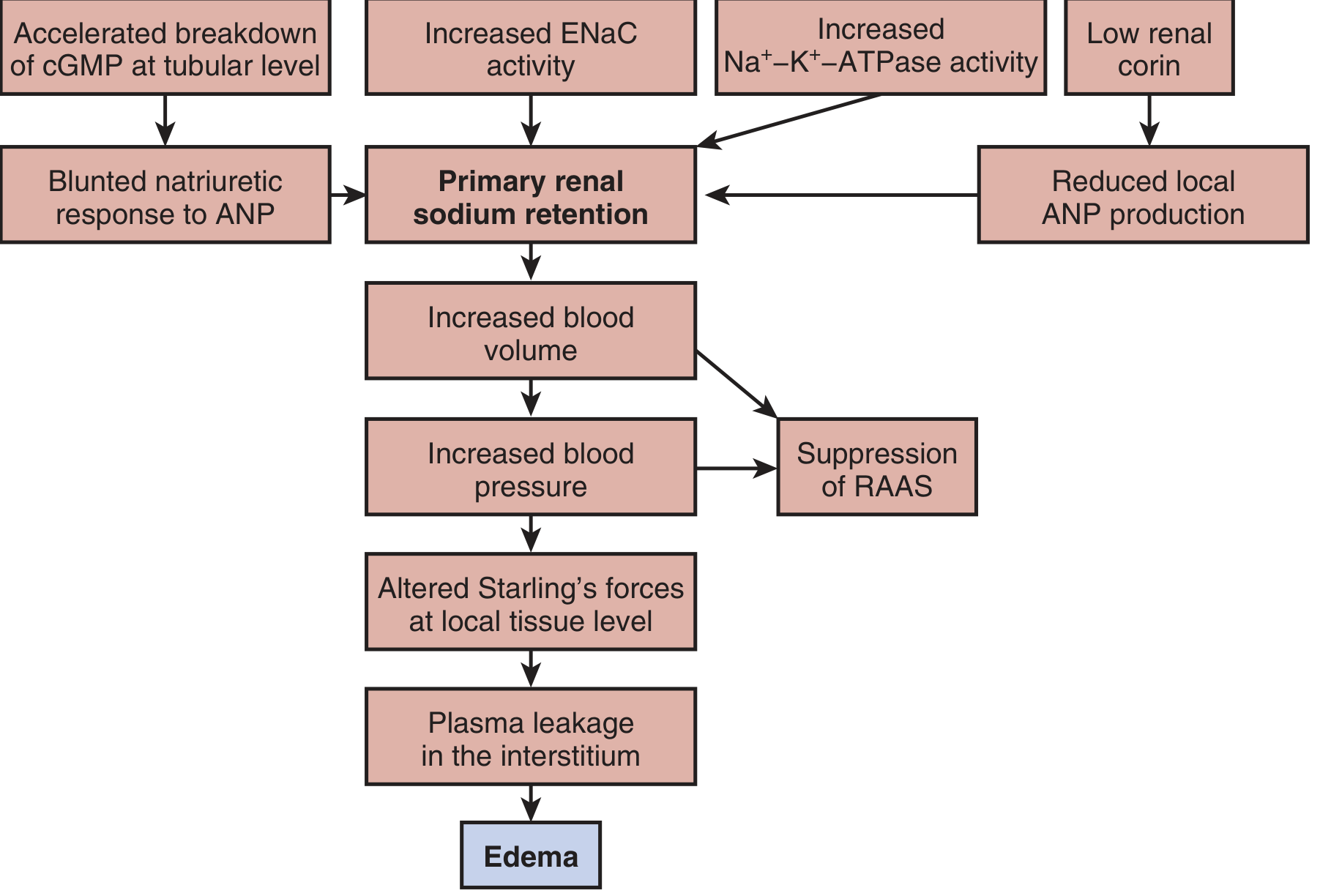
The "overfill" pathway: primary renal Na+ retention drives hypervolemia and plasma leakage into the interstitium.
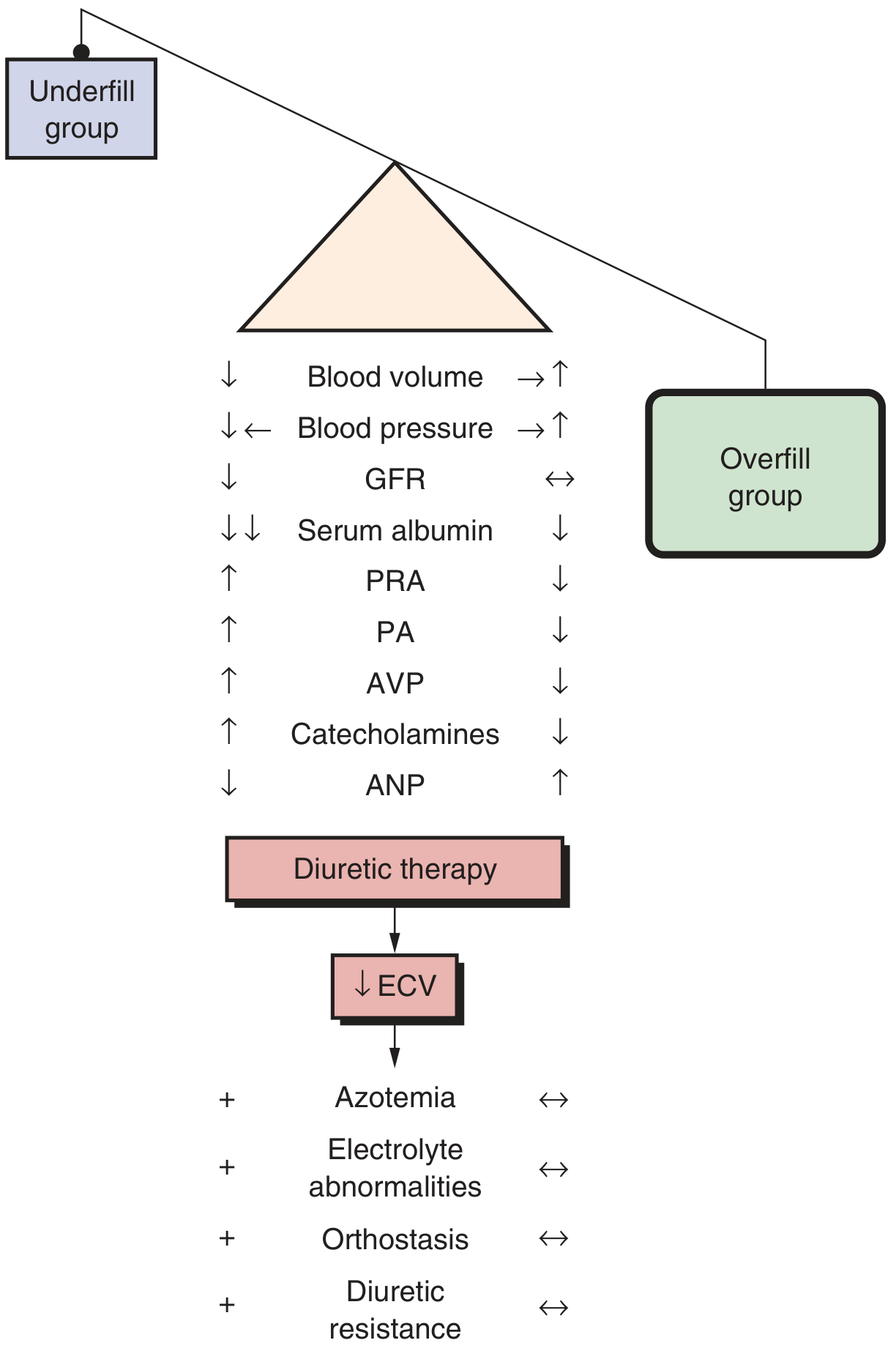
Underfill group (left) has decreased BP, activated RAAS; overfill group (right) has increased BP, suppressed RAAS, elevated ANP. Both groups develop edema.
4. Nephrotic Syndrome: Causes of Edema - Starling Forces
Per the Starling equation, edema is caused by:
- Decreased plasma oncotic pressure (↓ albumin) - the major factor in nephrotic syndrome
- Increased capillary hydrostatic pressure (as in GN or overfill states)
- Impaired lymphatic drainage
In hepatic cirrhosis and nephrotic syndrome, both reduced plasma oncotic pressure and primary sodium retention contribute to edema. Even in normal conditions, net filtration into the interstitium occurs; lymphatics compensate - when overwhelmed, edema develops.
5. Additional Complications of Nephrotic Edema
Hyperlipidemia
Due to: hepatic overproduction of lipoproteins (response to low oncotic pressure) + impaired clearance. Elevated VLDL, IDL, LDL, cholesterol; triglycerides variable. Reverses with remission.
Diuretic Resistance
- Hypoalbuminemia increases volume of distribution of loop diuretics
- Loop diuretic delivery to tubular lumen is impaired
- Collecting duct is refractory to ANP
- The fractional Na excretion of <0.2% indicates volume-contracted state (cautious use of diuretics)
Thrombosis Risk
Nephrotic patients are at increased risk for renal vein thrombosis and systemic thromboembolism due to loss of anticoagulant proteins (antithrombin III, protein C/S) in the urine.
6. Treatment of Edema in Nephritis / Nephrotic Syndrome
| Approach | Details |
|---|---|
| Dietary restriction | Salt restriction; fluid restriction if edema present |
| Loop diuretics | First-line for edema (furosemide); resistance is common in nephrotic syndrome |
| ACE inhibitors / ARBs | Reduce proteinuria, combat edema, dyslipidemia, and slow CKD progression |
| Corticosteroids | For nephrotic syndrome (esp. SSNS in children); prednisone 60 mg/m²/day initially |
| Steroid-sparing agents | Cyclophosphamide, MMF, rituximab, calcineurin inhibitors for FRNS/SDNS |
| Underlying disease treatment | PSGN is symptomatic; lupus nephritis requires immunosuppression |
7. Key Summary Points
- Edema in nephritis is primarily from Na+ and water retention due to reduced GFR and primary tubular Na+ reabsorption
- Edema in nephrotic syndrome involves both underfill (low oncotic pressure) and overfill (primary renal Na+ retention) mechanisms - minimal change disease predominantly underfill; most others predominantly overfill
- The collecting duct (especially ENaC and ANP resistance) is the primary nephron site of sodium retention in nephrotic edema
- Treating underlying proteinuria is more effective than diuretics alone for long-term edema management
Sources: Comprehensive Clinical Nephrology 7th Ed., Brenner and Rector's The Kidney, Campbell-Walsh Wein Urology, Swanson's Family Medicine Review
Make them easy
Nephritis and Edema - Made Simple 🧠
What is Nephritis?
Think of your kidneys as a filter. Nephritis means that filter is inflamed and damaged.
When the filter breaks:
- Blood leaks into urine (red/dark urine)
- Some protein leaks out
- Kidney can't remove extra salt and water
- Result → fluid builds up → EDEMA
Two Big Syndromes to Know
🔴 Nephritic Syndrome ("the angry kidney")
The kidney is inflamed and bleeding
Blood + protein in urine, high BP, puffy face/legs
🟡 Nephrotic Syndrome ("the leaky kidney")
The kidney leaks too much protein
Massive protein loss, very puffy (can be whole body), no blood in urine
Why Does Edema Happen? (Simple Version)
In Nephritis:
Damaged kidney → can't excrete salt/water
→ salt and water pile up in the body
→ SWELLING
In Nephrotic Syndrome - TWO ways:
Way 1 - "Underfill" (like a leaking pipe)
Kidney leaks protein → albumin drops in blood
→ blood can't hold water (low oncotic pressure)
→ water leaks OUT into tissues
→ blood vessels get "empty"
→ body panics, retains more salt
→ MORE SWELLING
Way 2 - "Overfill" (like a blocked drain)
Kidney directly retains too much salt
(collecting duct stuck in "hold" mode)
→ blood volume expands
→ fluid overflows into tissues
→ SWELLING
Quick Comparison Table
| Nephritis | Nephrosis | |
|---|---|---|
| Urine colour | Red/brown (blood) | Foamy (protein) |
| Swelling | Moderate | Severe (even eyelids, scrotum) |
| BP | High | Variable |
| Protein loss | Mild | Massive |
| Blood in urine | Yes | No |
| Main mechanism | Na+ retention | Low albumin + Na+ retention |
The Starling Equation (Don't Fear It)
Normally, fluid stays in blood vessels because:
Blood proteins PULL fluid in vs Blood pressure PUSHES fluid out
In nephrotic syndrome:
- You lose proteins → nothing pulling fluid back
- Fluid escapes into tissues
- = Edema
Edema Location Clue
| Location | What it tells you |
|---|---|
| Eyelids (periorbital) in morning | Classic in children with nephrotic syndrome |
| Ankle/leg edema | Common in adults |
| Scrotum / labia | Severe nephrotic |
| Whole body (anasarca) | Very severe / albumin very low |
Treatment (The Logic)
| Problem | Fix |
|---|---|
| Too much salt/water | Low-salt diet + loop diuretic (furosemide) |
| Protein leaking | ACE inhibitor/ARB - tightens the filter |
| Inflammation causing it | Steroids (prednisone) |
| Relapsing disease | Steroid-sparing agents (cyclophosphamide, rituximab) |
One-Line Memory Tricks
- Nephri-TIS = inflammaTIS = blood + protein + high BP
- Nephro-TIC = leaky TICket = protein leaks out massively → puffy
- Underfill = "empty pipes" → body overcorrects → swelling
- Overfill = "blocked drain" → kidney won't let salt go → swelling
- Both roads lead to the same destination: EDEMA
This is a shared conversation. Sign in to Orris to start your own chat.