
Terminal respiratory unit for md exams 10 marks answer from fishman only
Reading File
Now let me search Fishman's textbook for the terminal respiratory unit.
Finding Sources
Finding Sources
Finding Sources
Finding Sources
Finding Sources
Finding Sources
Good - found the key sections. Let me read the relevant content from Fishman's block 1 around those line numbers, and also search for more surrounding content.
Reading File
Excellent content. Let me read more - the next section and the Typical Path Model section.
Reading File
Now let me also read the section just before (around line 1855-1905) more carefully to get the full description of the acinus/terminal respiratory unit, and also search for the broader anatomy section with alveolar ducts, alveolar sacs, type I and type II cells.
Finding Sources
Finding Sources
Reading File
Finding Sources
Now let me read the core sections - "The Acinar Airway System" and the broader lung anatomy section.
Reading File
Reading File
I now have comprehensive content from Fishman's. Let me also fetch one key image from the text to include.
Loading Image
I now have all the content needed for a thorough 10-mark answer directly from Fishman's. Let me compose the answer.
Terminal Respiratory Unit (Pulmonary Acinus)
From: Fishman's Pulmonary Diseases and Disorders, 5th Edition
1. Definition
The acinus (terminal respiratory unit) is defined as the parenchymal unit in which all airways have alveoli attached to their walls and thus participate in gas exchange. It is the functional and structural unit of the lung for gas exchange.
"The acinus is defined as the parenchymal unit in which all airways have alveoli attached to their wall and thus participate in gas exchange. Along the airway tree, the acinus begins with a transitional bronchiole."
- Fishman's, Chapter 2
2. Position in the Airway Tree
The human airway tree branches over an average of 23 generations of dichotomous branching, ending in blind sacs (alveolar sacs). The last 9 generations are connected to alveoli and constitute the gas-exchanging parenchyma:
| Unit | Description |
|---|---|
| Generations 1-14 | Conducting airways (no alveoli) |
| Generation 14 (approx.) | Transitional bronchiole - start of the acinus |
| Generations 14-16 | Respiratory bronchioles (generations 1-3 of the acinus, z' = 0-2) |
| Generations 17-22 | Alveolar ducts |
| Generation 23 | Alveolar sacs (terminal) |
The acinus contains approximately 8 generations of branching internally (z' = 0 to 8), ending with 256 terminal alveolar sacs in an average human acinus.
3. Components of the Acinus
a. Transitional Bronchiole (z' = 0)
- The entry point of the acinus (located at approximately generation 14-15 of the airway tree)
- Marks the boundary between purely conducting airways and gas-exchanging airways
- Inner diameter: ~0.50 mm; length: ~1.4 mm
b. Respiratory Bronchioles (z' = 1-3)
- The first three generations of acinar airways following the transitional bronchiole
- Have only a few alveolar openings in their walls - so named because they participate partially in gas exchange
- Walls are lined by cuboidal epithelium with cilia, interspersed with alveolar patches
- The first three acinar generations (respiratory bronchioles) account for 3.4 mm of the total 8.3 mm acinar path length
c. Alveolar Ducts
- Deeper generations of the acinus where alveoli line the entire circumference of the airway wall
- Duct lumen is bounded on all sides by alveolar mouths
- Segment lengths decrease progressively from ~1330 μm to ~640 μm in peripheral generations
d. Alveolar Sacs
- The terminal blind-ending structures
- Clusters of alveoli opening into a common space
- The path length from the transitional bronchiole through respiratory bronchioles, alveolar ducts, to the end of alveolar sacs = 8.3 ± 1.4 mm (average longitudinal path length of the human acinus)
4. Morphometric Data - Typical Path Model of Human Acinus
(Fishman's Table 2-5 - Typical Path Model)
| Airways Generation (z) | Acinus Generation (z') | No. of segments N(z') | Length (mm) | Inner diameter (mm) |
|---|---|---|---|---|
| 15 | 0 | 1 | 1.40 | 0.50 |
| 16 | 1 | 2 | 1.33 | 0.50 |
| 17 | 2 | 4 | 1.12 | 0.49 |
| 18 | 3 | 8 | 0.93 | 0.40 |
| 19 | 4 | 16 | 0.83 | 0.38 |
| 20 | 5 | 32 | 0.70 | 0.35 |
| 21 | 6 | 64 | 0.59 | 0.30 |
| 22 | 7 | 128 | 0.59 | 0.28 |
| 23 | 8 | 256 | 0.64 | 0.26 |
Key morphometric facts:
- Mean acinus volume: 187 mm³ (SD = 79 mm³)
- Number of branching generations within acinus: ~8
- Terminal alveolar sacs per acinus: 256
- Total longitudinal path length (transitional bronchiole to alveolar sac): 8.3 ± 1.4 mm
5. Secondary Lobule vs Acinus
- The secondary lobule (~1 cm³, visible on lung surface, delineated by connective tissue septa) comprises approximately a dozen acini
- Secondary lobules are supplied by airway branches ~1 mm in diameter
- The secondary lobule is the unit visible on HRCT as the "secondary pulmonary lobule"
6. Ventilation Within the Acinus - Two-Step Mechanism
Fishman's describes O₂ delivery within the acinus as a two-step process:
- Bulk convective flow: Upon inspiration, O₂-rich air flows through the airways into the acinus, carrying O₂ by convection
- Diffusion in air phase: In the peripheral acinar airways, flow velocity slows because airway cross-section increases enormously. O₂ now moves toward the periphery by molecular diffusion in the gas phase, driven by the PO₂ gradient established as O₂ is absorbed at the alveolar surface
This is the basis for the "serial ventilation / parallel perfusion" model (Fig. 2-61B in Fishman's) - a critical distinction from the oversimplified "parallel bubble" model. The design means alveoli near the acinar entrance receive slightly more O₂ than those at the periphery.
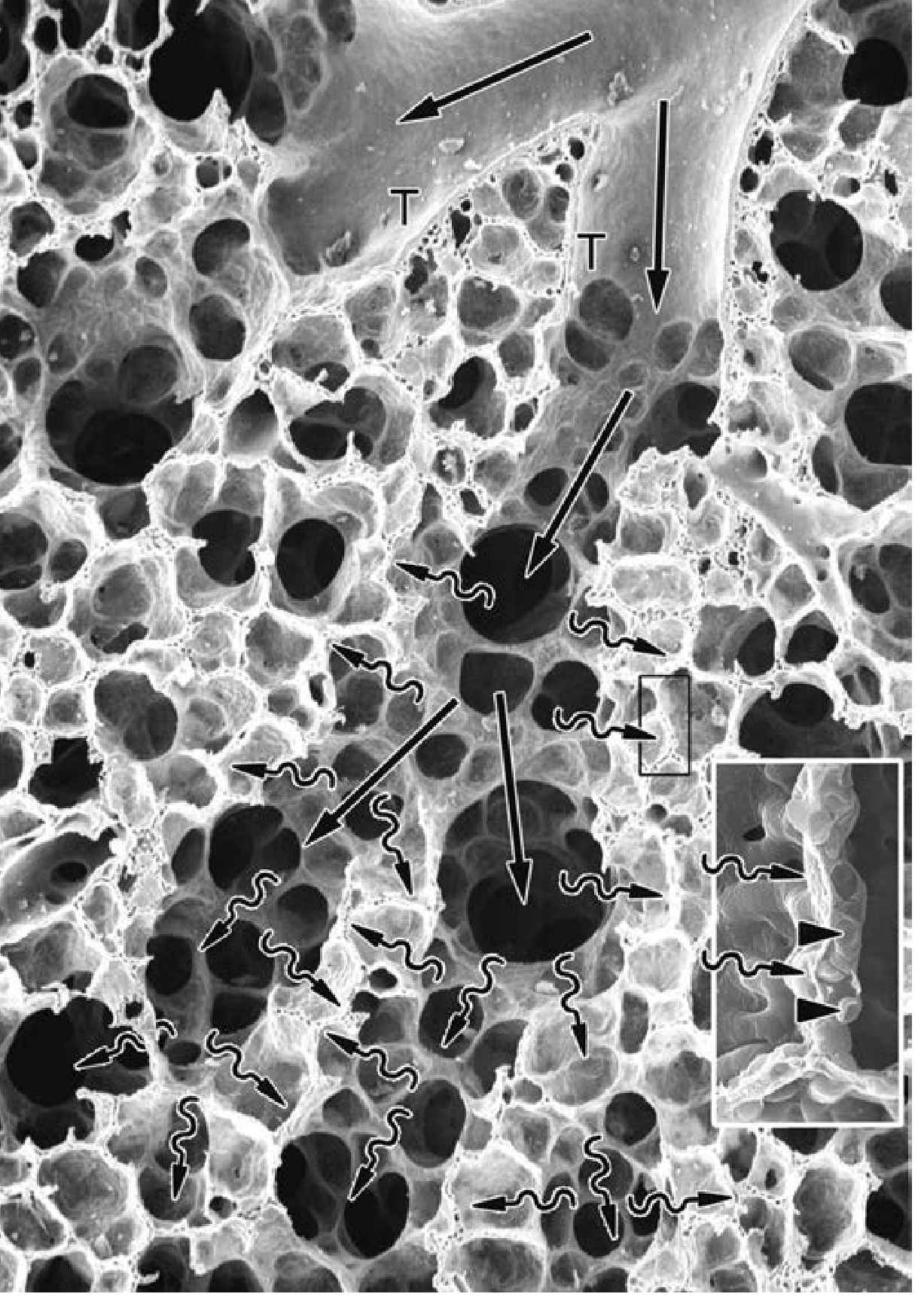
Figure 2-62 from Fishman's: Central part of acinar airways beginning with transitional bronchioles (T) and leading into branched alveolar ducts.
7. Gas Exchange Units Within the Acinus
The alveolar surface (~143 m² / tennis court size) is subdivided into approximately 400 million gas-exchange units. Each unit:
- Is individually perfused - corresponds to the unit capillary network spanning between a pulmonary arteriole and venule
- Is roughly disk-shaped, ~500 μm in diameter
- Has a surface area approximately equivalent to one alveolus
- Spans over several alveoli (and each alveolus is in contact with several capillary units)
These capillary units are arranged in parallel for perfusion but in series along the acinar airway for ventilation.
8. Alveolar Wall (Cellular Composition)
The alveolar epithelium (part of the terminal respiratory unit) consists of:
| Cell Type | Description |
|---|---|
| Type I pneumocytes | Squamous, line ~97% of alveolar surface; extremely thin extensions; optimized for gas diffusion |
| Type II pneumocytes | Cuboidal, occupy ~3% of surface; secretory cells; produce surfactant; progenitor cells for Type I |
| Brush cells | Rare; found near the acinar entrance |
| Alveolar macrophages | Found in alveolar spaces; first line of defense |
- Type I and Type II cells occur in a numeric ratio of ~1:2 (Type II are more numerous by number, but Type I cover far more surface area)
- The air-blood barrier has a thin part (Type I cell + fused basement membrane + endothelium) and a thick part (containing nuclei and connective tissue fibers)
- About half of the barrier surface is optimized (thin parts); the other half contains structural support elements
9. Alveolar Numbers and Surface Area (Morphometric Summary)
- Total number of alveoli in adult human lung: ~480 million (some older estimates ~300 million, Fishman's cites ~400 million gas-exchange units)
- Total alveolar surface area: ~143 m² (size of a tennis court)
- Mean alveolar diameter: ~200 μm
10. Clinical Relevance
Understanding the terminal respiratory unit is essential for:
- Emphysema: Panacinar emphysema destroys the entire acinus (alveolar ducts, sacs, and respiratory bronchioles); centrilobular/centriacinar emphysema preferentially destroys the proximal respiratory bronchioles (acinar center), sparing distal alveolar ducts initially
- Gas exchange impairment: The serial-ventilation design of the acinus means diffusion limitation at high acinar path lengths contributes to alveolar-arterial PO₂ gradients even in normal lungs
- Diffusing capacity (DL): Morphometric DLO₂ (~60 mL O₂/min/mmHg at rest) has ~2× reserve; only fully exploited during heavy exercise or hypoxia
Source: Fishman's Pulmonary Diseases and Disorders, 5th Edition (ISBN 9781260473940), Chapter 2 - "The Normal Lung: Anatomy and the Cells," pp. 55-87.
This is a shared conversation. Sign in to Orris to start your own chat.