
Forum of international respiratory society about asthma
Searching the Web
Forum of International Respiratory Societies asthma 2026
Searching the Web
FIRS Forum International Respiratory Societies asthma statement guidelines
Reading Web Page
https://firsnet.org/inhaled-medicines-intervention-statement…
Reading File
Here is a comprehensive overview of the Forum of International Respiratory Societies (FIRS) and its work on asthma:
Forum of International Respiratory Societies (FIRS) - Asthma
What is FIRS?
FIRS was established in 2001 and unites the world's leading international professional respiratory societies to promote global equity in the prevention, diagnosis, and treatment of respiratory disease. Its membership includes:
- American College of Chest Physicians (CHEST)
- American Thoracic Society (ATS)
- Asian Pacific Society of Respirology (APSR)
- Asociación Latinoamericana de Tórax (ALAT)
- European Respiratory Society (ERS)
- International Union Against Tuberculosis and Lung Disease (The Union)
- Pan African Thoracic Society (PATS)
- Global Initiative for Asthma (GINA)
- Global Initiative for Chronic Obstructive Lung Disease (GOLD)
With over 70,000 members globally, FIRS works alongside the WHO and other global bodies.
FIRS Position on Asthma
FIRS classifies asthma as one of the five most urgent respiratory conditions globally. Its advocacy focuses on three pillars:
1. Access to Inhaled Medicines
FIRS launched a major campaign on World Asthma Day 2025 to close wide gaps in access to inhaled medicines for asthma and COPD. Their core message: "No child should die because an inhaler is unavailable."
The campaign highlights that 102 million children under 15 have asthma, but life-saving inhalers remain inaccessible in many low- and middle-income countries (LMICs). FIRS is calling for action in five key areas:
- Increasing availability of quality, affordable inhalers
- Strengthening health system capacity
- Supporting guideline implementation in LMICs
- Reducing the economic burden of uncontrolled asthma on families
- Integrating asthma care within broader lung health systems
2. World Health Assembly Advocacy (2026)
At the 79th World Health Assembly, FIRS and The Union delivered an intervention calling for a draft Resolution to improve availability of quality, affordable, and effective inhalers for COPD and asthma in all LMICs. If adopted, this would push national governments, industry, and global health agencies to invest greater resources to meet this need.
3. Integrated Lung Health
FIRS advocates integrating asthma care with TB, COPD, smoking cessation, post-TB lung disease, and cancer screening at the community and primary care levels - moving away from disease-specific silos toward people-centred, equitable care.
FIRS Lung Health Taskforce (2026)
FIRS recently launched the FIRS Lung Health Taskforce in partnership with the Global Lung Function Initiative. It will:
- Develop a Lung Health Spirometry Toolkit
- Create a global Lung Health Index
- Advance understanding of lung health throughout life (relevant to early asthma detection)
Clinical Guidelines on Asthma (FIRS Member Societies)
While FIRS focuses on global advocacy, its member societies publish clinical guidelines:
- GINA (Global Initiative for Asthma) - the primary clinical guideline body for asthma management worldwide
- ERS/ATS joint guidelines on severe asthma - address phenotyping, biologic therapies, and refractory disease
- The ERS/ATS severe asthma guidelines cover diagnosis, evaluation, and stepwise treatment including biologics (omalizumab, mepolizumab, etc.)
Key Advocacy Themes (2025-2026)
| Issue | FIRS Stance |
|---|---|
| Access to inhalers in LMICs | High-priority campaign; resolution sought at WHA |
| Asthma in children | 102 million children affected; access gap a major concern |
| Guideline implementation | Health systems in many countries lack capacity to apply existing guidelines |
| Disease integration | Asthma should be screened/treated within integrated lung health programs |
| Economic burden | Poorly controlled asthma avoidable with appropriate management |
For the latest updates, visit the FIRS official website and GINA for current clinical guidelines.
About asthma is obstruction
Asthma is characterized by reversible airway obstruction - this is one of its defining features. The obstruction results from bronchospasm, mucosal edema, and mucus plugging, and it typically reverses spontaneously or with bronchodilators.
Searching sources...
Finding Sources
Finding Sources
Reading File
Reading File
Reading File
Finding Sources
Loading Image
Finding Sources
Reading File
Finding Sources
Here is a thorough breakdown of asthma as an obstructive lung disease, drawn from multiple authoritative textbooks:
Asthma: The Obstructive Pattern
Definition and Core Concept
Asthma is a chronic disease characterized by episodic and reversible airflow obstruction due to bronchial smooth muscle hyperreactivity and inflammation that is responsive to bronchodilator and corticosteroid treatments.
- Tintinalli's Emergency Medicine
Per the GINA 2019 definition (cited in Murray & Nadel):
"Asthma is a heterogeneous disease, usually characterized by chronic airway inflammation. It is defined by the history of respiratory symptoms such as wheeze, shortness of breath, chest tightness, and cough that vary over time and in intensity, together with variable expiratory airflow limitation."
Mechanisms Causing the Obstruction
Three main factors narrow the airways during an asthma attack:
| Mechanism | Description |
|---|---|
| Bronchospasm | Hyperreactive smooth muscle contracts, narrowing the airway lumen |
| Mucosal edema | Inflammatory mediators cause vascular leakage, swelling the bronchial wall |
| Mucus plugging | Hypersecretion of mucus blocks smaller airways |
These occur on a background of chronic eosinophilic and T-lymphocyte airway inflammation, triggered by allergens, irritants, infections, exercise, or medications.
- Cellular and Molecular Immunology (Abu-Ata)
- Miller's Anesthesia
Spirometry: Confirming the Obstructive Pattern
The obstruction in asthma shows up on pulmonary function testing as follows:
-
FEV1/FVC ratio < 70% - the hallmark of obstruction
-
FEV1 may be normal between flares, but falls during attacks
-
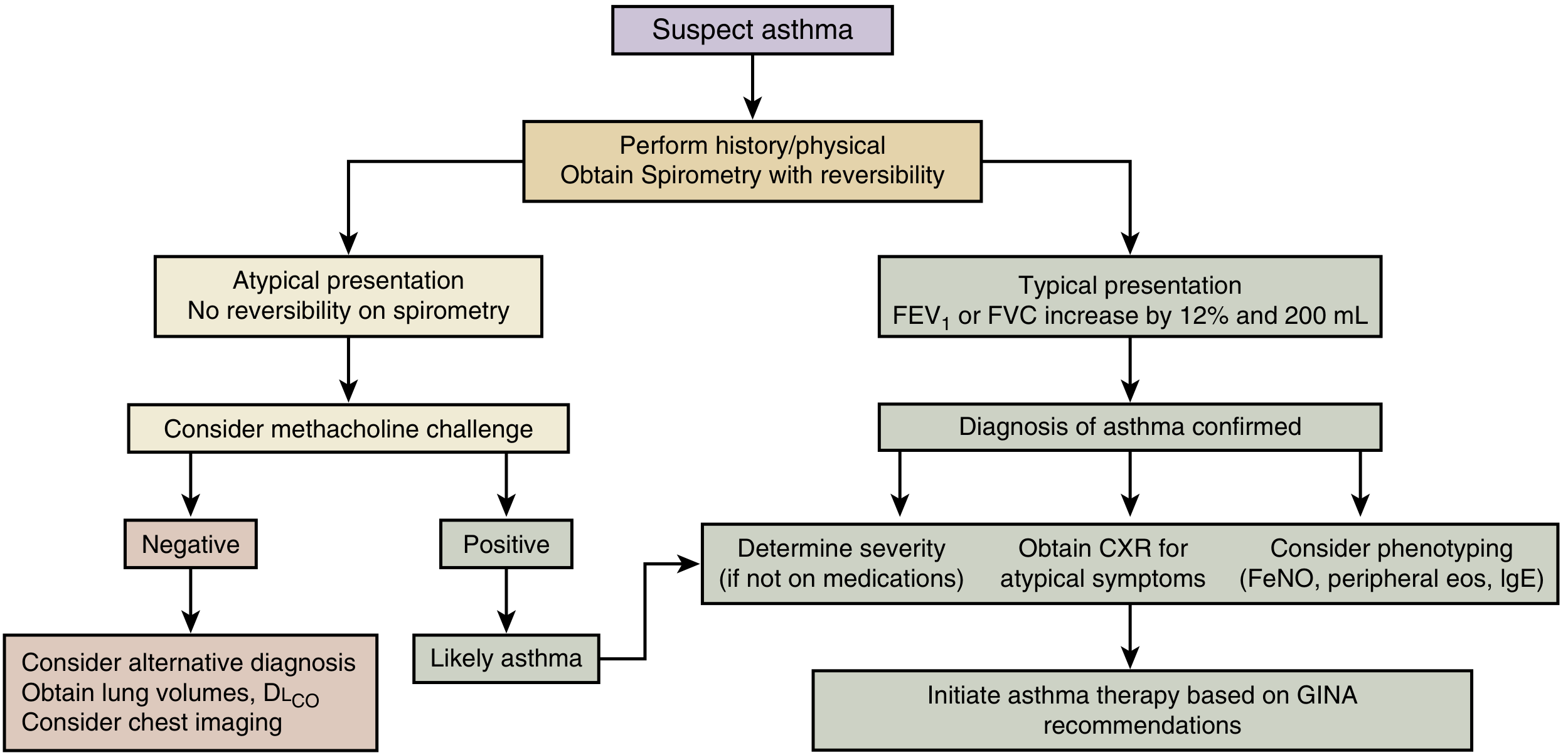
Reversibility test: Improvement of FEV1 >12% and >200 mL after bronchodilator = reversible airflow obstruction, strongly suggestive of asthma
-
A 20% and 200 mL increase in FVC after bronchodilator is also suggestive
-
In severe asthma, FVC may fall due to air trapping, which can paradoxically increase the FEV1/FVC ratio
-
FEF25-75% (mid-expiratory flow) may detect small airway obstruction even when FEV1 is normal
-
Murray & Nadel's Textbook of Respiratory Medicine
Airway Hyperresponsiveness (AHR)
AHR to environmental stimuli is a hallmark of asthma. When spirometry is normal but asthma is suspected, a methacholine challenge test is used:
-
FEV1 falls by >20% at the PC20 (provocative concentration)
-
PC20 <16 mg/mL = mild AHR
-
PC20 <4 mg/mL = moderate AHR
-
PC20 <1 mg/mL = severe AHR
-
Murray & Nadel's Textbook of Respiratory Medicine
Diffusing Capacity (DLCO): A Key Distinguishing Feature
Unlike COPD/emphysema, in asthma:
- DLCO is normal or elevated (due to increased perfusion of upper lung zones)
- This is a key way to distinguish asthma from other obstructive diseases
- An unexpected increase in DLCO should raise suspicion for undiagnosed asthma
- A decreased DLCO in a suspected asthmatic suggests an alternative diagnosis or coexisting condition
Reversibility vs. Fixed Obstruction
| Feature | Asthma | COPD |
|---|---|---|
| Reversibility | Largely reversible | Largely irreversible |
| Age of onset | Often younger | Typically older (>40 yrs) |
| Smoking history | Less common | Common |
| Atopy | Frequent | Less common |
| DLCO | Normal or elevated | Decreased |
| Corticosteroid response | Good | Limited |
Chronic/Remodeled Asthma: Long-standing asthma can cause structural changes ("airway remodeling") leading to persistent, fixed obstruction that no longer fully reverses. In such cases, distinguishing from COPD may be impossible. This is termed asthma-COPD overlap (ACO).
- Murray & Nadel's Textbook of Respiratory Medicine
Clinical Takeaway
Asthma is classified as an obstructive lung disease because it reduces expiratory airflow (low FEV1/FVC). What distinguishes it from COPD is the reversibility of that obstruction - at least early in the disease course. Over time, without adequate treatment, irreversible remodeling can make the obstruction permanent.
List of all obstructive lung diseases
Obstructive lung diseases share a common feature: reduced airflow on expiration due to airway narrowing or collapse. The main ones include asthma, COPD (emphysema + chronic bronchitis), bronchiectasis, cystic fibrosis, and bronchiolitis.
Searching sources...
Finding Sources
Finding Sources
Finding Sources
Finding Sources
Reading File
Reading File
Reading File
Reading File
Finding Sources
Here is a comprehensive, textbook-grounded list of all obstructive lung diseases, organized by location and type:
Obstructive Lung Diseases - Complete Classification
Defining feature: Reduced expiratory airflow (low FEV1/FVC ratio) due to airway narrowing, collapse, or plugging.
A. Upper Airway Obstructive Diseases
(Obstruction of larynx, trachea, large bronchi)
| Disease | Key Features |
|---|---|
| Vocal cord dysfunction / Paradoxical vocal fold motion | Extrathoracic variable obstruction on flow-volume loop; mimics asthma; no bronchodilator response; confirmed on laryngoscopy |
| Tracheal stenosis (post-intubation/tracheostomy) | Fixed obstruction; plateau on both inspiratory and expiratory flow-volume loop |
| Epiglottitis | Supraglottic swelling causing acute upper airway obstruction; sore throat, stridor |
| Laryngotracheal tumors / Neoplasms | Bronchogenic carcinoma, carcinoid, adenoma; unilateral wheeze, confirmed by bronchoscopy |
| Tracheomalacia | Collapse of tracheal wall; dynamic expiratory obstruction |
| Anaphylaxis | Acute laryngeal edema; abrupt onset with urticaria, angioedema, hypotension |
| Retropharyngeal abscess | Posterior pharyngeal swelling; stridor |
- Goldman-Cecil Medicine (Table 24-1)
B. Lower Airway Obstructive Diseases
(Obstruction of bronchi, bronchioles, alveolar ducts)
1. Asthma
- Episodic, reversible airflow obstruction
- Caused by bronchospasm + mucosal edema + mucus plugging
- FEV1/FVC <70%; reverses >12% + 200 mL with bronchodilator
- Hallmark: airway hyperresponsiveness (AHR)
2. Chronic Obstructive Pulmonary Disease (COPD)
COPD is an umbrella term with two main components that commonly coexist:
| Subtype | Mechanism |
|---|---|
| Emphysema | Destruction of alveolar walls; loss of elastic recoil; dynamic airway collapse; low DLCO |
| Chronic bronchitis | Mucus hypersecretion + airway wall thickening; DLCO normal/near-normal |
- Obstruction is largely irreversible (fixed)
- Typically in smokers >40 years old
3. Asthma-COPD Overlap (ACO)
- Persistent airflow limitation + features of both asthma and COPD
- Airway remodeling from chronic asthma → fixed obstruction
- Murray & Nadel's Textbook of Respiratory Medicine
4. Bronchiectasis
- Permanent bronchial dilation with wall thickening
- Copious mucopurulent sputum + digital clubbing
- Obstructive pattern on PFTs; diagnosis confirmed by high-resolution CT
5. Cystic Fibrosis (CF)
- Genetic (CFTR mutation); viscous mucus → progressive obstruction
- Features: productive cough, bronchiectasis, Pseudomonas colonization, pancreatic insufficiency, digital clubbing
- Progressive obstructive pattern; two sweat chloride values ≥50 mEq/L diagnostic
- Goldman-Cecil Medicine
6. Bronchiolitis / Bronchiolitis Obliterans
- Inflammation/fibrosis of small airways (<2 mm)
- Causes: viral (in children), connective tissue disease, post-transplant (chronic rejection), ulcerative colitis, toxic fume inhalation
- Mild obstructive + restrictive pattern on PFTs; hyperinflation
- Fine nodular infiltrates on CXR
- Bronchiolitis obliterans (constrictive bronchiolitis): submucosal fibrosis → bronchiolar narrowing
7. Small Airway Disease
- Isolated disease of airways <2 mm diameter
- FEV3 and FEF25-75% abnormally low; FEV1 may be normal
- DLCO and lung volumes normal; minimal bronchodilator response
- May represent early/pre-clinical obstructive disease
- Fishman's Pulmonary Diseases and Disorders
8. Hypersensitivity Pneumonitis (Extrinsic Allergic Alveolitis)
- Can produce mixed obstructive + restrictive picture
- Caused by repeated inhalation of organic antigens
9. Alpha-1 Antitrypsin Deficiency
- Genetic cause of early-onset emphysema in non-smokers
- Loss of protease inhibition → alveolar destruction (predominantly lower lobe)
- Obstructive pattern; very low DLCO
10. Aspiration-related airway obstruction
- Foreign body or recurrent aspiration causing mechanical airway blockage
- Can be acute (fixed obstruction) or chronic
Summary Comparison
| Disease | Reversibility | DLCO | Smoking link | Age of onset |
|---|---|---|---|---|
| Asthma | Reversible | Normal/High | No | Any (often young) |
| Emphysema | Irreversible | Low | Yes | >40 years |
| Chronic bronchitis | Largely irreversible | Normal | Yes | >40 years |
| Bronchiectasis | Partially reversible | Normal | No | Any |
| Cystic fibrosis | Partially reversible | Normal | No | Childhood |
| Bronchiolitis obliterans | Fixed | Normal | No | Any |
| Alpha-1 AT deficiency | Irreversible | Low | No (or minor) | Young adult |
| Small airway disease | Minimal response | Normal | Often | Middle age |
The key spirometric criterion for all these conditions is a reduced FEV1/FVC ratio (<70%), with reversibility testing and DLCO helping to differentiate between them.
- Fishman's Pulmonary Diseases and Disorders
- Murray & Nadel's Textbook of Respiratory Medicine
- Goldman-Cecil Medicine
This is a shared conversation. Sign in to Orris to start your own chat.