
Explain beta oxidation of fatty acids
I'll start by reading the medical library skill, then search for beta oxidation content in parallel.
Reading File
Now let me search the library and look for images in parallel:
Finding Sources
Finding Sources
Searching Images
beta oxidation steps acyl CoA mitochondria
Good results. Now let me read the key sections from multiple books in parallel:
Reading File
Reading File
Reading File
There's a diagram in Guyton. Let me fetch it and also read the biochemistry textbook for the detailed steps:
Loading Image
Reading File
Excellent - I have the diagram from Guyton and rich textual content. Let me now read the detailed biochemistry section on the steps and ATP yield:
Reading File
Finding Sources
I now have comprehensive information from multiple authoritative textbooks. Let me compile the full, detailed answer.
Beta Oxidation of Fatty Acids
Beta oxidation is the primary catabolic pathway for fatty acids, occurring mainly in the mitochondrial matrix. It systematically cleaves 2-carbon units from the fatty acyl chain, generating acetyl-CoA, FADH2, and NADH with each cycle. These products feed the TCA cycle and the electron transport chain to produce large amounts of ATP.
Overview
Beta oxidation occurs principally in mitochondria but also in peroxisomes (for very-long-chain fatty acids). The pathway is named because it is the beta-carbon (second carbon from the carboxylate end) that undergoes oxidation during each cycle.
Step 0: Activation - Formation of Fatty Acyl-CoA (Cytoplasm)
Before entering the pathway, a free fatty acid must be activated:
Fatty acid + CoA + ATP → Fatty acyl-CoA + AMP + Pyrophosphate
This reaction is catalyzed by fatty acyl-CoA synthetase (also called acyl-CoA synthetase or thiokinase), located on the outer mitochondrial membrane. ATP is consumed (equivalent to 2 high-energy bonds, since AMP + PPi are produced and pyrophosphate is hydrolyzed). The product is a fatty acyl-CoA thioester.
- Guyton and Hall Textbook of Medical Physiology, p. 845
Step 1: Transport into Mitochondria - The Carnitine Shuttle
Long-chain fatty acyl-CoA (>12 carbons) cannot cross the inner mitochondrial membrane directly. A dedicated transport system is required:
- Carnitine palmitoyltransferase I (CPT-I) (outer mitochondrial membrane): transfers the acyl group from CoA to carnitine, forming fatty acylcarnitine.
- Acylcarnitine:carnitine translocase: shuttles fatty acylcarnitine into the matrix in exchange for free carnitine.
- Carnitine palmitoyltransferase II (CPT-II) (inner mitochondrial membrane): reverses the reaction, regenerating fatty acyl-CoA inside the matrix.
CPT-I is the key regulatory checkpoint for beta oxidation. It is potently inhibited by malonyl-CoA (the committed intermediate in fatty acid synthesis), preventing both processes from occurring simultaneously.
Short- and medium-chain fatty acids can enter the mitochondrial matrix without carnitine.
- Sleisenger and Fordtran's Gastrointestinal and Liver Disease
The Four Repeating Steps of Beta Oxidation (the "Spiral")
Here is the reaction diagram from Guyton & Hall:
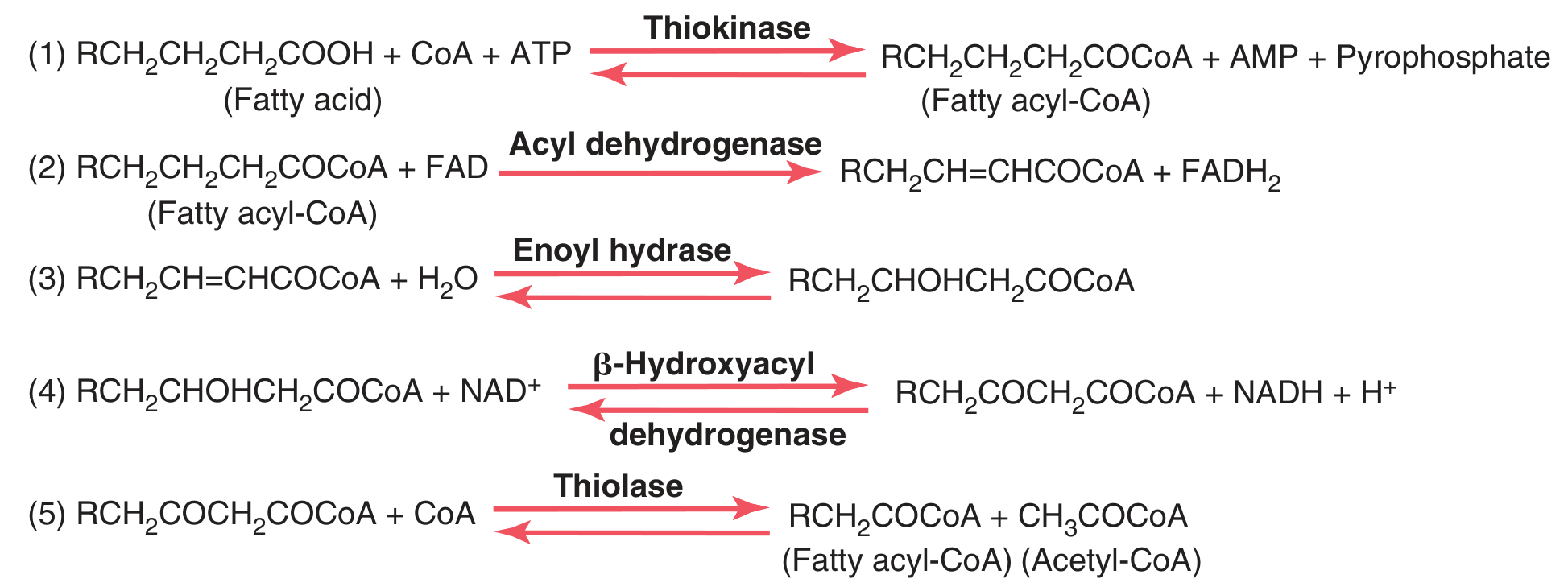
Each cycle consists of four enzymatic reactions:
| Step | Reaction | Enzyme | Coenzyme |
|---|---|---|---|
| 1. Oxidation | Fatty acyl-CoA → trans-2-enoyl-CoA | Acyl-CoA dehydrogenase | FAD → FADH₂ |
| 2. Hydration | trans-2-enoyl-CoA + H₂O → L-3-hydroxyacyl-CoA | Enoyl-CoA hydratase | - |
| 3. Oxidation | L-3-hydroxyacyl-CoA → 3-ketoacyl-CoA | 3-Hydroxyacyl-CoA dehydrogenase | NAD⁺ → NADH |
| 4. Thiolysis | 3-ketoacyl-CoA + CoA → acetyl-CoA + acyl-CoA (2C shorter) | Thiolase (β-ketothiolase) | - |
Step 1 - Acyl-CoA Dehydrogenase: Creates a trans double bond between carbons 2 and 3 (α and β carbons). There are three isoforms: VLCAD (very long-chain), MCAD (medium-chain), and SCAD (short-chain), each specific to fatty acid chain length. Two electrons are transferred to FAD, generating FADH₂.
Step 2 - Enoyl-CoA Hydratase: Adds water across the double bond, generating the L-stereoisomer of 3-hydroxyacyl-CoA.
Step 3 - 3-Hydroxyacyl-CoA Dehydrogenase: Oxidizes the hydroxyl group at carbon 3 to a keto group, reducing NAD⁺ to NADH.
Step 4 - Thiolase: Cleaves the bond between carbons 2 and 3 by attacking with a second CoA molecule. This releases acetyl-CoA (2-carbon unit) and a new acyl-CoA that is 2 carbons shorter than the original. This shortened acyl-CoA re-enters the cycle.
- Guyton and Hall Textbook of Medical Physiology, p. 845
- Sleisenger and Fordtran's Gastrointestinal and Liver Disease
Fate of Products
Acetyl-CoA enters the TCA (citric acid) cycle, combining with oxaloacetate to form citrate. Each acetyl-CoA ultimately generates 10 ATP via the TCA cycle and oxidative phosphorylation.
FADH₂ and NADH enter the electron transport chain at complexes II and I respectively, generating ~1.5 ATP (FADH₂) and ~2.5 ATP (NADH) per molecule via oxidative phosphorylation.
In the liver specifically, excess acetyl-CoA can be directed into ketone body synthesis (acetoacetate, β-hydroxybutyrate, acetone) via the HMG-CoA pathway - this only occurs in liver mitochondria.
ATP Yield: Example with Palmitic Acid (C16:0)
Palmitate (16-carbon saturated fatty acid) undergoes 7 cycles of beta oxidation to produce 8 acetyl-CoA molecules:
| Source | Quantity | ATP/molecule | ATP yield |
|---|---|---|---|
| FADH₂ from beta oxidation | 7 | 1.5 | 10.5 |
| NADH from beta oxidation | 7 | 2.5 | 17.5 |
| Acetyl-CoA → TCA cycle | 8 | 10 | 80 |
| Activation cost | -2 | ||
| Net ATP | ~106 |
For stearic acid (C18), Guyton & Hall cite a net yield of 146 ATP molecules.
- Guyton and Hall Textbook of Medical Physiology, p. 846
Regulation of Beta Oxidation
Beta oxidation is regulated at several levels:
- Malonyl-CoA inhibition of CPT-I - the primary control point. When carbohydrates are plentiful, malonyl-CoA (first committed intermediate in fatty acid synthesis) rises and blocks CPT-I, shutting off beta oxidation.
- Product inhibition - high levels of FADH₂, NADH, and acetyl-CoA inhibit the pathway enzymes when energy status is high.
- Hormonal control - glucagon and epinephrine activate hormone-sensitive lipase, releasing more free fatty acids for oxidation; insulin has the opposite effect.
- Basic Medical Biochemistry - A Clinical Approach, 6e
Special Cases
Unsaturated Fatty Acids
Require additional enzymes:
- Isomerase (for monounsaturated): converts cis-3-enoyl to trans-2-enoyl for normal beta oxidation.
- Reductase (for polyunsaturated): additional NADPH-requiring step, yielding one fewer FADH₂ per double bond.
Odd-Chain Fatty Acids
Beta oxidation of odd-chain fatty acids eventually produces propionyl-CoA (3-carbon) as the final product. This is converted to succinyl-CoA via propionyl-CoA carboxylase (requires biotin) and methylmalonyl-CoA mutase (requires vitamin B12), entering the TCA cycle.
Peroxisomal Beta Oxidation
-
Handles very-long-chain fatty acids (>C22) that cannot be directly processed by mitochondria
-
The first oxidation step transfers electrons to FAD → FADH₂, which is then passed directly to O₂ → H₂O₂ (detoxified by catalase) - this means no ATP is generated from this step
-
Products (medium-chain acyl-CoA) are eventually transferred to mitochondria for completion
-
Defects in peroxisomal biogenesis cause Zellweger syndrome
-
Sleisenger and Fordtran's Gastrointestinal and Liver Disease
-
Basic Medical Biochemistry - A Clinical Approach, 6e
Clinically Relevant Disorders
| Disorder | Defect | Consequence |
|---|---|---|
| MCAD deficiency | Medium-chain acyl-CoA dehydrogenase | Hypoglycemia, hypoketosis, sudden death in infants |
| Carnitine deficiency | Membrane carnitine transporter or CPT deficiency | Inability to oxidize long-chain FA; cardiomyopathy, muscle weakness |
| Zellweger syndrome | Peroxisome biogenesis | Accumulation of very-long-chain fatty acids; liver/brain disease |
| Trifunctional protein (TFP) deficiency | Mitochondrial trifunctional protein (steps 2-4) | Hypoglycemia, hypoketonemia, liver problems |
| Jamaican vomiting sickness | Hypoglycin from ackee fruit inhibits acyl-CoA dehydrogenase | Severe hypoglycemia, can be fatal |
| Refsum disease | Phytanoyl-CoA hydroxylase (peroxisomal α-oxidation) | Phytanic acid accumulation; retinitis pigmentosa, ataxia, neuropathy |
- Basic Medical Biochemistry - A Clinical Approach, 6e
- Goldman-Cecil Medicine
Summary of the Full Pathway
Fatty acid (cytoplasm)
     ↓  [Acyl-CoA synthetase, -2 ATP equivalent]
Fatty acyl-CoA
     ↓  [Carnitine shuttle via CPT-I / translocase / CPT-II]
Fatty acyl-CoA (mitochondrial matrix)
     ↓  ↙ Repeat 7x (for palmitate)
FOUR STEPS PER CYCLE:
  1. Acyl-CoA dehydrogenase → FADH₂
  2. Enoyl-CoA hydratase
  3. 3-Hydroxyacyl-CoA dehydrogenase → NADH
  4. Thiolase → Acetyl-CoA released
     ↓
Acetyl-CoA → TCA cycle → CO₂ + H₂O + ATP
FADH₂/NADH → Electron transport chain → ATP
Beta oxidation is a highly efficient energy pathway - fatty acids yield roughly 2.5 times more ATP per gram than carbohydrates, making stored fat the body's primary long-term energy reserve.
This is a shared conversation. Sign in to Orris to start your own chat.