
Abg analysis
Reading File
ABG (arterial blood gas) analysis involves interpreting pH, PaCO2, PaO2, HCO3-, and base excess to identify acid-base disturbances and oxygenation status. The classic approach: check pH (normal 7.35-7.45), determine if respiratory or metabolic, assess compensation, and look for mixed disorders.
Searching sources...
Finding Sources
Finding Sources
Reading File
Reading File
Reading File
Reading File
Loading Image
Finding Sources
Reading File
Reading File
Now I have enough content for a thorough, well-structured ABG analysis guide. Let me compile everything.
Arterial Blood Gas (ABG) Analysis
Normal Values
| Parameter | Normal Range |
|---|---|
| pH | 7.35 - 7.45 |
| PaCO2 | 35 - 45 mm Hg |
| PaO2 | 70 - 95 mm Hg (age-dependent) |
| HCO3- | 22 - 26 mmol/L |
| Base Excess (BE) | -2 to +2 mEq/L |
| SaO2 | 95 - 100% |
- pH < 7.35 = acidemia; pH > 7.45 = alkalemia
- PaCO2 < 35 = hyperventilation; PaCO2 > 45 = hypoventilation/hypercapnia
Step-by-Step Interpretation
Step 1 - Determine the pH
- < 7.35 = Acidosis
- > 7.45 = Alkalosis
- 7.35-7.45 = Normal (but a disorder may still exist - check other values)
Step 2 - Identify the Primary Disorder
| Disorder | pH | PaCO2 | HCO3- |
|---|---|---|---|
| Respiratory acidosis | ↓ | ↑ | Normal/↑ |
| Respiratory alkalosis | ↑ | ↓ | Normal/↓ |
| Metabolic acidosis | ↓ | Normal/↓ | ↓ |
| Metabolic alkalosis | ↑ | Normal/↑ | ↑ |
Rule: The parameter that matches the pH change is the primary driver.
Step 3 - Assess Compensation
Compensation is never complete - it only partially corrects the pH.
| Primary Disorder | Compensatory Response | Formula |
|---|---|---|
| Metabolic acidosis | ↓ PCO2 (hyperventilation) | Expected PCO2 = 1.3 × ΔHCO3- below normal; or Winter's formula: PCO2 = (1.5 × HCO3-) + 8 ± 2 |
| Metabolic alkalosis | ↑ PCO2 (hypoventilation) | Expected ΔPCO2 = 0.6 × ΔHCO3- |
| Respiratory acidosis (acute) | ↑ HCO3- (buffering) | HCO3- ↑ 1 mmol/L per 10 mm Hg ↑ PCO2 |
| Respiratory acidosis (chronic) | ↑ HCO3- (renal) | HCO3- ↑ 4 mmol/L per 10 mm Hg ↑ PCO2 |
| Respiratory alkalosis (acute) | ↓ HCO3- | HCO3- ↓ 2 mmol/L per 10 mm Hg ↓ PCO2 |
| Respiratory alkalosis (chronic) | ↓ HCO3- (renal) | HCO3- ↓ 5 mmol/L per 10 mm Hg ↓ PCO2 |
Key: If measured compensation does NOT match predicted, a mixed disorder is present.
- Respiratory compensation for metabolic disorders: rapid (minutes-hours)
- Metabolic compensation for respiratory disorders: slow (3-5 days for full renal compensation)
Step 4 - Calculate the Anion Gap (if metabolic acidosis)
Anion Gap = Na+ - (Cl- + HCO3-)
- Normal AG: 8-12 mEq/L (some use 12 as upper limit)
- Correct for albumin: for every 1 g/dL drop in albumin below 4, add 2.5 mEq/L to measured AG
| High AG Metabolic Acidosis (MUDPILES) | Normal AG Metabolic Acidosis (HARDUP) |
|---|---|
| Methanol | Hyperalimentation / Hospital saline |
| Uremia | Acid infusion / Addison's disease / Carbonic anhydrase inhibitors |
| DKA (diabetic ketoacidosis) | Renal tubular acidosis |
| Paraldehyde / Propylene glycol | Diarrhea |
| Iron / Isoniazid | Ureteral diversion |
| Lactic acidosis | Pancreatic fistula |
| Ethylene glycol | |
| Salicylates |
Step 5 - Assess Oxygenation
A-a Gradient = FiO2 × (Patm - PH2O) - (PaO2 + PaCO2/0.8)
Simplified estimate of normal A-a gradient: (Age/4) + 4
| Mechanism of Hypoxemia | A-a Gradient |
|---|---|
| V/Q mismatch (e.g., pneumonia, PE) | Increased |
| Diffusion impairment (e.g., ILD) | Increased |
| R-to-L shunt | Increased |
| Hypoventilation | Normal |
| Altitude / low FiO2 | Normal |
| Hepatopulmonary syndrome | Increased |
Normal PaO2 by age (sitting): PaO2 = 104.2 - (0.27 × age in years)
Acid-Base Map
This diagram plots pH vs PCO2 with labeled zones for each primary and mixed disorder:
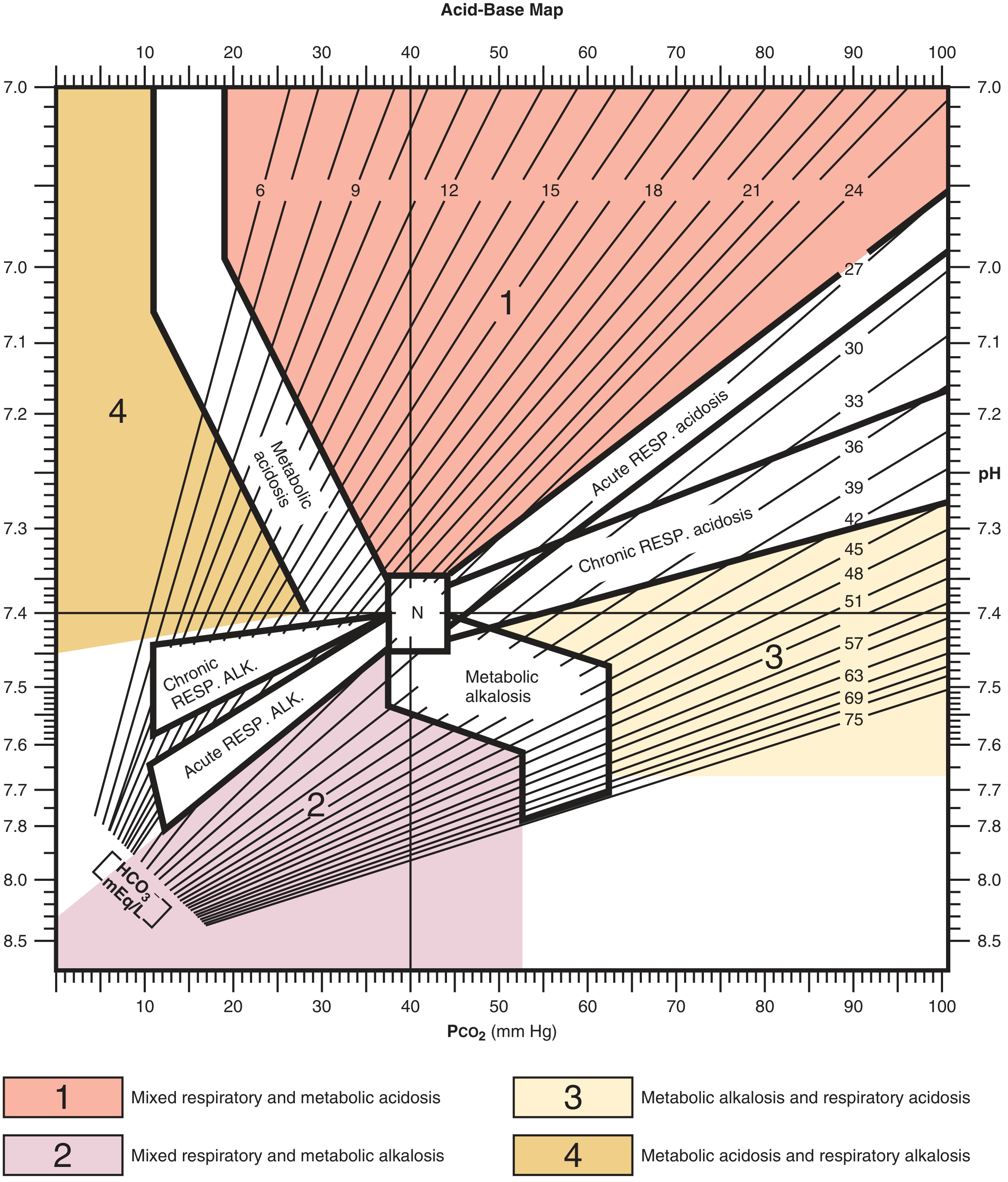
Roberts and Hedges' Clinical Procedures in Emergency Medicine
- Zone 1 (upper right, red): Mixed respiratory + metabolic acidosis
- Zone 2 (lower left, pink): Mixed respiratory + metabolic alkalosis
- Zone 3 (lower right, yellow): Metabolic alkalosis + respiratory acidosis
- Zone 4 (upper left, orange): Metabolic acidosis + respiratory alkalosis
- N (center): Normal
Worked Examples
Example 1 - Metabolic acidosis with compensation:
A 58-year-old with 1 week of diarrhea: Na+ 133, K+ 2.8, pH 7.26, Cl- 118, PCO2 13, HCO3- 5
- pH < 7.40 → acidosis
- HCO3- is low, PCO2 is not elevated → primary metabolic acidosis
- Expected PCO2 = 40 - (1.3 × [25-5]) = 40 - 26 = 14 mm Hg; actual = 13 → appropriate compensation, no mixed disorder
Example 2 - Respiratory alkalosis (sepsis):
A 74-year-old with sepsis: pH 7.49, PCO2 25, HCO3- 22
- pH > 7.45 → alkalosis
- PCO2 low, HCO3- normal → primary respiratory alkalosis
- Cause: hyperventilation from sepsis/fever
Quick Reference: Henderson-Hasselbalch Equation
pH = 6.1 + log10([HCO3-] / 0.003 × PaCO2)
This is the backbone of ABG interpretation. Any change in HCO3- (metabolic) or PaCO2 (respiratory) drives a change in pH.
Venous Blood Gas (VBG) vs. ABG
- Venous pH averages ~0.03 lower than arterial
- PvCO2 averages 3-8 mm Hg higher than PaCO2
- VBG is unreliable in hypotensive patients and severe hypercapnia
- A normal PvCO2 can be used to exclude hypercapnia
Sources: Goldman-Cecil Medicine, Roberts & Hedges' Clinical Procedures in Emergency Medicine, Barash's Clinical Anesthesia, ROSEN's Emergency Medicine
Abg analysis from.basics.to.clinicals
Finding Sources
Finding Sources
Finding Sources
Reading File
Reading File
Finding Sources
Finding Sources
Finding Sources
Reading File
Reading File
Reading File
Reading File
Reading File
Finding Sources
Loading Image
Finding Sources
Reading File
Finding Sources
Reading File
Loading Image
Now I have everything needed. Here is the full guide, basics to clinicals.
ABG Analysis: Basics to Clinicals
PART 1 - THE PHYSIOLOGY (Why ABG Matters)
The Body's pH Dilemma
The human body generates massive amounts of acid daily - roughly 15,000 mmol of volatile acid (CO2) from metabolism and 50-100 mEq of non-volatile (fixed) acids. Yet blood pH must stay between 7.35 and 7.45 for enzymes, ion channels, and protein structures to function. Outside this range, cellular function rapidly collapses.
pH = negative log of [H+]
- pH 7.40 = [H+] of 40 nmol/L (normal)
- pH 7.10 = [H+] of 79 nmol/L (potentially lethal)
The Henderson-Hasselbalch Equation
This is the mathematical core of ABG analysis:
pH = 6.1 + log10 ( [HCO3-] / 0.003 × PaCO2 )
- Numerator (HCO3-) = kidneys regulate this (metabolic component)
- Denominator (PaCO2) = lungs regulate this (respiratory component)
- Any change in either drives a change in pH
Three Lines of Defense
| Buffer System | Location | Speed | Mechanism |
|---|---|---|---|
| Chemical buffers (HCO3-, proteins, phosphate) | Blood, ICF | Seconds | H+ binding |
| Respiratory | Lungs | Minutes | Adjust PaCO2 via ventilation rate |
| Renal | Kidneys | Hours - days (3-5 days full effect) | Regulate HCO3- reabsorption/H+ excretion via carbonic anhydrase in tubular cells |
Key renal mechanism: Tubular cells use carbonic anhydrase to produce H+ and HCO3- from CO2. In acidosis - H+ secreted into tubular lumen, HCO3- reabsorbed into blood. In alkalosis - the reverse.
PART 2 - NORMAL ABG VALUES
| Parameter | Normal | Clinical Significance |
|---|---|---|
| pH | 7.35 - 7.45 | Overall acid-base balance |
| PaCO2 | 35 - 45 mm Hg | Ventilation; raised = hypoventilation, low = hyperventilation |
| PaO2 | 70 - 95 mm Hg (age-dependent) | Oxygenation |
| HCO3- | 22 - 26 mmol/L | Metabolic component |
| Base Excess (BE) | -2 to +2 mEq/L | Metabolic acid-base deviation from normal |
| SaO2 | 95 - 100% | Hemoglobin oxygen saturation |
Age-adjusted PaO2 (sitting): PaO2 = 104.2 - (0.27 × age in years)
PART 3 - THE 6-STEP SYSTEMATIC APPROACH
Step 1 - Determine pH Status
| pH | Interpretation |
|---|---|
| < 7.35 | Acidemia |
| 7.35 - 7.45 | Normal (but a disorder may still exist!) |
| > 7.45 | Alkalemia |
A normal pH does NOT exclude acid-base disorder - compensated or mixed disorders may coexist.
Step 2 - Identify the Primary Disorder
Match the pH direction to the changing parameter:
| pH | PaCO2 | HCO3- | Disorder |
|---|---|---|---|
| ↓ | ↑ | Normal / slightly ↑ | Respiratory acidosis |
| ↑ | ↓ | Normal / slightly ↓ | Respiratory alkalosis |
| ↓ | Normal / ↓ | ↓ | Metabolic acidosis |
| ↑ | Normal / ↑ | ↑ | Metabolic alkalosis |
Rule: The parameter that moves in the same direction as pH is the metabolic component; if it moves opposite, it's the respiratory component.
Step 3 - Assess Compensation
Compensation corrects pH but is never complete. It only moves pH back toward normal, not to normal.
| Primary Disorder | Compensation | Formula |
|---|---|---|
| Metabolic acidosis | ↓ PaCO2 (hyperventilation) | Winter's formula: PaCO2 = (1.5 × HCO3-) + 8 ± 2 |
| Metabolic alkalosis | ↑ PaCO2 (hypoventilation) | Expected ΔPCO2 = 0.7 × ΔHCO3- (or 40 + 0.7 × [HCO3-measured - 24]) |
| Respiratory acidosis (acute) | ↑ HCO3- (buffering) | HCO3- ↑ 1 mmol/L per ↑10 mm Hg PCO2 |
| Respiratory acidosis (chronic) | ↑ HCO3- (renal) | HCO3- ↑ 4 mmol/L per ↑10 mm Hg PCO2 |
| Respiratory alkalosis (acute) | ↓ HCO3- (buffering) | HCO3- ↓ 2 mmol/L per ↓10 mm Hg PCO2 |
| Respiratory alkalosis (chronic) | ↓ HCO3- (renal) | HCO3- ↓ 5 mmol/L per ↓10 mm Hg PCO2 |
If the measured compensation does not match the predicted → mixed disorder is present.
Timing matters:
- Respiratory compensation of metabolic disorders: minutes to hours
- Renal compensation of respiratory disorders: 3-5 days for full effect
Step 4 - Calculate the Anion Gap (when metabolic acidosis is present - or always)
AG = Na+ - (Cl- + HCO3-) Normal: 8-12 mEq/L (some texts use 12 as the upper limit; Barash uses <13)
Albumin correction is mandatory - albumin is the major unmeasured anion:
Corrected AG = measured AG + 2.5 × (4 - albumin g/dL)
| High AG Metabolic Acidosis | Normal AG (Hyperchloremic) Metabolic Acidosis |
|---|---|
| MUDPILES | HARDUP |
| Methanol | Hyperalimentation / Hospital saline |
| Uremia | Acid infusion / Addison's disease / Carbonic anhydrase inhibitors |
| DKA (diabetic, alcoholic, starvation) | Renal tubular acidosis |
| Paraldehyde / Propylene glycol | Diarrhea |
| Iron / Isoniazid | Ureterosigmoidostomy |
| Lactic acidosis | Pancreatic fistula / drainage |
| Ethylene glycol | |
| Salicylates |
Step 5 - Calculate the Urine Anion Gap (for normal-AG acidosis)
Urine AG = Urine Na+ + Urine K+ - Urine Cl-
| Urine AG | Interpretation |
|---|---|
| Negative (Cl- > Na+ + K+) | Appropriate NH4+ excretion → GI loss (diarrhea) |
| Positive (Cl- < Na+ + K+) | Impaired NH4+ excretion → Renal cause (RTA) |
Step 6 - Delta-Delta Ratio (Δ/Δ) for High-AG Acidosis
Used to unmask a hidden concurrent metabolic disorder.
Δ/Δ = (Measured AG - Normal AG) / (Normal HCO3- - Measured HCO3-) = ΔAG / ΔHCO3-
| Δ/Δ Ratio | Meaning |
|---|---|
| < 1.0 | High-AG acidosis + concurrent normal-AG acidosis (double acidosis, e.g., DKA + diarrhea) |
| 1.0 - 2.0 | Pure high-AG metabolic acidosis |
| > 2.0 | High-AG acidosis + concurrent metabolic alkalosis (or compensated chronic respiratory acidosis) |
Example from Harrison's: Uremia with vomiting: Na+ 140, K+ 3.0, Cl- 95, HCO3- 25, AG 20, PaCO2 40, pH 7.42 → ΔAG (10) >> ΔHCO3 (0) → high-AG acidosis masked by metabolic alkalosis from vomiting.
PART 4 - THE FOUR PRIMARY DISORDERS IN DEPTH
4A. Metabolic Acidosis
Definition: pH < 7.35, HCO3- < 22 mmol/L, PaCO2 low (compensatory)
Pathophysiology: Addition of strong acid (consumes HCO3-) OR loss of HCO3- (diarrhea, RTA)
Lactic Acidosis - important subtype:
| Type | Mechanism | Examples |
|---|---|---|
| Type A | Tissue hypoperfusion / hypoxia | Shock, cardiac arrest, bowel ischemia, severe hypoxemia |
| Type B | No tissue hypoxia | Metformin, liver failure, leukemia, HIV NRTIs (stavudine, zidovudine), seizures, heat stroke, CO poisoning |
Clinical features of severe acidemia (pH < 7.2):
- Myocardial depression, arrhythmias, vasodilation
- Hyperkalemia (H+ shifts into cells in exchange for K+)
- Kussmaul breathing (deep, labored hyperventilation)
- CNS depression
Treatment: Address the underlying cause. NaHCO3 is controversial - consider if pH < 7.10 (or < 7.20 in AKI). The BICAR-ICU trial found no difference in overall mortality with bicarbonate therapy, but a secondary analysis showed benefit in AKI patients.
4B. Metabolic Alkalosis
Definition: pH > 7.45, HCO3- > 26 mmol/L, PaCO2 high (compensatory)
Two components needed: Generation (acid loss or alkali gain) + Maintenance (usually impaired renal excretion of HCO3-)
Common causes:
- GI loss of H+: Vomiting, nasogastric suction → loss of HCl → hypochloremic alkalosis
- Diuretics: Loop/thiazide diuretics → Cl- and volume loss → contraction alkalosis + secondary hyperaldosteronism
- Exogenous alkali: Antacids, bicarbonate infusion
- Hyperaldosteronism: Increases distal H+ secretion
Urine Cl- to classify:
| Urine Cl- | Category | Response to saline |
|---|---|---|
| < 25 mEq/L | Saline-responsive | Yes (vomiting, diuretic, NG suction) |
| > 40 mEq/L | Saline-resistant | No (hyperaldosteronism, Cushing's, Bartter's) |
Clinical features: Hypokalemia, muscle weakness, tetany (rare), hypoventilation, cardiac arrhythmias.
4C. Respiratory Acidosis
Definition: pH < 7.35, PaCO2 > 45 mm Hg, HCO3- elevated (compensatory)
Pathophysiology: Any cause of reduced alveolar ventilation or increased CO2 production that outpaces ventilation.
Causes:
- CNS depression: Opioids, sedatives, anesthesia, stroke
- Neuromuscular: Guillain-Barré, myasthenia gravis, ALS, residual neuromuscular blockade
- Airway/lung: COPD, severe asthma, ARDS (permissive hypercapnia from lung-protective ventilation)
- Chest wall: Obesity hypoventilation, kyphoscoliosis, pneumothorax
- Hypermetabolic states (↑ CO2 production): Sepsis, malignant hyperthermia, high carbohydrate loads
Paradox: Respiratory acidosis causes catecholamine release → increased CO and BP; shifts O2-hemoglobin dissociation curve rightward (Bohr effect) → improves tissue oxygen delivery.
Acute vs. Chronic:
| Acute | Chronic | |
|---|---|---|
| HCO3- change per 10 mm Hg ↑PCO2 | +1 mmol/L | +4 mmol/L (3-4 days) |
| pH | Significantly low | Closer to normal |
| Clinical clue | Sudden onset, distress | Adapted, baseline hypercapnia |
Permissive hypercapnia: Deliberate in ARDS with lung-protective ventilation - accept elevated PaCO2 to limit ventilator-induced lung injury. Anticipate respiratory acidosis as a consequence.
4D. Respiratory Alkalosis
Definition: pH > 7.45, PaCO2 < 35 mm Hg, HCO3- low (compensatory)
Most common acid-base disturbance in the ICU; when severe, portends poor prognosis.
Causes (organized by mechanism):
- Central stimulation: Anxiety/panic, pain, fever, CNS injury (cerebral edema, tumor), salicylate toxicity (early), theophylline
- Peripheral stimulation: Hypoxemia (altitude, pneumonia, PE, ARDS), stimulation of lung receptors (interstitial lung disease, pulmonary edema)
- Hormonal: Pregnancy (progesterone ↑ ventilation, PaCO2 drops 5-10 mm Hg - a normal finding!)
- Systemic disease: Sepsis (early - often before fever and hypotension appear), liver failure (correlates with severity and mortality)
- Iatrogenic: Mechanical ventilator over-ventilation
Clinically important: Respiratory alkalosis of sepsis often precedes other hemodynamic signs - an early clue to impending septic shock.
Symptoms (acute): Paresthesias, circumoral numbness, chest tightness, dizziness, carpopedal spasm (tetany from reduced ionized Ca2+).
Treatment: Treat the underlying cause. In ventilated patients: reduce tidal volume or respiratory rate, increase dead space. In hyperventilation syndrome: reassurance, rebreathing (with oxygenation monitoring).
PART 5 - ADVANCED: OSMOLAR GAP
Used when high-AG metabolic acidosis is present and toxic alcohol ingestion is suspected.
Osmolar Gap = Measured Osmolality - Calculated Osmolarity Calculated Osmolarity = (2 × Na) + (Glucose/18) + (BUN/2.8) + (EtOH/3.7) Normal osmolar gap: ≤ 10 mOsm/kg
| Finding | Interpretation |
|---|---|
| Wide osmolar gap (>10) + high AG | Suspect methanol or ethylene glycol |
| Normal osmolar gap | Does NOT exclude toxic alcohol (gap falls as alcohol metabolizes) |
Quick estimations when level unavailable:
- Methanol (mg/dL) ≈ osmolar gap × 3
- Ethylene glycol (mg/dL) ≈ osmolar gap × 6
PART 6 - OXYGENATION ASSESSMENT
Alveolar-Arterial (A-a) Gradient
P(A-a)O2 = FiO2 × (Patm - PH2O) - (PaO2 + PaCO2/RQ)
On room air: simplified as (Age/4) + 4 (normal expected value)
| Mechanism of Hypoxemia | A-a Gradient | Example |
|---|---|---|
| V/Q mismatch | Increased | Pneumonia, PE |
| Diffusion impairment | Increased | ILD |
| R-to-L shunt | Increased | Pulmonary AVM, intracardiac shunt |
| Hypoventilation | Normal | Opioid overdose, neuromuscular weakness |
| Low FiO2 / altitude | Normal | Altitude exposure |
| Hepatopulmonary syndrome | Increased | Liver cirrhosis |
PART 7 - MIXED ACID-BASE DISORDERS
When compensation is inadequate OR excessive, a second primary disorder is present. Use the acid-base map and Δ/Δ ratio to unmask.
| Mixed Disorder | Key Clue | Classic Clinical Scenario |
|---|---|---|
| High-AG acidosis + respiratory alkalosis | PCO2 lower than Winter's formula predicts | Salicylate OD, sepsis with lactic acidosis |
| High-AG acidosis + respiratory acidosis | PCO2 higher than Winter's formula predicts | Severe pneumonia / pulmonary edema + shock |
| Metabolic alkalosis + respiratory alkalosis | pH much higher than expected; PCO2 doesn't rise | Cirrhosis + diuretics, end-stage liver disease |
| Metabolic alkalosis + respiratory acidosis | pH nearly normal but both HCO3- and PCO2 markedly high | COPD patient on diuretics |
| High-AG acidosis + metabolic alkalosis | Δ/Δ > 2; pH and HCO3- near normal despite elevated AG | DKA + vomiting, uremia + vomiting |
| High-AG acidosis + normal-AG acidosis | Δ/Δ < 1; HCO3- falls more than expected from AG alone | DKA + diarrhea, toluene toxicity |
PART 8 - CLINICAL CASE WALK-THROUGHS
Case 1 - DKA with Hidden Metabolic Alkalosis
Labs: Na+ 140, K+ 3.0, Cl- 95, HCO3- 25, AG 20, PaCO2 40, pH 7.42
- pH 7.42 → normal (slightly alkalotic trend)
- AG = 140 - (95+25) = 20 → high AG
- Compensation check: Winter's = (1.5×25)+8 = 45.5 - but PCO2 is 40 → higher than expected → suspect concurrent alkalosis
- Δ/Δ = (20-12)/(25-25) = 8/0 = infinity → ΔAG >> ΔHCO3 → concurrent metabolic alkalosis
- Diagnosis: High-AG metabolic acidosis (uremia) + metabolic alkalosis (vomiting)
Case 2 - Ethylene Glycol Ingestion
Labs: Na+ 140, Cl- 100, HCO3- 8, Glucose 80, BUN 30, EtOH 240 mg/dL, PaCO2 17, pH 7.13, Measured Osmolality 425
- pH 7.13 → severe acidemia
- HCO3- 8 → primary metabolic acidosis
- AG = 140 - (100+8) = 32 → high AG
- Winter's PCO2 = (1.5×8)+8 = 20 ± 2; actual = 17 → appropriate compensation, no superimposed respiratory disorder
- Δ-gap: ΔAG = 32-15 = 17; ΔHCO3 = 24-8 = 16 → ratio ~1:1 → pure high-AG acidosis
- Calculated osmolarity = (2×140) + (80/18) + (30/2.8) + (240/3.7) = 280 + 4.4 + 10.7 + 64.9 = 360
- Osmolar gap = 425 - 360 = 65 → markedly elevated → toxic alcohol ingestion
- Ethylene glycol estimate = 65 × 6 = 390 mg/dL
Case 3 - Sepsis (Early)
Labs: pH 7.49, PCO2 25, HCO3- 22
- pH 7.49 → alkalemia
- PCO2 ↓ → primary respiratory alkalosis
- HCO3- normal → acute (no renal compensation yet)
- Cause: sepsis-stimulated hyperventilation - often the earliest ABG sign of sepsis, before fever or hemodynamic changes
Case 4 - COPD Exacerbation
Labs: pH 7.28, PCO2 72, HCO3- 32
- pH 7.28 → acidemia
- PCO2 72 (↑) → primary respiratory acidosis
- Acute compensation: HCO3- should = 24 + (1 × (72-40)/10) = 24 + 3.2 = 27.2; measured is 32 → higher → chronic compensation (4 per 10 mm Hg = 24 + 12.8 = 36.8 expected for pure chronic)
- HCO3- of 32 is between acute (27) and chronic (37) predictions → acute-on-chronic respiratory acidosis
- Key management: Do not normalize PCO2 rapidly in known COPD - risks severe alkalosis as the high HCO3- is "unmasked"
PART 9 - QUICK REFERENCE CARD
Compensation Formulas at a Glance
Metabolic acidosis:     PCO2 expected = (1.5 × HCO3-) + 8 ± 2  [Winter's]
Metabolic alkalosis:    PCO2 expected = 40 + 0.7 × (HCO3- - 24)
Resp. acidosis (acute): HCO3- ↑ 1 per ↑10 PCO2
Resp. acidosis (chronic): HCO3- ↑ 4 per ↑10 PCO2
Resp. alkalosis (acute): HCO3- ↓ 2 per ↓10 PCO2
Resp. alkalosis (chronic): HCO3- ↓ 5 per ↓10 PCO2
Metabolic Paths - Compensation Diagram
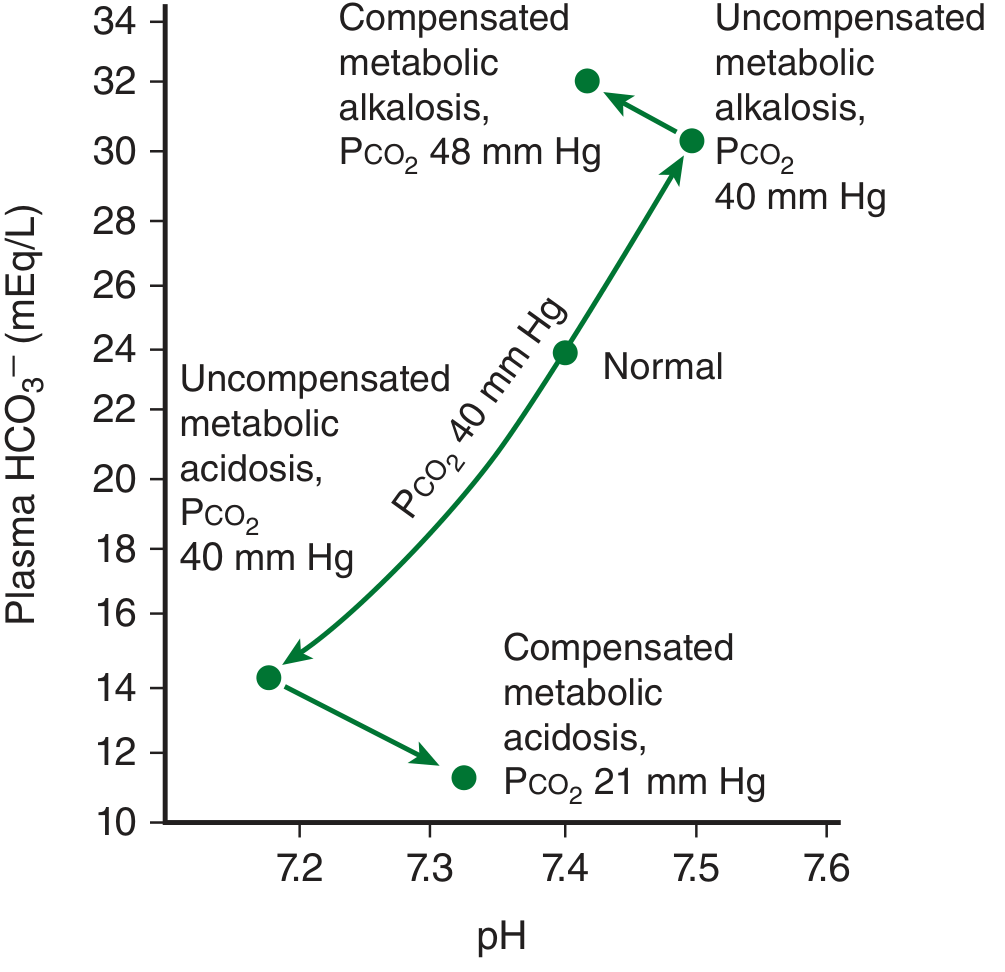
Ganong's Review of Medical Physiology - uncompensated metabolic disturbances occur along the PCO2 isobar line; respiratory compensation then moves pH back toward normal by altering PCO2.
Mnemonics
| Mnemonic | Applies to |
|---|---|
| MUDPILES | High-AG metabolic acidosis causes |
| HARDUP | Normal-AG metabolic acidosis causes |
| ROME | Respiratory Opposite, Metabolic Equal (the primary parameter moves opposite to pH in respiratory, same direction in metabolic) |
Sources: Goldman-Cecil Medicine; ROSEN's Emergency Medicine; Roberts & Hedges' Clinical Procedures in Emergency Medicine; Barash's Clinical Anesthesia 9e; Miller's Anesthesia 10e; Brenner & Rector's The Kidney; Ganong's Review of Medical Physiology; Harrison's Principles of Internal Medicine 22eThis is a complete ABG guide covering everything from physiology to clinical application. Here's what's included:
Part 1 - Physiology: Why the body needs tight pH control, Henderson-Hasselbalch equation, the three buffer systems (chemical, respiratory, renal) and their speeds.
Part 2 - Normal Values: All parameters with clinical significance.
Part 3 - The 6-Step Approach:
- pH status
- Primary disorder identification
- Compensation assessment (with all formulas)
- Anion gap + albumin correction (MUDPILES / HARDUP)
- Urine anion gap for normal-AG acidosis
- Delta-delta ratio to unmask hidden mixed disorders
Part 4 - Four Primary Disorders in Depth: Each with pathophysiology, causes, clinical features, and management - including lactic acidosis Type A/B, metabolic alkalosis chloride-responsive vs. resistant, permissive hypercapnia in ARDS, and respiratory alkalosis as an early sepsis sign.
Part 5 - Osmolar Gap: Toxic alcohol ingestion, estimation formulas.
Part 6 - Oxygenation: A-a gradient and all six mechanisms of hypoxemia.
Part 7 - Mixed Disorders: Using the acid-base map and Δ/Δ ratio with classic clinical scenarios.
Part 8 - Four Worked Clinical Cases: DKA with hidden metabolic alkalosis, ethylene glycol ingestion, early sepsis, and acute-on-chronic COPD.
This is a shared conversation. Sign in to Orris to start your own chat.