I have the full PPT content. Now let me integrate everything into a comprehensive, simplified, memorable guide.
🧠 THE FRONTAL LOBE - Complete Integrated Study Guide
(PPT + Textbooks Combined | Simplified for 20-Mark Exam)
Source: Brain & Behaviour (David Clark, Nash Boutons, Mario Mendez, 3rd Ed) + Kaplan & Sadock + Harrison's + Adams & Victor + Neuroanatomy through Clinical Cases
PART 1: ORIENTATION - WHERE IS IT?
Think of the frontal lobe as the "FRONT OFFICE" of the brain - it's the boss.
- Largest lobe of the brain (~1/3 of total cortex)
- Anterior to the central sulcus (separates from parietal lobe)
- Above the lateral sulcus / Sylvian fissure (separates from temporal lobe)
- Most anterior tip = frontal pole
- Also called the "Social Lobe" or "Newest Lobe" (evolutionarily most recent)
Gyri - easy to remember (4 gyri total):
| Gyrus | Where | Key Content |
|---|
| Precentral Gyrus | Directly anterior to central sulcus | Primary Motor Cortex (Area 4) |
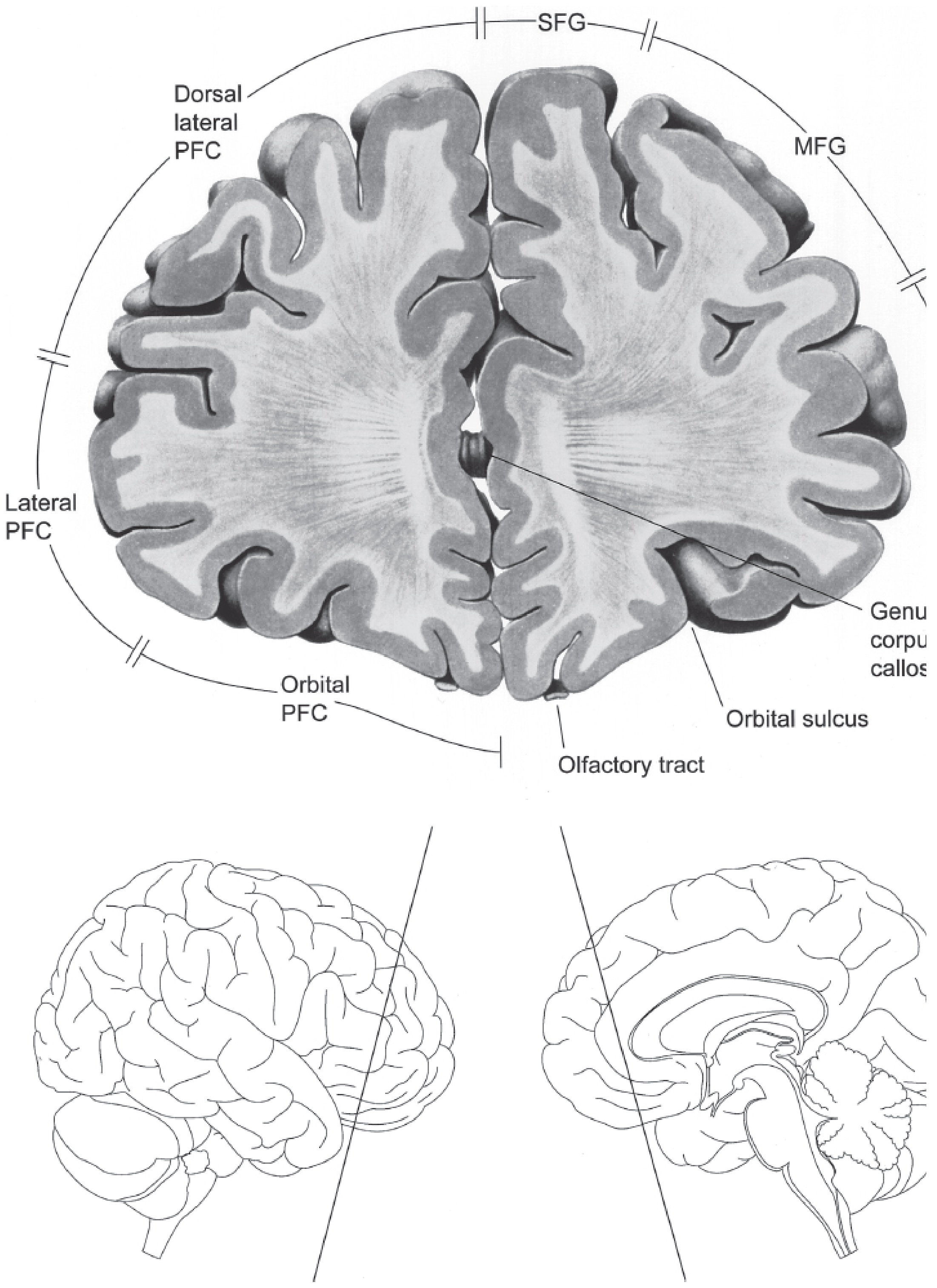
| Superior Frontal Gyrus (SFG) | Top horizontal strip | Higher cognition |
| Middle Frontal Gyrus (MFG) | Middle horizontal strip | DLPFC lives here |
| Inferior Frontal Gyrus (IFG) | Bottom strip, 3 parts: orbital, triangular, opercular | Broca's Area (44 & 45) |
PART 2: THE 6 FUNCTIONAL AREAS + THEIR FUNCTIONS + LESIONS + TESTS
Quick Map - Brodmann Numbers to Memorize:
Area 4   = Primary Motor
Area 6   = Premotor + SMA
Area 8   = Frontal Eye Fields
Area 9,10,46 = DLPFC
Area 10,11 = Orbitofrontal Cortex
Area 44,45 = Broca's Area
Area 24,25,32 = Anterior Cingulate (medial PFC)
🔴 1. PRIMARY MOTOR CORTEX (Area 4) - "The Muscle Commander"
Location: Precentral gyrus
Contains: Giant Betz cells (largest neurons in the body)
Inputs: Thalamus, basal ganglia, premotor cortex, sensory cortex
Output: Motor fibres → brainstem + spinal cord
Functions:
- Contraction of muscles on the OPPOSITE half of the body
- Bilateral control of: upper face, tongue, mandible, larynx, pharynx, axial muscles
- Each body part mapped on motor homunculus (face and hands get huge representation)
If damaged:
- Contralateral hemiparesis (UMN type - increased tone, increased reflexes, Babinski +ve)
- Increased/decreased tone, decreased power, decreased fine motor on opposite side
Bedside Tests:
- Motor Strength of Hand Grip - both hands, should be equal (dominant side slightly stronger). If examiner can easily free fingers = weak
- Finger Tapping (Motor Speed) - tap as fast as possible; does not differentiate from premotor cortex
🟠 2. PREMOTOR CORTEX (Area 6) - "The Motor Programme Store"
Location: Anterior to primary motor cortex, lateral surface
Inputs: Thalamus, basal ganglia, sensory cortex, SMA
Output: → Primary Motor Cortex
Functions:
- Stores motor programmes (learned motor skills)
- Controls coarse postural movements
- Externally triggered sequences
If damaged:
- Weakness in proximal muscles on contralateral side
- Apraxia (cannot perform learned skilled movements despite intact strength)
Bedside Tests:
- Finger-to-thumb succession test - touch each finger to thumb in rapid succession; watch speed and dexterity
- Apraxia tests - "blow a kiss" / "demonstrate use of a shovel"
🟡 3. SUPPLEMENTARY MOTOR AREA - SMA (Medial Area 6) - "The Internal Choreographer"
Location: Medial surface of frontal lobe, Area 6
Inputs: Cingulate gyrus, thalamus, sensory cortex, prefrontal cortex
Output: → Premotor cortex and primary motor cortex
Functions:
- Intentional perception of movement
- Procedural memory (how to do things - riding a bike)
- Internally generated (self-initiated) movements
- Bilateral motor coordination
If damaged:
- Mutism (cannot speak)
- Akinesia (cannot initiate movement)
- Alien hand syndrome
- Contralateral motor neglect
🟢 4. FRONTAL EYE FIELDS (Area 8) - "The Gaze Controller"
Location: Posterior middle frontal gyrus
Inputs: Parietal and temporal cortex
Output: → Caudate nucleus, superior colliculus, PPRF (Paramedian Pontine Reticular Formation)
Functions:
- Voluntary saccadic eye movements to the CONTRALATERAL side
- "Stimulation = eyes look AWAY from the side being stimulated"
If damaged:
- Destructive lesion → eyes deviate TOWARD the lesion (ipsilateral) = AWAY from hemiplegia
- Irritative/seizure → eyes deviate AWAY from lesion (contraversive) = TOWARD hemiplegia
- Easy memory trick: "Destruction = looking at your damage; Irritation = looking away from your damage"
Bedside Tests:
- Ask patient to follow a finger left to right, up and down (smooth pursuit)
- Ask patient to look left and right WITHOUT a finger to follow (tests voluntary saccades)
- Note: any inability to move or jerky movement
🔵 5. PREFRONTAL CORTEX (PFC) - "The CEO" - MOST IMPORTANT FOR PSYCHIATRY
This is the biggest area and the most relevant for your exam. It has 3 subregions:
A. DORSOLATERAL PFC / DLPFC (Areas 9, 10, 46)
Functions - "Executive Functions":
- Integration of sensory information
- Generation of range of responses to challenges
- Selection of most appropriate response
- Working memory (holding info while doing a task)
- Maintenance of task set
- Sequential ordering of data
- Self-evaluation of performance
- Shifting cognitive set (mental flexibility)
- "Formal thought disorder arises from a LACK of executive planning and editing" - PPT
If damaged:
- Poor planning, impaired working memory
- Cannot shift between tasks (perseveration)
- Disoriented thinking, difficulty coping with changing environments
Bedside Tests (from PPT - this is exam gold):
- "Is the patient able to make an appointment and arrive on time?"
- "Is the patient able to give a coherent account of their problems?"
- Digit span - 7 forward, 5 backward (normal); <7 forward = abnormal
- COWAT (Controlled Oral Word Association Test = FAS Test) - words starting with F, A, S in 1 minute each; >10 items normal, <8 = significant deficit. No proper nouns, no suffixed repeats.
- Category fluency - name animals / fruits / vegetables; >10 normal
- Alternating Hand Sequences / Luria Test - one hand palm up, other palm down; reverse as rapidly as possible. Frontal patients perform poorly.
- Wisconsin Card Sorting Test (WCST) - sort cards by colour/form/number; rules change silently. Frontal lobe damage = cannot adapt. Also abnormal in caudate damage and schizophrenia.
- Trail Making Test - connect dots (Part B = alternating numbers and letters). Tests: mental flexibility, executive functioning, speed of processing.
B. ORBITOFRONTAL CORTEX / OFC (Areas 10, 11)
Functions:
- Empathic, civil and socially appropriate behaviour
- Impulse control
- Decision-making (integrates emotional signals from amygdala)
- Reward processing
- Most of the personality change in frontal lobe injury is due to OFC damage
If damaged:
- Irritable and labile mood
- Disinhibition - inappropriate sexual behaviour, poor social judgment
- Witzelsucht - insensitive, crass humor that the patient finds funny but nobody else does
- Failure to respond to conventions of acceptable social behaviour
- No empathy, no concern for feelings of others
Increased OFC activity seen in:
- OCD (OFC + caudate hypermetabolism)
- Huntington's disease
- Globus pallidus lesions
Bedside Tests (from PPT):
- "Does the patient dress or behave in a way suggesting lack of concern for others?"
- Sense of Smell - test with coffee, cloves, etc. (anosmia = OFC tumor, trauma, dementia)
- Go/No-Go Test - "raise finger for 1 tap, keep still for 2 taps." Frontal patients CANNOT suppress the response to 2 taps. Failure = OFC + impaired inhibition. Also seen in ASPD, head injury, schizophrenia.
- Stroop Test - Say the INK COLOR, not the word (e.g., word "RED" printed in green ink → answer "green"). Failure of inhibition = OFC damage, OCD, impulse control disorders.
C. MEDIAL PREFRONTAL CORTEX / ANTERIOR CINGULATE CORTEX (Areas 24, 25, 32)
Functions:
- Motivation and drive
- Error monitoring and conflict detection
- Initiation of action
- Emotional regulation
If damaged:
- Profound apathy (pseudoapathetic state)
- Akinetic mutism (severe end) to mild abulia (mild end)
- Emotional blunting
- Seen in: bilateral ACA occlusion, trauma, hydrocephalus, bilateral thalamic infarction
🟣 6. BROCA'S AREA (Areas 44 & 45) - "The Speaker"
Location: Pars triangularis (Area 45) + Pars opercularis (Area 44) of inferior frontal gyrus
Hemisphere: LEFT (dominant) in most people (right-handed)
Functions:
- Production and formation of expressive speech/vocalization
- Connects with adjacent primary motor area → stimulates muscles of larynx, mouth, tongue, soft palate, respiratory muscles
If damaged - Broca's (Expressive) Aphasia:
- Loss of ability to produce speech = Expressive Aphasia = Motor Aphasia
- Patient CAN: think the words, write them, understand them (comprehension intact)
- Patient CANNOT: express in speech fluently, initiate speech, repeat, dictate
- Speech is non-fluent, laboured, telegraphic
- No paralysis of tongue/lips/vocal cords (purely cortical)
- Increased risk of MDD in these patients (they are aware and frustrated)
PART 3: THE 3 FRONTAL LOBE SYNDROMES (EXAM FAVOURITE - from PPT)
This is the most asked section. Learn these 3 syndromes with their nicknames:
| Syndrome | Other Name | Region | Core Features |
|---|
| Orbitofrontal Syndrome | Pseudopsychopathic state | OFC (Area 10/11) | Impulsiveness, distractibility, hyperkinesis, no empathy, no concern for others, irritable + labile mood, Witzelsucht |
| Medial Frontal Lobe Syndrome (MFLS) | Pseudoapathetic state | Medial PFC / ACC | Predominantly APATHY; spectrum from akinetic mutism → mild abulia |
| Frontal Convexity Syndrome (FCS) | Pseudodepressive state / Lateral frontal lobe syndrome | DLPFC | Executive deficits: perseveration, impersistence, difficulty planning, impaired serial order; release reflexes; soft neurological signs |
Memory trick: "P-P-D" = Pseudo-Psychopathic (OFC) | Pseudo-Apathetic (Medial) | Pseudo-Depressive (DLPFC)
"Schizophrenia is often considered to be a Frontal Convexity Syndrome" - from your PPT (exam line!)
PART 4: FRONTAL RELEASE SIGNS (Primitive Reflexes Re-Emerging)
These are reflexes that the developing frontal lobe suppresses. They return when the frontal lobe is damaged.
| Sign | How to Test | What You See |
|---|
| Grasp reflex | Stroke palm gently | Hand grasps involuntarily |
| Suck reflex | Stroke the lips | Sucking movement |
| Snout reflex | Tap the philtrum (above lips) | Lips pucker/protrude |
| Rooting reflex | Touch corner of mouth | Head turns toward stimulus |
| Glabellar tap | Tap between eyebrows repeatedly | Normal: blink stops after 3-4 taps; Abnormal: keeps blinking every tap |
| Palmomental reflex | Scratch thenar eminence (palm) | Ipsilateral chin muscle contracts |
| Gegenhalten (paratonia) | Try to passively move limb | Involuntary resistance matching your force |
Other signs to check:
- Motor impersistence - ask to hold tongue out or arms raised for 20 seconds (frontal patients cannot sustain)
- Abulia - passive, apathetic, speaks softly, markedly delayed responses
- Witzelsucht - inappropriate silly jocularity
- Confabulation - fabricates without intent to deceive
- Utilization behavior - picks up/uses random objects in front of them (e.g., wears someone else's glasses)
- Perseveration - keeps repeating same response even after question changes
- Frontal magnetic gait - small shuffling steps, feet "glued" to floor
- Incontinence - typically unconcerned about it
PART 5: COMPLETE TEST BATTERY FOR FRONTAL LOBE ASSESSMENT
I. History and Behavioral Observations
- Get history from family / other contacts - real-world behavior is the BEST test
- Watch for abulia, witzelsucht, confabulation, utilization behavior, perseveration, incontinence, inappropriate comments/touching
II. Mental Status Tests (Bedside - All in One Table)
| Test | What It Tests | Normal Score | Abnormal = |
|---|
| Digit Span (forward + backward) | Attention / working memory | 7 forward, 5 backward | <7 fwd, <5 bkwd |
| Months of year backward | Working memory | <15 seconds | Slow/errors |
| Serial Sevens (100-7-7-7...) | Concentration | Correct, fast | Errors, slow |
| Doubling Threes (2×3=6, ×2=12...) | Concentration (easier version) | Rapid correct answers | Stops early |
| COWAT / FAS Test | Verbal fluency (dominant frontal) | >10-12 words/letter/min | <8 = significant deficit |
| Animal/Category Naming | Frontal-temporal fluency | >15 animals/min or >10/category | <10 abnormal |
| Go-No-Go Test | Response inhibition (OFC) | Correctly holds back on 2 taps | Cannot suppress response |
| Stroop Test | Inhibition, executive function | Names ink color ignoring word | Reads word instead |
| Luria Alternating Hand Sequences | Set shifting / perseveration (DLPFC) | Rapidly alternates palm up/down | Cannot reverse, slow, errors |
| Luria Written/Manual Sequencing | Perseveration | Continues alternating pattern | Perseverates |
| Wisconsin Card Sorting Test (WCST) | Cognitive flexibility | Adapts when rules change | Cannot shift strategy |
| Trail Making Test B | Set shifting, processing speed | A-1-B-2-C-3 without errors | Cannot alternate |
| Proverb Interpretation | Abstract reasoning | Gives abstract meaning | Concrete ("rolling stone... = a stone that rolls") |
| Similarities | Abstract reasoning | "Apple & orange - both fruits" | Concrete ("both round") |
| Gambling Task (Iowa Gambling Task) | OFC decision making | Prefers long-term gains | Keeps picking high-risk |
| Conceptual Series Completion | Executive reasoning | Identifies pattern | Cannot identify |
III. Physical Exam
- Olfaction (coffee, cloves) - anosmia = OFC tumor/trauma/FTD
- Frontal release signs (above)
- Eye movements - voluntary saccades + smooth pursuit
- Gegenhalten / paratonia
- Hemiparesis / UMN signs
- Frontal gait - magnetic, shuffling
- Soft neurological signs (in FCS/schizophrenia)
IV. Formal Neuropsychological Tests
- Halstead Category Test / Milan Sorting Test - abstraction and paradigm shifting
- Porteus Maze / Reitan Trail Making - planning, regulation, checking programs
- Benton's Verbal Fluency Test - verbal skill and verbal regulation
- Figural Fluency (Five-Point Test) - nondominant frontal
V. Imaging
- MRI brain - structural atrophy, tumors, strokes
- PET / SPECT - hypofrontality (schizophrenia, depression, FTD)
- fMRI - DLPFC activation during working memory tasks
- EEG - frontal lobe epilepsy (brief, nocturnal, can mimic psychiatric episodes)
PART 6: PSYCHIATRIC DISORDERS AND FRONTAL LOBE (from PPT)
1. SCHIZOPHRENIA
- Most symptoms = PFC involvement
- Affective symptoms → Ventromedial PFC (VMPFC)
- Cognitive symptoms → DLPFC
- Aggressive symptoms → OFC
- Negative symptoms → Mesocortical areas + PFC
- Left temporal gray matter volume decrease ∝ disease severity
- Treatment: DBS over Nucleus Accumbens and Ventral Striatum
- "Schizophrenia is considered a Frontal Convexity Syndrome"
2. DEPRESSION
- Reduced DA, NE, 5-HT in PFC → cognitive dulling
- Damage to LEFT frontal lobe (stroke/lesion) → increases risk of depression
- rTMS (HIGH frequency) over DLPFC = FDA approved for treatment-resistant depression
- DBS over VMPFC (Area 25 - subgenual ACC)
3. ADHD
- Problems in executive functions of frontal cortex
- Hyperactivity → PFC
- Selective attention deficit → Dorsal Anterior Cingulate Gyrus
- Sustained attention + problem solving → DLPFC
- Impulsivity → OFC
- Frontal-striatal loop dysfunction; cortical thickness matures ~3 years late
4. OCD
- CSTC loop abnormality (Cortico-Striato-Thalamo-Cortical)
- Mainly OFC involved (OFC hypermetabolism)
- Low 5-HT levels in frontal lobe
- rTMS (LOW frequency) over SMA and OFC (not FDA approved)
- Increased OFC + caudate metabolism is characteristic
5. DEPRESSION FROM BROCA'S APHASIA
- Expressive aphasia → patient is aware they cannot speak → increased risk of MDD
6. ALCOHOLISM
- PFC linked to impulse control → PFC damage → increased binge drinking behavior
7. FRONTOTEMPORAL DEMENTIA (FTD)
- Neary criteria core features:
- Early decline in social and personal conduct
- Emotional blunting
- Loss of insight
- Relative sparing of memory and visuospatial function early on
- Executive function affected more than memory
Two variants:
- Behavioural variant (bvFTD): disinhibition, apathy, loss of empathy, perseveration, stereotyped/compulsive behaviour, hyperorality, dietary changes
- Semantic variant: speech production, word finding, object naming, grammar, comprehension affected
8. FRONTAL LOBE EPILEPSY
- Bizarre presentation with physical/emotional aura, tingling, numbness, tension
- Fear on face, tonic posturing, clonic movements
- Can be Simple or Complex partial seizure
- Multiple brief episodes daily, often nocturnal
- Often NO post-ictal deficits - this leads to misdiagnosis as psychiatric/psychogenic episodes!
- 20-30% of operative procedures for intractable epilepsy
- Specific features by area:
- Dorsolateral: contraversive head/eye turning, aphasia (dominant)
- SMA: fencing posture, speech arrest, unusual sounds
- Orbitofrontal/cingulate: elaborate motor automatisms, autonomic changes, olfactory hallucinations
PART 7: ONE-PAGE MEMORY CHEAT SHEET
FRONTAL LOBE = SOCIAL LOBE = NEWEST LOBE

AREA 4  → Primary Motor → Damage = Contralateral hemiparesis
AREA 6  → Premotor/SMA  → Damage = Proximal weakness/Apraxia/Akinesia+Mutism
AREA 8  → Frontal Eye Fields → Destructive = Eyes look AT lesion
AREA 44/45 → Broca → Damage = Expressive (non-fluent) aphasia
AREA 9/46 → DLPFC → Damage = Apathy, perseveration, poor working memory
AREA 10/11 → OFC → Damage = Disinhibition, impulsivity, witzelsucht
AREA 24/25 → Medial PFC/ACC → Damage = Akinetic mutism, apathy

THE 3 SYNDROMES:
OFC damage   = Pseudo-PSYCHOPATHIC (disinhibited)
Medial damage = Pseudo-APATHETIC (akinetic mutism → abulia)
DLPFC damage  = Pseudo-DEPRESSIVE (executive failure)

TESTS TO REMEMBER:
FAS (COWAT) > 10-12 per letter
Go-No-Go = OFC inhibition
WCST = DLPFC flexibility
Stroop = OFC inhibition
Luria = Perseveration
Trail B = Set shifting
Digit span = 7 forward / 5 backward

PSYCHIATRIC LINKS:
Schizophrenia = Hypofrontality (DLPFC)
Depression = Left frontal → rTMS high freq DLPFC (FDA approved)
OCD = OFC hyperactivity → rTMS low freq OFC
ADHD = Frontostriatal circuit
FTD = OFC+DLPFC degeneration
Alcoholism = OFC/PFC damage → impulse loss
PART 8: CLASSIC CASE TO QUOTE IN EXAM (Phineas Gage)
Phineas Gage (1848): A 25-year-old railroad worker had an iron rod driven through both frontal lobes in an explosion. He survived physically, but his personality changed completely. He became "fitful, irreverent, profane, impatient, unable to follow advice, no longer able to follow plans" - his friends said "he was no longer Gage." This is the prototype of orbitofrontal syndrome/disinhibition syndrome.
Reference: Brain & Behaviour, David Clark, Nash Boutons, Mario Mendez, 3rd Edition, Pg 84-121 | Kaplan & Sadock's Comprehensive Textbook of Psychiatry | Harrison's Principles of Internal Medicine 22E | Neuroanatomy through Clinical Cases 3rd Ed | Adams & Victor's Principles of Neurology 12th Ed