
Endometrial ca
Reading File
Finding Sources
Finding Sources
Searching PubMed
"endometrial cancer" AND treatment
Reading File
Reading File
Reading File
Reading File
Reading File
I have enough material now to give a comprehensive overview. Let me search for the FIGO staging table content specifically since that's a key clinical reference.
Finding Sources
I have enough to write a thorough, well-organized answer. Here it is.
Endometrial Carcinoma
Endometrial carcinoma is the most common malignancy of the female genital tract, accounting for almost half of all gynecologic cancers and about 2.8% lifetime risk in women. It ranks fourth among cancers in women (after breast, lung, and colorectal) and occurs mainly in postmenopausal women, becoming more aggressive with advancing age (Berek & Novak's Gynecology, p. 2141).
Pathogenesis - Two Types
Type I (75-85% of cases)
- Estrogen-dependent, arises from a background of endometrial hyperplasia
- Occurs in younger, perimenopausal women with unopposed estrogen exposure (endogenous or exogenous)
- Usually well-differentiated (endometrioid histology), favorable prognosis
- Early molecular changes: inactivation of DNA mismatch repair genes and the PTEN gene
Type II
- Estrogen-independent, arises against a background of endometrial atrophy, not hyperplasia
- Occurs in older, postmenopausal, often thin women; disproportionately affects African American and Asian women
- Poorly differentiated (serous, clear cell histology), worse prognosis
- Early molecular event: TP53 mutation, often present even in the precursor lesion (serous endometrial intraepithelial carcinoma)
- Serous and clear cell carcinomas make up less than 10% of cases but cause more than half of all endometrial cancer deaths
(Robbins & Kumar Basic Pathology, p. 718; Berek & Novak's Gynecology, p. 2143)
Risk Factors
Most relate to prolonged, unopposed estrogen stimulation:
- Nulliparity (2-3x risk)
- Anovulatory cycles / infertility / irregular menses
- Late menopause (after 52, 2.4x risk vs. before 49)
- Obesity (1.5x overweight, >2.5x obese - from peripheral aromatization of androstenedione to estrone)
- Unopposed exogenous estrogen therapy (4-8x risk, increases with dose and duration)
- Diabetes, hypertension, PCOS, tamoxifen use, Lynch syndrome/HNPCC
Clinical Presentation
- Postmenopausal bleeding is the cardinal symptom - though only about 10% of women with postmenopausal bleeding actually have endometrial cancer (endometrial atrophy 60-80%, estrogen therapy 15-25%, polyps 2-12%, hyperplasia 5-10% account for the rest).
- Premenopausal women may have menometrorrhagia, oligomenorrhea, or bleeding persisting past the usual age of menopause.
- Physical exam is often unremarkable early; look for peripheral lymphadenopathy, adnexal masses, parametrial induration, or cul-de-sac nodularity in advanced disease.
Diagnosis
- Office endometrial aspiration biopsy is the first-line diagnostic step (90-98% diagnostic accuracy vs. D&C/hysterectomy).
- Transvaginal ultrasound and hysteroscopy are useful adjuncts, especially if biopsy is inconclusive or polyps are suspected.
- Preoperative workup: history/physical, chest X-ray (to exclude pulmonary metastases), CBC, EKG. CT or MRI can help assess myometrial invasion and guide extent of surgery, particularly in type II disease.
Pathologic Types
- Endometrioid adenocarcinoma (most common)
- Mucinous carcinoma
- Serous carcinoma
- Clear cell carcinoma
- Squamous carcinoma
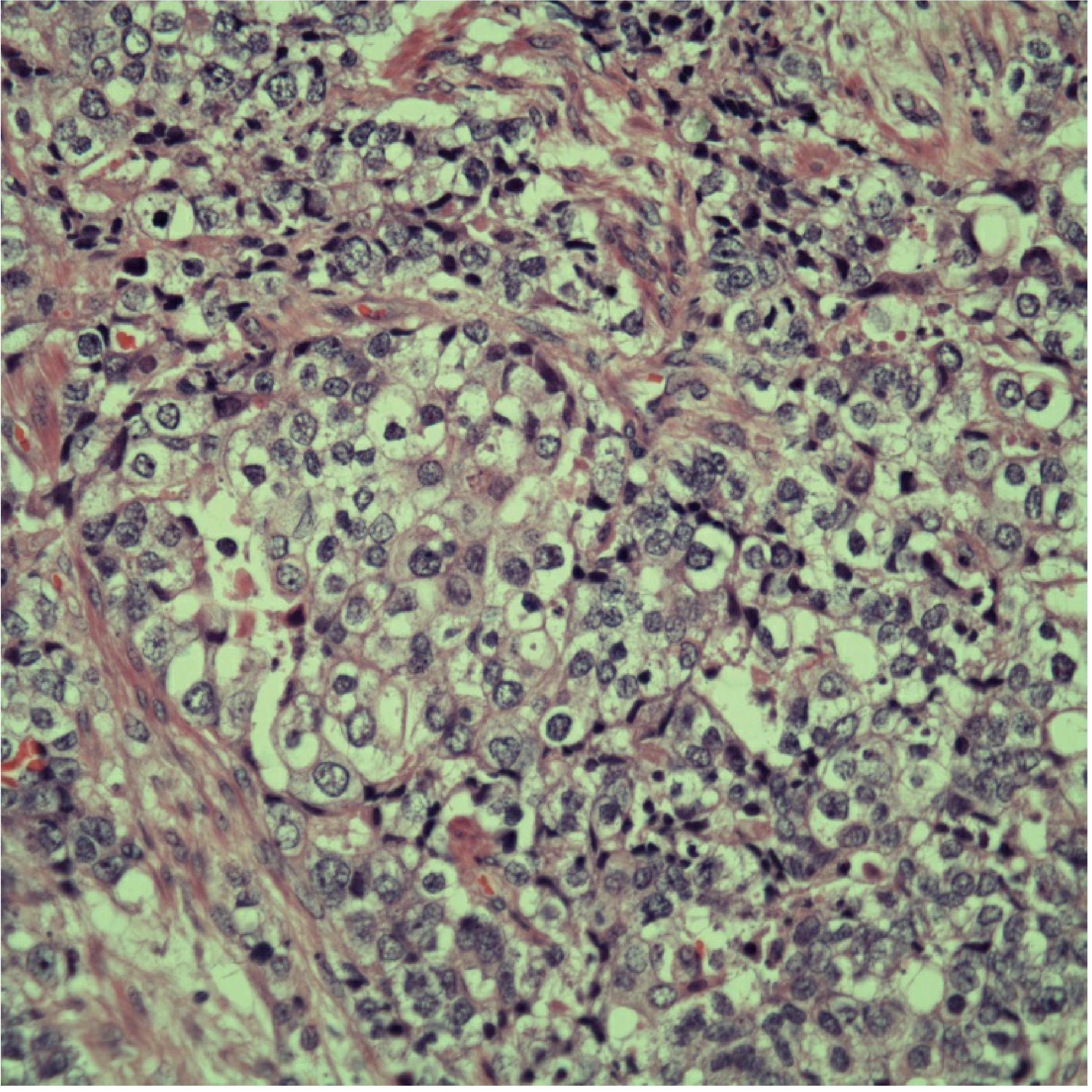
Below is an example of clear cell adenocarcinoma histology showing back-to-back glands with polygonal/columnar cells and prominent nucleoli:
Staging (FIGO, surgical)
Endometrial cancer is surgically staged (not clinically staged, except in patients who cannot undergo surgery). The 2009 FIGO revision:
- Combined former stages IA/IB into a single Stage I
- Eliminated old Stage IIA - only cervical stromal invasion now defines Stage II
- Removed positive peritoneal cytology as an upstaging criterion (though washings are still recommended and retain prognostic value)
- Split Stage IIIC into IIIC1 (positive pelvic nodes) and IIIC2 (positive para-aortic nodes)
- Recognized parametrial involvement as Stage IIIB
Standard surgical staging includes total hysterectomy, bilateral salpingo-oophorectomy, peritoneal cytology/washings, and lymph node assessment (pelvic +/- para-aortic), which may be omitted in patients with negligible risk of nodal spread (e.g., low-grade, minimally invasive tumors).
Prognostic Factors
Advancing age, non-endometrioid or grade 3 histology, deep myometrial invasion, lymphovascular space invasion, large tumor size, cervical extension, lymph node metastasis, and intraperitoneal spread.
Treatment
- Surgery (hysterectomy, BSO, staging) is primary treatment for most patients.
- Adjuvant radiotherapy (vaginal vault brachytherapy, external pelvic radiation, or extended-field/whole-abdomen radiation depending on risk factors) reduces local/vaginal recurrence and improves disease-free survival in selected higher-risk patients.
- Chemotherapy is used for advanced-stage, high-grade, or recurrent disease.
- Hormonal therapy (progestins) has a role in low-grade, hormone-receptor-positive disease and in fertility-sparing management of early (Stage IA) endometrioid cancer in young women who wish to preserve fertility.
- Recurrent disease: isolated vaginal recurrences can be salvaged with radiotherapy in up to 80% of previously unirradiated patients.
Recent Evidence Worth Noting
A few recent systematic reviews/meta-analyses may refine current practice beyond what's in the textbook (which reflects data through ~2018):
- Fertility-sparing treatment for atypical hyperplasia and early endometrial cancer (progestins, levonorgestrel IUD, +/- metformin) - Cochrane systematic review, 2025 (PMID: 40626388), and a related meta-analysis specific to Stage IA cancer (PMID: 39032722, 2024). These support fertility preservation as a reasonable option in carefully selected young patients with well-differentiated, superficial disease, but with recurrence risk that needs counseling.
- First-line treatment for advanced/recurrent disease has shifted meaningfully with immunotherapy (e.g., pembrolizumab combinations) - systematic review, 2025 (PMID: 39557140). This reflects a significant update from older chemotherapy-only paradigms, particularly relevant for mismatch-repair-deficient (dMMR) tumors.
If you want, I can go deeper into any specific area - staging table details, molecular classification (POLE, MMR, p53, NSMP subtypes per the current molecular/TCGA classification), specific treatment protocols, or fertility-sparing criteria.
This is a shared conversation. Sign in to Orris to start your own chat.