
MAC and and everything I need to know as a Anesthesiology resident.
Reading File
MAC (Minimum Alveolar Concentration) is the concentration of an inhaled anesthetic in the alveoli at 1 atm that prevents movement in 50% of patients in response to a standard surgical stimulus. It's the cornerstone pharmacodynamic measure for volatile anesthetics.
Searching sources...
Finding Sources
Finding Sources
Finding Sources
Excellent - three major anesthesia textbooks available. Now let me pull the core MAC sections from Morgan & Mikhail and Miller's.
Reading File
Finding Sources
Finding Sources
Reading File
Reading File
Finding Sources
Reading File
Finding Sources
Finding Sources
I now have rich content from the Morgan & Mikhail MAC section. Let me get the full MAC properties table and factors table, plus fetch the key figures.
Reading File
Reading File
I now have comprehensive information. Let me also read the MAC factors table from Morgan & Mikhail:
Reading File
Loading Image
I now have everything needed for a comprehensive, well-structured MAC reference. Let me compile the full answer.
MAC (Minimum Alveolar Concentration) - Complete Anesthesiology Resident Reference
1. Definition
MAC is the alveolar concentration of an inhaled anesthetic (expressed as % of 1 atmosphere) that prevents movement in 50% of patients in response to a standardized noxious stimulus (classically, a surgical skin incision).
- It is the ED50 (median effective dose) for the immobility endpoint
- It reflects brain partial pressure at steady state, since alveolar and brain partial pressures equilibrate
- It allows potency comparisons between agents
- It is a population median - has limited utility in managing individual patients, especially during rapidly changing concentrations (induction/emergence)
- Morgan & Mikhail's Clinical Anesthesiology, 7e, p. 294
2. MAC Values for Common Agents
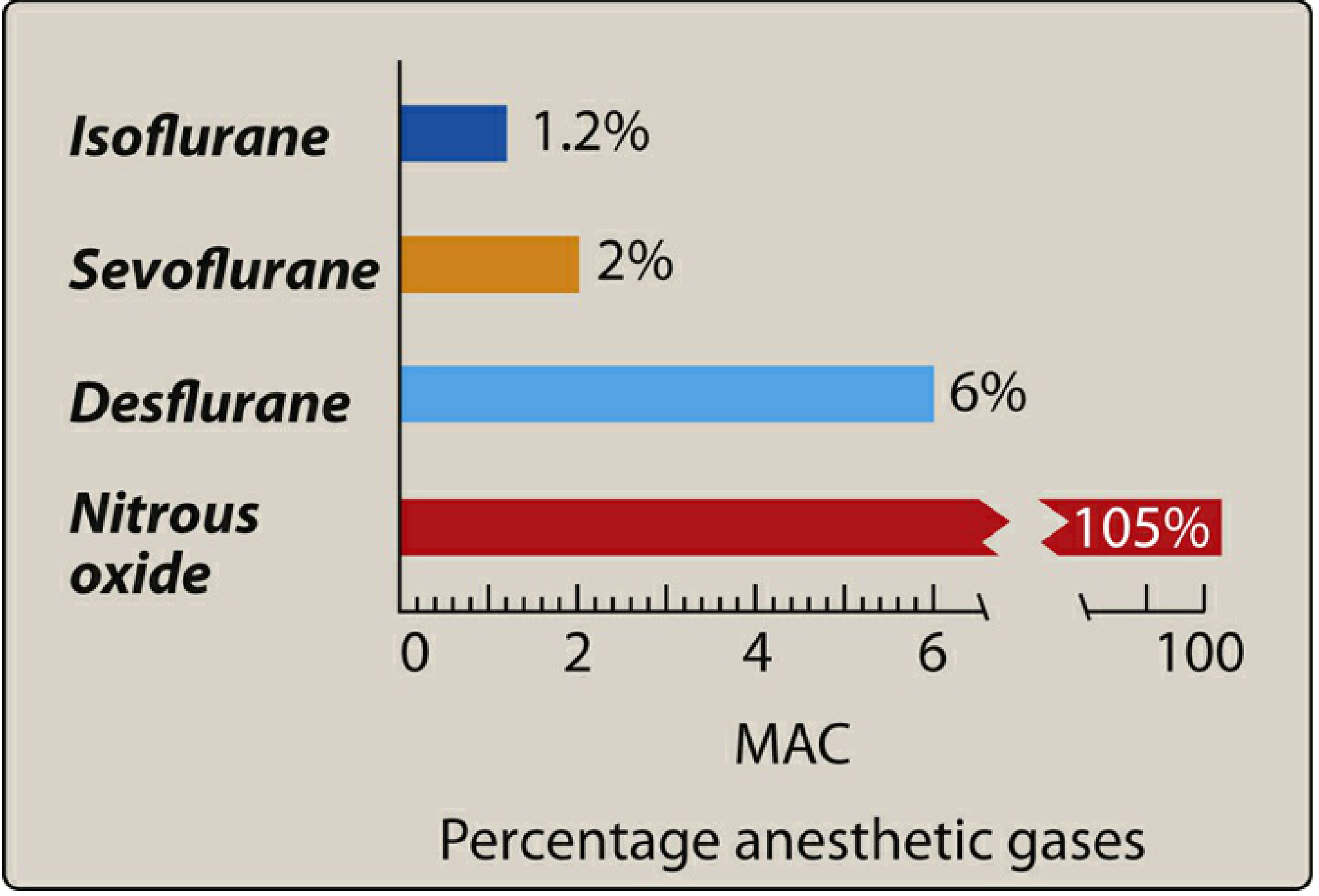
| Agent | MAC (%) | Vapor Pressure (mmHg at 20°C) | Blood/Gas Partition Coeff. |
|---|---|---|---|
| Nitrous oxide (N₂O) | 105 | - (gas) | 0.47 |
| Halothane | 0.75 | 243 | 2.4 |
| Isoflurane | 1.2 | 240 | 1.4 |
| Sevoflurane | 2.0 | 160 | 0.65 |
| Desflurane | 6.0 | 681 | 0.42 |
- Nitrous oxide's MAC >100% means it cannot produce surgical anesthesia alone at normobaric conditions (any N₂O:O₂ mixture that allows survival cannot reach 105%)
- High MAC = low potency (more drug needed); Low MAC = high potency
- The inverse of MAC is an index of potency
- Morgan & Mikhail's Clinical Anesthesiology, 7e, p. 294-295; Lippincott Pharmacology, p. 668
3. Key MAC Multiples (Clinically Critical)
| Multiple | Clinical Meaning |
|---|---|
| 0.3-0.4 MAC | MAC-awake: 50% of patients open eyes on command (emergence) |
| 1.0 MAC | 50% of patients don't move at skin incision (ED50) |
| 1.3 MAC | ~95% of patients don't move (approximates ED95) |
| 1.5 MAC | Hemodynamic suppression becomes clinically significant |
MAC-BAR (block adrenergic response): ~1.5-1.7 MAC - the concentration that blunts autonomic responses (tachycardia, hypertension) to surgical stimulation in 50% of patients. Higher than standard MAC.
4. MAC Additivity
MAC values from different agents are additive:
0.5 MAC N₂O + 0.5 MAC isoflurane = 1.0 MAC equivalent effect on immobility
Important caveat: Myocardial depression is NOT equivalent at the same MAC across agents. For example, 0.5 MAC halothane causes significantly more myocardial depression than 0.5 MAC N₂O, even though both have the same immobility effect.
- Morgan & Mikhail's Clinical Anesthesiology, 7e, p. 295
5. Factors That Modify MAC
Increase MAC (patient more resistant - need more drug)
| Factor | Notes |
|---|---|
| Young age | Infants have highest MAC; decreases ~6% per decade |
| Hyperthermia | Above normal; decreases if >42°C |
| Chronic alcohol abuse | CNS tolerance (chronic ethanol ↑ MAC; acute intoxication ↓ MAC) |
| Hypernatremia | Via CSF osmolality changes |
| Sympathomimetics (acute) | e.g., cocaine, ephedrine - increase CNS catecholamines |
| Chronic opioid use | Via opioid tolerance |
Decrease MAC (patient more sensitive - need less drug)
| Factor | Notes |
|---|---|
| Increasing age | Elderly patients need significantly less |
| Hypothermia | Each 1°C drop reduces MAC ~5% |
| Pregnancy | ↓ by one-third at 8 weeks' gestation; normalizes by 72h postpartum |
| Sepsis / critical illness | |
| Acute alcohol intoxication | |
| Severe hypotension | MAP <40 mmHg |
| Severe anemia | Hematocrit <10% |
| Hypoxia | PaO₂ <40 mmHg |
| Severe hypercarbia | PaCO₂ >95 mmHg (via CSF pH) |
| Hyponatremia | |
| Hypercalcemia | |
| IV anesthetics | Opioids, propofol, ketamine, benzodiazepines, barbiturates |
| Alpha-2 agonists | Clonidine, dexmedetomidine (significant MAC-sparing effect) |
| Local anesthetics | Except cocaine |
| Verapamil, lithium |
Does NOT affect MAC
- Thyroid disease (hyper or hypothyroid)
- Sex
- Duration of anesthesia
- Hyper/hypokalemia
- PaCO₂ in the normal range
- Morgan & Mikhail's Clinical Anesthesiology, 7e, Table 8-4, p. 296; Lippincott Pharmacology, p. 668
6. Meyer-Overton Correlation (Basis of MAC / Potency)
MAC correlates inversely with lipid solubility (oil/gas partition coefficient). More lipid-soluble agents partition into CNS membranes more avidly → lower concentration needed → lower MAC → higher potency.
- This is the Meyer-Overton rule: anesthetic potency correlates with lipid solubility
- Likely mechanism: anesthetics dissolve into hydrophobic domains of ligand-gated ion channels, particularly GABA-A receptors (enhanced) and NMDA receptors (inhibited)
- Glycine receptor α1-subunit and nicotinic ACh receptors are also implicated
- Morgan & Mikhail's Clinical Anesthesiology, 7e, p. 290-291
7. Partition Coefficients (Critical for Understanding Kinetics)
| Agent | Blood/Gas | Brain/Blood | Muscle/Blood | Fat/Blood |
|---|---|---|---|---|
| Nitrous oxide | 0.47 | 1.1 | 1.2 | 2.3 |
| Halothane | 2.4 | 2.9 | 3.5 | 60 |
| Isoflurane | 1.4 | 2.6 | 4.0 | 45 |
| Desflurane | 0.42 | 1.3 | 2.0 | 27 |
| Sevoflurane | 0.65 | 1.7 | 3.1 | 48 |
Key principle: Low blood/gas coefficient = faster induction and emergence (less uptake into blood, faster rise of alveolar partial pressure toward inspired concentration). Desflurane and N₂O have the fastest kinetics; halothane the slowest.
- Morgan & Mikhail's Clinical Anesthesiology, 7e, Table 8-1, p. 281
8. Factors Affecting Uptake (FA/FI Rise)
The speed at which alveolar concentration (FA) approaches inspired concentration (FI) determines induction speed:
- Solubility in blood - Low blood/gas coefficient → FA/FI rises fast (desflurane, N₂O)
- Cardiac output - High CO → more uptake → slows FA/FI rise → slows induction. Low CO states (e.g., heart failure, shock) → rapid rise → risk of overdose with soluble agents
- Alveolar-venous partial pressure gradient - Tissue uptake drives this; larger gradient = more uptake = slower FA rise
- Alveolar ventilation - Higher MV accelerates FA/FI equilibration (more so for soluble agents)
- Functional residual capacity (FRC) - Larger FRC → slower washout and wash-in (more volume to fill)
Overpressure strategy: Giving a higher inspired concentration than target MAC initially speeds induction by overcoming uptake, but raises the risk of overdose - monitor carefully.
- Morgan & Mikhail's Clinical Anesthesiology, 7e, p. 281-282; Lippincott Pharmacology, p. 669
9. Levels of Sedation Context
MAC sits within the broader continuum of CNS depression:
| Level | Mentation | Airway | Cardiovascular |
|---|---|---|---|
| Minimal (anxiolysis) | Responds normally to verbal | Unaffected | Unaffected |
| Moderate sedation | Responds purposefully to verbal/tactile | Adequate | Usually maintained |
| Deep sedation | Responds to repeated verbal or pain | May need intervention | Usually maintained |
| General anesthesia (1 MAC) | Unarousable to pain | Usually requires intervention | May be impaired |
- Lippincott Pharmacology, Figure 20.3, p. 665
10. Practical Clinical Pearls for the OR
- At induction: FA is far below target MAC; use overpressure and IV co-induction agents (propofol, opioids) to reach effective depth fast
- At 0.5 MAC: N₂O + 0.5 MAC volatile is a common and effective combination
- MAC-awake (0.3-0.4): Patients may move, open eyes, but are still at risk for awareness if this is the sole agent
- MAC-BAR (~1.5): Needed to blunt sympathetic responses in high-stimulus moments (laryngoscopy, sternotomy)
- Age adjustment: A 70-year-old needs roughly 20-25% less volatile anesthetic than a 40-year-old
- Dexmedetomidine: Provides significant MAC reduction (useful opioid/volatile sparing strategy)
- Low-flow anesthesia: Using low fresh gas flow requires accurate end-tidal agent monitoring since inspired and alveolar concentrations diverge from vaporizer dial setting
- Desflurane caution: Its high vapor pressure (681 mmHg at 20°C) requires a heated pressurized vaporizer; rapid increases in desflurane concentration cause sympathetic stimulation and airway irritation (contraindicated for mask induction)
- Sevoflurane advantage: Low blood/gas coefficient + non-pungent smell = ideal for inhalation induction in children
11. Additional MAC Concepts (Advanced)
- MAC-EI (endotracheal intubation): The MAC that prevents response to laryngoscopy/intubation - higher than skin incision MAC (~1.3 MAC for most agents) because intubation is a stronger stimulus
- MAC-hour: Cumulative anesthetic exposure dose (1.0 MAC × 1 hour = 1 MAC-hour). Used in PONV risk scoring (Apfel score) and in tracking exposure
- Context-sensitive half-time of volatiles: Unlike IVAs, wash-out of volatiles from tissues is not highly context-sensitive for agents with low blood/gas coefficients (desflurane, sevoflurane recover predictably)
Sources:
- Morgan & Mikhail's Clinical Anesthesiology, 7e - Chapter 8, pp. 281-296
- Miller's Anesthesia, 10e - Inhaled Anesthetics chapters
- Lippincott Illustrated Reviews: Pharmacology - Chapter 20, pp. 665-669
- Barash Clinical Anesthesia, 9e - Neuropharmacology of Inhaled Anesthetics
How is blood gas coefficient related,simple explanation and also factors affecting uptake-explain properly.
Reading File
Finding Sources
Reading File
Reading File
Reading File
Loading Image
Loading Image
Perfect - I have everything needed. Here's the full, clear explanation:
Blood/Gas Partition Coefficient - Simple Explanation
The Core Idea: Blood as a "Sponge"
Think of blood as a sponge sitting between the alveoli and the brain.
- The goal of inhalational anesthesia is to get the anesthetic from the alveolus → into the blood → into the brain
- The brain only responds to partial pressure, not total amount
- So you need to build up partial pressure in the alveolus fast - and whatever "steals" the drug away from the alveolus slows that build-up
The blood/gas partition coefficient tells you how greedily the blood sponge soaks up the drug.
What the Number Actually Means
Blood/gas partition coefficient = concentration in blood / concentration in gas, at equilibrium (equal partial pressures)
| Agent | Blood/Gas Coefficient |
|---|---|
| Isoflurane | 1.4 |
| Sevoflurane | 0.65 |
| Nitrous oxide | 0.47 |
| Desflurane | 0.42 |
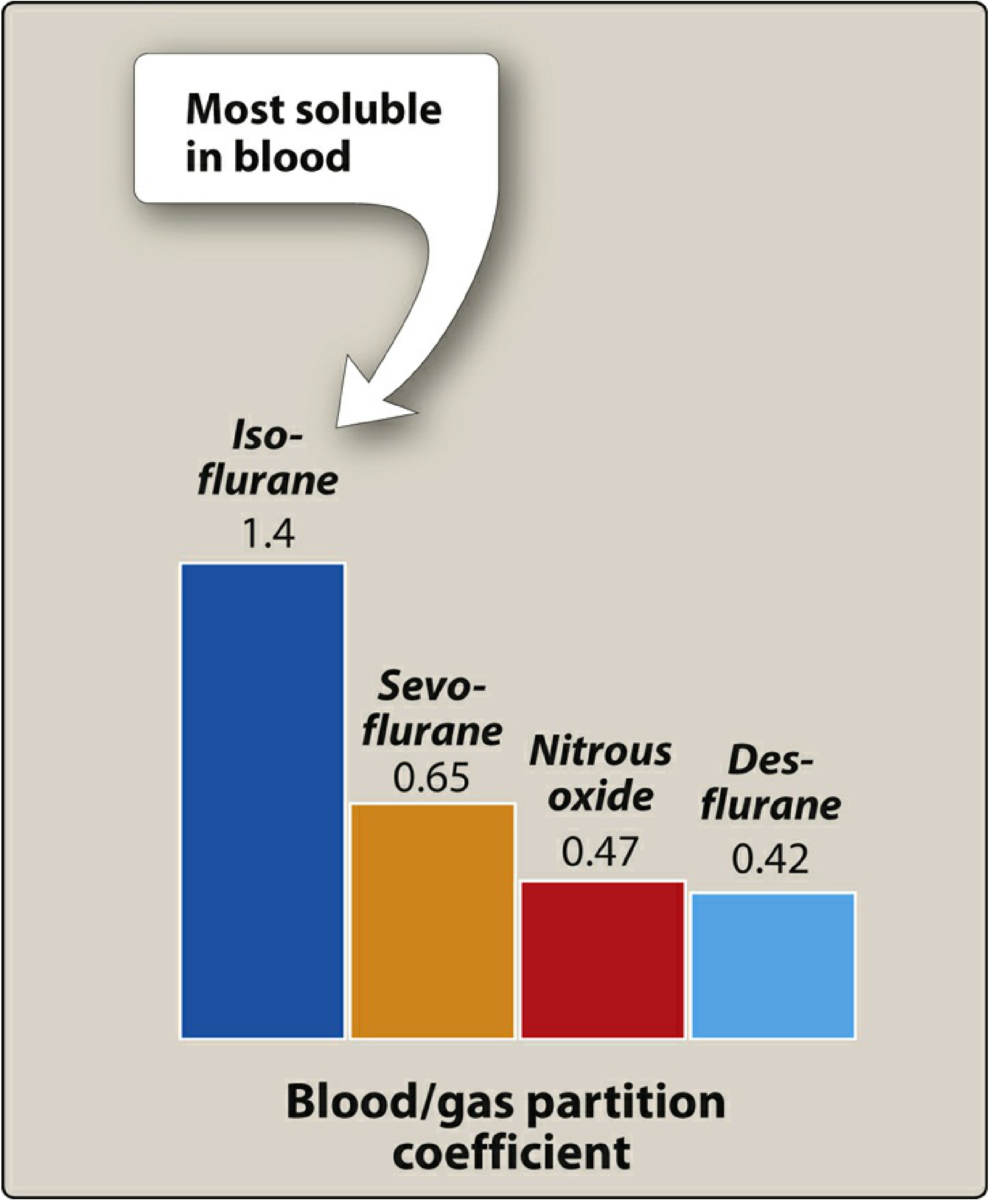
Take N₂O (0.47): at equilibrium, 1 mL of blood holds only 0.47x as much N₂O as 1 mL of alveolar gas. The blood doesn't absorb much - so partial pressure in the alveolus rises quickly.
Take isoflurane (1.4): blood holds 1.4x more per mL. Blood soaks up far more drug before equilibrating, draining the alveolus and delaying the rise in alveolar (and therefore brain) partial pressure.
The Golden Rule
High blood/gas coefficient = HIGH blood solubility = HIGH uptake = SLOW induction (and slow emergence) Low blood/gas coefficient = LOW blood solubility = LOW uptake = FAST induction (and fast emergence)
Simple Analogy:
Imagine filling a bucket (alveolus) from a tap (vaporizer), but there's a leak (blood uptake).
- Desflurane/N₂O = tiny leak. Bucket fills fast → brain partial pressure rises fast → fast induction.
- Isoflurane = big leak. Water keeps draining out → bucket takes ages to fill → slow induction.
The same logic works in reverse for emergence: agents with high blood solubility "store" more in the blood/tissues, so they take longer to wash out.
Induction & Emergence Curves (FA/FI)
This graph shows FA (alveolar concentration) rising as a fraction of FI (inspired concentration) over time:
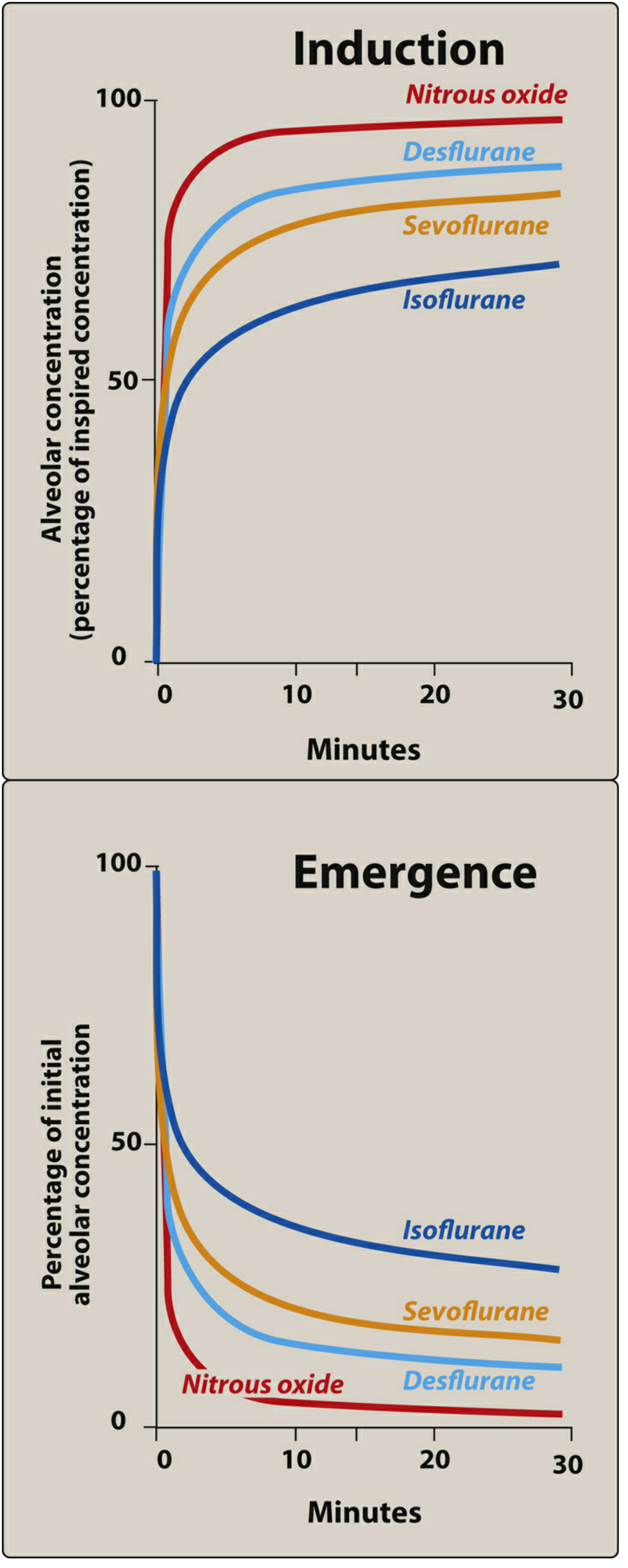
- N₂O and desflurane - FA/FI shoots up rapidly (low blood solubility, not "stolen" by blood)
- Isoflurane - FA/FI rises slowly (high solubility, blood keeps absorbing it)
- Emergence mirrors induction: the same agents that induce slowly also have prolonged recovery
- Lippincott Pharmacology, pp. 669-671; Morgan & Mikhail 7e, p. 281
Factors Affecting Uptake - Full Explanation
The key formula to remember:
Uptake = Solubility (λ b/g) × Cardiac Output × (Alveolar PP - Venous PP)
Three primary factors drive uptake. Each one understood properly will help you predict every clinical scenario.
Factor 1: Solubility in Blood (Blood/Gas Coefficient)
Already explained above. The higher the solubility:
- The more drug blood "steals" from the alveolus per unit time
- The slower FA rises
- The slower induction proceeds
Clinical implication: Postprandial lipemia increases blood/gas solubility (fat in blood makes it absorb more). Anemia decreases it (less protein/lipid in blood → less uptake → slightly faster induction).
Factor 2: Cardiac Output (Alveolar Blood Flow)
This one confuses many residents. Think it through carefully.
High Cardiac Output → Slower Induction
- More blood per minute flows through the lungs
- More drug is picked up from the alveolus each minute
- FA/FI rise is slowed (more drug "drained away")
- Brain gets drug at a dilute concentration for a longer time
- Induction is delayed
Low Cardiac Output → Faster Induction (but DANGER)
- Less blood passes the alveolus per minute
- Less drug is removed → FA builds up rapidly
- But crucially: the brain is also perfused less, so there's a competing effect
- Net result: for soluble agents (isoflurane), low CO dramatically accelerates alveolar build-up → risk of overdose
- For insoluble agents (desflurane, N₂O), CO matters much less because very little is taken up anyway regardless
Danger scenario: A patient in cardiogenic shock getting isoflurane. The low CO causes rapid FA rise → accidental overdose → further BP drop → disaster. This is why sick patients need much lower dial settings.
Effect of CO is most pronounced for soluble agents; least pronounced for insoluble ones.
- Morgan & Mikhail 7e, p. 282
Factor 3: Alveolar-to-Venous Partial Pressure Gradient (A-V Gradient)
- Blood returning from the tissues (venous blood) has been giving up anesthetic to the organs
- The more the tissues take up, the lower the venous partial pressure
- A large A-V gradient means tissues are hungry for drug → they keep pulling it out of the blood → blood keeps pulling it from the alveolus → FA rises slowly
What drives this gradient?
Tissue uptake depends on three analogous sub-factors:
| Sub-factor | Effect |
|---|---|
| Tissue/blood solubility coefficient | Higher = tissues absorb more = larger gradient maintained |
| Tissue blood flow | Higher flow = more drug delivered/removed = larger gradient |
| Arterial-tissue partial pressure difference | Larger difference = more uptake = larger gradient |
The Four Tissue Compartments:
| Group | Examples | % Body Weight | % Cardiac Output | Behaviour |
|---|---|---|---|---|
| Vessel-rich | Brain, heart, liver, kidney | 10% | 75% | Saturates quickly (minutes); first to equilibrate |
| Muscle | Skeletal muscle, skin | 50% | 19% | Moderate flow, large volume; uptake sustained for hours |
| Fat | Adipose tissue | 20% | 6% | Poor flow but enormous capacity (fat/blood solubility very high); would take days to equilibrate |
| Vessel-poor | Bone, ligament, cartilage | 20% | ~0% | Negligible uptake - clinically irrelevant |
The initial steep rise in FA/FI is due to unopposed filling of alveoli before much tissue uptake has occurred. The rate of rise slows as the vessel-rich group equilibrates and begins returning drug-laden venous blood (reducing the A-V gradient), and then slows again as the muscle group gradually saturates.
Fat never fully equilibrates during clinical anesthesia - it acts as an infinite sink for prolonged cases, especially relevant for highly lipid-soluble agents (halothane, isoflurane) in long or obese patients.
- Morgan & Mikhail 7e, pp. 282-283; Lippincott Pharmacology, pp. 671-672
Additional Factors Affecting Alveolar Concentration (FA)
4. Alveolar Ventilation
This affects the delivery side (how fast FI fills the alveolus), not purely uptake:
- Higher minute ventilation → faster wash-in → faster FA rise toward FI
- Ventilation matters most for soluble agents (because they are rapidly "drained" - so you need to push more in)
- For insoluble agents, the effect of increased ventilation is minor (FA already rises fast)
- Hypoventilation (opioid respiratory depression) slows induction of soluble agents considerably
5. Functional Residual Capacity (FRC)
- Large FRC = large reservoir of non-anesthetic gas in the lungs at the start
- Takes more breaths to "wash in" the agent → slower initial rise of FA
- This is why pre-oxygenation/denitrogenation is important and why obese/FRC-reduced patients have faster wash-in
6. Concentration Effect
When you deliver a high inspired concentration of a gas (especially N₂O), the rapid uptake of large volumes of that gas creates a slight vacuum effect that:
- Concentrates the remaining gas in the alveolus (raises FA)
- Draws in more fresh gas from the airways (increases effective ventilation)
Both effects accelerate the FA/FI rise beyond what simple calculations would predict. This is the concentration effect - clinically relevant mainly for N₂O at high concentrations.
7. Second Gas Effect
If you deliver N₂O alongside a volatile agent (e.g., isoflurane), the rapid uptake of N₂O:
- Concentrates the volatile agent in the alveolus
- Simultaneously augments ventilation (drawing in more volatile)
Net effect: the FA of the second gas (isoflurane) rises faster than it would if given alone. This is the second gas effect - the mechanism behind why N₂O + volatile combinations speed induction.
Summary: The Big Picture
FA/FI rises FASTER when:          FA/FI rises SLOWER when:
- Low blood/gas coefficient        - High blood/gas coefficient
- Low cardiac output               - High cardiac output
- Small A-V gradient               - Large A-V gradient
- High minute ventilation          - Low minute ventilation
- Small FRC                        - Large FRC
- High inspired concentration      - Low inspired concentration
  (concentration effect)
And remember: emergence is the exact reverse of induction. All the same factors apply, but now the alveolus is empty (agent turned off) and drug flows from tissues → blood → alveolus → exhaled.
Sources: Morgan & Mikhail's Clinical Anesthesiology, 7e, pp. 281-284; Lippincott Illustrated Reviews Pharmacology, pp. 669-673
Today a class on this pdf,tell me what and all I need to learn ,baseed on this pdf with rationale and more of tabular form.
Reading File
Running Command
cd /tmp/workspace/attachments/bbcc5720-8950-4c42-b0d2-c4ee8ab9be9c/ && python3 -c " from pptx import Presentation prs = Presentation('Inhalational anaesthetic agents 2.pptx') for i, slide in enumerate(prs.slides, 1): print(f'\n=== SLIDE {i} ===') for shape in slide.shapes: if shape.has_text_frame and shape.text_frame.text.strip(): print(shape.text_frame.text) "
Now let me pull the detailed content from the textbooks to fill in the gaps (slides 10-12 on respiratory/CVS effects, slide 16 on toxicity, slide 18 on halothane hepatitis, and slide 22 on environmental effects were empty/headers only).
Finding Sources
Finding Sources
Finding Sources
Finding Sources
Finding Sources
Finding Sources
Finding Sources
Reading File
I have all the key data. Now I'll compile the complete study guide.
Complete Study Guide: Inhalational Anaesthetic Agents
Based on your class PDF + Morgan & Mikhail's Clinical Anesthesiology 7e
PART 1: INDIVIDUAL AGENTS - QUICK REFERENCE
1A. Physical Properties
| Property | N₂O | Halothane | Isoflurane | Sevoflurane | Desflurane |
|---|---|---|---|---|---|
| Appearance | Colorless gas | Colorless liquid | Colorless liquid | Colorless liquid | Colorless liquid |
| Smell | Sweet | Pleasant | Pungent (limits mask induction) | Pleasant | Pungent |
| Flammability | Non-flammable (but supports combustion) | Non-flammable | Non-flammable | Non-flammable | Non-flammable |
| Storage | Blue cylinders, 760 psi | Amber bottles + thymol 0.01% as preservative | No preservative needed | No preservative needed | No preservative needed |
| Boiling point | Gas at room temp | 50.2°C | 48.5°C | 58.5°C | 22.8°C (near room temp - needs heated pressurized vaporizer) |
| Special notes | 1.5× heavier than air; 35× more soluble than N₂ | Contains thymol to prevent spontaneous oxidation | Structural isomer of enflurane | Methyl propyl ether | Fluorinated methyl ethyl ether; structure similar to isoflurane |
Rationale for storage facts:
- Halothane in amber bottles = protects from light-induced degradation; thymol prevents oxidation but builds up in vaporizer (must clean regularly)
- Desflurane's near-room-temp boiling point means it would vaporize uncontrollably in a standard vaporizer - Tec 6 vaporizer heats it to 39°C under pressure
1B. Pharmacokinetic Properties (THE MOST TESTED TABLE)
| Property | N₂O | Halothane | Isoflurane | Sevoflurane | Desflurane |
|---|---|---|---|---|---|
| MAC (%) | 104-105 | 0.74 | 1.15 | 2.05 | 6.0 |
| Blood/Gas Coefficient | 0.46 | 2.4 | 1.4 | 0.65 | 0.42 |
| Induction speed | Fast | Slowest | Slow-moderate | Fast | Fastest |
| Recovery speed | Fast | Slowest | Moderate | Fast | Fastest |
| Potency | Least (can't provide sole anesthesia) | Highest | High | Moderate | Least among volatiles |
| Metabolism | <0.01% | 20% (most) | 0.2% | 3-5% | <0.1% |
Key memory trick:
Low blood/gas = low solubility = low uptake by blood = fast rise of FA/FI = fast induction AND fast recovery High blood/gas = high solubility = blood is a "sponge" = slow FA rise = slow induction AND slow recovery
Order of blood solubility (memorize):
Halothane (2.4) > Isoflurane (1.4) > Sevoflurane (0.65) > N₂O (0.46) > Desflurane (0.42)
Order of potency (inverse of MAC):
Halothane > Isoflurane > Sevoflurane > Desflurane > N₂O
PART 2: ORGAN SYSTEM EFFECTS (The Heart of the Exam)
2A. Cardiovascular Effects
| Parameter | N₂O | Halothane | Isoflurane | Desflurane | Sevoflurane |
|---|---|---|---|---|---|
| Blood Pressure | No change | ↓↓ | ↓↓ | ↓↓ | ↓ |
| Heart Rate | No change | ↓ (sensitizes to arrhythmia) | ↑ (reflex tachycardia) | No change or ↑ | No change |
| SVR (vascular resistance) | No change | No change | ↓↓ (vasodilation) | ↓↓ | ↓ |
| Cardiac Output | No change | ↓ (direct myocardial depression) | No change | No change or ↓ | ↓ |
| Mechanism of BP drop | - | Direct myocardial depression | Vasodilation (↓ SVR) | Vasodilation | Mixed |
Rationale - Why isoflurane and desflurane cause reflex tachycardia:
- They drop BP mainly by reducing SVR (vasodilation)
- Baroreceptors detect low BP → sympathetic activation → ↑ HR
- Halothane drops CO instead → no reflex tachycardia, actually causes bradycardia
Critical clinical note - Desflurane "sympathetic surge":
- Rapid increase in desflurane concentration triggers catecholamine release → sudden tachycardia + hypertension
- Avoid rapid upward titration of desflurane
Halothane arrhythmia risk:
- Halothane sensitizes the myocardium to catecholamines (epinephrine)
- Safe limit of epinephrine with halothane = 1.5 mcg/kg (vs 4.5 mcg/kg for isoflurane)
- Risk of ventricular arrhythmias if epinephrine used with halothane
2B. Respiratory Effects
| Parameter | N₂O | Halothane | Isoflurane | Desflurane | Sevoflurane |
|---|---|---|---|---|---|
| Tidal Volume | ↓ | ↓↓ | ↓↓ | ↓ | ↓ |
| Respiratory Rate | ↑ | ↑↑ | ↑ | ↑↑ | ↑ |
| PaCO₂ (resting) | No change | ↑ | ↑ | ↑↑ | ↑ |
| Response to CO₂ challenge | ↑ | ↑ | ↑ | ↑↑ | ↑ |
| Airway irritation | None | None | Yes (pungent) | Yes (worst - coughing, laryngospasm) | Minimal (sweet) |
| Bronchodilation | Mild | Best bronchodilator | Yes | Increases resistance at rapid rise | Yes |
| Hypoxic Pulmonary Vasoconstriction (HPV) | Preserved | Inhibited | Inhibited | Inhibited | Inhibited |
Key rationale:
- All volatiles cause dose-dependent respiratory depression - they reduce tidal volume but compensate (partially) by increasing rate. Net effect: RR goes up, TV goes down, but CO₂ still rises (inadequate compensation)
- Halothane is the best bronchodilator historically - used in status asthmaticus before sevoflurane became available
- Sevoflurane is now preferred for asthmatic patients and for inhalational induction (non-pungent + bronchodilates)
- Inhibition of HPV by volatiles can worsen V/Q mismatch in one-lung ventilation
2C. CNS Effects
| Parameter | N₂O | Halothane | Isoflurane | Desflurane | Sevoflurane |
|---|---|---|---|---|---|
| Cerebral Blood Flow (CBF) | ↑ | ↑↑ | ↑ | ↑ | ↑ |
| Intracranial Pressure (ICP) | ↑↑ | ↑↑ | ↑ | ↑ | ↑ |
| Cerebral Metabolic Rate (CMRO₂) | ↑ | ↓ | ↓↓ | ↓↓ | ↓↓ |
| Epileptiform activity | None | None | None | None | Yes (at high doses, in children) |
| EEG changes | Minimal | Mild slowing | Burst suppression at high doses | Burst suppression | Burst suppression; spike activity possible |
Key rationale:
- All volatile agents are cerebral vasodilators - they uncouple CBF from CMRO₂ (normally CBF follows metabolic demand)
- N₂O causes the most ICP rise relative to its anesthetic effect - avoid in neurosurgery or head-injured patients
- Isoflurane, desflurane, and sevoflurane reduce CMRO₂ (protective) while still slightly increasing CBF
- The net ICP increase can be blunted by hyperventilation (reduce PaCO₂)
2D. Neuromuscular Effects
| Agent | Effect | Clinical Note |
|---|---|---|
| N₂O | Minimal relaxation; rigidity at high concentrations | Cannot rely on it for relaxation |
| Halothane | Relaxes skeletal muscle; potentiates NMBDs | Good adjunct for relaxation |
| Isoflurane | Good muscle relaxation | Dose-dependent potentiation of NMBDs |
| Desflurane | Best muscle relaxation among volatiles | Greater potentiation of NMBDs than isoflurane |
| Sevoflurane | Good relaxation | Similar to isoflurane |
| All volatiles | Trigger agents for Malignant Hyperthermia (MH) | Avoid in MH-susceptible patients; use TIVA instead |
2E. Other Organ Systems
| System | Effect | Agent-Specific Notes |
|---|---|---|
| Renal | ↓ CO → ↓ GFR → ↓ urine output | Dose-dependent; reversible. Sevoflurane → Compound A → direct nephrotoxicity (controversial) |
| GIT / PONV | N₂O strongly associated with PONV | N₂O activates CTZ and vomiting center in medulla; avoid in high-risk PONV patients |
| Uterus | All = uterine relaxants | Dose-dependent relaxation of uterine smooth muscle; useful in uterine manipulation; risk of PPH at high doses |
| Liver | Halothane hepatotoxicity (see below) | Other agents: minimal hepatic effects |
PART 3: TOXICITY (High-Yield for Exams)
3A. N₂O - Unique Dangers
| Toxicity | Mechanism | Clinical Scenario |
|---|---|---|
| Diffusion Hypoxia (Fink effect) | On discontinuation, massive N₂O exits alveoli → dilutes O₂ and CO₂ → transient hypoxia | Prevention: Give 100% O₂ for 5-10 min after stopping N₂O |
| Expansion of air-filled spaces | N₂O is 35× more soluble than N₂. It diffuses into closed air spaces faster than N₂ diffuses out → space expands | Contraindications: Pneumothorax, bowel obstruction, air embolism, pneumocephalus, middle ear surgery (tympanoplasty), intraocular air bubble, pulmonary bullae |
| Tracheal tube cuff expansion | N₂O diffuses into cuff → ↑ cuff pressure → mucosal ischemia | Monitor/use saline-filled cuffs in long cases |
| Vitamin B12 inactivation | Irreversibly oxidizes cobalt in vitamin B12 → inhibits methionine synthase → impairs DNA synthesis | Risk: prolonged/repeated exposure → megaloblastic anemia, subacute combined degeneration of cord. Contraindicated in B12 deficiency, pregnancy (especially 1st trimester) |
| Pulmonary vasoconstriction | ↑ PVR | Avoid in pulmonary hypertension |
| Environmental | Ozone-depleting gas; greenhouse effect | Significant environmental concern |
3B. Halothane Hepatitis
| Type | Incidence | Mechanism | Features |
|---|---|---|---|
| Type 1 (Mild) | ~20% of patients | Direct hepatotoxic metabolite (reductive metabolism → free radicals) | Self-limiting, elevated LFTs, may occur after single exposure |
| Type 2 (Fulminant) | 1:35,000 | Immune-mediated - halothane metabolites (TFA = trifluoroacetyl) act as haptens → antibodies against halothane-altered liver antigens | Only after multiple exposures; fever, jaundice, eosinophilia; mortality 50-75% |
Risk factors for fulminant halothane hepatitis: Repeated exposure, middle-aged obese females, personal/family history of halothane reaction, enzyme inducers (increases oxidative metabolism).
Rule: Halothane should never be re-administered within 3 months. If liver dysfunction follows halothane, never use again.
3C. Compound A (Sevoflurane)
| Feature | Detail |
|---|---|
| What it is | Fluoromethyl-2,2-difluoro-1-(trifluoromethyl)vinyl ether - a degradation product of sevoflurane |
| Produced by | Reaction of sevoflurane with soda lime or barium hydroxide lime (NOT calcium hydroxide lime) |
| Toxicity | Nephrotoxic in animals (tubular necrosis); clinical significance in humans debated |
| Increased by | High temperature, low flow anesthesia, dry absorbent, high sevoflurane concentration, long duration |
| Clinical guideline | Minimum fresh gas flow of 2 L/min for sevoflurane; avoid very low flow (<1 L/min) for prolonged cases |
3D. Carbon Monoxide - Desflurane
| Feature | Detail |
|---|---|
| Produced by | Degradation of desflurane (also isoflurane, enflurane) by desiccated CO₂ absorbent - especially barium hydroxide lime, NaOH, KOH |
| Why desiccated? | Absorbent left to dry over weekends with O₂/air flowing; Monday morning cases at highest risk |
| Clinical problem | CO under GA is silent - no symptoms; SpO₂ may be falsely normal or lower than expected |
| Diagnosis | ABG showing elevated carboxyhemoglobin |
| Prevention | Replace absorbent before cases if patient complains of unusual symptoms; never leave gas flowing through dry absorbent; use less reactive absorbents (Amsorb) |
PART 4: IDEAL INHALATIONAL AGENT vs REALITY
| Ideal Property | N₂O | Halothane | Isoflurane | Sevoflurane | Desflurane |
|---|---|---|---|---|---|
| High potency | ✗ (MAC 105%) | ✓ | ✓ | Moderate | ✗ (least potent) |
| Low blood solubility | ✓ | ✗ | Partial | ✓ | ✓ |
| No airway irritation | ✓ | ✓ | ✗ | ✓ | ✗ |
| Hemodynamic stability | Partial | ✗ (arrhythmias) | ✗ (tachycardia) | Best | ✗ (sympathetic surge) |
| No hepatotoxicity | ✓ | ✗✗ | Rare | ✓ | ✓ |
| No nephrotoxicity | ✓ | ✓ | ✓ | Compound A risk | ✓ |
| No MH trigger | ✓ | ✗ | ✗ | ✗ | ✗ |
| No PONV | ✗ | ✗ | ✗ | ✗ | ✗ |
| No environmental harm | ✗ (ozone) | Moderate | Moderate | Moderate | Worst GWP |
| Low cost | ✓ | ✓ | ✓ | ✗ | ✗ |
PART 5: SPECIAL CLINICAL SITUATIONS - WHICH AGENT TO USE?
| Clinical Scenario | Best Choice | Avoid | Reason |
|---|---|---|---|
| Inhalational induction (children) | Sevoflurane | Desflurane, isoflurane | Non-pungent, fast, pleasant |
| Asthma/reactive airways | Sevoflurane | Desflurane | Bronchodilates; non-irritating |
| Day surgery / fast turnover | Desflurane or sevoflurane | Halothane, isoflurane | Fastest emergence |
| Neuroanaesthesia | Isoflurane or sevoflurane (low dose) | N₂O, halothane | Least ICP rise; preserve cerebral autoregulation |
| Cardiac surgery (preconditioning) | Isoflurane, sevoflurane | - | Ischemic preconditioning benefit |
| Pulmonary hypertension | Any volatile | N₂O | N₂O increases PVR |
| Morbidly obese | Desflurane | Halothane | Minimal fat accumulation (low blood/gas + low fat/blood solubility relative to others) |
| Bowel obstruction / air embolism | Volatile anesthetics | N₂O | N₂O expands gas spaces |
| MH-susceptible patient | TIVA (propofol) | All volatiles + succinylcholine | All volatiles are MH triggers |
| Previous halothane hepatitis | Any non-halothane | Halothane | Immune sensitization → fulminant hepatitis |
| Obstetrics (uterine manipulation needed) | Low-dose volatile | High-dose volatile | High doses → PPH from uterine relaxation |
PART 6: SUMMARY MEMORY TABLE
| Agent | Key "headline" fact | Remember because... |
|---|---|---|
| N₂O | Can't be a sole anesthetic; diffusion hypoxia; B12 inactivation; expands air spaces | MAC 105% - literally impossible to use alone safely |
| Halothane | Slowest kinetics; thymol; hepatitis; sensitizes to catecholamines | Historical agent; "hall of fame" for complications |
| Isoflurane | Workhorse; pungent; reacts with soda lime → CO; reflex tachycardia | Most widely used worldwide; cheap; stable |
| Sevoflurane | Ideal for induction; Compound A risk; fast; pleasant | "Sevo = sweet = kids" |
| Desflurane | Fastest recovery; special vaporizer (Tec 6); sympathetic surge; CO production | "Des = Desk = fastest to leave" |
Sources: Morgan & Mikhail's Clinical Anesthesiology, 7e (Tables 8-3, 8-4, 8-6); Lippincott Illustrated Reviews Pharmacology; your class slides (Moderator: Dr Shobhan, Presenter: Dr Priyanka)
This is a shared conversation. Sign in to Orris to start your own chat.