
Candidiasis
Reading File
Finding Sources
Searching PubMed
candidiasis treatment management
Reading File
Reading File
Finding Sources
Reading File
Reading File
Finding Sources
Reading File
Reading File
Finding Sources
Reading File
Reading File
Reading File
Loading Image
Loading Image
Now I have comprehensive information. Let me compile a thorough response.
Candidiasis
Overview
Candidiasis (candidosis, moniliasis) is an infection caused by Candida species — opportunistic yeasts that are normal commensals of the skin, oropharynx, GI tract, and genital mucosa. Though usually commensal, Candida acts as an opportunistic pathogen when host defenses are disrupted. C. albicans is the most common species; others include C. glabrata, C. tropicalis, C. parapsilosis, C. krusei, and the emerging, often drug-resistant C. auris.
Microbiology & Pathogenesis
Candida establishes infection through several virulence mechanisms:
- Adhesion to human epithelial cells
- Morphologic switching between yeast and pseudohyphal/hyphal forms — hyphae are more invasive
- Biofilm formation — particularly on indwelling catheters and prosthetic devices
- Immune evasion — escape from phagocytosis
Host immune defense relies primarily on:
- Innate immunity: Neutrophils and macrophages are critical (especially in the first 48 hours). Leukopenia — especially from chemotherapy — dramatically increases invasive risk.
- Adaptive immunity: T-cell (Th17) immunity protects mucosal surfaces. Defects in the IL-17 pathway (STAT1, STAT3, IL17F, IL17RA mutations) predispose to chronic mucocutaneous candidiasis. CARD9 mutations specifically impair neutrophil killing of Candida.
- Notably, anti-IL-17 biologics (brodalumab, secukinumab, ixekizumab) increase mucosal candidiasis risk.
Key distinction:
- Neutropenia → risk of invasive/disseminated candidiasis
- T-cell deficiency (HIV/AIDS) → risk of persistent mucocutaneous candidiasis; invasive disease is rare
Clinical Classifications
1. Mucocutaneous / Superficial Forms
Oropharyngeal Candidiasis (Thrush)
- White, curd-like plaques on buccal mucosa, palate, tongue — scraped off to reveal erythematous non-ulcerated mucosa
- Erythematous (atrophic) form: shiny, depapillated tongue (median rhomboid glossitis), common in denture wearers
- Angular cheilitis (perlèche): painful fissuring/crusting at oral commissures
- Thrush in an otherwise healthy individual without risk factors warrants HIV testing
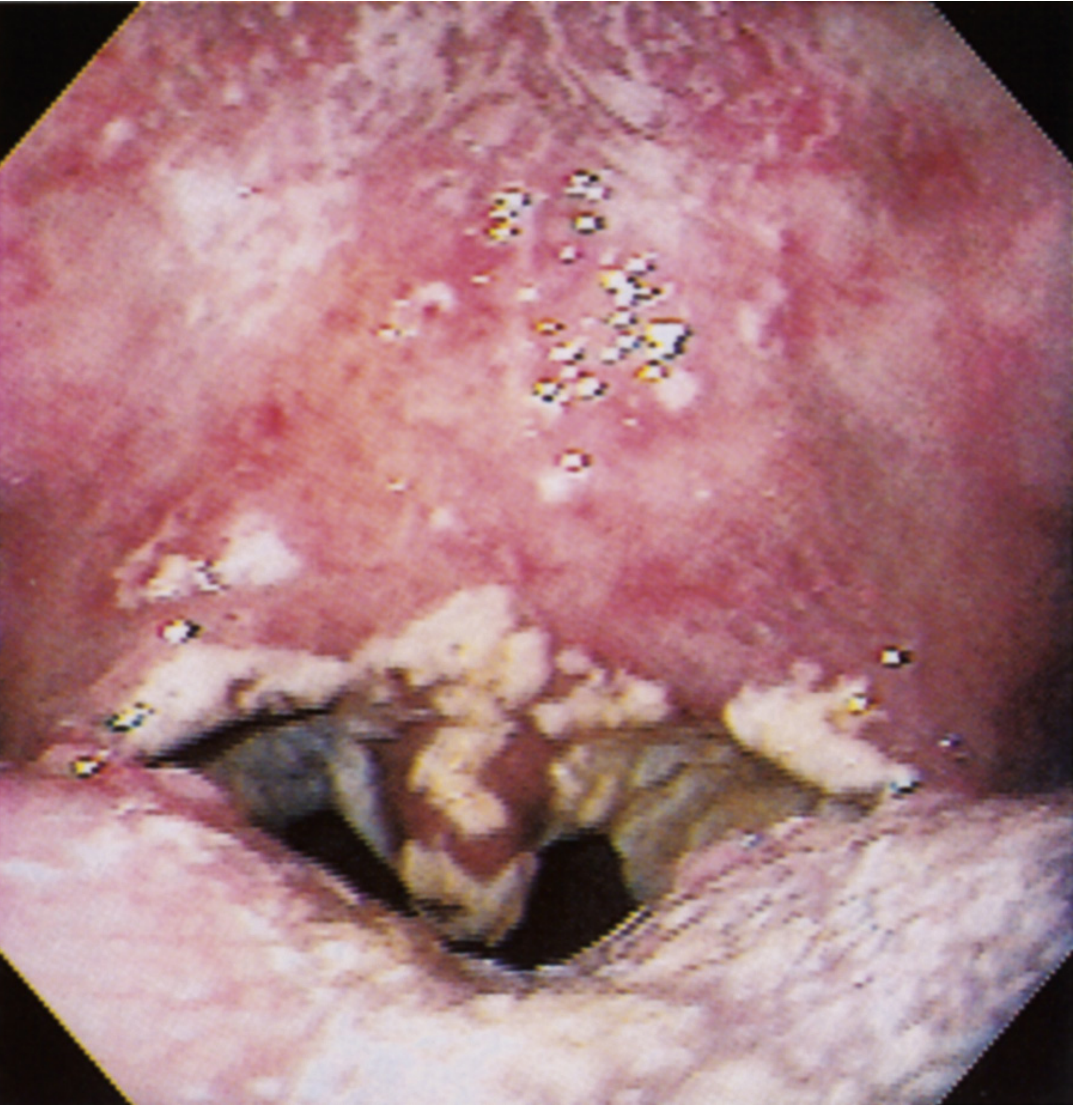
Esophageal Candidiasis
- Almost always requires immune dysfunction (low CD4 in HIV, leukemia, immunosuppressants)
- Classic symptom: odynophagia localized to a discrete substernal area
- Concurrent thrush may or may not be present
- Endoscopy: plaque-like lesions/ulcerations; biopsy shows budding yeasts and pseudohyphae invading mucosa
Cutaneous Candidiasis
- Intertriginous (axillae, inframammary, groin, infrapannus): beefy-red patches/plaques with satellite papules and pustules at the periphery; maceration common
- Diaper dermatitis: same appearance in the diaper area
- Interdigital: macerated whitish plaque on erythematous base (erosio interdigitalis blastomycetica) — especially in chronic wet-work exposure
- Paronychia and onychomycosis: nail fold inflammation, nail dystrophy
Vulvovaginitis
- Most frequent mucocutaneous manifestation of candidiasis in women of childbearing age
- Thick, white, curd-like ("cottage cheese") discharge; pruritus and burning; vulvar erythema and edema
- Risk factors: antibiotic use, diabetes, pregnancy, OCP use, immunosuppression
Balanitis / Balanoposthitis
- Erythema, pustules on glans and prepuce; more pustular than vulvitis
Chronic Mucocutaneous Candidiasis (CMC)
- Diffuse skin, mucosal, and nail involvement due to underlying primary immunodeficiency (IL-17 pathway defects)
2. Invasive / Disseminated Candidiasis
Candidemia
- Candida is the most common cause of fatal fungal sepsis
- Risk factors: indwelling central venous catheters, TPN, broad-spectrum antibiotics, abdominal surgery, ICU stay, neutropenia, renal replacement therapy
- Mortality: ~35% at 12 weeks; can exceed 80% in some series
- Skin findings: erythematous papules and nodules, sometimes with central pustulation — hematogenous emboli
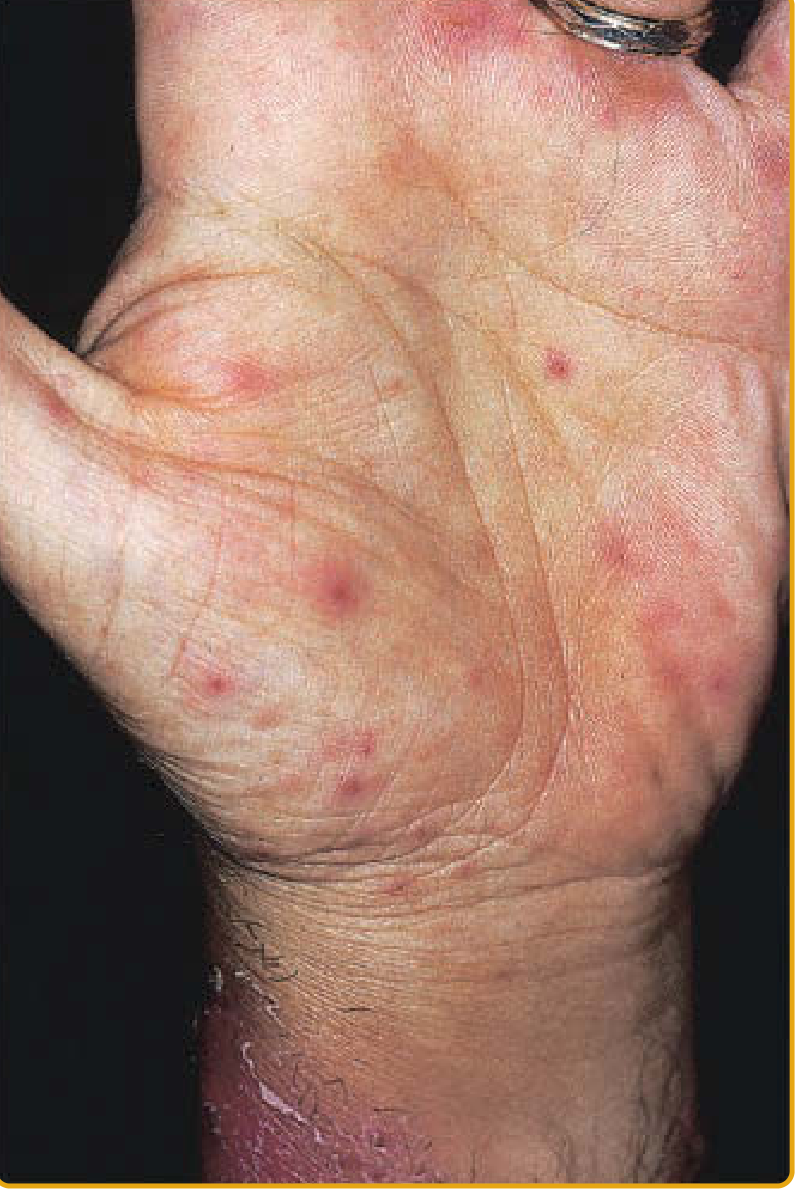
Other Sites of Invasive Disease
| Site | Features |
|---|---|
| Endophthalmitis | White retinal lesions; vitritis; risk of permanent vision loss in ~4–7% of candidemia cases; dilated fundoscopy mandatory |
| Endocarditis | Large vegetations; often requires surgery |
| Hepatosplenic (chronic disseminated) | "Punched-out" lesions on CT/MRI in liver and spleen; classically occurs during neutrophil recovery in leukemia patients |
| Meningitis | Part of disseminated infection; common in low-birthweight neonates |
| Renal/UTI | Fungus balls may obstruct collecting system |
| Osteoarticular | Vertebral osteomyelitis is most common; symptoms may lag weeks after fungemia |
| Peritonitis | Post-bowel surgery/perforation; also in CAPD patients |
Risk Factors
| Superficial Candidiasis | Invasive Candidiasis |
|---|---|
| Extremes of age | Neutropenia (chemotherapy) |
| Diabetes mellitus | Central venous catheter |
| Obesity | TPN / broad-spectrum antibiotics |
| Pregnancy | Abdominal surgery / GI perforation |
| Antibiotic / corticosteroid use | ICU stay |
| HIV/AIDS | Hemodialysis |
| Dentures, wet-work exposure | Solid organ / bone marrow transplant |
| Anti-IL-17 biologics | Neonatal prematurity |
Diagnosis
Mucocutaneous Disease
- Often clinical
- KOH preparation of skin scrapings: budding yeasts and pseudohyphae
- Gram stain: gram-positive budding yeasts
- Culture if recurrent/unresponsive — to identify resistant species (C. glabrata, C. krusei)
- Esophageal disease: endoscopy + biopsy
Invasive Candidiasis
- Blood cultures — sensitivity is only ~50%; negative culture does not exclude invasive disease
- Beta-D-glucan (BDG) assay: serum marker of fungal infection; useful for early detection and monitoring
- CT/MRI: hepatosplenic candidiasis shows punched-out lesions in liver and spleen
- Dilated fundoscopy: mandatory for all patients with candidemia to exclude endophthalmitis
- Species identification matters — determines azole susceptibility and guides treatment
Management
Cutaneous / Mucocutaneous
| Form | First Line | Second Line |
|---|---|---|
| Cutaneous | Topical imidazoles (clotrimazole, miconazole, ketoconazole, econazole) | Oral fluconazole |
| Cutaneous | Topical nystatin | |
| Paronychia | Avoid wet work; topical corticosteroids; topical tacrolimus | Topical imidazole solutions; thymol 40% in ethanol |
| Onychomycosis | Oral itraconazole; oral fluconazole | Oral terbinafine |
| Thrush (mild) | Clotrimazole troches | Nystatin suspension |
| Thrush (moderate–severe) | Fluconazole 100–200 mg/day × 7–14 days | Itraconazole, posaconazole, voriconazole, amphotericin B |
| Esophageal | Fluconazole 200–400 mg/day × 14–21 days | Echinocandin IV |
| Vulvovaginitis (uncomplicated) | Topical azoles (clotrimazole, miconazole) OR fluconazole 150 mg PO × 1 | |
| Vulvovaginitis (recurrent/severe) | Fluconazole 150 mg every 72 h × 3 doses, then weekly maintenance |
Denture care: soak in dilute bleach solution; remove dentures overnight — essential for clearing denture stomatitis.
Anti-IL-17 / azole interactions: ketoconazole and itraconazole strongly inhibit CYP3A4 — significant drug-drug interaction potential.
Invasive / Disseminated Candidiasis
Per IDSA 2016 guidelines:
- First-line (all invasive): Echinocandin (caspofungin, micafungin, or anidulafungin) IV
- Fluconazole is an acceptable alternative in hemodynamically stable, non-neutropenic patients with susceptible species
- Step-down: transition to oral fluconazole once clinically improved, blood cultures negative, species confirmed susceptible
- Neutropenic patients: echinocandin preferred over fluconazole; may add G-CSF/GM-CSF
- Candida endocarditis: antifungal therapy + surgical valve replacement usually required
- Remove all intravascular catheters when feasible — central venous catheters are a critical source
- Duration: at least 14 days after last positive blood culture and resolution of symptoms
New agent: Rezafungin (next-generation echinocandin) — FDA approved for candidemia/invasive candidiasis in adults; prolonged half-life allows once-weekly IV dosing.
Important Species Notes
- C. auris: Emerging, multidrug-resistant species; difficult to identify by standard laboratory methods; prone to nosocomial outbreaks; requires MALDI-TOF with updated databases or molecular methods for identification
- C. glabrata / C. krusei: Intrinsically reduced azole susceptibility; echinocandin preferred
- C. parapsilosis: May have reduced echinocandin susceptibility; commonly associated with catheter infections and neonatal candidemia
Sources: Fitzpatrick's Dermatology, 9e; Goldman-Cecil Medicine; Harrison's Principles of Internal Medicine 22e (2025); Sleisenger & Fordtran's GI and Liver Disease; Katzung's Basic and Clinical Pharmacology, 16e
Mangement of allergic dermatitis
Finding Sources
Finding Sources
Searching PubMed
allergic contact dermatitis atopic dermatitis management
You've run out of free credits. Sign up for a free account to continue using Orris.
This is a shared conversation. Sign in to Orris to start your own chat.