
What is headache?
Headache is pain or discomfort in the head, scalp, or neck. It is one of the most common medical complaints. Headaches can be primary (no underlying disease - like tension, migraine, or cluster headaches) or secondary (caused by another condition like infection, hypertension, or trauma). Most headaches are benign and self-limiting, but some signal serious pathology.
Searching sources...
Reading File
Finding Sources
Searching the Web
headache definition classification types causes 2025
Reading File
Reading File
Finding Sources
Reading File
Reading File
Searching Images
headache classification types diagram primary secondary
Reading File
Now I have enough from the textbooks to give a thorough answer. Let me also check the flowchart image referenced in the Frameworks for Internal Medicine textbook.
Loading Image
Reading File
Loading Image
Here is a thorough answer based on authoritative medical textbooks:
Headache
Definition
Headache is pain or discomfort felt in the head, scalp, or neck. It is one of the most common medical symptoms - about 90% of all adults experience headache at some point in their lives, and over 75% of children have complained of headaches by age 15. - Goldman-Cecil Medicine, p. 3809
Classification
The International Classification of Headache Disorders, 3rd edition (ICHD-3) divides headaches into three broad groups:
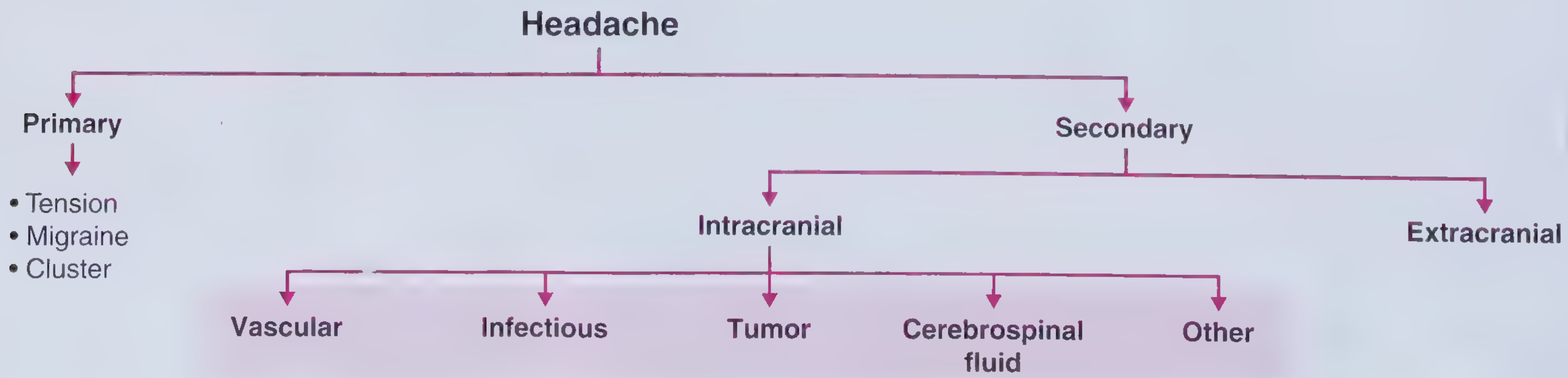
1. Primary Headache Disorders
These occur on their own, without an identifiable underlying disease. They account for the vast majority of all headaches.
| Type | Key Features |
|---|---|
| Migraine | Moderate-to-severe, unilateral, throbbing; with nausea, vomiting, photophobia, phonophobia; may have aura (visual/sensory disturbances) |
| Tension-type headache (TTH) | Band-like, bilateral, mild-to-moderate; most common type (60-80% of the population) |
| Cluster headache | Severe, unilateral, periorbital; occurs in clusters; associated with autonomic features (tearing, ptosis, rhinorrhea) |
| Trigeminal autonomic cephalalgias (TACs) | Includes paroxysmal hemicrania, SUNA, hemicrania continua |
| Other primary headaches | Cough headache, exercise headache, sex headache, thunderclap headache, hypnic headache, etc. |
2. Secondary Headache Disorders
These result from an identifiable underlying condition. Causes include:
- Intracranial: Vascular (subarachnoid hemorrhage, stroke, arteriovenous malformation), infection (meningitis, encephalitis), tumor, cerebrospinal fluid disorders (raised/low ICP)
- Extracranial: Sinus disease, dental problems, eye disorders, cervical spine disease
- Systemic: Hypertension, metabolic disorders, medication overuse, substance withdrawal, infection
3. Painful Cranial Neuropathies and Other Headaches
Includes trigeminal neuralgia and other facial pain syndromes.
- Bradley and Daroff's Neurology in Clinical Practice, ICHD-3 classification
Pathophysiology
Headache pain is initiated by primary trigeminal afferents that innervate blood vessels, mucosa, muscles, and tissues. These fibers converge in the trigeminal ganglion, especially the first (ophthalmic) division. The key pathway is:
- Trigeminal afferents → trigeminal ganglion → subnucleus caudalis
- Subnucleus caudalis receives input from meningeal vessels, dura, and upper cervical cord
- Signals project via the spinothalamic tract to the thalamus, then to the sensory cortex
- In primary headaches, chemical mediators such as calcitonin gene-related peptide (CGRP) activate this pathway spontaneously
- Cortical spreading depression is thought to underlie migraine aura
The genetic component is well established - familial hemiplegic migraine involves mutations in CACNA1A (calcium channels), ATP1A2 (Na⁺/K⁺-ATPase), and SCN1A (sodium channels). - Goldman-Cecil Medicine, p. 3809
Clinical Features
- Pain may be throbbing, band-like, or aching; unilateral or bilateral
- Migraine is associated with nausea, vomiting, photophobia, phonophobia
- Autonomic features (ptosis, conjunctival injection, tearing, Horner syndrome) occur with cluster headache and TACs
- Aura = focal visual, sensory, or motor neurological disturbance preceding or accompanying headache
Red Flags ("SNOOP4" criteria)
Certain features demand urgent evaluation (neuroimaging, etc.):
-
Thunderclap headache - sudden, severe ("worst headache of my life") - may indicate subarachnoid hemorrhage
-
New-onset severe headache in a patient with no headache history
-
Progressive worsening headache - increasing frequency or severity
-
Headache in a cancer or immunocompromised patient
-
Associated fever, altered consciousness, or focal neurological deficit
-
Headache always localized to one area or unresponsive to treatment
-
Bradley and Daroff's Neurology in Clinical Practice, p. 2082
Diagnosis
Five key history elements (Goldman-Cecil Medicine):
- Family history - genetic predisposition
- Life history of headache - new vs. longstanding
- Attack history - character, duration, frequency, triggers
- Medical and psychiatric history - comorbidities
- Medication and drug history - medication-overuse headache (MOH)
MRI is the preferred imaging modality when a secondary cause is suspected.
Epidemiology & Burden
-
Tension-type headache affects 60-80% of the population
-
Migraine affects ~15% (women 18.3%, men 7.6%)
-
Cluster headache is rare (~0.1%) but severely disabling
-
The WHO lists migraine among the top 10 most disabling conditions worldwide
-
Direct and indirect costs of migraine in the USA exceed $27 billion annually
-
First-degree relatives of patients with migraine or cluster headache have up to a 4-fold increased risk of the same headache type
-
Goldman-Cecil Medicine, p. 3809; Frameworks for Internal Medicine, p. 529
This is a shared conversation. Sign in to Orris to start your own chat.