
Crucial points in life cycle of man.
Reading File
The life cycle of man (human male) passes through several key biological, developmental, and physiological stages - from fertilization through old age. These include embryonic development, puberty, reproductive maturity, and senescence.
Searching sources...
Finding Sources
Finding Sources
Searching the Web
crucial points life cycle of man human male developmental stages biology
Finding Sources
Finding Sources
Finding Sources
Reading File
Finding Sources
Finding Sources
Finding Sources
Reading File
Loading Image
Finding Sources
Here is a comprehensive overview of the crucial points in the life cycle of man (human male):
Crucial Points in the Life Cycle of Man
The human male life cycle passes through six major biological stages, each marked by distinct physiological events, hormonal shifts, and structural changes.
1. Fertilization and Conception
The life cycle begins when a sperm fertilizes an oocyte, forming a zygote. This single event determines genetic sex (46,XY in the male). The zygote undergoes rapid cleavage and travels down the fallopian tube, arriving at the uterus as a blastocyst.
Key events:
- Fertilization typically occurs in the ampulla of the fallopian tube
- Implantation in the uterine endometrium occurs around day 6-10
- The sex chromosomes (XY) trigger the SRY gene on the Y chromosome, initiating male gonadal differentiation
2. Fetal Development (Weeks 1-38)
This stage sees the transformation from a cluster of cells into a fully formed male infant.
Key milestones:
- Week 4-8 (Embryonic period): Major organ systems form (heart, brain, limbs); testes differentiate under SRY gene influence
- Week 8-12: The testes begin secreting testosterone and anti-Mullerian hormone (AMH), causing Wolffian duct development (male internal genitalia) and Mullerian duct regression
- Week 12-20: External genitalia virilize under dihydrotestosterone (DHT); testes descend into the scrotum by birth
- Weeks 20-38: Rapid growth; lungs mature; testes fully descend
The fetal hypothalamic-pituitary-gonadal (HPG) axis is already active, and GnRH pulses are present.
3. Infancy and Childhood (0-10 years)
At birth, there is a brief "mini-puberty" (first 3-6 months of life) where LH, FSH, and testosterone levels temporarily surge - thought to be important for germ cell maturation and penile/testicular growth.
After this:
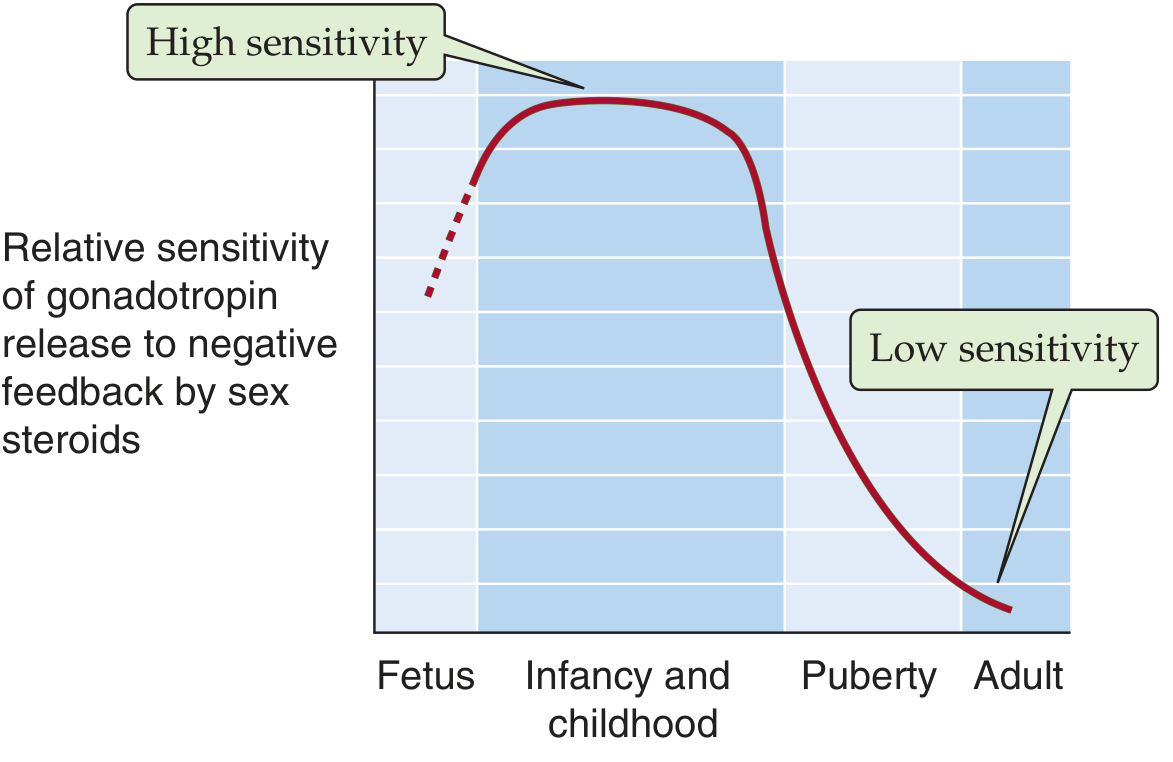
- The HPG axis becomes highly sensitive to negative feedback by sex steroids, keeping gonadotropin levels suppressed throughout childhood (see diagram below)
- Linear growth occurs under the influence of growth hormone (GH) and IGF-1
- Adrenarche (adrenal androgen production) begins around age 6-8, causing early pubic and axillary hair
4. Puberty (Ages ~9-17)
Puberty is triggered by the loss of hypothalamic sensitivity to sex steroid negative feedback, causing a rise in GnRH pulse frequency and amplitude, which increases LH and FSH secretion from the pituitary, in turn stimulating testicular testosterone production.
Tanner Staging in Males (from Medical Physiology):
| Stage | Pubic Hair | Genital Development |
|---|---|---|
| 1 | None (vellus only) | Preadolescent size |
| 2 | Sparse at base of penis | Scrotum and testes enlarge |
| 3 | Darker, coarser, spreads above pubis | Penis enlarges mainly in length |
| 4 | Adult type, smaller area | Penis enlarges in length and girth |
| 5 | Full adult pattern | Full adult pattern |
Physical changes driven by testosterone and GH include:
- Pubertal growth spurt: Boys gain an average of 28 cm in height during this period
- Testicular enlargement (first sign in males, typically age 9-11)
- Voice deepening (laryngeal growth)
- Muscle mass increase - men develop twice the number of muscle cells as women
- Bone density increase and epiphyseal plate fusion (ending height gain)
- Spermarche (first sperm production) - occurs around age 13-14
5. Adulthood and Reproductive Maturity (Ages 18-50s)
This is the period of peak physical capacity and reproductive function.
Key features:
- Spermatogenesis is continuous: ~1,500 spermatozoa are produced per second in the seminiferous tubules
- Testosterone levels are highest in the 20s and 30s
- Testosterone drives libido, erythropoiesis (higher hematocrit in men), bone maintenance, and muscle maintenance
- The HPG axis is at lowest sensitivity to negative feedback (see figure above), allowing stable high testosterone output
- Reproductive function remains active well into the 50s-60s (unlike women who have a defined menopause)
6. Andropause and Aging (Ages 50+)
Unlike the abrupt ovarian failure in women, the male decline in reproductive hormones is gradual - sometimes called andropause or late-onset hypogonadism.
Key changes:
- Testosterone levels decline ~1-2% per year after age 30
- SHBG (sex hormone binding globulin) increases with age, further reducing free (active) testosterone
- Sperm quality declines but does not completely cease
- Reduced muscle mass (sarcopenia) and bone density (osteopenia)
- Increased fat mass, especially visceral
- GH and IGF-1 secretion fall progressively (somatopause)
- Prostate enlargement (BPH) affects most men over 60
Summary Timeline
| Stage | Age | Key Event |
|---|---|---|
| Fertilization | Conception | Zygote formed; XY sex determined |
| Fetal | 0-38 weeks | Testis formation, testosterone, genital differentiation |
| Infancy | 0-3 years | Mini-puberty; HPG axis quiescent |
| Childhood | 3-10 years | GH-driven growth; adrenarche |
| Puberty | 9-17 years | Tanner stages; growth spurt; spermarche |
| Adulthood | 18-50s | Peak testosterone; continuous spermatogenesis |
| Aging | 50+ | Gradual androgen decline; sarcopenia; BPH |
Sources: Medical Physiology (Boron & Boulpaep), Tanner Staging Table and Figure 53-12; evolution of the human life cycle research.
This is a shared conversation. Sign in to Orris to start your own chat.