
Human body cell
The human body cell is the basic structural and functional unit of the human body. Here's a quick overview:
Structure: A typical human cell has three main parts - the cell membrane (outer boundary), the cytoplasm (gel-like interior), and the nucleus (control center containing DNA).
Key Organelles: Mitochondria (energy production), ribosomes (protein synthesis), endoplasmic reticulum (transport/processing), Golgi apparatus (packaging/secretion), and lysosomes (waste digestion).
Size & Number: Most cells are 10-100 micrometers in diameter. The human body contains roughly 37 trillion cells.
Types: There are about 200 distinct cell types - neurons, muscle cells, red blood cells, epithelial cells, and more.
Searching sources...
Reading File
Searching the Web
human body cell structure organelles function overview
Finding Sources
Finding Sources
Finding Sources
I found relevant content from multiple authoritative textbooks. Let me read the key sections, especially from Guyton & Hall and Histology texts.
Reading File
Reading File
I found excellent content and cell diagrams. Let me fetch the cell diagrams from Guyton & Hall and read more of the Histology content.
Loading Image
Loading Image
Reading File
I now have excellent textbook content and detailed diagrams. Here is the complete, well-referenced answer:
The Human Body Cell
The human body cell is the fundamental unit of life. Every tissue and organ is built from cells, and each cell carries out all the basic processes needed for survival - energy production, protein synthesis, waste disposal, and reproduction.
Basic Structure
A cell has three main compartments:
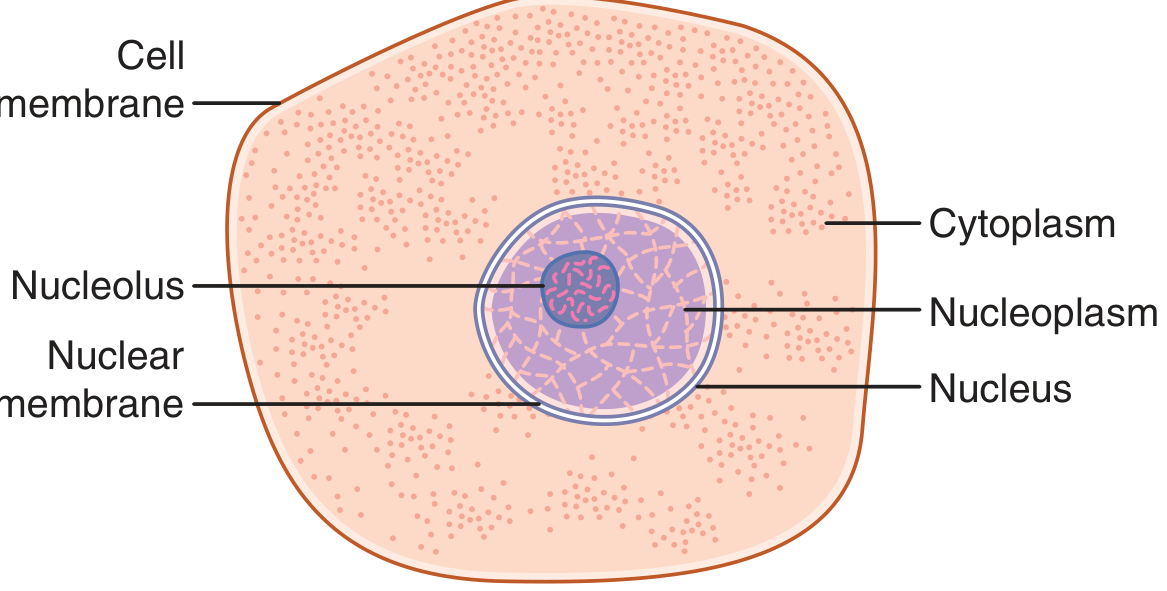
| Compartment | Description |
|---|---|
| Cell membrane | Outer boundary; selectively controls what enters and exits |
| Cytoplasm | Gel-like interior containing organelles, cytoskeleton, and inclusions |
| Nucleus | Largest organelle; contains DNA and directs cell activities |
- Guyton and Hall Textbook of Medical Physiology
- Histology: A Text and Atlas, Histology
Detailed Diagram of Organelles
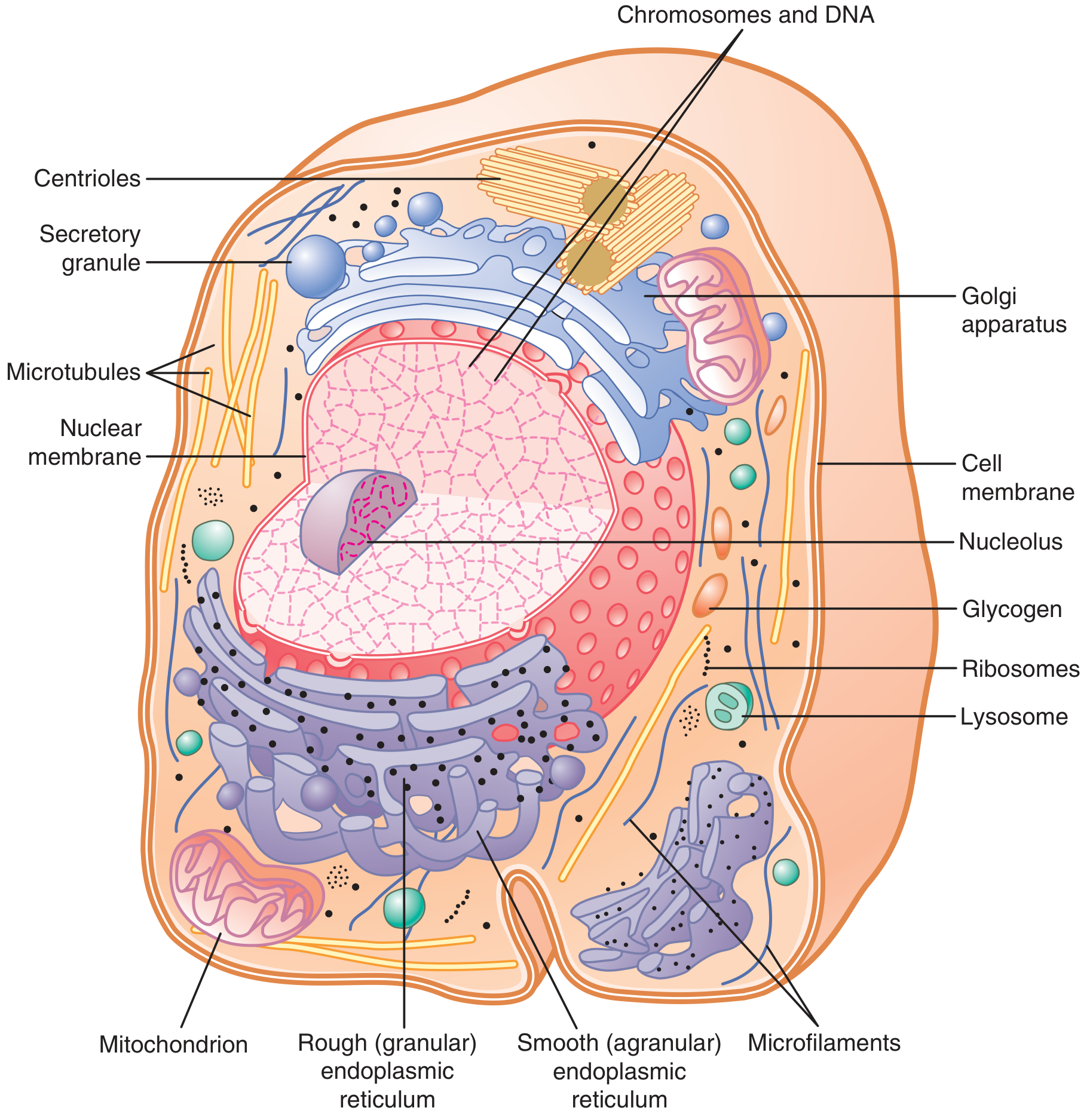
Major Organelles and Their Functions
1. Cell Membrane (Plasma Membrane)
- A lipid bilayer 7.5-10 nanometers thick
- Composition: ~55% proteins, 25% phospholipids, 13% cholesterol, 4% other lipids, 3% carbohydrates
- Hydrophilic phosphate heads face outward (toward water), hydrophobic fatty acid tails face inward
- Proteins embedded in the membrane act as channels, receptors, and enzymes
- Fat-soluble substances (O₂, CO₂) cross freely; ions and glucose require protein channels
2. Nucleus
- The control center - contains the genome (DNA) and enzymes for DNA replication and RNA transcription
- Surrounded by a double nuclear membrane with nuclear pores
- Contains the nucleolus - a dense region of RNA that is the site of ribosome assembly
- The nucleoplasm (fluid inside) contains chromatin (DNA + histone proteins)
3. Mitochondria
- The powerhouses of the cell - produce ATP via oxidative phosphorylation
- Double-membraned; the inner membrane is folded into cristae to maximize surface area
- Contain their own DNA (inherited maternally) - evidence of their evolutionary origin as bacteria
- Loss of mitochondrial function eliminates >95% of the cell's energy supply
4. Endoplasmic Reticulum (ER)
- Rough ER (rER) - studded with ribosomes; site of protein synthesis and modification
- Smooth ER (SER) - lacks ribosomes; involved in lipid synthesis, detoxification (liver), and calcium storage (muscle)
5. Ribosomes
- Nonmembranous organelles composed of rRNA and protein
- Site of protein synthesis; found free in cytoplasm or attached to rough ER
- Assembled in the nucleolus
6. Golgi Apparatus
- The post office of the cell - receives proteins from rER, modifies, packages, and sorts them
- Produces secretory vesicles, lysosomes, and membrane components
7. Lysosomes
- Membrane-bound sacs containing ~40 types of hydrolytic enzymes
- Digest worn-out organelles, bacteria, and cellular debris (autophagy and phagocytosis)
- Their enzyme-resistant membrane is critical - if ruptured, the enzymes would digest the entire cell
8. Peroxisomes
- Contain oxidative enzymes (catalase, oxidases)
- Break down fatty acids and detoxify harmful substances like hydrogen peroxide (H₂O₂ → H₂O + O₂)
9. Cytoskeleton
- Microtubules - hollow tubes built from tubulin; form cilia, flagella, the mitotic spindle, and axonal transport tracks
- Intermediate filaments - structural support; vary by cell type (e.g., keratin in skin cells, vimentin in connective tissue)
- Actin filaments (microfilaments) - involved in cell shape, movement, and muscle contraction
10. Centrioles
- Paired structures that organize the mitotic spindle during cell division
- Also form the basal bodies of cilia and flagella
Cell Membrane - Molecular Detail
The lipid bilayer has three main lipid types:
- Phospholipids - most abundant; amphipathic (hydrophilic head + hydrophobic tail)
- Sphingolipids - protective functions, signal transmission, adhesion sites
- Cholesterol - regulates membrane fluidity and permeability
Chemical Composition of a Typical Cell
| Molecule | % of Cell Mass |
|---|---|
| Water | ~70-85% |
| Proteins | ~10-20% |
| Lipids | ~2% |
| Carbohydrates | ~1% (up to 6% in liver cells) |
| Nucleic acids | ~1% |
Types of Human Cells (~200 types)
| Cell Type | Key Feature |
|---|---|
| Neurons | Long axons for electrical signal transmission |
| Red blood cells (erythrocytes) | Biconcave, no nucleus, packed with hemoglobin |
| Muscle cells (myocytes) | Packed with contractile filaments (actin + myosin) |
| Epithelial cells | Form sheets lining surfaces and organs |
| Adipocytes (fat cells) | Triglycerides = up to 95% of cell mass |
| Sperm cells | Flagellum for motility; mitochondria provide energy |
Two Categories of Organelles
Per Histology: A Text and Atlas:
- Membranous organelles (enclosed by a lipid bilayer): plasma membrane, rough ER, smooth ER, Golgi apparatus, lysosomes, peroxisomes, mitochondria, nucleus
- Nonmembranous organelles (self-assembled protein polymers): ribosomes, centrioles, cytoskeletal filaments
Sources: Guyton and Hall Textbook of Medical Physiology | Histology: A Text and Atlas with Correlated Cell and Molecular Biology | Basic Medical Biochemistry: A Clinical Approach
This is a shared conversation. Sign in to Orris to start your own chat.