
Explain me ecg changes of major heart diseases in emergency
Reading File
Now let me search the library in parallel for all major emergency ECG topics:
Finding Sources
Finding Sources
Finding Sources
Good — found key sources. Now let me read the main ECG sections from Tintinalli's Emergency Medicine and Harrison's in parallel:
Reading File
Reading File
Finding Sources
Finding Sources
Excellent data coming in. Let me now pull ECG sections for PE, cardiac tamponade, aortic dissection, Wolff-Parkinson-White, and the full Tintinalli ECG section:
Reading File
Finding Sources
Finding Sources
Finding Sources
I have excellent content. Let me now fetch the key ECG images and a few more critical content blocks simultaneously:
Reading File
Reading File
Reading File
I now have comprehensive data. Let me fetch the key ECG images to include visually:
Loading Image
Loading Image
Loading Image
I now have comprehensive data from Tintinalli's Emergency Medicine, Harrison's, Goldman-Cecil, and Rosen's Emergency Medicine. Let me compile the full answer:
ECG Changes in Major Cardiac Emergencies
Sources: Tintinalli's Emergency Medicine, Harrison's Principles of Internal Medicine 22E, Goldman-Cecil Medicine, Rosen's Emergency Medicine, Braunwald's Heart Disease
Pathophysiology of ST Changes (The Foundation)
Ischemia exerts complex time-dependent effects on myocardial cells. Severe acute ischemia lowers the resting membrane potential, creating a voltage gradient between normal and ischemic zones — "currents of injury" — visible as ST deviation. The direction of the ST vector determines whether you see elevation or depression:
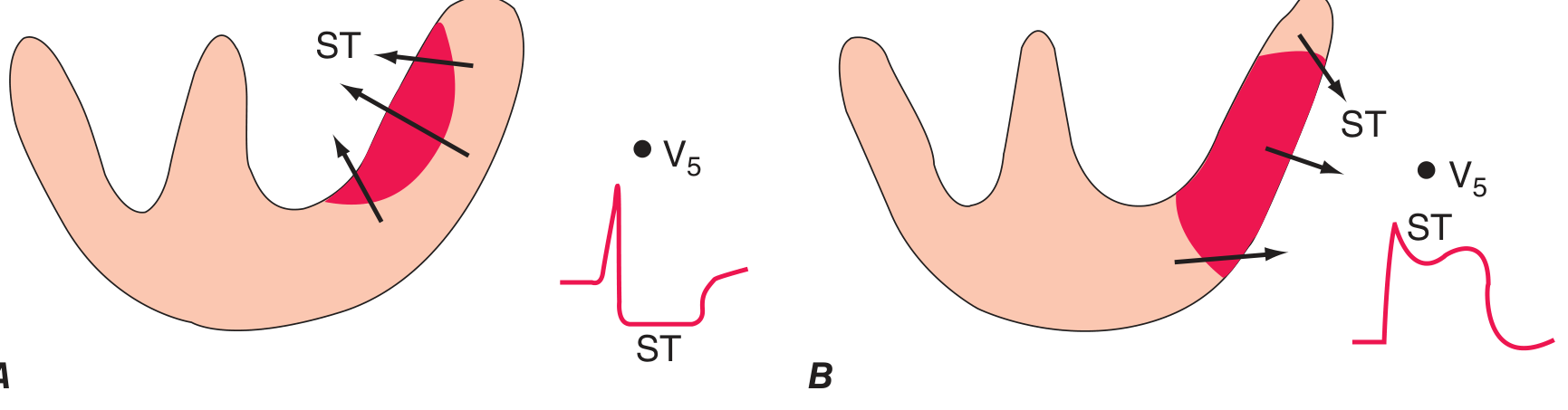
A = Subendocardial ischemia → ST depression in overlying leads. B = Transmural (epicardial) ischemia → ST elevation in overlying leads.
1. STEMI — ST-Elevation Myocardial Infarction
Diagnostic Criteria (per Tintinalli's)
New ST elevation at the J-point:
- ≥1 mm in all leads except V₂–V₃
- ≥2 mm in V₂–V₃ (men ≥40 y), ≥2.5 mm (men <40 y), ≥1.5 mm (women)
Localisation by Territory
| Territory | Leads with ST Elevation | Infarct-Related Artery |
|---|---|---|
| Anteroseptal | V₁, V₂ (±V₃) | Proximal LAD |
| Anterior | V₁–V₄ | LAD |
| Anterolateral | V₁–V₆, I, aVL | Proximal LAD / LCx |
| Lateral | I, aVL | LCx or diagonal |
| Inferior | II, III, aVF | RCA (most common) or LCx |
| Inferolateral | II, III, aVF + V₅, V₆ | RCA or dominant LCx |
| True posterior | Tall R in V₁–V₂, R/S ≥1, ST depression V₁–V₃ | LCx / RCA |
| Right ventricular (RV) | II, III, aVF + ST elevation in V₃R–V₆R | Proximal RCA |
Inferior STEMI ECG (RCA occlusion):
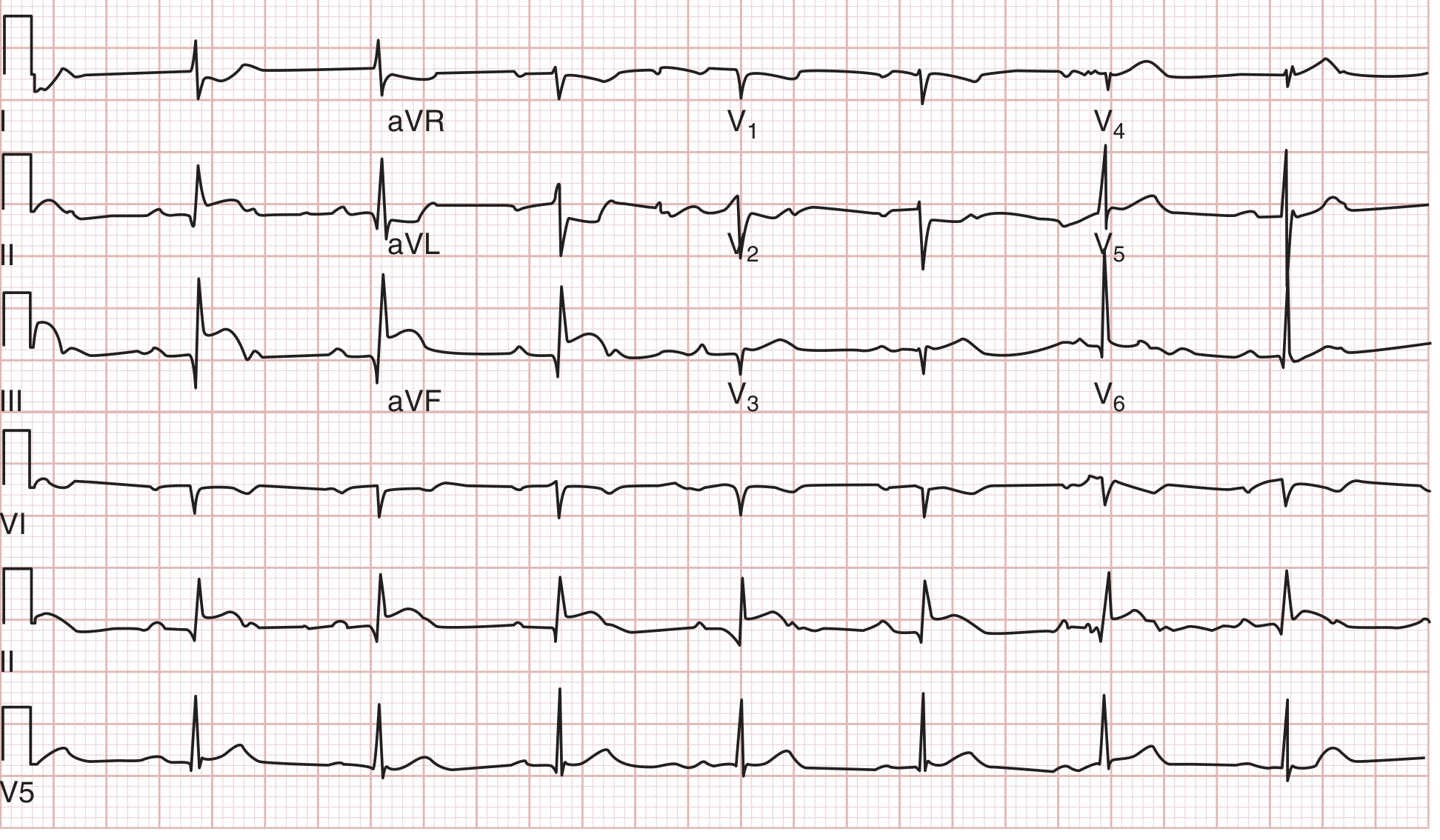
ST elevation in III > II, ST depression in I and aVL — 100% RCA occlusion confirmed at catheterisation.
Anterior STEMI ECG (LAD occlusion):
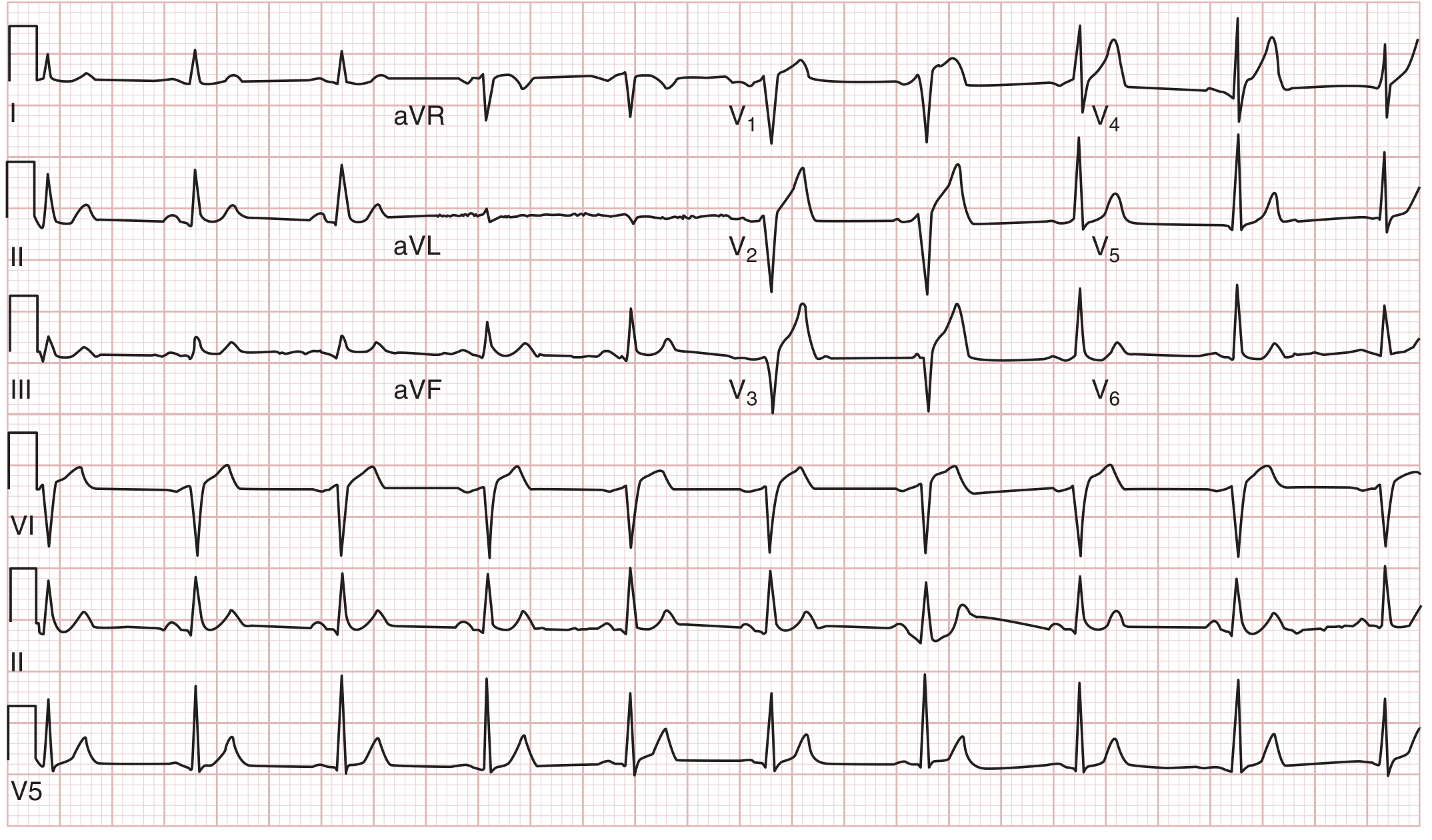
ST elevation in I, V₁–V₃ with absence of depression in II/III/aVF — distal LAD.
Evolutionary ECG Sequence
| Time | ECG Finding |
|---|---|
| Minutes (hyperacute) | Tall, broad, peaked hyperacute T waves |
| Hours | ST elevation — convex ("tombstone") or concave |
| Hours–days | T-wave inversion begins in same leads |
| Hours–days | Pathological Q waves develop (>40 ms wide, >25% of R height) |
| Days–weeks | ST normalises; T waves may remain inverted |
| Months–years | Q waves persist (marker of old infarct) |
Key Points
- Reciprocal ST depression in leads opposite the infarct zone indicates larger injury, more severe CAD, worse prognosis
- New LBBB with chest pain was historically a STEMI equivalent, but <10% actually have AMI — use Sgarbossa criteria
- RV infarction: always obtain right-sided leads (V₄R) in inferior STEMI; ST elevation ≥1 mm in V₄R is highly suggestive
2. NSTEMI / Unstable Angina
ECG Findings
- ST depression ≥0.5 mm in ≥2 contiguous leads (subendocardial ischemia pattern)
- T-wave inversions — symmetric, deep
- ST elevation in aVR with diffuse ST depression elsewhere → suggests left main or proximal LAD occlusion (or severe 3-vessel disease)
- Normal ECG in 1–6% of confirmed NSTEMI — does not exclude the diagnosis
Wellens' Syndrome (Critical LAD Stenosis)
A warning pattern indicating critical proximal LAD stenosis — often pain-free at time of ECG:
- Type A (25%): Biphasic T waves in V₂–V₃
- Type B (75%): Deeply symmetric T-wave inversions in V₂–V₃ (may extend to V₄–V₆)
- T-wave changes normalise when pain returns, reappear when pain subsides — dynamic pattern
3. Acute Pericarditis
Stages of ECG Change
| Stage | Timing | ECG |
|---|---|---|
| Stage I | Acute (days) | Diffuse concave ("saddle-shaped") ST elevation in nearly all leads (I, II, III, aVF, V₂–V₆); PR depression (most specific); ST elevation in aVR with PR elevation |
| Stage II | 1–2 weeks | ST and PR normalise |
| Stage III | Weeks | Diffuse T-wave inversions |
| Stage IV | Months | ECG returns to normal |
Distinguishing from STEMI
| Feature | Pericarditis | STEMI |
|---|---|---|
| ST distribution | Diffuse (all leads) | Regional (territory) |
| ST shape | Concave (saddle) | Convex (tombstone) |
| Reciprocal changes | Absent (except aVR) | Present |
| PR depression | Yes | No |
| Q waves | No | Yes (evolving) |
| ST:T ratio in V₆ | >0.25 → pericarditis | <0.25 |
4. Cardiac Tamponade
ECG Findings
- Sinus tachycardia — almost universal
- Low voltage (QRS amplitude <5 mm in limb leads, <10 mm precordial) — from pericardial fluid insulating electrical activity
- Electrical alternans — beat-to-beat alternation in QRS amplitude/morphology as the heart swings within fluid; pathognomonic when present
"The cardiac position will alternate, with the heart returning to its original position with every other beat, thus electrical alternans may be seen." — Rosen's Emergency Medicine
- Electrical alternans is highly specific but seen in only ~20% of tamponade; its absence does not exclude tamponade
5. Pulmonary Embolism (PE)
The ECG in PE is often non-specific or normal in minor PE. In massive PE with right heart strain:
Classic Pattern — S₁Q₃T₃
- S wave in lead I (right axis deviation)
- Q wave in lead III
- T-wave inversion in lead III
Other RV Strain Patterns
- Sinus tachycardia — most common finding
- New RBBB (complete or incomplete) — indicates severe RV strain/hypertension
- T-wave inversions in V₁–V₄ — RV strain
- Right axis deviation
- P pulmonale (peaked P in II >2.5 mm) — right atrial enlargement
- Atrial fibrillation/flutter
- ST elevation in V₁ ± aVR
"A new right bundle branch block suggests right ventricular strain and severe pulmonary hypertension." — Goldman-Cecil Medicine
The S₁Q₃T₃ is specific but present in only ~20% of PE cases; sinus tachycardia + anterior T-wave inversions is more commonly seen with large PE.
6. Hyperkalemia
ECG changes progress in a predictable sequence with rising K⁺:
| K⁺ Level | ECG Change |
|---|---|
| 5.5–6.5 mEq/L | Tall, peaked (tent-shaped) T waves, narrow base, shortened QT |
| 6.5–7.5 mEq/L | Loss of P waves, PR prolongation, widening QRS |
| 7.0–8.0 mEq/L | Wide QRS, ST changes (depression), bundle branch blocks |
| >8.0–9.0 mEq/L | Sine wave pattern (QRS merges with T wave) → imminent cardiac arrest, VF |
The sine wave is a medical emergency requiring immediate IV calcium.
7. Wolff-Parkinson-White (WPW)
ECG Triad During Sinus Rhythm
- Short PR interval (<120 ms) — rapid conduction via accessory pathway bypasses AV node delay
- Delta wave — slurred upstroke of initial QRS (pre-excitation of ventricle)
- Widened QRS complex — fusion of normal and accessory pathway depolarisation
- Secondary ST-T changes — discordant to QRS direction
Tachyarrhythmias in WPW (Emergency)
| Type | ECG | Rate | Danger |
|---|---|---|---|
| Orthodromic AVRT (65%) | Narrow QRS, regular, no delta wave | 160–220 bpm | Moderate |
| Antidromic AVRT (5–10%) | Wide QRS, regular, can mimic VT | 160–220 bpm | High |
| AF with pre-excitation (25%) | Wide, bizarre, irregular QRS, delta waves, rate often >200 bpm | >200 bpm | Immediately life-threatening |
Critical Warning: In WPW + AF, avoid AV-nodal blocking agents (adenosine, verapamil, digoxin, beta-blockers) — they block the normal pathway, forcing all conduction down the accessory pathway, potentially triggering VF.
8. Ventricular Tachycardia (VT) vs. SVT with Aberrancy
VT Features on ECG (Favour VT)
- AV dissociation (P waves independent of QRS) — most specific sign
- QRS width >160 ms
- Concordance in precordial leads (all positive or all negative)
- Fusion beats and capture beats
- Extreme axis (Northwest axis, −90° to ±180°)
- Brugada criteria / Josephson's sign (notching near S-wave nadir)
SVT with Aberrancy
- QRS usually <160 ms
- Typical RBBB or LBBB morphology
- Responds to vagal manoeuvres or adenosine
9. Aortic Dissection
ECG is usually non-specific, but important to obtain urgently to exclude MI (since thrombolytics given for MI are fatal in dissection):
- Most common: normal ECG or non-specific ST-T changes
- ST elevation in inferior leads — if dissection involves the RCA ostium (Type A with coronary involvement)
- LVH pattern — from underlying hypertension (common predisposing factor)
- Pericardial effusion changes (low voltage, electrical alternans) — from haemopericardium in Type A
10. Brugada Syndrome
A channelopathy causing sudden cardiac death in structurally normal hearts:
- Type 1 (diagnostic): Coved ST elevation ≥2 mm in V₁–V₂ with T-wave inversion — "coved pattern"
- Type 2: Saddle-back ST elevation ≥2 mm in V₁–V₂ (high takeoff) — not diagnostic alone
- Pattern can be concealed and unmasked by fever, sodium channel blockers, class IC antiarrhythmics
11. Long QT Syndrome / Torsades de Pointes
- QTc >440 ms (men), >460 ms (women) — prolonged
- QTc >500 ms — high risk for Torsades de Pointes (TdP)
- Torsades: Polymorphic VT with rotating axis ("twisting of the points") around baseline — characteristically self-terminates but can degenerate to VF
- Triggers: hypomagnesaemia, hypokalaemia, QT-prolonging drugs (class IA/III antiarrhythmics, antipsychotics, antiemetics)
- Treatment: IV magnesium 2g, correct electrolytes, consider overdrive pacing
Quick Reference Summary Table
| Emergency | Key ECG Finding | Do Not Miss |
|---|---|---|
| Anterior STEMI | ST elevation V₁–V₄ | Check for aVR elevation (LM/proximal LAD) |
| Inferior STEMI | ST elevation II, III, aVF | Get right-sided leads → RV infarction |
| Posterior MI | Tall R + ST depression V₁–V₃ | Mirror image: posterior leads show elevation |
| NSTEMI/UA | ST depression, T inversion | Normal ECG does not exclude |
| Wellens' syndrome | Biphasic/deep T in V₂–V₃ (pain free) | Do NOT stress test — proximal LAD critical stenosis |
| Pericarditis | Diffuse concave ST elevation + PR depression | Differentiate from STEMI |
| Tamponade | Low voltage + electrical alternans | Treat clinically + echo, not ECG alone |
| PE (massive) | Sinus tachy, S₁Q₃T₃, new RBBB, T inversion V₁–V₄ | Normal ECG does not exclude PE |
| Hyperkalemia | Peaked T → loss of P → wide QRS → sine wave | Sine wave = give IV calcium STAT |
| WPW + AF | Wide irregular QRS >200 bpm | NO AV blockers — can cause VF |
| VT | Wide QRS + AV dissociation | Treat as VT until proven otherwise |
| Brugada | Coved ST in V₁–V₂ | Fever can unmask; high SCD risk |
| Long QT / TdP | QTc >500 ms, polymorphic VT | IV Mg 2g + correct K⁺/Mg²⁺ |
Sources: Tintinalli's Emergency Medicine (9e), Harrison's Principles of Internal Medicine 22E (2025), Goldman-Cecil Medicine, Rosen's Emergency Medicine, Braunwald's Heart Disease
This is a shared conversation. Sign in to Orris to start your own chat.