
Explain me 10 common heart diseases with ECG changes and ECG images of those diseases
Reading File
Finding Sources
Searching Images
ECG electrocardiogram myocardial infarction ST elevation
Finding Sources
Searching Images
atrial fibrillation ECG tracing absent P waves irregular RR
Searching Images
ventricular tachycardia ECG wide QRS tachycardia
Searching Images
complete heart block third degree AV block ECG P waves dissociation
Searching Images
left ventricular hypertrophy ECG voltage criteria tall R waves
Searching Images
Wolff-Parkinson-White syndrome ECG delta wave short PR interval
Searching Images
pulmonary embolism ECG S1Q3T3 right heart strain sinus tachycardia
Searching Images
hypertrophic cardiomyopathy ECG ST changes deep T wave inversions
Searching Images
pericarditis ECG saddle-shaped ST elevation diffuse PR depression
Searching Images
dilated cardiomyopathy ECG LBBB low voltage poor R wave progression
Here is a comprehensive overview of 10 common heart diseases with their characteristic ECG changes and real ECG images:
10 Common Heart Diseases: ECG Changes & Images
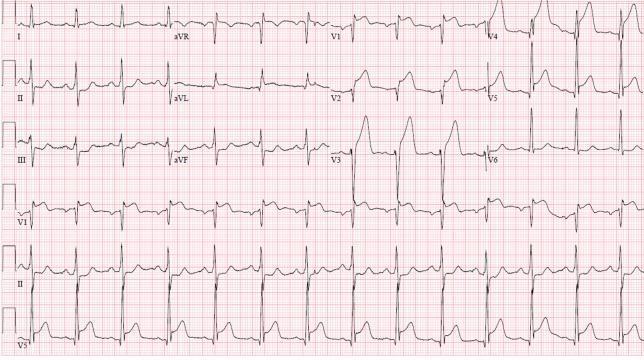
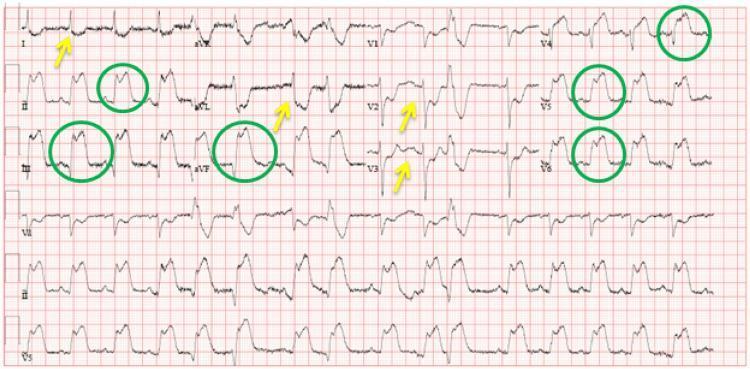
1. 🫀 ST-Elevation Myocardial Infarction (STEMI)
ECG Changes
- Hyperacute T waves — earliest sign (peaked, broad T waves in affected territory)
- ST-segment elevation ≥1 mm in ≥2 contiguous limb leads or ≥2 mm in precordial leads (convex/tombstone morphology)
- Reciprocal ST depression in opposing leads
- Pathological Q waves (≥0.04 s wide, ≥25% of R wave height) — develop hours to days later
- T-wave inversion in the subacute phase
Localisation by Leads
| Territory | Leads with ST elevation | Artery |
|---|---|---|
| Anterior | V1–V4 | LAD |
| Inferior | II, III, aVF | RCA / LCx |
| Lateral | I, aVL, V5–V6 | LCx / LAD |
| Posterior | Reciprocal depression V1–V3 | RCA / LCx |
ECG Image — Anterior STEMI (LAD occlusion)
ECG Image — Inferolateral STEMI (RCA/LCx occlusion)
2. 🫀 Atrial Fibrillation (AF)
ECG Changes
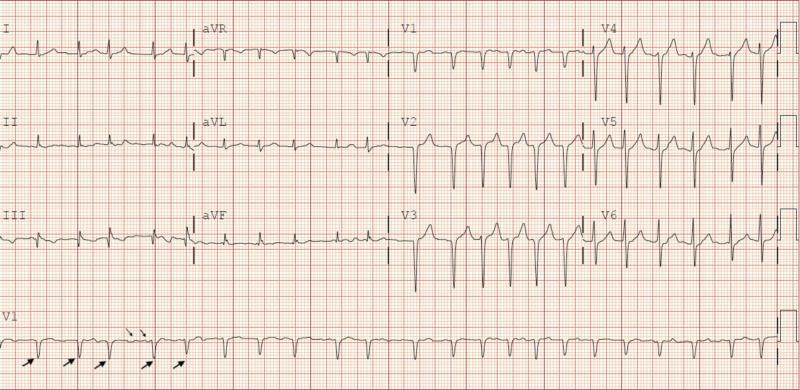
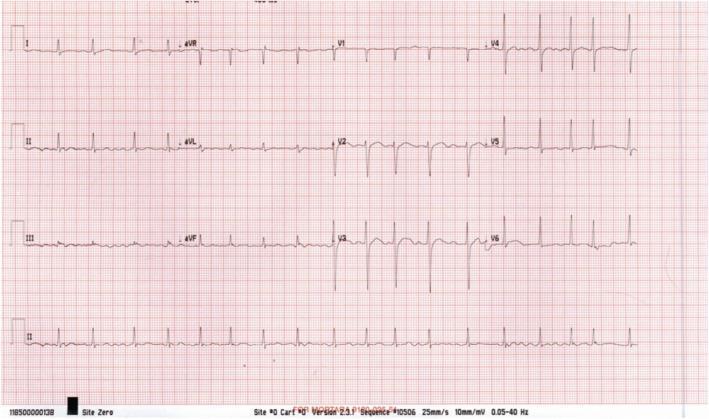
- Absent P waves — replaced by chaotic fibrillatory baseline (f-waves)
- Irregularly irregular RR intervals — hallmark finding
- Narrow QRS complexes (unless aberrant conduction or pre-existing BBB)
- Ventricular rate variable — may be rapid (AF with RVR) or slow (if AV nodal disease)
- Fibrillatory waves best seen in V1 and inferior leads
ECG Image — Atrial Fibrillation with Rapid Ventricular Response
ECG Image — Atrial Fibrillation (moderate rate)
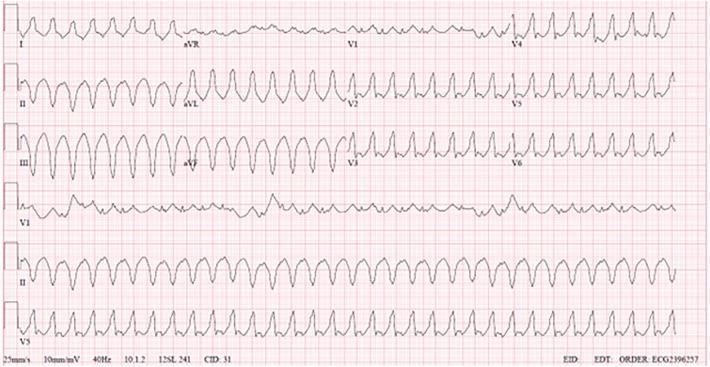
3. 🫀 Ventricular Tachycardia (VT)
ECG Changes
- Regular wide-complex tachycardia — QRS duration >120 ms (often >140 ms)
- Heart rate typically 100–250 bpm
- AV dissociation — P waves march independently (pathognomonic)
- Fusion beats and capture beats (confirm VT)
- Positive or negative concordance across precordial leads
- Brugada, Josephson, or Vereckei criteria used to differentiate from SVT with aberrancy
ECG Image — Monomorphic Ventricular Tachycardia
4. 🫀 Complete (Third-Degree) AV Block
ECG Changes
- Complete AV dissociation — P waves and QRS have no fixed relationship
- P waves march through at their own regular (faster) rate
- Escape rhythm — narrow QRS if junctional (40–60 bpm); wide QRS if ventricular (20–40 bpm)
- Regular RR intervals (escape rhythm is regular)
- Can follow inferior MI (usually transient, nodal block) or anterior MI (infra-Hisian, often permanent)
ECG Image — Third-Degree AV Block
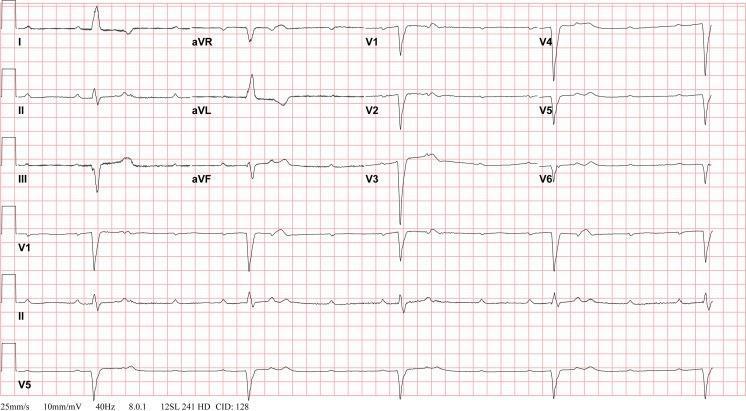
ECG Image — Third-Degree AV Block (Rhythm Strip)

5. 🫀 Left Ventricular Hypertrophy (LVH)
ECG Changes
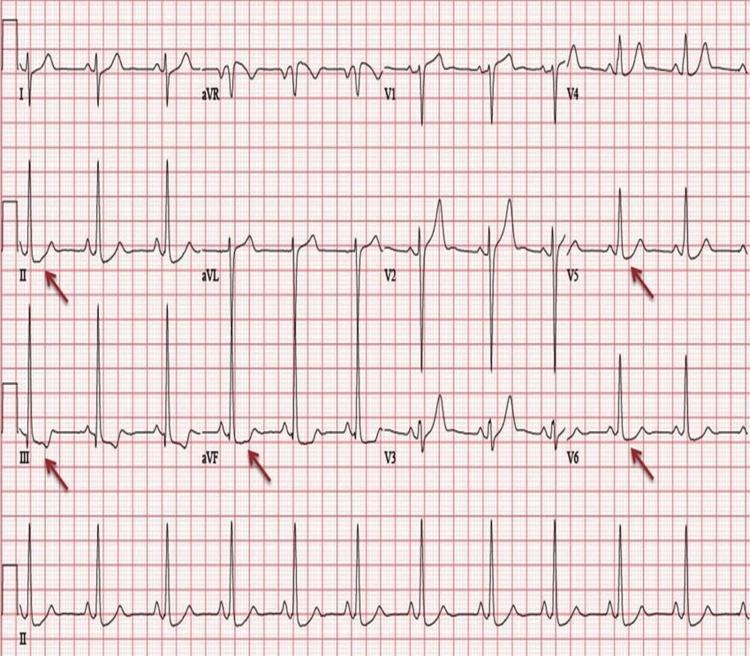
- High QRS voltage — Sokolow-Lyon: S in V1 + R in V5 or V6 ≥35 mm; Cornell: R in aVL ≥11 mm
- Left axis deviation (–30° or more negative)
- LVH strain pattern: ST depression + asymmetric T-wave inversion in lateral leads (I, aVL, V5–V6)
- Left atrial enlargement (P mitrale: bifid P wave in lead II, negative terminal P deflection in V1)
- Prolonged QRS intrinsicoid deflection in V5/V6 (>50 ms)
ECG Image — LVH with Strain Pattern
6. 🫀 Wolff-Parkinson-White (WPW) Syndrome
ECG Changes
- Short PR interval — <120 ms (due to accessory pathway bypassing AV node)
- Delta wave — slurred slow upstroke at onset of QRS
- Widened QRS — total duration >120 ms (due to ventricular pre-excitation)
- Secondary ST-T changes — discordant from delta wave direction
- Pathway location estimated by delta wave polarity:
- Positive delta in V1 → left-sided pathway
- Negative delta in II, III, aVF → posteroseptal pathway
ECG Image — WPW Syndrome
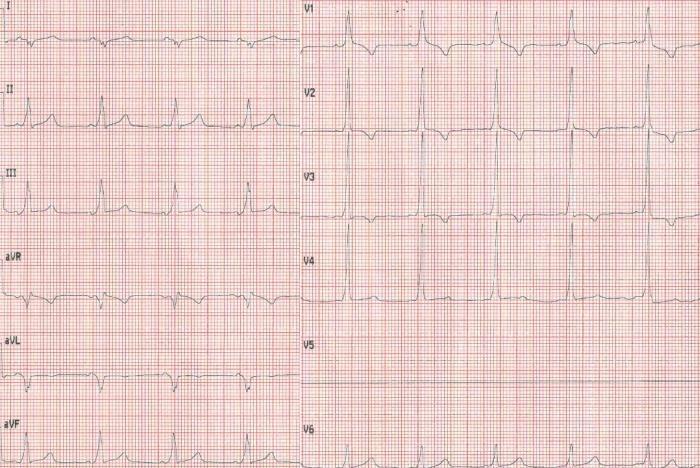
ECG Image — WPW with Pseudoinfarction Pattern
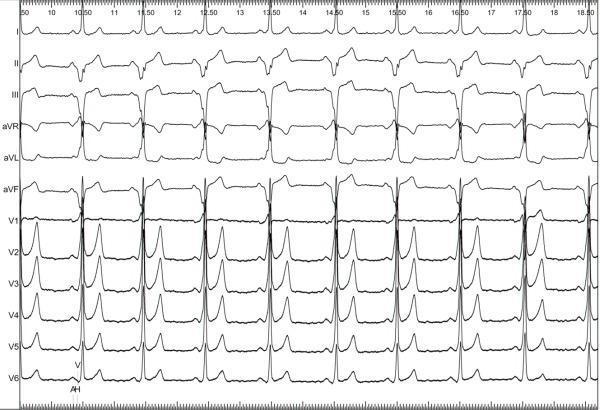
7. 🫀 Pulmonary Embolism (PE)
ECG Changes
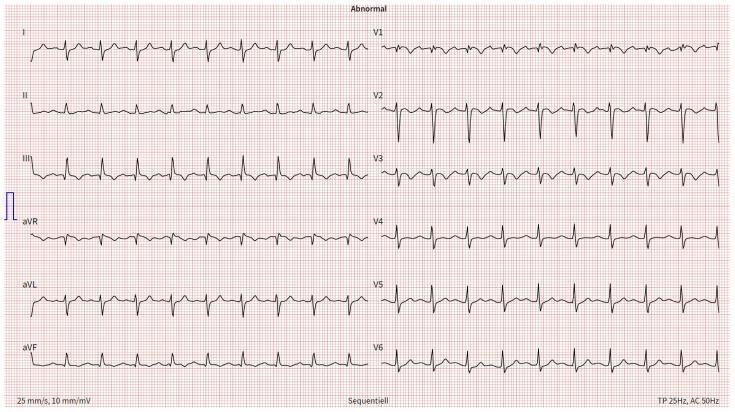
- Sinus tachycardia — most common finding (>50% of cases)
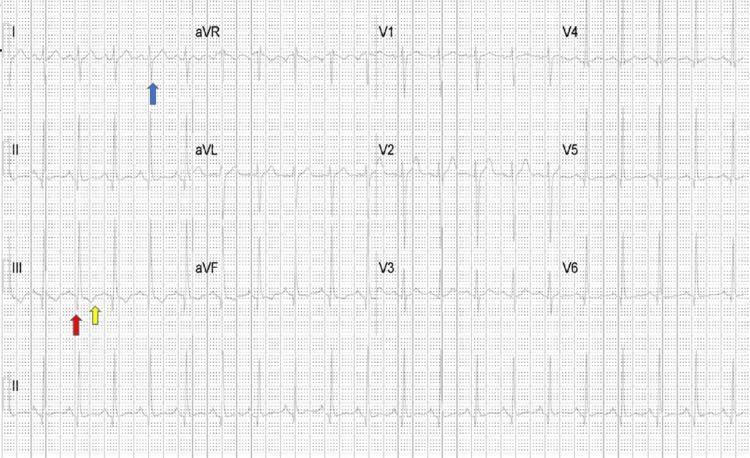
- S1Q3T3 pattern — deep S in lead I + Q wave in lead III + T-wave inversion in lead III
- Right bundle branch block — complete or incomplete (rSR' in V1, wide S in V6)
- T-wave inversions in V1–V4 — right ventricular strain
- Right axis deviation
- P pulmonale (tall P wave >2.5 mm in II) — right atrial overload
- ECG is non-specific — normal in ~25% of PE cases
ECG Image — Pulmonary Embolism with S1Q3T3
ECG Image — Annotated S1Q3T3 Sign
8. 🫀 Hypertrophic Cardiomyopathy (HCM)
ECG Changes
- LVH voltage criteria (common)
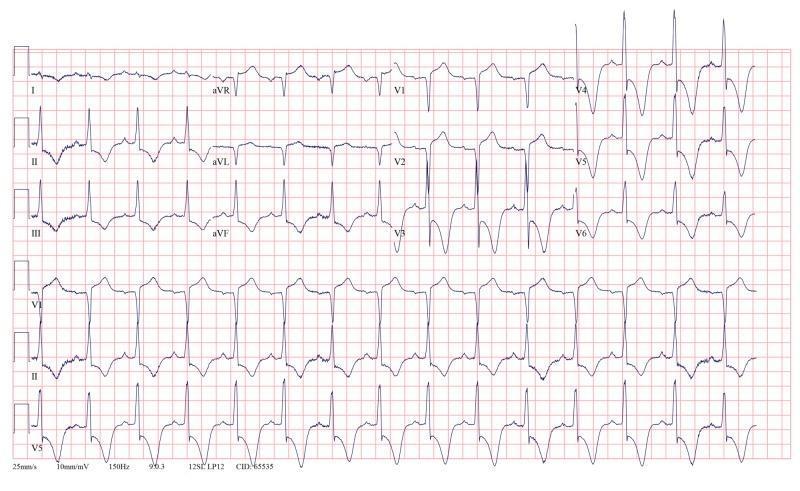
- Giant T-wave inversions in precordial leads (V3–V6) — classic in apical HCM (Yamaguchi variant)
- Deep narrow Q waves in I, aVL, V5–V6 (due to septal hypertrophy)
- Left axis deviation
- Left atrial enlargement (bifid P, prolonged P duration)
- ST depression in lateral leads (strain pattern)
- Arrhythmias: AF, VT common
ECG Image — Apical HCM (Yamaguchi Syndrome)
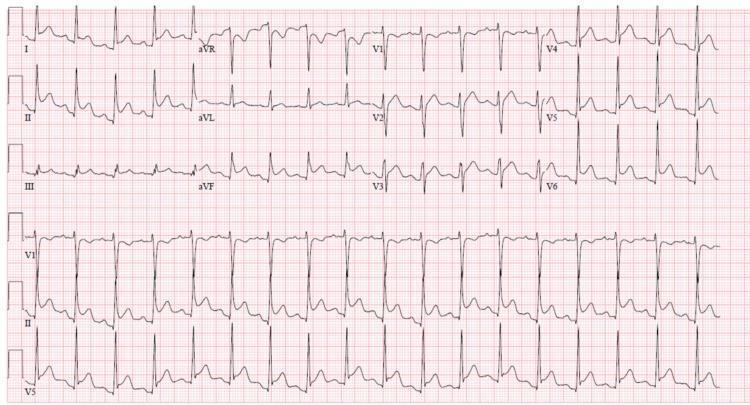
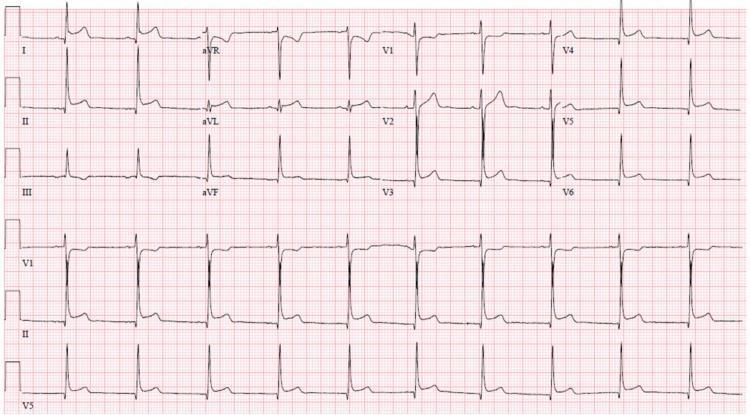
9. 🫀 Acute Pericarditis
ECG Changes (evolve through 4 stages)
| Stage | Timing | ECG Feature |
|---|---|---|
| Stage I | Days 1–2 | Diffuse concave ("saddle-back") ST elevation in all leads except aVR/V1; PR depression |
| Stage II | Days 1–3 | ST returns to baseline; PR depression may persist |
| Stage III | Weeks 1–3 | T-wave inversion (may become widespread) |
| Stage IV | Weeks–months | Normalisation |
- Key differentiators from STEMI: diffuse (not regional) ST elevation, saddle-back morphology, PR depression, no reciprocal changes (except aVR)
- Spodick's sign: downsloping TP segment (highly specific)
ECG Image — Acute Pericarditis (Stage I)
ECG Image — Pericarditis with Spodick's Sign
10. 🫀 Dilated Cardiomyopathy (DCM)
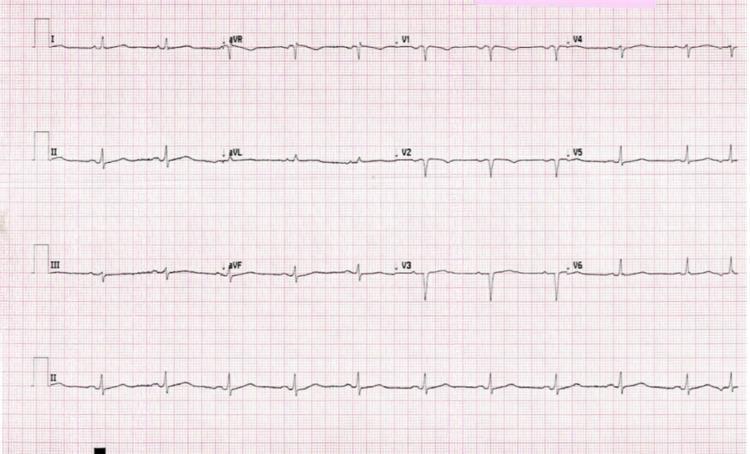
ECG Changes
- Left bundle branch block (LBBB) — most characteristic; broad notched R in I/V5–V6, deep S/rS in V1
- Low QRS voltage in limb leads (<5 mm)
- Poor R-wave progression (PRWP) across precordial leads
- Non-specific ST-T changes and diffuse T-wave flattening/inversion
- Left atrial enlargement (P mitrale)
- Atrial fibrillation — very common in advanced DCM
- Ventricular ectopy / non-sustained VT
ECG Image — DCM Pattern (Low Voltage + PRWP)
Quick Reference Summary Table
| Disease | Key ECG Features |
|---|---|
| STEMI | Convex ST elevation, reciprocal depression, Q waves |
| Atrial Fibrillation | No P waves, irregularly irregular, narrow QRS |
| Ventricular Tachycardia | Wide QRS >120 ms, AV dissociation, rate 100–250 |
| Complete AV Block | P-QRS dissociation, slow escape rhythm |
| LVH | High voltage, strain pattern, left axis deviation |
| WPW | Short PR, delta wave, wide QRS |
| Pulmonary Embolism | Sinus tachycardia, S1Q3T3, RBBB, RV strain |
| HCM (Apical) | Giant T-wave inversions V3–V6, high voltage |
| Pericarditis | Saddle-back ST elevation, PR depression, diffuse |
| Dilated Cardiomyopathy | LBBB, low voltage, PRWP, T-wave changes |
Clinical Pearl: ECG interpretation must always be combined with clinical context, symptoms, biomarkers, and imaging. A single ECG finding can overlap multiple diagnoses — pattern recognition improves with systematic practice using all 12 leads.
This is a shared conversation. Sign in to Orris to start your own chat.