
Please give me all milstones of child with photos with proper understanding including fine,motor, language,social,vision,locolization sound etc
Reading File
Finding Sources
Finding Sources
Searching the Web
child developmental milestones fine motor gross motor language social vision hearing age chart
Reading File
Finding Sources
Reading Web Page
child developmental milestones fine motor gross motor language social vision hearing
Reading File
Finding Sources
Loading Image
Reading File
Loading Image
Loading Image
Reading File
Searching the Web
child developmental milestones gross motor 0-5 years sitting walking running visual chart infographic
Loading Image
Searching the Web
child language development milestones 0-5 years speech words sentences infographic chart
Loading Image
Searching the Web
child vision development milestones hearing localization sound infant 0-12 months infographic
Loading Image
Loading Image
I now have comprehensive data from the medical textbooks, authoritative charts, and visual infographics. Let me compile the complete, well-illustrated guide:
🧒 Child Developmental Milestones - Complete Guide
Child development is assessed across multiple domains. Normal development follows a cephalocaudal (head-to-toe) and proximodistal (center-to-periphery) pattern. All timelines represent the 50th percentile - there is a normal range of variation of several weeks to months.
📊 Overview Chart

1. 🏃 GROSS MOTOR MILESTONES
Gross motor skills involve large muscle movements - posture, balance, sitting, walking, running. Development proceeds head downward: head control first, then trunk, then legs.

| Age | Key Gross Motor Milestone |
|---|---|
| Newborn | Primitive reflexes (Moro, stepping, grasp, Babinski); head turns side-to-side prone |
| 1 month | Lifts chin briefly when prone |
| 2 months | Lifts head 45° prone; head steady when held upright |
| 4 months | Head up 90° prone, arms extended; rolls front to back |
| 5 months | Independent prop sitting (tripod) |
| 6 months | Sits with support/tripod; rolls both ways; bears weight on legs when held |
| 6-7 months | Independent upright sitting |
| 8-9 months | Belly crawling; pulls to stand; sits unsupported hands-free |
| 9-10 months | Crawling on hands and knees; cruises (walks holding furniture) |
| 12 months | Stands alone briefly; takes first independent steps (wide-based gait) |
| 15 months | Walks well independently |
| 18 months | Runs (stiffly); squats to pick things up; walks backward |
| 2 years | Runs well; kicks a ball; walks up and down stairs (both feet on each step) |
| 3 years | Climbs stairs alternating feet; stands on one leg briefly; rides tricycle |
| 4 years | Hops and skips on one foot; throws ball overhead; climbs and descends stairs like adult |
| 5 years | Skips smoothly; jumps, gallops; mature running pattern |
Red Flags:
- Cannot lift head/trunk during tummy time by 6 months
- Cannot sit independently by 9 months
- Cannot stand independently by 18 months
- Cannot walk by 18 months (refer by this point)
2. ✋ FINE MOTOR MILESTONES
Fine motor skills involve precise, skilled hand movements, visual-motor coordination, and tool use.
.png?revision=1)
| Age | Key Fine Motor Milestone |
|---|---|
| Newborn | Primitive palmar grasp reflex; hands fisted |
| 6 weeks | Tracks objects; hands start to open; bats at objects |
| 4 months | Palmar grasp (voluntary); reaches with both arms; holds hands together at midline |
| 6 months | Transfers objects hand-to-hand; raking grasp; picks up toy with one hand |
| 9 months | Inferior pincer grasp (thumb and side of index finger); pokes at objects; brings toys to mouth |
| 12 months | Fine pincer grasp (fingertips); voluntary release; bangs 2 cubes; stacks 2 blocks; points to objects |
| 15 months | Scribbles with crayon; picks up 2 small toys in one hand; uses spoon (clumsy) |
| 18 months | Stacks 3-4 blocks; puts objects into containers; waves goodbye; isolates index finger |
| 24 months | Stacks 6-8 blocks; turns book pages; strings beads; holds crayon with finger-tips & thumb |
| 2.5 years | Copies vertical and horizontal lines; builds tower of 8 blocks |
| 3 years | Copies circle; builds 9-cube tower + bridge from 3 cubes; uses scissors |
| 4 years | Copies cross (+) and square; cuts across paper with scissors; draws human with 2-4 parts |
| 5 years | Copies triangle; draws detailed human figure; prints first name (4 letters); uses fork and spoon well |
Drawing Progression:
- 18 months - Scribbles
- 2 years - Circular scribbles
- 2.5 years - Vertical and horizontal lines
- 3 years - Circle
- 3.5 years - Cross (+)
- 4 years - Square
- 4.5 years - Triangle
- 5 years - Letters and name
3. 🗣️ LANGUAGE MILESTONES
Language develops as both receptive (understanding) and expressive (speaking). Receptive language is always ahead of expressive language.

| Age | Language Milestone |
|---|---|
| Newborn | Cries variably; alerts/startles to sound; prefers mother's voice |
| 2 months | Cooing ("oooh", "aah"); different cries for hunger vs. discomfort |
| 4 months | Laughs aloud; razzes; squeals; turn-taking "conversations" |
| 6 months | Non-specific babbling (vowel sounds: "baba", "gaga"); turns to voice |
| 9 months | Specific "mama"/"dada" with meaning; gestures (waves "bye-bye", raises arms for "up") |
| 12 months | 1 word (beyond mama/dada) with clear meaning; responds to name; obeys "No!" with gesture |
| 15 months | 3-6 words; points to ask for things; inhibits with "no" |
| 18 months | 10+ words; jargon with adult intonation; names familiar objects |
| 2 years | 2-word phrases ("more juice", "daddy go"); 50+ words; 50% intelligible to strangers |
| 2.5 years | 3-word phrases; refers to self as "I"; asks questions; names 1-3 colors |
| 3 years | 250-900 words; short sentences (4-5 words); talks constantly; recites nursery rhymes; 75% intelligible |
| 4 years | Tells stories; uses past tense; counts to 4; asks "why?/when?/how?"; 100% intelligible |
| 5 years | Full sentences; names 4+ colors; counts to 10; asks meaning of words |
Key Word Count Rules:
- 12 months = 1 word
- 18 months = 10 words
- 2 years = 50 words + 2-word phrases
- 3 years = 250+ words + sentences
Red Flags:
- No babbling by 12 months
- No single words by 15 months
- No 2-word combinations by 24 months
- Not 75% intelligible to strangers by age 3
4. 👁️ VISION MILESTONES
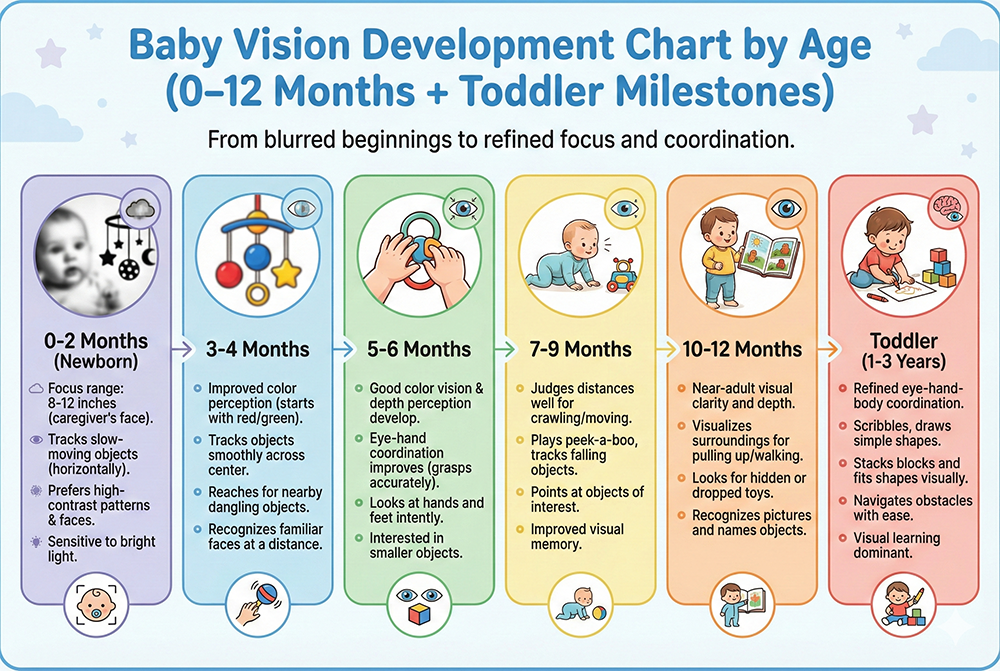
| Age | Vision Development |
|---|---|
| Newborn | Focus range 8-12 inches (caregiver's face); sees only black, white, gray; sensitive to bright light; blinks to light |
| 2 months | Follows moving object past midline; social smile triggered by face |
| 3 months | Fixes and follows horizontally AND vertically; eyes work together; bats at objects |
| 3-4 months | Begins to develop color vision (starts with red/green); tracks objects smoothly across center; recognizes faces at distance |
| 5-6 months | Good color vision; depth perception develops; eye-hand coordination improves; looks at hands and feet; interested in smaller objects |
| 7-9 months | Judges distance for crawling; tracks falling objects; points at objects of interest; improved visual memory |
| 10-12 months | Near-adult visual clarity and depth; visualizes surroundings for walking; looks for hidden toys; recognizes pictures |
| Toddler (1-3 yrs) | Refined eye-hand-body coordination; scribbles and draws simple shapes; stacks blocks; navigates obstacles |
| 4-5 years | Visual acuity ~20/40; copies shapes; visual learning dominant |
Vision Acuity Norms:
- Newborn: ~20/400
- 6 months: ~20/100
- 1 year: ~20/50
- 3 years: ~20/40
- 5 years: ~20/30 (approaching adult)
5. 👂 HEARING & SOUND LOCALIZATION MILESTONES

| Age | Hearing & Sound Localization |
|---|---|
| Newborn | Startles to loud sounds (Moro reflex); responds to low-frequency sounds (vowels more than consonants); quiets to familiar voices |
| 1 month | Alerts to sound; briefly stills in response to voice |
| 2 months | Turns toward voice; coos in response to speech |
| 3 months | Responds differently to angry vs. friendly voice; recognizes parent's voice |
| 4-6 months | Turns head and eyes toward sound sources (sound localization begins); babbles and gurgles; responds to voices by babbling; recognizes familiar sounds (e.g., spoon on plate) |
| 7-9 months | Full sound localization - turns head and body to sound in any direction; responds to own name; imitates speech and non-speech sounds (baa-baa, blowing raspberries) |
| 10-12 months | Turns toward soft sounds; responds to music; looks for named objects out of sight; correctly uses "mama" and "dada" |
| 13-24 months | Listens to stories and songs; pays attention to TV/radio sounds; follows familiar conversations; comes when called by name |
| 2-3 years | Understands 2-step directions; hears from another room |
| 4-5 years | Hears and understands most of what is said at home and in school |
Localization Development Timeline:
- 4-6 months: Horizontal localization (side to side)
- 6-8 months: Diagonal localization
- 8-12 months: Full 360° localization (above, below, behind)
6. 🤝 SOCIAL & EMOTIONAL MILESTONES
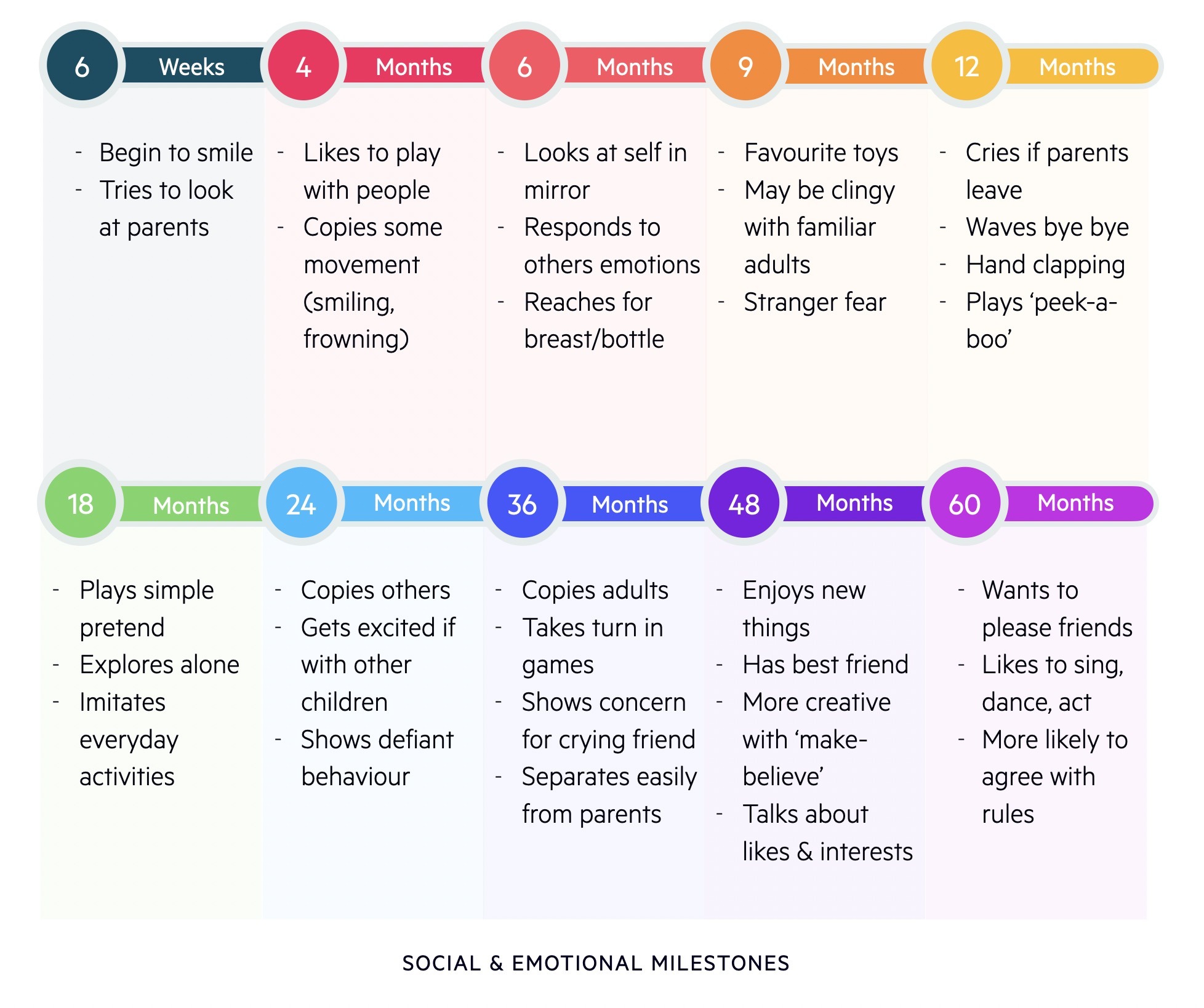
| Age | Social/Emotional Milestone |
|---|---|
| Newborn | Bonding (parent to child); prefers mother's face; social smile begins |
| 6 weeks | Social smile (most important milestone at this age!); tries to look at parents |
| 2 months | Prefers usual caregiver; attends to faces; follows with eyes; attachment begins (child to parent) |
| 4 months | Likes to play with people; copies movements (smiling, frowning); explores parent's face; turn-taking conversations |
| 6 months | Stranger anxiety begins; looks at self in mirror; responds to others' emotions; reaches for breast/bottle |
| 9 months | Favorite toys; clingy with familiar adults; stranger fear prominent; plays peek-a-boo |
| 12 months | Cries when parents leave; waves "bye-bye"; hand clapping; plays social games; separation anxiety |
| 18 months | Simple pretend play; explores independently; imitates everyday activities; parallel play |
| 2 years | Plays with other children; copies others; shows defiant behavior; parallel → cooperative play begins |
| 3 years | Takes turns in games; shows concern for crying friend; separates more easily from parents; copies adults |
| 4 years | Has a best friend; enjoys new things; more creative make-believe; talks about likes and interests |
| 5 years | Wants to please friends; likes to sing, dance, act; agrees with rules; leadership among children |
7. 🧠 COGNITIVE / ADAPTIVE MILESTONES (Summary)
| Age | Cognitive / Problem-Solving |
|---|---|
| Newborn | Visual focal length ~10 inches; prefers contrast/faces; bonding |
| 4 months | Anticipates routines; purposeful sensory exploration (eyes, hands, mouth) |
| 6 months | Looks for dropped or partially hidden object; memory lasts ~24 hours |
| 9 months | Object permanence (knows objects exist even when hidden); uncovers toy; peek-a-boo |
| 12 months | Cause and effect; trial and error; imitates gestures; uses objects functionally (rolls toy car) |
| 18 months | Puts toys away; symbolic play begins |
| 2 years | Folds paper once; builds tower of 6; 3-word combinations |
| 3 years | Identifies 5 colors; builds bridge from 3 cubes; knows full name |
| 4 years | Counts 4 pennies; understands short/long; draws person with 2-4 parts |
| 5 years | Counts 10 pennies; names 4 colors; copies square and triangle |
🚨 KEY RED FLAGS - When to Refer
| Age | Concerning Sign |
|---|---|
| By 3 months | No social smile |
| By 6 months | No babbling; no social smiling; cannot lift head/trunk |
| By 9 months | Cannot sit with support |
| By 12 months | No babbling; no gestures (pointing, waving); no single words |
| By 15 months | No single words; no pointing |
| By 18 months | No walking; fewer than 10 words; not responding to name consistently |
| By 24 months | No 2-word phrases; fewer than 50 words |
| By 3 years | Not 75% intelligible; cannot follow 2-step directions |
| Any age | Loss of previously acquired skills (always urgent - investigate immediately) |
📝 MNEMONIC - GFSC System (PedsCases)
"Gotta Find Strong Coffee Soon"
- G = Gross Motor
- F = Fine Motor
- S = Speech/Language
- C = Cognitive/Problem Solving
- S = Social/Emotional
Use the Denver Developmental Screening Test (DDST) or Ages & Stages Questionnaire (ASQ) as validated tools for clinical screening.
Sources: Adams & Victor's Principles of Neurology (12th Ed.); PedsCases Developmental Milestones Chart; NIDCD Speech and Language Guidelines; North Shore Pediatric Therapy infographics; American Academy of Ophthalmology
Please give me photos for quick remember
Generating Image
Generating Image
Generating Image
Generating Image
Generating Image
Generating Image
This is a shared conversation. Sign in to Orris to start your own chat.