
Dysgerminoma treatment
I'll read the medical library skill first, then search in parallel.
Reading File
Now I'll run parallel searches across the library and PubMed simultaneously.
Finding Sources
Searching PubMed
dysgerminoma treatment chemotherapy
Excellent. Now I'll read both textbook sections in parallel.
Reading File
Reading File
The Berek & Novak section was truncated. Let me read the treatment-focused portion.
Reading File
Reading File
Reading File
I now have comprehensive treatment data. Let me also read the key survival and recurrence section (around line 1340) that was truncated.
Reading File
I now have all the data needed for a thorough answer. Let me fetch the management flowchart image too.
Loading Image
Loading Image
I now have a complete picture from both textbooks plus the management flowchart. Here is the full, organized answer.
Dysgerminoma - Treatment
Background
Dysgerminoma is the ovarian counterpart of testicular seminoma and is the most common malignant ovarian germ cell tumor (30-40% of all malignant germ cell tumors; ~2% of all ovarian cancers). Seventy-five percent occur between ages 10-30. It is the only ovarian germ cell tumor with a significant bilaterality rate (~10-15% of stage I cases). About 65% present at stage I.
Histology:
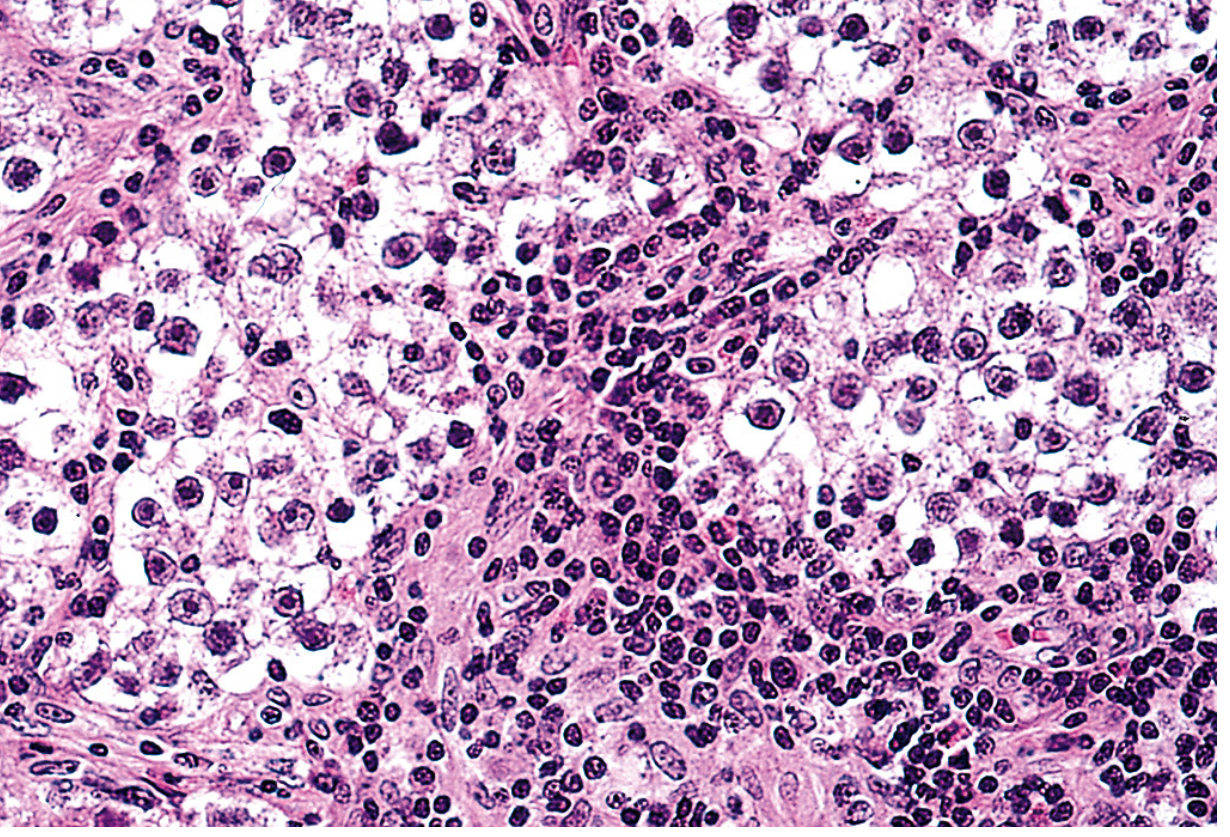
Large vesicular cells with clear cytoplasm in sheets/cords, separated by fibrous stroma infiltrated by lymphocytes and sometimes granulomas. Expresses OCT3/4, NANOG, KIT (~30-50% activating KIT mutations).
Management Algorithm
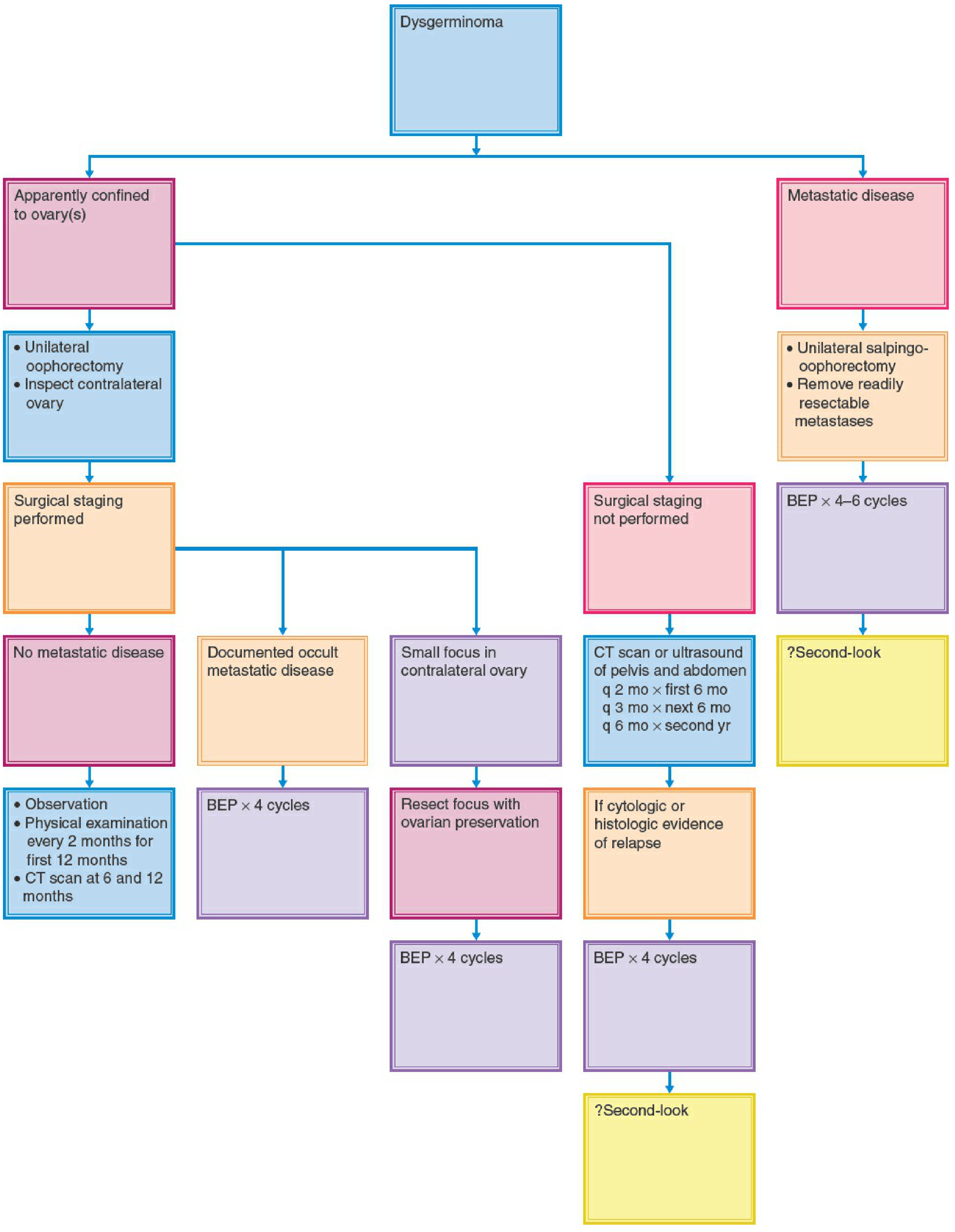
1. Surgery (Primary Treatment for Early Disease)
The minimum surgical procedure is unilateral oophorectomy (or unilateral salpingo-oophorectomy). Fertility preservation is almost always the goal since this tumor predominantly affects young women.
Key surgical principles:
| Situation | Approach |
|---|---|
| Apparent stage I, fertility desired | Unilateral oophorectomy + thorough surgical staging |
| Fertility not desired, advanced disease | Total abdominal hysterectomy + bilateral salpingo-oophorectomy |
| Y chromosome in karyotype (gonadal dysgenesis) | Bilateral oophorectomy; uterus may be preserved for future embryo transfer |
| Small focus in contralateral ovary | Resect focus with ovarian preservation |
| Metastatic disease, fertility desired | Unilateral salpingo-oophorectomy + remove readily resectable metastases |
Staging includes: Inspection and palpation of all peritoneal surfaces, unilateral pelvic lymphadenectomy, palpation/biopsy of para-aortic nodes (tumors metastasize to para-aortic nodes near the renal vessels), and biopsy of any suspicious lesions.
2. Post-Surgical Management by Stage
Stage IA (unilateral, encapsulated - no staging performed)
- Options:
- Completion surgical staging (preferred - stage IA does not require adjuvant chemo)
- Close surveillance - CT pelvis/abdomen and tumor markers (LDH, AFP, beta-hCG) at q2 months x 6 months, q3 months x next 6 months, q6 months x second year
- Adjuvant chemotherapy if capsular rupture or more advanced stage found
Stage IA (surgically staged, no metastatic disease)
- Observation - physical exam every 2 months for 12 months, CT at 6 and 12 months
- 5-year disease-free survival >95% with surgery alone
Stage IB/IC, II, III (occult or documented metastatic disease)
- BEP x 4 cycles (see regimen below)
Stage III/IV (advanced, incompletely resected)
- BEP x 3-4 cycles (risk-stratified based on testicular germ cell tumor data)
- GOG data: 19/20 patients with stage III/IV dysgerminoma treated with cisplatin-based regimens were alive and disease-free at median 26 months
3. Chemotherapy
Platinum-based chemotherapy is the treatment of choice, with the major advantage of fertility preservation.
First-Line Regimens
| Regimen | Drugs and Doses |
|---|---|
| BEP (standard) | Bleomycin 30,000 IU IV on days 1, 8, 15 q3wk; Etoposide 100 mg/m²/day x 5 days q3wk; Cisplatin 20 mg/m²/day x 5 days (or 100 mg/m² x 1 day) q3wk |
| EP | Etoposide + Cisplatin (without bleomycin) |
| EC (GOG protocol) | Etoposide 120 mg/m² IV days 1-3 q4wk; Carboplatin 400 mg/m² IV day 1 q4wk - 100% disease-free remission in completely resected stage IB-III |
- Standard: 3-4 cycles of BEP, number determined by risk stratification analogous to seminoma protocols
- VBP (vinblastine, bleomycin, cisplatin) was used historically but is now largely replaced by BEP
4. Radiation Therapy
Dysgerminomas are highly radiosensitive (2,500-3,500 cGy can be curative even for gross metastatic disease). However, radiation is rarely used as first-line treatment because:
- Loss of fertility (if pelvic/abdominal fields required)
- Chemotherapy achieves equivalent or superior cure rates while preserving fertility
Radiation may be considered in very selected subsets with recurrent disease.
5. Recurrent Disease
- ~75% of recurrences occur within the first year; most common sites are the peritoneal cavity and retroperitoneal lymph nodes
- Patients not previously treated with chemotherapy: standard first-line BEP
- Patients who relapse after BEP:
- TIP (paclitaxel, ifosfamide, cisplatin)
- VIP (vinblastine, ifosfamide, cisplatin)
- High-dose chemotherapy (in selected patients) - manage in specialized centers
- Radiation as a last resort
6. Special Considerations
- Tumor markers: LDH (primary marker), AFP, beta-hCG should be monitored even in pure dysgerminoma because occult mixed germ cell elements (e.g., yolk sac tumor) may produce AFP elevation
- Syncytiotrophoblastic giant cells in the tumor may elevate beta-hCG; this does not alter prognosis
- Gonadal dysgenesis patients (45,X/46,XY; androgen insensitivity): dysgerminomas commonly arise in gonadoblastomas; if gonadoblastoma is left in situ, >50% develop into ovarian malignancy - bilateral gonadectomy recommended
- KIT mutations (~30-50%) represent a potential target for imatinib, though this remains investigational
- Features predicting higher recurrence risk: tumor >10-15 cm, age <20, high mitotic index, anaplastic or medullary histologic pattern
Prognosis
| Stage | Outcome |
|---|---|
| Stage IA (unilateral, encapsulated) | >95% 5-year disease-free survival after oophorectomy alone |
| All stages (chemo-treated) | Excellent; even stage III/IV disease is often curable |
Overall, dysgerminoma has one of the best prognoses of any malignant ovarian tumor due to its exquisite sensitivity to both chemotherapy and radiation.
Sources:
- Berek & Novak's Gynecology, pp. 2379-2387
- Robbins, Cotran & Kumar Pathologic Basis of Disease, p. 947
- Recent reviews: Dysgerminoma of the ovary (Minerva Obstet Gynecol, 2025; PMID 38953909), Malignant germ cell tumors of the ovary (J Gynecol Oncol, 2025; PMID 40275685)
This is a shared conversation. Sign in to Orris to start your own chat.