
Why pituitary stalk effect prolactin as dopamine is not from post pituitary
The pituitary stalk effect causes hyperprolactinemia because dopamine - which normally inhibits prolactin secretion - is produced in the hypothalamus (arcuate nucleus), not the posterior pituitary. It travels down the portal blood vessels in the stalk to reach the anterior pituitary lactotrophs. When the stalk is compressed or damaged, this dopamine delivery is interrupted, removing tonic inhibition and allowing prolactin to rise.
Searching sources...
Reading File
Finding Sources
Finding Sources
Reading File
Reading File
Reading File
Loading Image
Here is a thorough explanation of why pituitary stalk damage raises prolactin, directly addressing why dopamine is NOT from the posterior pituitary.
The Pituitary Stalk Effect and Prolactin - Full Explanation
The Core Concept: Prolactin is Under Tonic Inhibition
Prolactin is unique among anterior pituitary hormones. All other anterior pituitary hormones (GH, TSH, LH, FSH, ACTH) are primarily under stimulatory hypothalamic control. Prolactin is the opposite - it is under tonic inhibitory control. This means:
- Without ongoing inhibition, prolactin is secreted continuously and in excess.
- Anything that breaks the inhibitory signal causes prolactin to rise.
As Guyton & Hall states directly: "Damage to the hypothalamus or blockage of the hypothalamic-hypophysial portal system often increases prolactin secretion while it depresses secretion of the other anterior pituitary hormones."
Where Does the Dopamine Come From?
This is the key to your question. The inhibitory dopamine reaching the anterior pituitary comes from three routes (Costanzo Physiology):
| Source | Route |
|---|---|
| 1. Arcuate nucleus of the hypothalamus (MAJOR source) | Secreted into median eminence → enters portal capillaries → travels down the stalk → reaches anterior pituitary lactotrophs |
| 2. Dopaminergic neurons in the posterior pituitary (minor) | Via short connecting portal veins to anterior pituitary |
| 3. Non-lactotroph cells in the anterior pituitary | Paracrine diffusion to nearby lactotrophs |
The dominant pathway is #1: hypothalamus → portal blood → anterior pituitary. This is the pathway that runs through the pituitary stalk.
Why the Posterior Pituitary is Not the Relevant Source
Your question gets right to the heart of the matter. The posterior pituitary:
- Stores and releases oxytocin and ADH (vasopressin) - hormones made in the hypothalamic supraoptic and paraventricular nuclei.
- It does contain some dopaminergic neurons that contribute a minor amount of dopamine to the anterior pituitary via short portal veins.
- But this minor posterior pituitary dopamine contribution cannot compensate when the main stalk is compressed.
The posterior pituitary does NOT produce any meaningful dopamine for prolactin regulation. The hypothalamic-portal route is overwhelmingly dominant. So when the stalk is cut or compressed, the major dopamine supply is interrupted, not the posterior pituitary's minor contribution.
What Happens When the Stalk is Compressed?
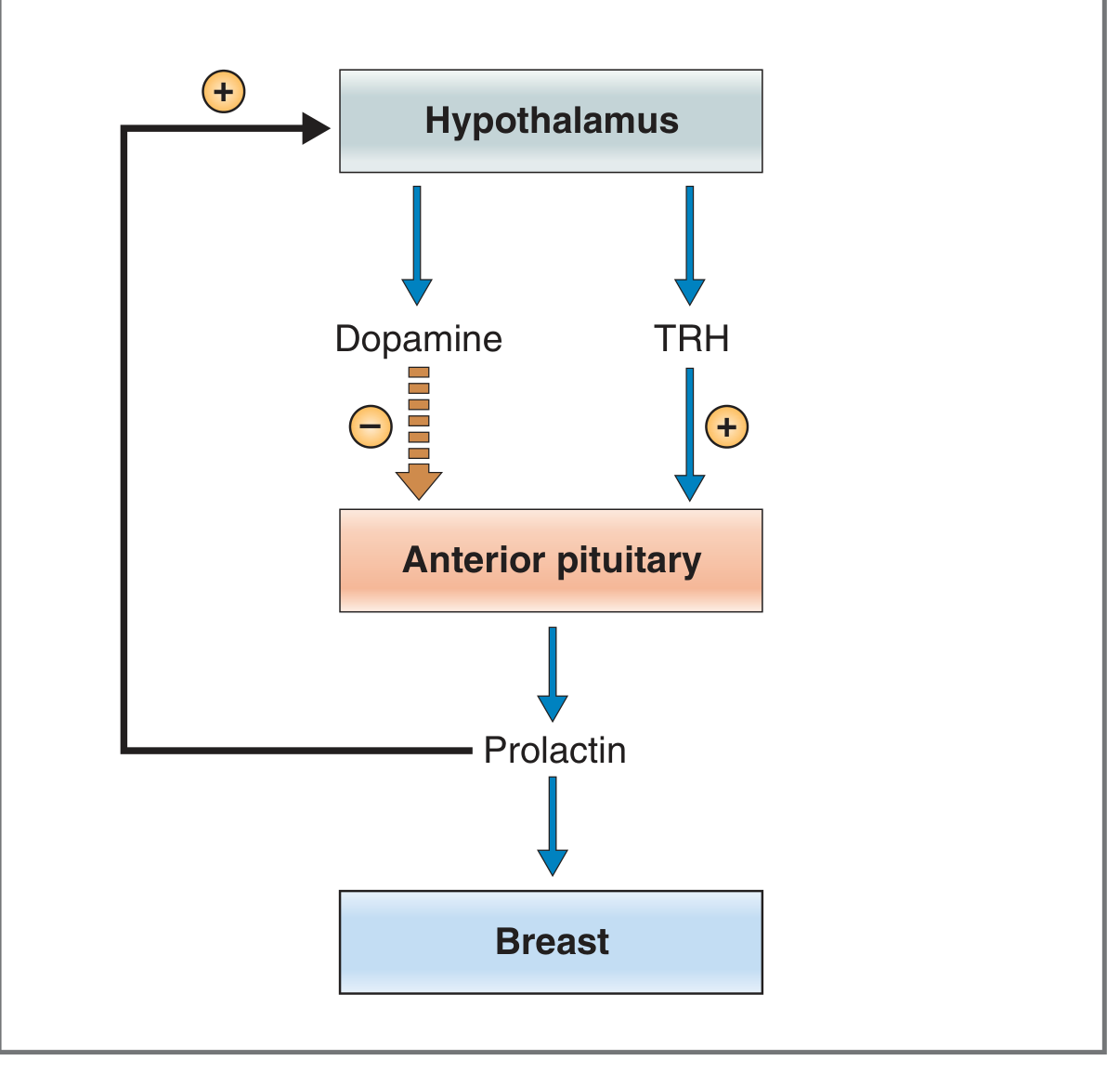
As shown above, dopamine from the hypothalamus travels down and exerts a tonic (-) inhibition on the anterior pituitary. When the stalk is compressed:
- Dopamine delivery is blocked - the portal blood cannot carry dopamine from the hypothalamus to the anterior pituitary.
- Tonic inhibition of lactotrophs is lost - prolactin secretion is disinhibited.
- Prolactin rises - typically to levels below 150 ng/mL (this distinguishes stalk effect from a true prolactinoma, which often causes much higher levels).
As Mulholland Surgery puts it: "The 'stalk effect' occurs when a non-prolactin-secreting mass exerts pressure on the infundibulum and thereby diminishes the amount of dopamine that reaches the anterior pituitary (diminished inhibition), resulting in increased prolactin release."
Summary
| Question | Answer |
|---|---|
| Where does anti-prolactin dopamine come from? | Arcuate nucleus of the hypothalamus |
| How does it reach the anterior pituitary? | Via hypothalamic-hypophysial portal blood vessels running through the stalk |
| Why not the posterior pituitary? | Posterior pituitary releases oxytocin and ADH; it is NOT the main dopamine source for prolactin regulation |
| What happens when the stalk is compressed? | Portal dopamine delivery is cut off → anterior pituitary lactotrophs are disinhibited → prolactin rises |
| Typical prolactin level with stalk effect? | Usually < 150 ng/mL (vs. prolactinoma which can be much higher) |
The clinically important takeaway: stalk compression from any mass (craniopharyngioma, meningioma, non-functioning pituitary adenoma, metastasis) can raise prolactin not because the mass makes prolactin, but because it physically blocks the portal delivery of hypothalamic dopamine.
- Costanzo Physiology 7th Ed., p. 417
- Guyton & Hall Medical Physiology, p. 1045
- Mulholland and Greenfield's Surgery 7e, p. 4209
This is a shared conversation. Sign in to Orris to start your own chat.