
Explain in detail about national district level rehab programmmes in cbr
national district level rehabilitation programme CBR India disability
https://www.ilo.org/media/316271/download
https://www.physio-pedia.com/Community_Based_Rehabilitation_…
India National Level Rehabilitation Programme NLRP District Level Rehabilitation Programme DLRP CBR structure
https://pmc.ncbi.nlm.nih.gov/articles/PMC3893941
National and District Level Rehabilitation Programmes in CBR
Definition of CBR
"A strategy within general community development for the rehabilitation, equalization of opportunities and social inclusion of all people with disabilities. CBR is implemented through the combined efforts of people with disabilities themselves, their families, organizations and communities, and the relevant governmental and non-governmental health, education, vocational, social and other services."
- Park's Textbook of Preventive and Social Medicine
The Three-Tier Structure of CBR
NATIONAL LEVEL
    ↕
INTERMEDIATE / DISTRICT LEVEL
    ↕
COMMUNITY LEVEL
1. National Level Programmes
1.1 National Policies
- National policies provide the overall direction and legal framework for CBR activities across the country.
- Key legislation includes the Persons with Disabilities (Equal Opportunities, Protection of Rights and Full Participation) Act, 1995 and the Rights of Persons with Disabilities Act, 2016 (India).
- The 2016 Act expanded the list of recognized disabilities from 7 to 21, including speech/language disability, specific learning disability, acid attack victims, dwarfism, muscular dystrophy, thalassemia, hemophilia and sickle cell disease.
1.2 National Coordination
- One ministry typically leads CBR nationally - usually the Ministry responsible for health, social affairs, education, or labour.
- In India, the Ministry of Social Justice and Empowerment has taken the leading role.
- A national CBR network ensures that benefits of the UN Convention on the Rights of Persons with Disabilities reach all PWDs.
- The ILO's CBR strategy document identifies national-level coordination and resource allocation as critical elements for CBR programme sustainability.
1.3 Management Structure
- The national government takes a leading managerial role in CBR programmes.
- The national ministry provides the organizational framework under which all lower levels operate.
- Inter-ministerial coordination is required among health, education, social welfare, and labour sectors.
1.4 National Level Institutes (India)
| Institute | Location | Focus Area |
|---|---|---|
| NIMH - National Institute for Mentally Handicapped | Secunderabad (Branches: Mumbai, Delhi, Kolkata) | Mental/intellectual disability |
| NIHH - Ali Yavar Jung National Institute for the Hearing Handicapped | Mumbai (Branches: Delhi, Kolkata, Secunderabad) | Hearing impairment |
| NIVH - National Institute for the Visually Handicapped | Dehradun (Branch: Chennai) | Visual impairment |
| NIOH - National Institute for the Orthopaedically Handicapped | Kolkata | Orthopaedic disability |
| IPH - Institute for the Physically Handicapped | New Delhi | Physical rehabilitation |
- Research and development of models of care
- Human resource development and training
- Crisis management and education
- Placement and employment assistance
- Development and supply of aids and appliances
- Documentation and dissemination of information
1.5 National Allocation of Resources
- Adequate funding for CBR must be guaranteed at the national level.
- Assistance to voluntary organizations: up to 90% in urban areas and 95% in rural areas for education, training and rehabilitation of the disabled - Park's Textbook of Preventive and Social Medicine.
- Budgetary support ensures that CBR benefits reach all PWDs, especially in remote and rural areas.
1.6 National Support Mechanisms
- National CBR Mission: to empower PWDs regardless of caste, colour, creed, religion, gender, age, type and cause of disability.
- Goal areas include:
- Raising awareness
- Promoting inclusion
- Reducing poverty
- Eliminating stigma
- Meeting basic needs
- Facilitating access to health, education and livelihood
2. Intermediate / District Level Programmes
2.1 District Rehabilitation Centres (DRCs)
- Launched in 1985 under the Ministry of Social Justice and Empowerment, Government of India.
- DRCs are the primary vehicle for delivering rehabilitation services at the district level.
- Four Regional Rehabilitation Training Centres (RRTCs) were established under the DRC scheme at:
- Mumbai
- Chennai
- Cuttack
- Lucknow
- Training of village-level functionaries and DRC professionals
- Orientation and training of State Government officials
- Research in service delivery and low-cost aids
- Development of training materials and manuals for field use
- Creating community awareness through folders, posters, audio-visuals, films and traditional art forms (PMC article: Disability and Rehabilitation Services in India, PMID: PMC3893941)
2.2 District Disability Rehabilitation Centres (DDRCs)
- A new scheme launched in January/February 2000 by the Ministry of Social Justice and Empowerment.
- Established to provide comprehensive rehabilitation services to PWDs at the grassroot level.
- 199 DDRCs were sanctioned initially; 100 additional DDRCs were proposed during the 11th Five-Year Plan.
- Awareness generation
- Survey, identification and early intervention
- Counselling of PWDs and their families
- Provision of assistive devices and aids
- Education, training and vocational rehabilitation
- Medical rehabilitation
- Implementation of the Persons with Disability Act, 1995 (PMC, Disability and Rehabilitation Services in India)
2.3 CBR Managers at District Level
- Each district designates CBR managers or coordinators.
- In some countries/states, district-level CBR committees are formed.
- These managers are responsible for:
- Identifying persons who need services
- Coordinating with community members and multi-sectoral service providers
- Record keeping and monitoring
- Liaising between community-level workers and national bodies
- The responsible ministry trains CBR management personnel in:
- Service identification techniques
- Community coordination
- Record keeping and reporting
- Program planning and evaluation
2.4 Role of DPOs (Disabled Persons' Organizations) at District Level
- DPOs require training to act as liaisons between community and district/national levels.
- Key skills: advocacy, coordination, planning, evaluation, and fundraising.
2.5 Referral System
- At district or provincial level - serving approximately 20% of PWDs requiring intermediate services.
- Requires the following human resources: general physicians, intermediate-level supervisors, orthopedic technicians, resource teachers and vocational trainers.
- For those who cannot be managed at community level, referral goes to district, then provincial, then national level.
- National level professionals deliver complex rehabilitation services and train district/provincial personnel.
3. Community Level Programmes
- Serves approximately 1/3 of all PWDs who can be helped through CBR alone.
- Services delivered via community health workers, CBR workers, ANMs, sub-center staff.
- PHC and sub-centers serve as the backbone for community-level CBR delivery.
4. India's Five Major National Schemes for Disabled
- Assistance to voluntary organizations - up to 90-95% grants for education, training, rehabilitation, vocational guidance, and psychiatric rehabilitation.
- National Scholarship Scheme - scholarships for disabled students at +2 level and above.
- National Award for the best employer - recognizes employers who employ the disabled.
- National Awards to disabled individuals - for outstanding achievements.
- National Award to institutions - recognizes institutions providing services to the disabled. (Park's Textbook of Preventive and Social Medicine)
5. CBR Matrix: The Programme Framework
| Component | Key Elements |
|---|---|
| Health | Promotion, prevention, medical care, rehabilitation, assistive devices |
| Education | Early childhood, primary, secondary/higher, non-formal, lifelong learning |
| Livelihood | Skills development, self-employment, waged employment, financial services, social protection |
| Social | Personal assistance, relationships, marriage & family, culture & arts, recreation & sports |
| Empowerment | Advocacy, communication, community mobilization, political participation, self-help groups |
6. Multi-Sectoral Support Required
- Health sector - medical care, assistive technology, referrals
- Education sector - inclusive education policies at community, district and national levels
- Employment/labour sector - vocational training, job placement, self-employment support
- Social sector - social protection, welfare services, legal rights
- NGOs - service delivery, community awareness, advocacy
- Media - awareness campaigns, anti-stigma programmes
- Disabled Persons' Organizations (DPOs) - advocacy, peer support
7. Principles of CBR
- Inclusion - PWDs participate fully in all aspects of life
- Participation - PWDs involved in planning, decision-making and evaluation
- Sustainability - programmes designed for long-term viability
- Empowerment - building individual and community capacity
- Advocacy - promoting rights and access to services
8. Key Challenges at National and District Levels
- Rehabilitation services in India are largely confined to cities, leaving rural PWDs underserved.
- A large percentage of PWDs live in poverty and remote rural areas.
- Most CBR in India is run by NGOs, with limited government direct delivery.
- Limited evidence on effectiveness, coverage and methodology.
- Coordination between multiple ministries (health, social justice, education, labour) remains weak.
- Standardization of training, record keeping, and evaluation is insufficient.
- The PMC article on CBR in India stresses that the government needs to promote funding, training and research to make CBR more effective.
Summary Table
| Level | Key Structures | Key Functions |
|---|---|---|
| National | Apex institutes (NIMH, NIHH, NIVH, NIOH, IPH), Ministry of Social Justice | Policy, legislation, resource allocation, coordination, specialized training, research |
| District | DRCs, DDRCs, RRTCs, District CBR Managers, DPOs | Coordination, service delivery, referral management, training of community workers, monitoring |
| Community | PHC, sub-centre, ANM, CBR workers | Screening, identification, home visits, basic rehabilitation, referral |
- Park's Textbook of Preventive and Social Medicine (Park's PSM)
- Disability and Rehabilitation Services in India: Issues and Challenges - PMC3893941
- CBR in India - PMC4209696
- ILO: CBR - A Strategy for Rehabilitation
- Physio-Pedia: Community Based Rehabilitation
Help me to rember this
How would you like to remember this content?
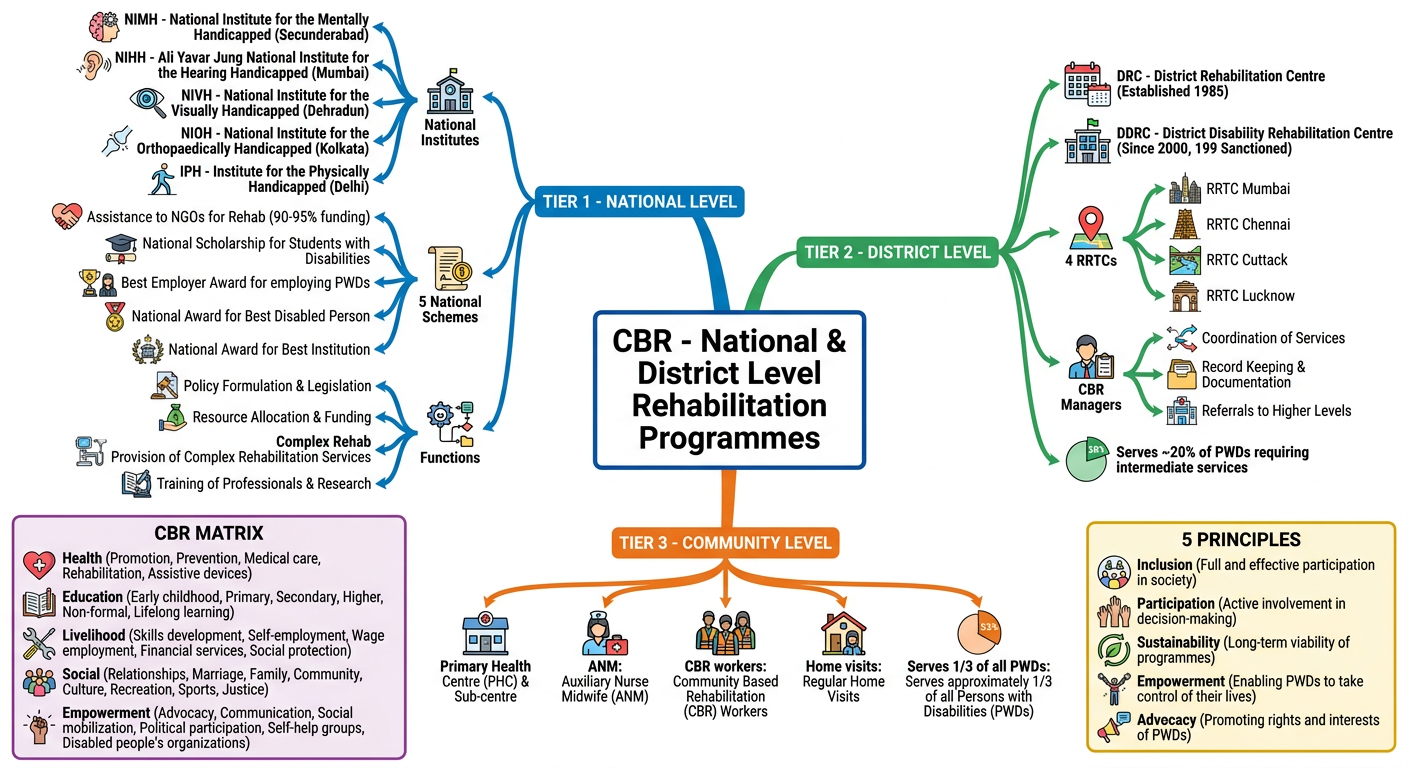
A detailed, colorful mind map titled "CBR - National & District Level Rehabilitation Programmes" at the center in bold. The map branches out into three main tiers with clear color coding: TIER 1 - NATIONAL LEVEL (blue): branches showing: 1) National Institutes: NIMH (Mental, Secunderabad), NIHH (Hearing, Mumbai), NIVH (Visual, Dehradun), NIOH (Orthopaedic, Kolkata), IPH (Physical, Delhi). 2) 5 National Schemes: Assistance to NGOs (90-95%), National Scholarship, Best Employer Award, Award to Disabled, Award to Institutions. 3) Functions: Policy & Legislation, Resource Allocation, Complex Rehab, Training & Research. TIER 2 - DISTRICT LEVEL (green): branches showing: 1) DRC - District Rehab Centre (since 1985). 2) DDRC - District Disability Rehab Centre (since 2000, 199 sanctioned). 3) 4 RRTCs: Mumbai, Chennai, Cuttack, Lucknow. 4) CBR Managers: Coordination, Record keeping, Referrals. 5) Serves 20% of PWDs needing intermediate services. TIER 3 - COMMUNITY LEVEL (orange): PHC, Sub-centre, ANM, CBR workers, Home visits. Serves 1/3 of all PWDs. CBR MATRIX box (purple): 5 components: Health, Education, Livelihood, Social, Empowerment. 5 PRINCIPLES box (yellow): Inclusion, Participation, Sustainability, Empowerment, Advocacy. Clean white background, color-coded branches, icons for each category, readable fonts, professional medical education style.
Quick Memory Aids
The 3-Tier Pyramid
         🏛 NATIONAL
        ↕  Policy + Apex Institutes
       🏢 DISTRICT
      ↕  DRC + DDRC + RRTC
     🏘 COMMUNITY
    PHC + Sub-centre + CBR Worker
Remember the 5 National Institutes → "NOMNI"
| Letter | Institute | Disability | Location |
|---|---|---|---|
| N | NIMH | Mental | Secunderabad |
| O | NIOH | Orthopaedic | Kolkata |
| M | (Ministry of SJ&E leads) | - | - |
| N | NIHH | Hearing | Mumbai |
| I | NIVH | Visual | Dehradun |
| + | IPH | Physical | Delhi |
Remember the 4 RRTCs → "MCCL"
"My Car Can Lead"
- Mumbai
- Chennai
- Cuttack
- Lucknow
Key Years to Remember
| Year | Event |
|---|---|
| 1985 | DRC (District Rehab Centre) launched |
| 2000 | DDRC (District Disability Rehab Centre) launched |
| 1984 | NIMH set up |
| 1995 | PWD Act |
| 2016 | RPwD Act (disabilities 7→21) |
CBR Matrix = "HELSE"
- Health
- Education
- Livelihood
- Social
- Empowerment
5 CBR Principles = "IPSEA"
- Inclusion
- Participation
- Sustainability
- Empowerment
- Advocacy
Referral Rule (easy to recall)
"1/3 Rule"
- 1/3 → Need NO rehab
- 1/3 → CBR alone is enough
- 1/3 → Need SPECIALIZED referral (district/national)
Grant % for NGOs
"90 in city, 95 in village"
- Urban NGOs → 90% grant
- Rural NGOs → 95% grant