
Which organs are involved in the successive stages of creatine synthesis
Creatine synthesis is a two-step process involving two different organs - the kidney starts the process and the liver completes it. Here's a quick summary:
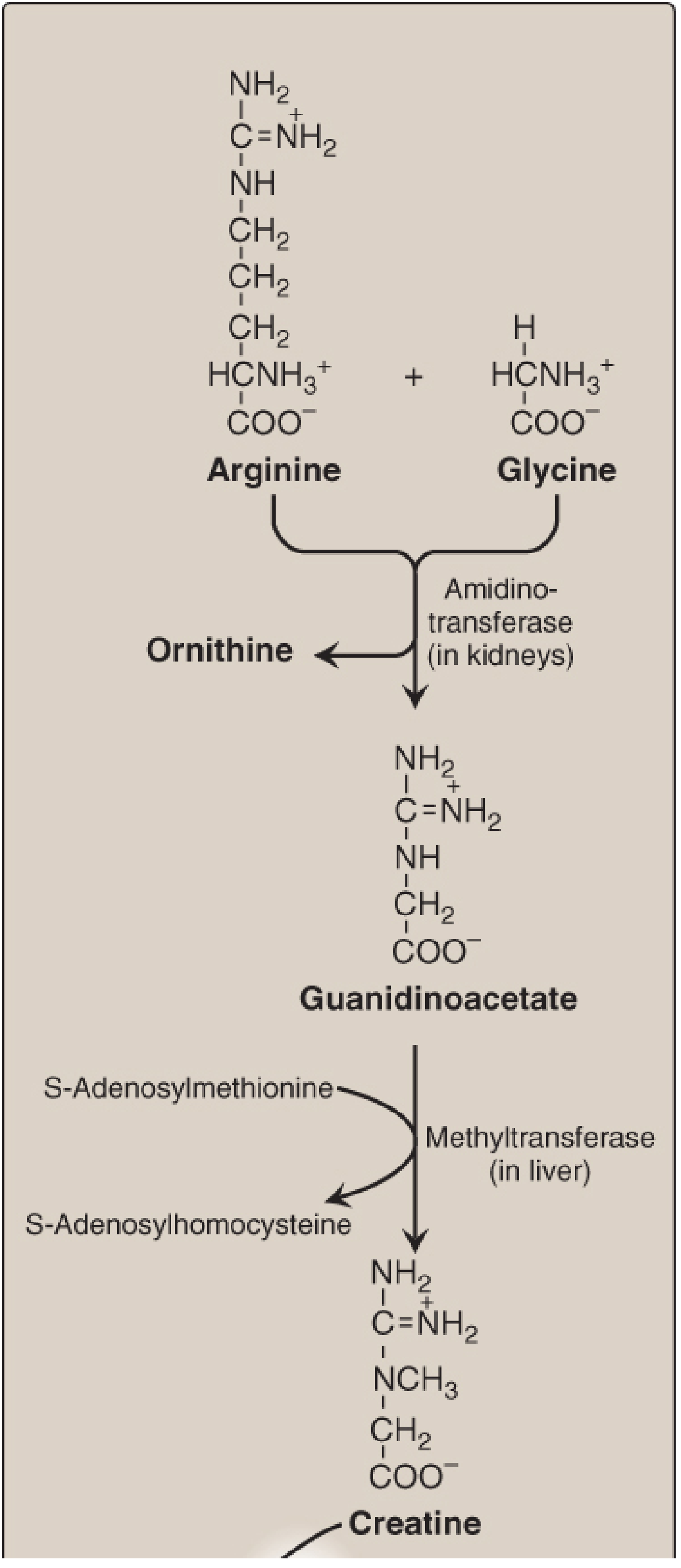
- Kidney: The first step occurs here, where arginine and glycine combine (via arginine:glycine amidinotransferase) to form guanidinoacetate (GAA) and ornithine.
- Liver: The second step occurs here, where guanidinoacetate is methylated by S-adenosylmethionine (SAM) via guanidinoacetate methyltransferase (GAMT) to form creatine.
The creatine is then transported via blood to muscle and brain where it is used.
Searching sources...
Reading File
Finding Sources
Finding Sources
Reading File
Reading File
Loading Image
Here is a detailed breakdown of the organs involved in the successive stages of creatine synthesis, sourced directly from the textbooks:
Creatine Synthesis: Organs and Stages
Creatine is synthesized in a two-step pathway distributed across two organs: the kidney and the liver.
Stage 1 - Kidney (Step 1)
Organ: Kidneys
Enzyme: Arginine:glycine amidinotransferase (transamidinase)
Substrates: Arginine + Glycine
Products: Guanidinoacetate + Ornithine
In the kidney, the guanidinium group of arginine is transferred to glycine. This produces guanidinoacetate (also called glycocyamine) and releases ornithine as a byproduct. Guanidinoacetate then travels via the bloodstream to the liver.
Stage 2 - Liver (Step 2)
Organ: Liver
Enzyme: Guanidinoacetate methyltransferase (GAMT)
Methyl donor: S-Adenosyl methionine (SAM), which becomes S-adenosylhomocysteine
Substrate: Guanidinoacetate
Product: Creatine
In the liver, guanidinoacetate is methylated by SAM to produce creatine. SAM is converted to S-adenosylhomocysteine in the process.
After Synthesis - Target Tissues
The creatine formed in the liver is released into the bloodstream and taken up by:
- Skeletal muscle (largest reservoir)
- Heart muscle
- Brain
In these tissues, creatine kinase (CK/CPK) phosphorylates creatine using ATP to form creatine phosphate, the high-energy storage form.
Diagram (from Lippincott's Illustrated Reviews - Biochemistry, 8th ed.)
Summary Table
| Stage | Organ | Enzyme | Reaction |
|---|---|---|---|
| 1 | Kidney | Amidinotransferase | Arginine + Glycine → Guanidinoacetate + Ornithine |
| 2 | Liver | Guanidinoacetate methyltransferase | Guanidinoacetate + SAM → Creatine + SAH |
| Use/storage | Muscle, heart, brain | Creatine kinase (CK) | Creatine + ATP → Creatine phosphate + ADP |
Key points:
-
Three amino acids contribute atoms to creatine: arginine (guanidino group), glycine (the carbon backbone), and methionine (via SAM, the methyl group)
-
Creatine and creatine phosphate spontaneously cyclize to form creatinine, which is excreted in urine and used clinically as a marker of renal function and muscle mass
-
Creatine synthesis accounts for a large portion of SAM consumption in the body, making it relevant to one-carbon metabolism and homocysteine levels
-
Basic Medical Biochemistry: A Clinical Approach, 6e, p. 1610
-
Lippincott's Illustrated Reviews: Biochemistry, 8th ed., p. 812-813
This is a shared conversation. Sign in to Orris to start your own chat.