
Cell cycle
Reading File
Reading File
Finding Sources
Searching PubMed
"cell cycle"[MeSH Terms] AND "cyclin-dependent kinases"[MeSH Terms]
Reading File
Reading File
Reading File
Finding Sources
Cell cycle
The cell cycle is a self-regulated sequence of events that controls cell growth and division. Progress is monitored at checkpoints (Histology: A Text and Atlas, p. 291).
Phases
| Phase | What happens | Checkpoint |
|---|---|---|
| G1 | Usually the longest and most variable phase. It begins at the end of mitosis. The cell gathers nutrients and makes the RNA and proteins needed for DNA synthesis. | The restriction point, the most important checkpoint, where the cell assesses its replicative potential |
| S | DNA is replicated. | S DNA-damage checkpoint |
| G2 | The cell prepares for mitosis and keeps checking the new DNA. | G2 DNA-damage checkpoint and unreplicated-DNA checkpoint |
| M | Mitosis and cytokinesis. | Spindle-assembly and chromosome-segregation checkpoints |
| G0 | Resting or quiescent state outside the cycle. Cells can re-enter G1. | Not applicable |
Source: Histology: A Text and Atlas, p. 291.
Molecular control
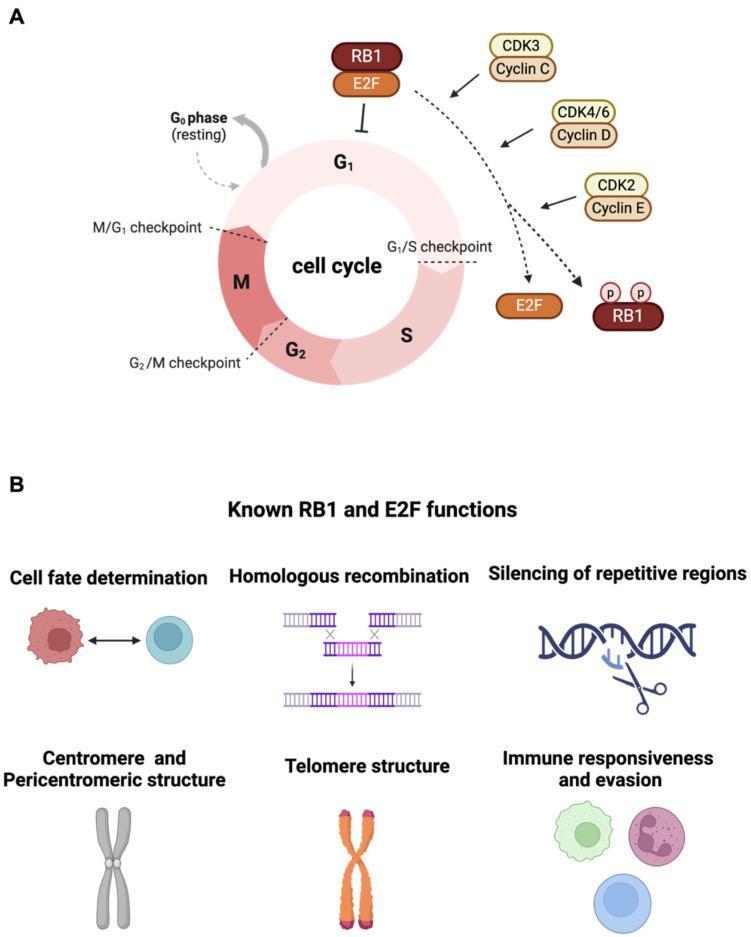
The cycle is driven by cyclin-CDK complexes. Cyclins are synthesized and degraded at regular intervals, and CDKs are the catalytic partners (Histology: A Text and Atlas, p. 291).
- G1 to S: Cyclin D with CDK4/6, then cyclin E with CDK2, phosphorylate Rb. Rb normally binds E2F and turns it into a transcriptional repressor. Once Rb is phosphorylated, E2F activates the genes needed for S phase entry (Berek & Novak's Gynecology, Cell Division Cycle Genes). Cyclin-CDK phosphorylation of Rb lets the cell pass the G1 restriction point (Robbins & Kumar, Cyclins and CDKs).
- Inhibitors:
- CIP/KIP family (p21, p27) blocks cyclin-CDK complexes.
- INK4 family (p16) acts on CDK4/6.
- CDKN2A on 9p21 encodes p16INK4A and p14ARF. p14ARF inhibits MDM2 and so stabilizes p53 (Cummings Otolaryngology, CDKN2A).
- p53, "guardian of the genome": DNA damage stabilizes p53, which induces p21 and GADD45. p21 blocks cyclin/CDK phosphorylation of Rb, so Rb keeps E2F inhibited and the cell stays arrested while the damage is repaired (Basic Medical Biochemistry, 6e, p53 section). If repair fails, the cell undergoes apoptosis.
Clinical relevance
- Cancer: Loss of Rb or p53, CDKN2A deletion, or cyclin D/CDK4 overexpression lets cells bypass the G1/S checkpoint. Sabiston describes G1/S as the point after which a cell is committed to division (Sabiston Textbook of Surgery, Evading Growth Suppressors).
- Pharmacology: CDK4/6 inhibitors (palbociclib, ribociclib, abemaciclib) block Rb phosphorylation and arrest cells in G1 (Goodman & Gilman's, Fig. 71-3). They are used in hormone receptor-positive breast cancer.
- Cell-cycle-specific chemotherapy:
- Antimetabolites act in S phase.
- Vinca alkaloids and taxanes act in M phase.
- Bleomycin acts in G2. This is from general pharmacology knowledge, not from the retrieved sources.
Recent evidence
A 2024 systematic review of natural CDK inhibitors in cancer (PMID 38467339) fits the standard model above. I found no recent evidence that contradicts it.
I can go deeper on mitosis stages, meiosis, checkpoint failure in specific cancers, or cell-cycle-specific drugs.
This is a shared conversation. Sign in to Orris to start your own chat.