
give image of Bonding primarily to etched enamel.
bonding primarily etched enamel diagram histology image dental adhesive
bonding primarily to etched enamel resin tags micromechanical retention SEM image dental

- Phosphoric acid (usually 37%) dissolves the hydroxyapatite at the enamel rod periphery, creating etched porosity
- This produces a rough, microporous enamel surface with exposed inorganic enamel rods and organic matrix
- The result is a significant increase in surface energy and surface area for bonding
- Resin flows into the etched microporosities and sets, forming resin tags that interlock mechanically within the enamel rod structure
- This micromechanical interlocking is the primary (and most reliable) mechanism of enamel bonding
- Bond strengths of 20-30 MPa are routinely achieved with etched enamel
- Enamel is ~96% inorganic (hydroxyapatite), making micromechanical retention after etching the dominant bonding mechanism
- No "hybrid layer" forms in enamel (unlike dentin) - bonding relies purely on resin tag penetration
- The classic Type I, II, and III etch patterns (Silverstone classification) all create different degrees of surface roughness but all rely on this same principle
- Bond to etched enamel is predictable, durable, and hydrolytically stable - far more so than dentin bonding
give images of -1st Generation Adhesives (1955–1975) Principles Bonding primarily to etched enamel. Relied on mechanical retention rather than true dentin adhesion. No smear layer removal or dentin conditioning.
1st generation dental adhesives 1955 1975 bonding etched enamel mechanical retention diagram
first generation dental adhesive smear layer no dentin conditioning resin enamel bonding image
Buonocore 1955 acid etch enamel first generation bonding agent GPDM glycerophosphoric dimethacrylate resin tags image
first generation dental adhesive bonding enamel only smear layer intact no dentin bond 1-3 MPa Buonocore diagram schematic
1st Generation Dental Adhesives (1955-1975)
Image 1 - Mechanism of Adhesion: Physical, Mechanical & Chemical Bonding
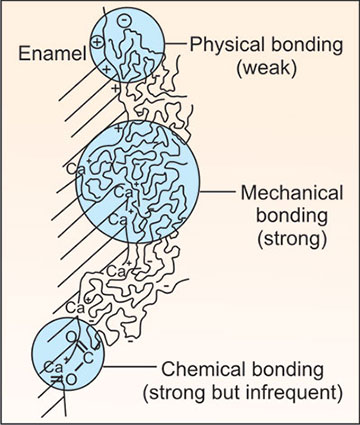
- Physical bonding (top) - very weak, van der Waals forces only
- Mechanical bonding (middle) - the dominant and strongest mechanism - resin locks into etched enamel microporosities
- Chemical bonding (bottom) - strong but rare/infrequent with 1st gen materials
Image 2 - Etched Enamel: Resin Tag Formation (The Core Principle)
- Left: After acid etching - enamel rods are exposed, porosity is created (surface loss), no conditioning of dentin
- Right: Resin flows into the micropores forming resin tags - purely mechanical interlocking within enamel. No hybrid layer, no smear layer removal
Image 3 - Smear Layer Left Intact (No Dentin Conditioning)
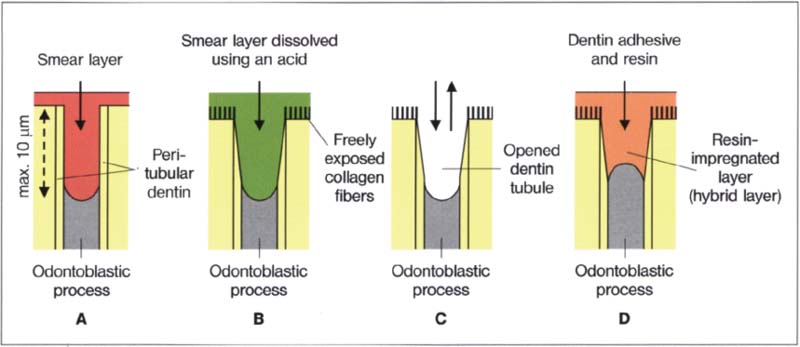
- Panel A shows the smear layer intact (max 10 µm) sitting on peritubular dentin - this is where 1st gen adhesives stopped; they bonded weakly ON TOP of the smear layer or only to enamel
- Panels B-D show what later generations achieved (acid dissolution, collagen exposure, hybrid layer) - all absent in the 1st generation
Image 4 - Evolution of Adhesive Strategies (Context)

Key Principles - 1st Generation Adhesives Summary
| Feature | 1st Generation (1955-1975) |
|---|---|
| Pioneer | Dr. Michael Buonocore, 1955 |
| Active agent | Glycerophosphoric acid dimethacrylate (GPDM) |
| Bonding substrate | Etched enamel ONLY |
| Bond mechanism | Micromechanical (resin tags into enamel rods) |
| Smear layer | Left intact - NOT removed or conditioned |
| Dentin adhesion | None (no true dentin bonding) |
| Bond strength | 1-3 MPa (very low) |
| Cavity prep | Macromechanical retention still required |
| Clinical outcome | High failure rate; no longer used in practice |
give images for this -Advantages First successful enamel bonding system. Introduced the concept of adhesive dentistry. Simple clinical application.
Buonocore 1955 first enamel bonding system adhesive dentistry concept historical image
acid etch enamel bonding simple clinical application phosphoric acid etching composite resin procedure steps image
Buonocore portrait father adhesive dentistry pit fissure sealant acid etch technique 1955 historical photo