
I did not understand zero order Kinetics so explain briefly pharma
Zero-order kinetics means the drug is eliminated at a constant rate regardless of its concentration in the body. Think of it like a drain that removes a fixed amount per unit time, no matter how full the tank is.
Searching sources...
Reading File
Finding Sources
Reading File
Reading File
Reading File
Loading Image
Here is a clear, brief explanation of zero-order kinetics from your pharmacology textbooks:
Zero-Order Kinetics in Pharmacology
The Core Idea
Zero-order kinetics means a constant amount of drug is eliminated per unit of time, regardless of how much drug is in the body. The rate of elimination does not change with concentration.
Mathematically:
dA(t)/dt = -k₀
where k₀ has units of mass/time (e.g., mg/min) - not per concentration like first-order.
Why Does It Happen?
It occurs because the metabolic enzymes become saturated. When plasma drug concentration is far higher than the enzyme's Km (Michaelis constant), the enzyme is working at maximum speed (Vmax) and cannot go faster no matter how much more drug you add.
The Michaelis-Menten equation simplifies to:
v = Vmax × [C] / (Km + [C]) → when [C] >> Km → v = Vmax (constant)
This is why it is also called saturation kinetics or nonlinear kinetics.
Zero-Order vs First-Order - Key Comparison
| Feature | Zero-Order | First-Order |
|---|---|---|
| Rate of elimination | Constant (fixed amount/time) | Proportional to drug concentration |
| Half-life | Not fixed - changes with dose | Fixed, predictable |
| Plasma conc. vs time | Linear decline | Exponential decline |
| Graph shape | Straight line going down | Curved (exponential) |
| Also called | Nonlinear / saturation kinetics | Linear kinetics |
Classic Drugs with Zero-Order Kinetics
- Ethanol (alcohol) - the most classic example
- Phenytoin (anti-epileptic) - at therapeutic doses, its metabolism saturates
- Aspirin (at high doses)
These drugs are dangerous because a small dose increase can cause a disproportionately large rise in plasma concentration - making toxicity hard to predict.
The Key Graph
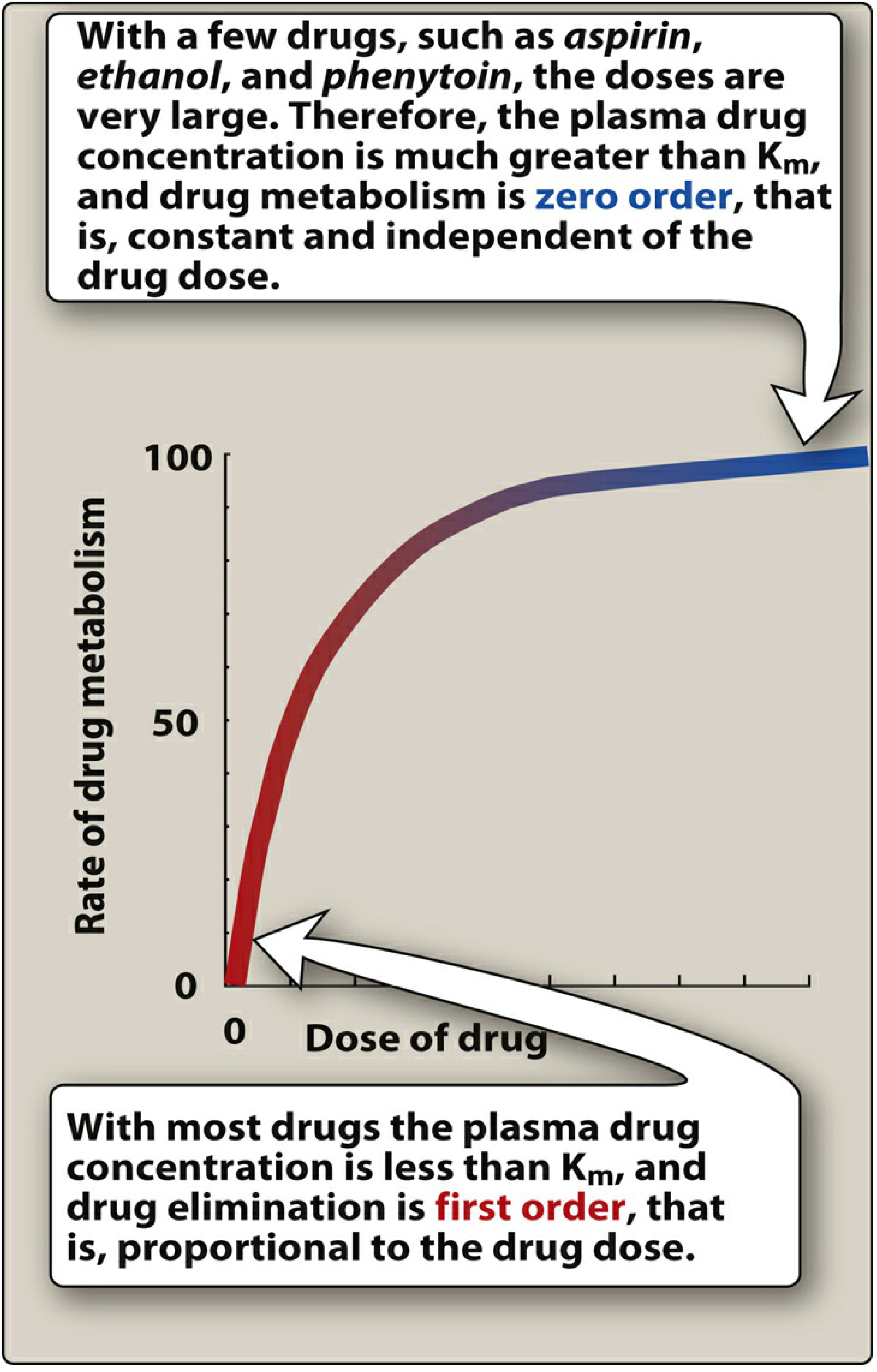
Notice how the curve plateaus (blue/red line flattens) - that plateau region is where zero-order kinetics applies. At low concentrations (bottom left), elimination is first-order (proportional to dose). Once the enzyme is saturated at high concentrations, the rate maxes out and becomes zero-order.
Clinical Importance
Because half-life is not fixed in zero-order kinetics, you cannot predict drug levels by simple half-life calculations. Dosing errors with phenytoin or alcohol intoxication management require careful monitoring, because the body clears a set amount per hour (e.g., ethanol is eliminated at roughly 10-15 mL/hour in most adults) no matter the blood level.
- Lippincott Illustrated Reviews: Pharmacology, p. 53-54
- Goodman & Gilman's Pharmacological Basis of Therapeutics, p. 49-50
- Miller's Anesthesia 10e, p. 1720
This is a shared conversation. Sign in to Orris to start your own chat.