
Fever
I'll look up comprehensive information on fever from the medical library.
Searching sources...
Reading File
Finding Sources
Finding Sources
Good - I have multiple strong sources. Let me read the most comprehensive ones in parallel.
Reading File
Reading File
Reading File
Good physiology from Costanzo. Now let me get the dedicated clinical content from Goldman-Cecil and Swanson's Family Medicine.
Reading File
Finding Sources
Excellent - Ganong's has a dedicated FEVER section. Let me read it along with the FUO content from Swanson's.
Reading File
Reading File
I have the pathogenesis diagram URL. Let me also fetch it and search for more clinical content (management, FUO causes, fever patterns).
Loading Image
Finding Sources
Finding Sources
Let me read the FUO content from Frameworks for Internal Medicine and also fetch the FUO categorization image.
Reading File
Loading Image
Excellent - I now have excellent content and diagrams. Let me also get clinical management content from Bradley/Daroff Neurology and search for fever patterns and management.
Reading File
Finding Sources
I now have comprehensive content from multiple authoritative textbooks. Let me compile a thorough, well-structured answer.
Fever - A Comprehensive Overview
Definition
Fever (pyrexia) is an abnormal elevation of core body temperature resulting from a raised hypothalamic temperature set point. It is generally defined as a rectal temperature >38°C (100.4°F). Temperatures above 41.1°C (106°F) carry serious risk of end-organ damage, and above 43°C, heat stroke and death become common.
- Costanzo Physiology 7th Ed.
Pathophysiology
The mechanism of fever is a cascade involving exogenous stimuli, immune cells, cytokines, and the hypothalamus:
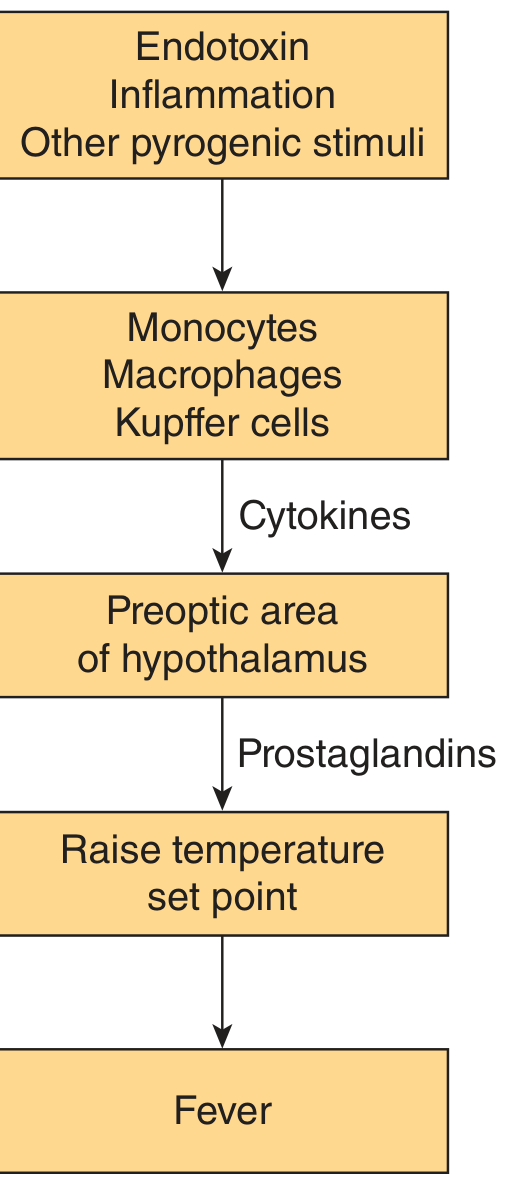
Step-by-step cascade:
- Pyrogenic stimulus (endotoxin/LPS, viral antigens, inflammation, immune complexes) activates monocytes, macrophages, and Kupffer cells.
- These cells release endogenous pyrogens (EP) - cytokines including IL-1β, IL-6, TNF-α, IFN-β, and IFN-γ.
- LPS also signals via vagal afferents to the preoptic anterior hypothalamus, activating COX-2 to generate prostaglandin E2 (PGE2). A slower second wave of PGE2 is produced locally in the brain by IL-1β.
- PGE2 acts on EP1-EP4 receptors in the preoptic hypothalamus, raising the temperature set point - the hypothalamus now treats normal body temperature as "too low."
- The body activates heat-conservation mechanisms: vasoconstriction, shivering, and reduced sweating to raise temperature to the new set point.
- Fever results.
- Ganong's Review of Medical Physiology 26th Ed. | Bradley and Daroff's Neurology in Clinical Practice
Note on mechanism update: Classical teaching attributed fever purely to circulating cytokines, but current evidence suggests the initial brain signal travels via vagal afferents with norepinephrine activating COX-2 in the preoptic area - not circulating cytokines alone. Circulating IL-1β acts in a slower, secondary phase.
Causes of Fever
Fever is one of the most common presenting symptoms in medicine and has a wide differential:
Infectious (most common)
- Bacterial: pneumonia, UTI, cellulitis, septicemia, TB, endocarditis, abscess
- Viral: influenza, EBV, CMV, HIV, enteroviruses
- Fungal: histoplasmosis, cryptococcosis (especially in immunocompromised)
- Parasitic: malaria (cyclical fever from red cell rupture releasing pyrogens/cytokines)
Non-Infectious Inflammatory
- Autoimmune: SLE, rheumatoid arthritis, Still's disease, vasculitis
- Granulomatous: sarcoidosis
- Inflammatory bowel disease
- Familial Mediterranean fever, polymyalgia rheumatica
Malignant
- Hematologic: lymphoma, leukemia, myelodysplastic syndrome
- Solid tumors: renal cell carcinoma, hepatocellular carcinoma, colon cancer, metastatic carcinoma
Drug-Induced Hyperthermia
- Malignant hyperthermia (inhalation anesthetics - ryanodine receptor mutation)
- Neuroleptic malignant syndrome (NMS - antipsychotics)
- Serotonin syndrome
- Anticholinergic poisoning
Surgical / Post-operative Fever
Common causes include atelectasis, pneumonia, UTI, transfusion reactions, line sepsis, and surgical site infection. - Goldman-Cecil Medicine
Fever of Unknown Origin (FUO)
Classic definition: Fever >38.3°C on several occasions, lasting >3 weeks, with no diagnosis after 1 week of inpatient investigation (modified to 3 days in hospital or 3 outpatient visits in modern practice).
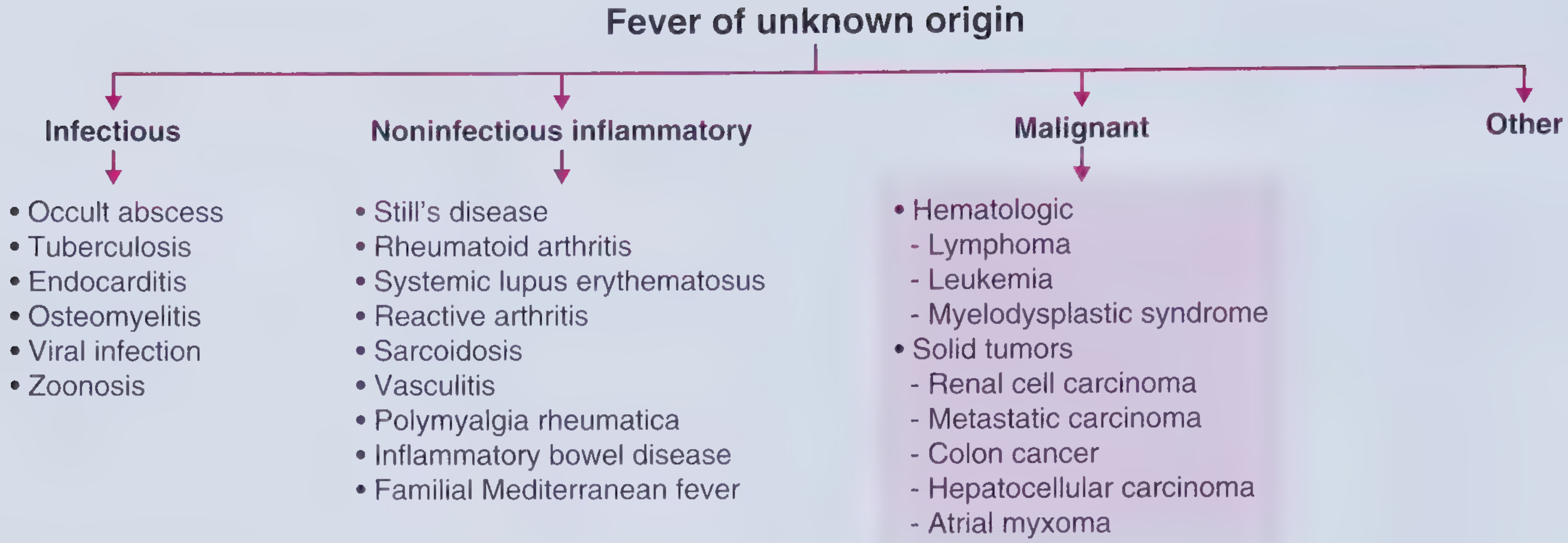
FUO causes fall into four categories (see diagram above):
| Category | Examples |
|---|---|
| Infectious | Occult abscess, TB (miliary), endocarditis, osteomyelitis, zoonoses |
| Noninfectious inflammatory | Still's disease, SLE, RA, sarcoidosis, vasculitis, IBD, Familial Mediterranean fever |
| Malignant | Lymphoma, leukemia, renal cell carcinoma, HCC, atrial myxoma |
| Other | Drug fever, factitious fever, undiagnosed |
Most common etiology: infectious causes dominate, with no final diagnosis found in a significant proportion of cases. Most common viral causes: EBV and CMV.
- Frameworks for Internal Medicine
Antipyretics - Mechanism of Action
| Drug | Mechanism |
|---|---|
| Aspirin / NSAIDs | Inhibit cyclooxygenase (COX) -> block PGE2 synthesis in hypothalamus -> lower set point |
| Paracetamol (Acetaminophen) | Also inhibits COX (primarily central) -> reduces hypothalamic PGE2 |
| Ibuprofen | COX inhibitor; commonly used in children (children's ibuprofen effective in reducing fever to ~38°C) |
When antipyretics lower the set point, the hypothalamus "sees" the body temperature as too high and activates heat-dissipating mechanisms: vasodilation and sweating.
- Costanzo Physiology 7th Ed.
Biological Role of Fever
Fever is not simply harmful - it has evolved adaptive functions:
- Many microorganisms have a narrow optimal growth temperature; elevated temperature inhibits their growth
- Antibody production increases at elevated temperatures
- Before antibiotics, induced hyperthermia was used to treat neurosyphilis (beneficial)
- Fever also benefits patients with anthrax, pneumococcal pneumonia, leprosy, and certain viral/fungal/rickettsial infections
- Some tumors grow more slowly at higher temperatures
However, prolonged temperatures >41°C cause brain damage, and >43°C heat stroke with high mortality.
- Ganong's Review of Medical Physiology 26th Ed.
Dangerous Related Syndromes
| Syndrome | Key Feature |
|---|---|
| Heat stroke | Core temp rise with impaired heat dissipation; hyperthermia, hypotension, tachycardia, decreased consciousness, seizures |
| Malignant hyperthermia | Triggered by inhalation anesthetics; ryanodine receptor mutation -> massive Ca²⁺ release from sarcoplasmic reticulum -> skeletal muscle contracture + extreme heat production |
| Neuroleptic malignant syndrome (NMS) | Antipsychotics; diffuse muscle rigidity, akinesia, fever, decreased consciousness, autonomic dysfunction |
| Serotonin syndrome | Serotonergic excess; hyperthermia with clonus, agitation |
Key Clinical Points
- Always exclude acute infection before attributing fever to non-infectious causes (especially in immunosuppressed patients on steroids or biologics)
- In SLE, fever may represent disease flare or opportunistic infection (PCP, cryptococcal meningitis, Listeria, herpes zoster)
- In pediatrics, key developments include Hib and conjugated pneumococcal vaccines, which have significantly changed the approach to febrile children
- Empirical antibiotics breed resistance; use culture-guided therapy when possible
- Hydration, nutrition, and general supportive care are often neglected but important in prolonged fever
Infectious and treatment
The user wants to dig deeper into infectious causes of fever and their treatment. Let me search the medical library for this.
Searching sources...
Finding Sources
Finding Sources
Finding Sources
Finding Sources
Goldman-Cecil has a dedicated section "APPROACH TO FEVER OR SUSPECTED INFECTION IN THE NORMAL HOST." Let me read that along with the FUO infectious causes from Frameworks and Fishman's pulmonary section.
Reading File
Reading File
Let me get the full Goldman-Cecil section on approach to fever, plus more treatment content and specific infectious causes.
Reading File
Finding Sources
Excellent - Goldman-Cecil has a very rich antibiotic table. Let me read more of this section and also search specifically for fever + sepsis approach and antibiotic selection.
Reading File
Finding Sources
Rich content. Let me read more of this section for the diagnostic approach and treatment principles.
Reading File
Finding Sources
Let me read the antibiotic therapy section and the Goldman-Cecil treatment approach.
Reading File
Reading File
Let me get the full diagnostic workup and antibiotic principles section from Goldman-Cecil, and the FUO infectious work up from Frameworks.
Reading File
Reading File
Excellent - I now have very comprehensive content on infectious causes and treatment approach. Let me compile the full detailed answer.
Infectious Causes of Fever & Treatment
Overview: Approach to the Febrile Patient
Most acute, undifferentiated febrile illnesses resolve spontaneously within 1-2 weeks without a specific diagnosis. However, a systematic approach is needed to identify serious bacterial infections that require prompt treatment.
Key principle: Empiric antibiotics should be avoided as a default. Most causes of pharyngitis in adults are viral; bacterial pneumonia is effectively excluded by normal vital signs and a normal chest exam. Culture-guided therapy is preferred whenever possible to avoid antimicrobial resistance.
- Goldman-Cecil Medicine, International Edition
Infectious Causes of Fever - By Syndrome
1. Fever + Rash
A careful history must establish:
- Immunocompromising conditions
- Travel history
- Animal/insect exposures
- New medications (drug fever is common)
- Sexual history
| Rash Type | Key Differential |
|---|---|
| Petechial / purpuric | Meningococcemia, Rocky Mountain spotted fever (RMSF), dengue, endocarditis |
| Maculopapular | Viral exanthem, drug reaction, secondary syphilis, EBV/CMV, rubella |
| Vesicular | Varicella-zoster, HSV, hand-foot-mouth disease |
| Erythroderma | Toxic shock syndrome (Staph/Strep), scarlet fever |
2. Fever + Lymphadenopathy
From Goldman-Cecil Medicine - Table 259-4:
| Regional Lymphadenopathy | Generalized Lymphadenopathy |
|---|---|
| Cervical: Streptococci, TB, viral URTI | EBV (infectious mononucleosis) |
| Peripheral: Bartonella henselae (cat scratch), Herpesviruses | CMV |
| Sporotrichosis | HIV |
| Lymphoma, metastatic cancer | Sarcoidosis |
| Syphilis (secondary), Toxoplasmosis, Viral hepatitis |
3. Fever + Musculoskeletal Complaints
- Localized tenderness/swelling/erythema: Suggests septic arthritis, osteomyelitis, or spinal epidural abscess (due to S. aureus in Western countries; M. tuberculosis in endemic areas for vertebral disease/psoas abscess)
- Polyarthritis: Disseminated gonococcal infection, chikungunya, dengue, parvovirus B19, Hepatitis B/C, Lyme disease
- Deep muscle myositis: Clostridial, streptococcal, or mixed aerobic-anaerobic infections
- Rhabdomyolysis: Legionellosis, various viral infections
- Diffuse myositis: Leptospirosis, toxoplasmosis
4. Fever in the Hospital (Nosocomial Fever)
In ICU patients, ~80% of febrile episodes are infectious.
Common Infectious Causes (from Goldman-Cecil Table 259-1):
| Common Infectious | Less Common Infectious |
|---|---|
| Clostridioides difficile enterocolitis | Biliary tract disease |
| Pneumonia (HAP/VAP) | Endometritis |
| Surgical wound infection | Intra-abdominal abscess |
| Urinary tract infection | Mediastinitis |
| Vascular catheter infection | Sinusitis |
Common Non-Infectious Causes (hospital setting):
Drug-induced fever, hematoma, transfusion reaction, venous thromboembolism, post-op state, MI, pancreatitis, organ infarction.
Note: C. difficile can cause fever and a leukemoid reaction even with little or no diarrhea.
5. Postoperative Fever
| Timing | Likely Cause |
|---|---|
| Within 24 hours | S. pyogenes or Clostridium species |
| 3+ days (with catheter) | Urinary tract infection |
| Day 5-7 | Surgical wound infection (more common after GI procedures) |
| Any time | C. difficile, drug fever, atelectasis, acalculous cholecystitis, DVT/PE |
Infectious Causes of FUO - Detailed Breakdown
Intra-abdominal Abscess
- Most common infectious cause of FUO in the industrialized world
- Common sites: liver, spleen, intraperitoneal cavity
- Also: dental, renal, perinephric abscesses
- Usually preceded by biliary disease, diverticulitis, appendicitis, or Crohn's disease
- CT abdomen/pelvis has high diagnostic yield and should be performed early
- Elderly patients may have subtle signs - leading to protracted course
- Treatment: Antibiotics + percutaneous drainage (image-guided); open surgery reserved for select cases
Tuberculosis
- Forms most likely to present as FUO:
- Extrapulmonary (especially hepatic TB) without clear localizing features
- Miliary TB without characteristic CXR pattern
- Pulmonary TB in immunocompromised (CXR may be normal in HIV)
- Investigations: Interferon-γ release assay (IGRA) or tuberculin skin test, sputum smear/culture/PCR, BAL, tissue biopsy (lung, liver, bone marrow)
- Treatment: Standard 4-drug RIPE regimen (Rifampicin, Isoniazid, Pyrazinamide, Ethambutol)
Endocarditis
- Culture-negative endocarditis - consider after prior antibiotic use, or fastidious organisms (HACEK group, Bartonella, Coxiella burnetii/Q fever, Brucella, fungi)
- Classic presentation: Fever, night sweats, weight loss + new murmur
- Treatment: Prolonged IV antibiotics (4-6 weeks); surgery for hemodynamic compromise or failure to clear bacteremia
Osteomyelitis
- Most common site in FUO: vertebral osteomyelitis (usually starts as discitis with symmetrical involvement of adjacent vertebrae)
- Causes: S. aureus (most common), TB in endemic areas
- Antibiotics not helpful for chronic osteomyelitis in isolation - surgical debridement often required
Viral Causes (most common: EBV and CMV)
- EBV (infectious mononucleosis): fever, pharyngitis, lymphadenopathy, hepatosplenomegaly
- CMV: similar syndrome but more heterophile-negative
- HIV: acute retroviral syndrome - fever, rash, lymphadenopathy, pharyngitis
- Treatment: largely supportive; antivirals for specific indications (CMV in immunocompromised, HIV with ART)
Zoonoses
- Cat scratch disease (Bartonella henselae): tender regional lymphadenopathy after cat scratch
- Leptospirosis: freshwater exposure, fever, conjunctival suffusion, AKI, liver injury, thrombocytopenia, hyponatremia - treated with doxycycline or penicillin
- Q fever (Coxiella burnetii): livestock/animal contact - treated with doxycycline
- Brucellosis: animal/dairy exposure
Diagnostic Workup
Initial Evaluation for FUO (Goldman-Cecil Table 259-7)
| Test | Rationale |
|---|---|
| CBC with differential | Leukocytosis, eosinophilia, cytopenias |
| Comprehensive metabolic panel | Liver, kidney function |
| Urinalysis + sediment | UTI, glomerulonephritis |
| ESR + CRP | Inflammation marker |
| Blood cultures x3 (spaced >74 hrs apart) | Bacteremia, endocarditis |
| HIV Ag/Ab (4th generation) | HIV |
| CMV IgM/IgG + EBV heterophile Ab | Viral causes |
| TB IGRA | Tuberculosis |
| LDH | Lymphoma, hemolysis |
| TSH | Thyroiditis |
| Rheumatoid factor, ANA | Autoimmune |
| Chest X-ray | Pulmonary TB, lymphoma, pneumonia |
| Hepatitis A/B/E serologies (if LFTs abnormal) | Viral hepatitis |
| Lower limb Doppler US | DVT |
| Echocardiography | Endocarditis |
| CT chest/abdomen/pelvis | Abscesses, lymphoma, TB |
Treatment Principles
Antipyretics
- Paracetamol (Acetaminophen) and Ibuprofen are first-line for symptomatic fever relief
- Both inhibit COX → reduce hypothalamic PGE2 → lower set point → vasodilation + sweating
- They do NOT treat the underlying infection
Antimicrobial Therapy
General principles:
- Cultures before antibiotics - always obtain blood cultures (and other relevant cultures) before starting antibiotics
- Narrow spectrum when possible - broad-spectrum empirical antibiotics breed resistance
- Shorter courses are generally better (Ann Intern Med 2019)
- De-escalate once culture and sensitivity results are available
Empirical antibiotic selection for common settings:
| Scenario | Empirical Antibiotic Choice |
|---|---|
| Community-acquired infection (non-severe) | Amoxicillin-clavulanate / fluoroquinolone |
| Intra-abdominal infection | Piperacillin/tazobactam OR 3rd/4th-gen cephalosporin + metronidazole |
| ESBL-producing Enterobacteriaceae | Carbapenem (drug of choice) |
| MRSA | Vancomycin |
| VRE | Linezolid or daptomycin |
| Suspected Candida (severe/Candida glabrata) | Micafungin (echinocandin) |
| HAP/VAP | Antipseudomonal beta-lactam ± anti-MRSA agent |
- Fischer's Mastery of Surgery 8th Ed. | Goldman-Cecil Medicine
Antimicrobial Stewardship
Key elements of hospital stewardship programs include:
-
Leadership commitment and dedicated resources
-
Prospective audit and feedback / preauthorization
-
Tracking resistance patterns and antibiotic use
-
Regular reporting to prescribers and hospital leadership
-
Education on adverse reactions, resistance, and optimal prescribing
-
Goldman-Cecil Medicine (CDC Core Elements)
Source Control
For abscesses and loculated infections:
- Image-guided percutaneous drainage is now standard (lower morbidity than open surgery)
- May serve as bridge to definitive surgical repair
- IV antibiotics alone may suffice for small intrahepatic abscesses (<3 cm)
- MDR organisms warrant early infectious disease consultation
Red Flags Requiring Urgent Evaluation
- Fever >41°C (hyperpyrexia - consider CNS hemorrhage or medication-induced)
- Fever + petechial rash → meningococcemia until proven otherwise
- Fever + stiff neck + photophobia → bacterial meningitis (LP urgently)
- Fever + new murmur → endocarditis
- Fever + immunocompromised state → broad differential including opportunistic infections
This is a shared conversation. Sign in to Orris to start your own chat.