
Gate keeper ganes
"Gate keeper games" - did you mean a specific type of game, a game title, or something else? Let me know what you're looking for!
Asking for Preferences
What are you looking for with 'gate keeper games'?
Genes
Reading File
The query "Gate keeper genes" is a genetics/molecular biology topic. Let me search the medical library for this.
Finding Sources
Searching the Web
gatekeeper genes cancer tumor suppressor definition examples
Now let me read the detailed textbook sections for a thorough answer.
Reading File
Reading File
Excellent - I now have comprehensive textbook content. Let me also fetch the figure on the Knudson two-hit model.
Loading Image
Here is a comprehensive breakdown of Gatekeeper Genes:
Gatekeeper Genes
Definition
Gatekeeper genes are a subclass of tumor suppressor genes that directly regulate cell proliferation. Their products control entry into - and progression through - the cell cycle, and can trigger apoptosis when needed. When both alleles of a gatekeeper gene are inactivated, the cell loses a critical brake on growth, and tumorigenesis can begin.
- Harper's Illustrated Biochemistry, 32nd Ed: "Gatekeeper genes (products) control cell proliferation, and include mainly genes that act to regulate the cell cycle and apoptosis."
- Harper's Glossary: "Genes that code for proteins that control or inhibit cell growth. Such genes are generally referred to as tumor suppressor genes (e.g., P53 and RB). Mutation in such genes often initiates the cascade of events that cause oncogenesis."
Gatekeepers vs. Caretakers vs. Landscapers
| Feature | Gatekeeper Genes | Caretaker Genes | Landscaper Genes |
|---|---|---|---|
| Function | Directly control cell proliferation and apoptosis | Preserve genome integrity via DNA repair | Regulate the tumor microenvironment |
| Mechanism of cancer | Mutation removes the brake on cell growth | Mutation allows other mutations to accumulate | Altered environment promotes unregulated proliferation |
| Examples | p53 (TP53), RB1, APC | MLH1, MSH2, MSH6, BRCA1/2 | SMAD4 (in some contexts) |
- Berek & Novak's Gynecology: "Caretaker genes preserve the integrity of the genome and are involved in DNA repair (stability genes). The inactivation of caretakers increases the likelihood of persistent mutations in gatekeeper genes and other cancer-related genes."
Key Examples
1. TP53 (p53) - "Guardian of the Genome"
- Located on chromosome 17p13
- Most commonly mutated gene in human cancer (>50% of all cancers)
- When DNA is damaged, p53 is activated - it halts the cell cycle at G1/S checkpoint, allowing DNA repair
- If damage is irreparable, p53 triggers apoptosis
- Mutant p53 fails to stop aberrant cell division
2. RB1 (Retinoblastoma Gene)
- First tumor suppressor gene discovered
- pRb prevents cell cycle progression from G1 → S phase by binding to the transcription factor E2F and repressing gene transcription needed for DNA replication
- Loss of RB1 function → uncontrolled entry into S phase
- Classic example of the Knudson "two-hit" hypothesis (see figure below)
3. APC (Adenomatous Polyposis Coli)
-
Called the "gatekeeper gene" for colorectal neoplasia
-
Mutations are the earliest detectable event in the adenoma-to-carcinoma sequence
-
APC protein regulates the Wnt/beta-catenin signaling pathway
-
Somatic APC mutations occur in 60-80% of sporadic colorectal cancers
-
Germline APC mutation causes Familial Adenomatous Polyposis (FAP)
-
Yamada's Textbook of Gastroenterology: "For this reason, the APC gene has been referred to as the gatekeeper gene for colorectal neoplasia."
The Knudson "Two-Hit" Hypothesis
Gatekeeper genes follow a recessive loss-of-function pattern - both alleles must be inactivated for the tumor suppressor effect to be lost.
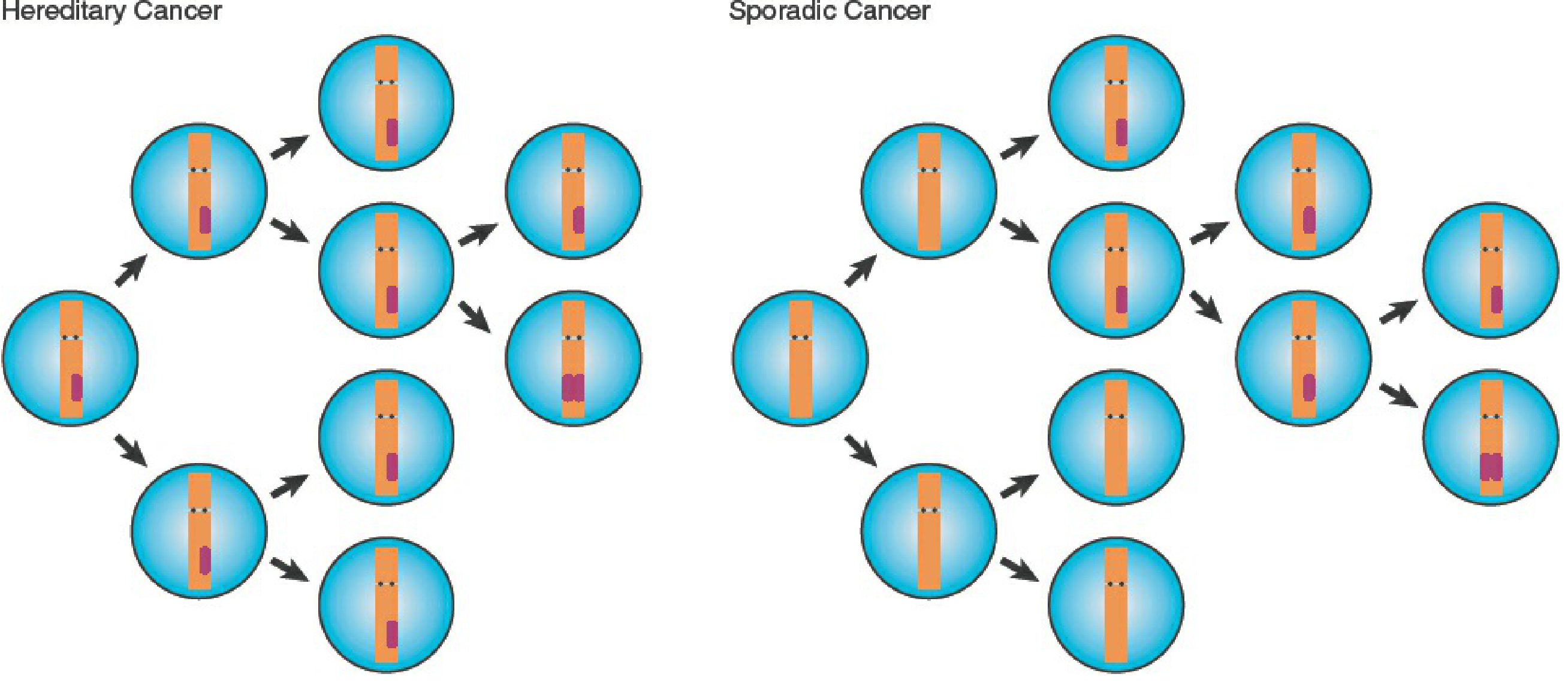
Hereditary cancer: All cells carry one mutant allele (first hit is inherited). Only one additional somatic mutation ("second hit") is needed - so tumors arise earlier and more frequently.
Sporadic cancer: Both alleles must be independently inactivated by somatic mutations - statistically less likely, so tumors arise later in life.
How Gatekeeper Mutations Differ from Oncogene Mutations
| Gatekeeper (Tumor Suppressor) | Oncogene | |
|---|---|---|
| Alleles required for effect | Both must be mutated (recessive) | One mutation is sufficient (dominant) |
| Mechanism | Loss of function removes brake on growth | Gain of function accelerates growth |
| Inheritance | Can be germline (heritable) or somatic | Usually somatic only |
| Tissue preference | Often tissue-specific (e.g., RB1 → retinoblastoma) | Generally not tissue-specific |
- Harper's Illustrated Biochemistry, 32nd Ed, Table 56-5
Clinical Significance
-
Hereditary cancer syndromes are largely driven by germline mutations in gatekeeper genes:
- RB1 mutation → Hereditary Retinoblastoma
- TP53 mutation → Li-Fraumeni Syndrome
- APC mutation → Familial Adenomatous Polyposis
- BRCA1/2 (caretaker, not gatekeeper) → Hereditary Breast/Ovarian Cancer
-
Loss of gatekeeper function is typically an early, initiating event in tumorigenesis, not a late event - this distinguishes them from many caretaker gene mutations.
-
Most adult solid tumors require 5 to 10 rate-limiting mutations in total (including gatekeeper hits) to acquire the fully malignant phenotype. - Berek & Novak's Gynecology, p. 240
This is a shared conversation. Sign in to Orris to start your own chat.