
Ankylosing spondylitis
I'll start by reading the medical library skill, then search for comprehensive information on ankylosing spondylitis.
Quick Answer: Ankylosing spondylitis (AS) is a chronic inflammatory arthritis primarily affecting the axial skeleton (sacroiliac joints and spine), causing progressive spinal fusion. It typically affects young men, presenting with inflammatory back pain, morning stiffness, and reduced spinal mobility. Treatment includes NSAIDs, physiotherapy, and biologics (TNF-alpha/IL-17 inhibitors).
Searching sources...
Reading File
Now let me search the medical library and images in parallel:
Finding Sources
Searching PubMed
"ankylosing spondylitis"[MeSH Terms] AND treatment
Good results. Now let me read the most comprehensive sections - Goldman-Cecil and Grainger & Allison (radiology) in parallel:
Reading File
Reading File
The radiology textbook has excellent detail. Let me read more of it along with the Goldman-Cecil main AS chapter (block41):
Reading File
Reading File
Now let me get the main clinical content from Goldman-Cecil block11 (the primary AS chapter) and fetch key images:
Finding Sources
Loading Image
Loading Image
Now let me read the core Goldman-Cecil AS clinical section (block11 around line 3935):
Reading File
Now let me get the main clinical chapter (Chapter 244) from Goldman-Cecil:
Finding Sources
Finding Sources
Let me read the main clinical AS section from Firestein & Kelley's Rheumatology and Campbell's Orthopaedics:
Reading File
Finding Sources
Let me read the core Firestein & Kelley rheumatology chapter on AS:
Reading File
Reading File
Let me get the main Firestein rheumatology AS section (block6) and the treatment/management section (block15 around line 7807):
Reading File
Reading File
I now have extensive information to write a comprehensive answer. Let me also quickly get the management section from Firestein block15 around line 7855-7911 (physical exam, ASAS criteria, NSAID/biologic treatment):
Reading File
I now have comprehensive information to compile a thorough response. Let me write it:
Ankylosing Spondylitis (AS)
Definition and Classification
Ankylosing spondylitis (AS) is a chronic, progressive inflammatory disease of the axial skeleton and a prototype of the seronegative spondyloarthropathies (SpA). It primarily affects the sacroiliac (SI) joints, spine, and large peripheral joints, and can involve the eyes, heart, lungs, and kidneys. It is also known by its eponyms Bechterew's disease and Marie-Strümpell's disease. Historical descriptions date back to the Egyptian era; the first clear modern clinical description was by Irish physician Bernard Connor in 1693, who noted a skeleton with "all the bones...united to make but one bone without articulation." - Firestein & Kelley's Textbook of Rheumatology
Epidemiology
| Feature | Detail |
|---|---|
| Sex | Male > Female (3:1 ratio) |
| Age of onset | Typically 20-40 years (mean: ~23 years) |
| Diagnostic delay | 8.5-11.4 years from symptom onset |
| HLA-B27 prevalence | 88-96% of AS patients carry HLA-B27 |
| Risk in HLA-B27(+) | Only 2-5% of HLA-B27 carriers develop AS |
| Sibling recurrence risk | ~9.2% (vs. 0.1-0.4% in the general population) |
| Heritability | Estimated >95% |
- Campbell's Operative Orthopaedics 15th Ed 2026; Firestein & Kelley's Textbook of Rheumatology
Genetics and Pathogenesis
HLA-B27 is the strongest genetic susceptibility factor - carried by >90% of White patients with AS (relative risk 50-100x). However, HLA-B27 alone is insufficient; over 80 additional risk loci have been identified, including:
- Aminopeptidase genes (ERAP1, ERAP2) - reinforce the role of antigen presentation; ERAP1 association shows genetic epistasis with HLA-B27
- IL-23 pathway genes (IL-23R, IL-12B, IL-27) - drive Th17 cell differentiation and IL-17 production
- Notably, drugs targeting IL-17 are effective in AS, while IL-23 inhibitors are not - pointing to an IL-23-independent IL-17 mechanism at entheseal sites
The hallmark pathologic change is enthesitis - inflammation at the insertions of tendons, ligaments, and capsules into bone. This leads to fibrosis and ossification of peri-spinal structures, producing the characteristic progressive spinal ankylosis.
- Firestein & Kelley's Textbook of Rheumatology
Clinical Features
Articular Manifestations
Axial skeleton (dominant):
- Inflammatory back pain (IBP) - insidious onset, worse in the morning, improves with exercise, does not improve with rest
- Sacroiliitis (bilateral, symmetric) - buttock pain radiating to the thighs
- Progressive spinal stiffness and loss of mobility (lumbar, thoracic, cervical)
- Ankylosis progresses caudal to cephalad (sacroiliac → lumbar → thoracic → cervical)
Peripheral joints (up to 30%):
- Hip joint is the most commonly affected peripheral joint after the SI joints
- Shoulder, knee involvement less common
Extra-articular Manifestations
| System | Manifestation |
|---|---|
| Eyes | Acute anterior uveitis (iritis) - most common extra-articular feature; recurrent, unilateral, painful |
| Heart | Aortic insufficiency, conduction defects (AV block) |
| Lungs | Restrictive lung disease (costovertebral/sternoclavicular joint fusion fixes the rib cage in inspiration); upper lobe fibroblulous disease (1-4%) |
| Kidneys | Amyloid deposition causing renal failure |
| Skin | Psoriasis (in some SpA overlap) |
- Campbell's Operative Orthopaedics; Goldman-Cecil Medicine
Diagnosis and Imaging
Modified New York Criteria (1984)
Radiologic criterion (mandatory): Bilateral grade 2-4 OR unilateral grade 3-4 sacroiliitis on plain radiographs
At least one clinical criterion:
- Low back pain and stiffness for >3 months, relieved by exercise but not rest
- Limited motion of the lumbar spine in both the sagittal and frontal planes
- Limited chest expansion (relative to normal values for age and sex)
Radiologic Progression
Sacroiliac joints (earliest site):
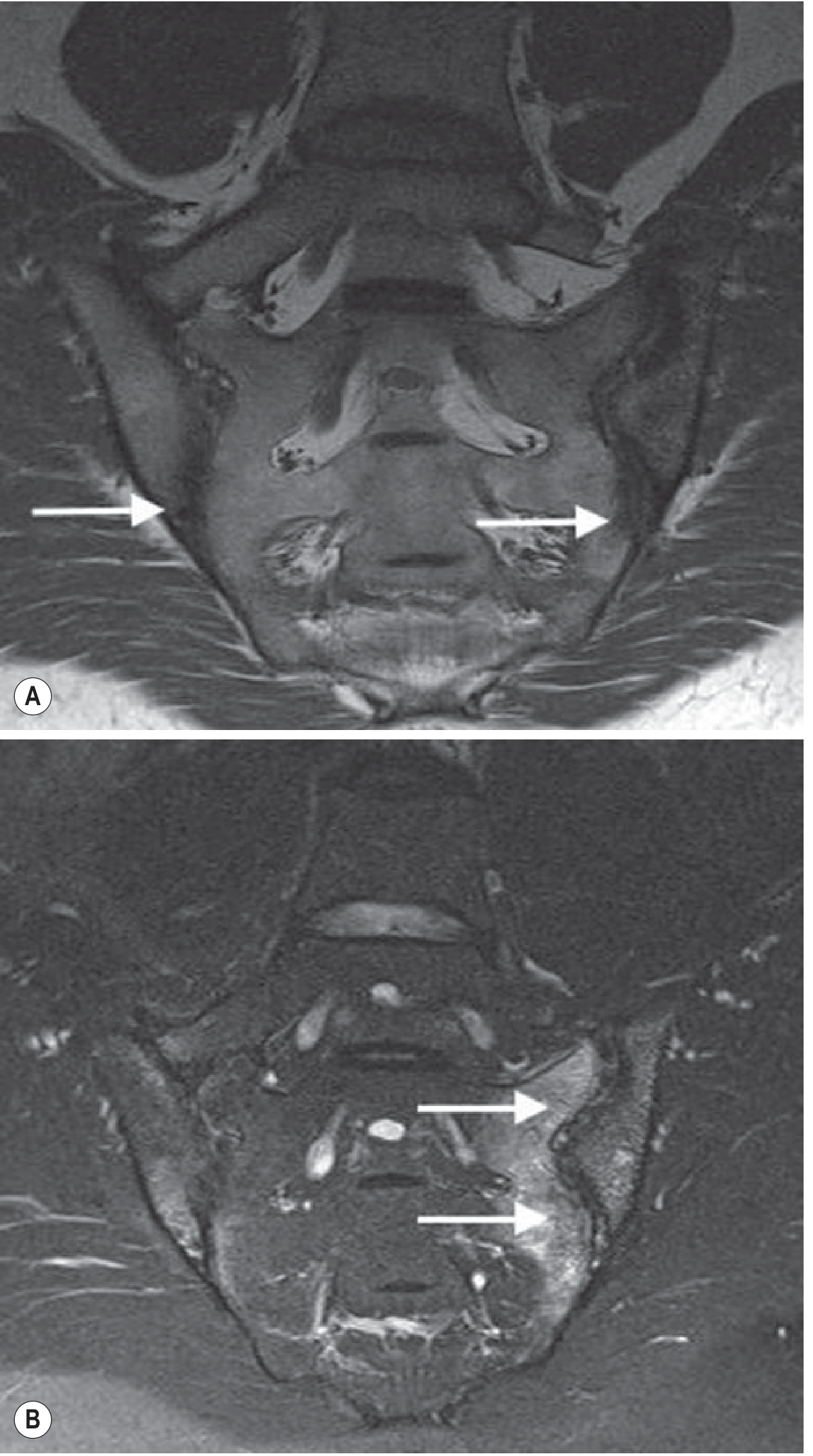
- MRI: Subchondral bone marrow edema (earliest, best detected on T2 fat-suppressed/STIR images)
- Plain X-ray/CT: Erosive change, subchondral sclerosis → ankylosis
MRI of the sacroiliac joints in AS - (A) T1-weighted showing erosions with joint space loss, (B) T2 fat-suppressed showing subchondral edema indicating active disease:
Spine:
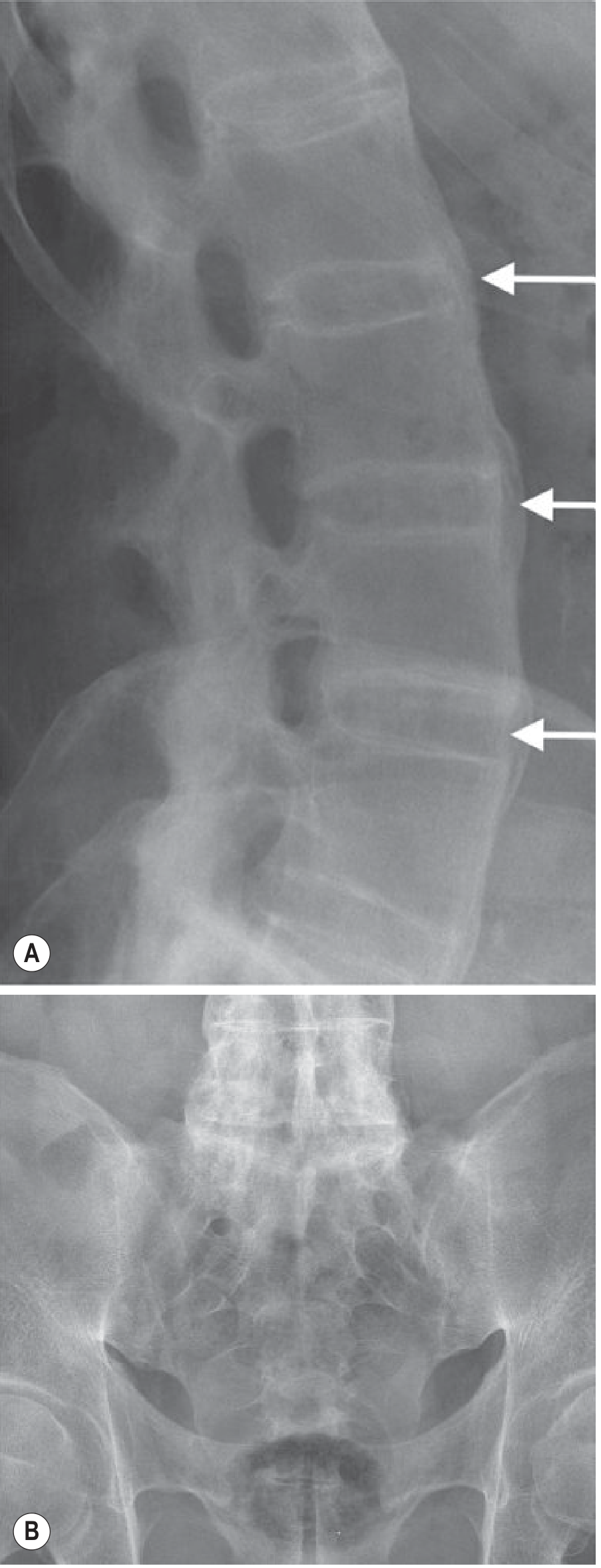
- Romanus lesions: Sclerotic "shiny corners" on lateral X-ray - earliest radiographic spinal sign; enthesitis at Sharpey fiber insertion into vertebral body corners
- Squared vertebrae: Erosive change at Romanus sites + anterior longitudinal ligament ossification
- Syndesmophytes: Thin, vertically oriented outgrowths (distinguishing AS from the coarser syndesmophytes of psoriatic/reactive arthritis)
- Bamboo spine: Complete fusion of vertebral bodies and SI joints in advanced untreated disease
Advanced AS - (A) Bridging vertical syndesmophytes in the lumbar spine (arrows); (B) Complete bony fusion of the sacroiliac joints:
Key distinguishing features (AS vs. other spondyloarthropathies):
-
AS syndesmophytes: thin, vertical orientation
-
Psoriatic/reactive arthritis: coarse, asymmetric paravertebral ossifications
-
Grainger & Allison's Diagnostic Radiology
Complications
-
Spinal fracture: The rigid, osteopenic spine is highly prone to fracture even with minimal trauma; transverse fractures through fused segments are highly unstable and can be catastrophic
-
Andersson lesion: Inflammatory pseudarthrosis at unfused levels in a largely fused spine - can mimic infection
-
Osteoporosis: Due to chronic inflammation and abnormal biomechanical loading
-
Cauda equina syndrome: Late complication
-
Spondylodiscitis
-
Restrictive lung disease: Rib cage fixation; diaphragm takes over breathing; intercostal muscle atrophy
-
Fibrobullous upper lobe disease: Occurs in ~1-4% of patients (bilateral reticulonodular infiltrates, cyst formation, parenchymal destruction)
-
Goldman-Cecil Medicine; Grainger & Allison's Diagnostic Radiology
Treatment
1. Non-pharmacologic
- Patient education
- Regular physiotherapy and exercise (essential to maintain posture and spinal mobility)
- Smoking cessation (reduces pulmonary complications)
2. NSAIDs (First-line pharmacologic treatment)
- Continuous NSAID use (rather than on-demand) may slow radiographic progression
- Cochrane review (A1) supports NSAIDs for symptom control in axial SpA
3. Biologics
TNF-alpha inhibitors (bDMARDs - first choice when NSAIDs fail):
- 5 agents: infliximab, etanercept, adalimumab, certolizumab, golimumab
- Dramatically reduce symptoms, improve quality of life, CRP, anemia, sleep quality
- Control spinal inflammation on MRI
- Early and continuous treatment appears to inhibit radiographic progression
- Cochrane meta-analysis (A2) supports TNF inhibitors for AS
IL-17A inhibitors:
- Secukinumab, ixekizumab - effective in AS; particularly useful in patients with prior TNF failure or with concomitant psoriasis/uveitis
JAK inhibitors (small molecule, oral):
- Tofacitinib (FDA approved Dec 2021): 5 mg BID - ASAS20 achieved in 56.4% vs. 12.5% placebo at week 16
- Upadacitinib (FDA approved 2022): 15 mg OD - ASAS40 achieved in 52% vs. 26% placebo; also approved for non-radiographic axSpA (nr-axSpA)
- Approved for patients with inadequate response to or intolerance of TNF inhibitors
Note: Conventional DMARDs (methotrexate, sulfasalazine) have no proven benefit for axial disease but may be used for peripheral arthritis.
- Firestein & Kelley's Textbook of Rheumatology
4. Surgery
- Spinal osteotomy for severe fixed kyphosis
- Total hip replacement for end-stage hip disease
Axial SpA Spectrum and ASAS Criteria
The modern classification recognizes a broader spectrum:
- Radiographic axSpA = AS (by modified New York criteria - sacroiliitis visible on X-ray)
- Non-radiographic axSpA (nr-axSpA): Active inflammation on MRI without radiographic sacroiliitis; certolizumab was the first anti-TNF FDA-approved for this indication
Assessment scores: BASDAI (Bath AS Disease Activity Index), ASDAS (AS Disease Activity Score), BASFI (Bath AS Functional Index), BASMI (mobility index)
Prognosis
- The strongest predictor of new syndesmophyte formation is baseline presence of syndesmophytes
- Highly variable course; early aggressive treatment with biologics can modify disease progression
- Work disability and reduced quality of life are significant long-term risks
- Hip involvement that progresses to spontaneous arthrodesis can occur
Recent Evidence Note: A 2025 systematic review on acupuncture for AS (PMID: 39973247) and a 2024 overview of adalimumab therapy (PMID: 38415452) represent recent published reviews. No major evidence contradicting current pharmacologic guidelines was identified.
This is a shared conversation. Sign in to Orris to start your own chat.