
Frosh approach knee
Reading File
The Frosh (anterior) approach to the knee is a surgical approach used in orthopedic procedures. Let me search the library and web in parallel for detailed information.
Finding Sources
Finding Sources
Searching the Web
Frosh approach knee surgical anatomy orthopedic
Good - found the relevant textbook passage. Let me read that block and also extract more from the PMC article for comprehensive coverage.
Reading File
Reading Web Page
https://pmc.ncbi.nlm.nih.gov/articles/PMC10622288
Let me read more of the textbook to get the full Frosch approach description.
Reading File
Now let me get the Frosch approach description specifically from the textbook:
Finding Sources
Reading File
Excellent! I now have comprehensive information. Let me also fetch the key diagram image.
Loading Image
I now have all the information needed for a thorough answer. Here is the complete overview:
Frosch Approach to the Knee
The Frosch approach (also called the posterolateral approach to the tibial plateau without fibular osteotomy) is a posterolateral surgical approach to the proximal tibia, specifically designed for fractures of the posterolateral tibial plateau. It was described by Frosch KH, Balcarek P, Walde T, and Stürmer KM (J Orthop Trauma, 2010).
Indication
- Posterolateral tibial plateau fractures (isolated or combined with lateral tibial plateau fractures)
- Preferred when direct visualization and buttress plating of the posterolateral condyle is required
- Allows simultaneous anterolateral and posterolateral exposure without fibular osteotomy
Patient Positioning
- Lateral decubitus position with the operative side up
- The knee is supported on a thick rolled pillow
- (Note: The "Frosh posterolateral approach" variant described in Rockwood & Green uses a straight incision in the lateral position, which is slightly different from the standard reverse L-shaped posterior approach)
Surgical Technique (Frosch et al. - Campbell's Operative Orthopaedics 15th Ed)
- Place patient in the lateral decubitus position, operative side up
- Support the knee with a thick, rolled pillow
- Make a 15 cm posterolateral incision starting 3 cm above the joint line, then follow the fibula distally
- Incise the posterior part of the iliotibial band from Gerdy's tubercle and perform a lateral arthrotomy
- Bluntly dissect into the popliteal fossa between the lateral head of gastrocnemius and the soleus, exposing the popliteus muscle
- Ligate the inferior geniculate vessels if necessary
- Develop the interval between the biceps femoris muscle and the popliteus muscle
- Detach the soleus from the posterior aspect of the fibula, exposing the posterolateral plateau
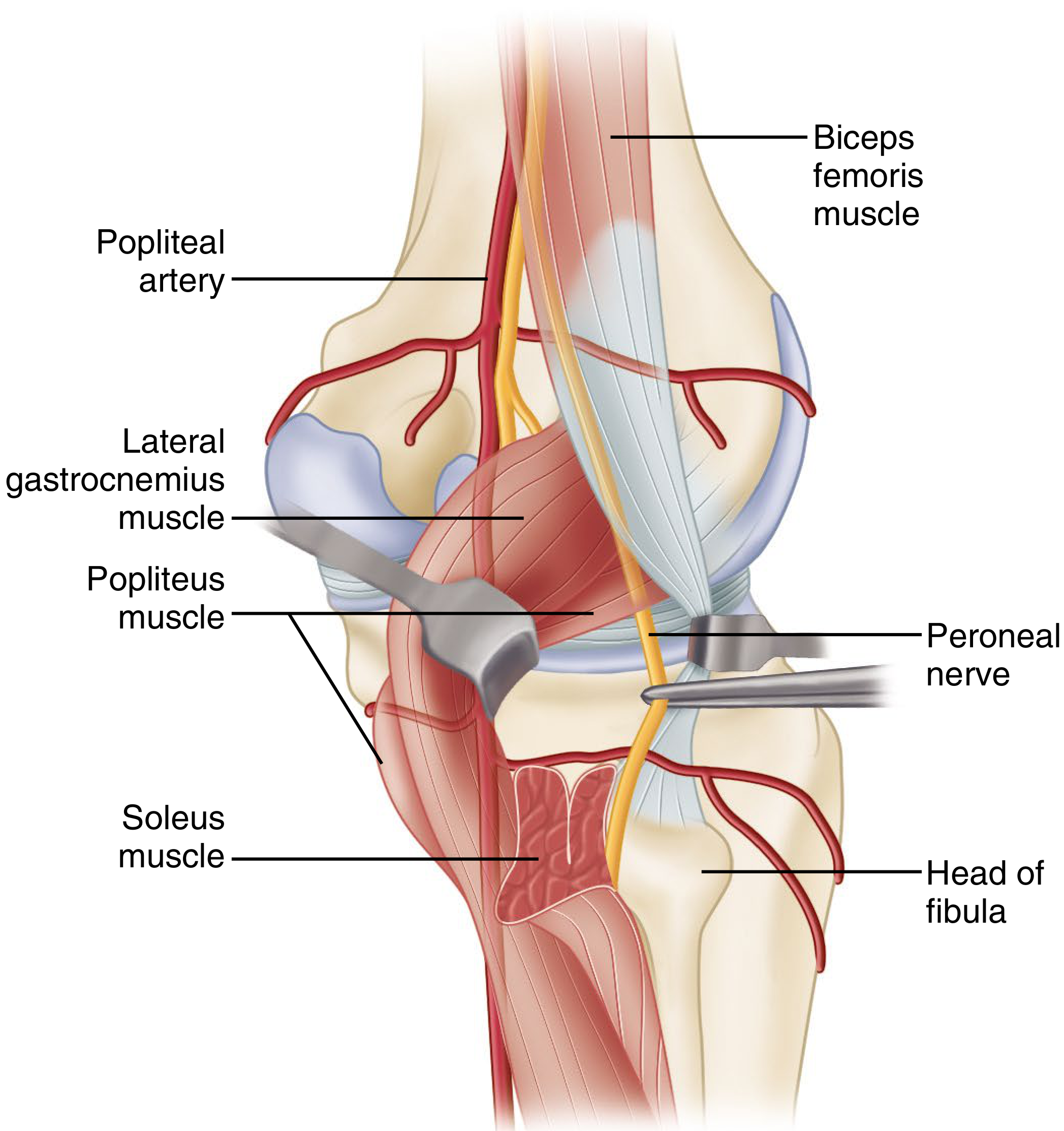
Key surgical interval: between popliteus muscle and biceps femoris. Soleus is reflected from the proximal fibula. The common peroneal nerve runs along the biceps femoris and must be identified and protected.
Key Anatomical Structures
| Structure | Relevance |
|---|---|
| Common peroneal nerve | Runs along biceps femoris; must be identified and protected |
| Popliteal artery | Deep and medial; at risk with deep dissection |
| Lateral gastrocnemius | Retracted medially |
| Soleus | Detached from fibula to expose posterolateral plateau |
| Biceps femoris | Forms lateral boundary of the interval |
| Popliteus | Medial boundary of the deep interval |
| Inferior geniculate vessels | May need ligation |
Advantages Over Alternatives
- No fibular osteotomy needed - avoids common peroneal nerve palsy, osteotomy non-union, and proximal tibiofibular joint disruption
- Single incision handles both anterolateral and posterolateral fractures - reduces soft tissue trauma and skin flap necrosis risk
- Direct visualization of posterolateral articular surface for reduction under vision and buttress plate placement
- Can simultaneously address associated common peroneal nerve injuries
- Lateral incision placement avoids scarring that would limit knee flexion/extension
Disadvantages
- Technically demanding - requires thorough familiarity with posterolateral knee anatomy
- Complex anatomical region (proximity of popliteal artery, peroneal nerve)
- Higher learning curve; requires significant experience in knee surgery
Comparison with Other Posterolateral Approaches
| Approach | Key Feature |
|---|---|
| Frosch | No fibular osteotomy; lateral decubitus; single incision for L+PL plateau |
| Fibular head osteotomy approach | Fibula divided 2 mm proximal to peroneal nerve; higher nerve/nonunion risk |
| Posterior reverse L-shaped (PRLA) | Prone position; horizontal + vertical limb; medial to lateral gastrocnemius |
| Bhattacharyya | S-shaped incision; medial to medial head of gastrocnemius |
| Lobenhoffer | Similar plane to Bhattacharyya; medial head of gastrocnemius not released |
Sources:
- Campbell's Operative Orthopaedics, 15th Ed 2026, Technique 1.38 (Frosch et al.), p. 1868-1878
- Rockwood and Green's Fractures in Adults, 10th Ed 2025, Chapter 62, Posterior Approaches section
- PMC Clinical Analysis of the Frosch Approach - Frosch approach for posterolateral + lateral tibial plateau fractures combined
This is a shared conversation. Sign in to Orris to start your own chat.