
Anaesthetic management of 75 year old for total HRA with history of MI 3 months ago . Give me an exam ready answer for MD Anaesthesiology exam with neet ss questions .
Reading File
Now let me search the medical library in parallel for all relevant topics.
Finding Sources
Finding Sources
Finding Sources
Searching PubMed
"hip arthroplasty" AND "anaesthesia" AND "cardiac risk"
Finding Sources
Finding Sources
Finding Sources
Searching PubMed
"hip arthroplasty" AND "anesthesia" AND "regional"
Good, I have key sources. Now let me read the most relevant sections from Miller's Anesthesia and Harrison's in parallel.
Reading File
Reading File
Reading File
Reading File
Reading File
Reading File
Reading File
Excellent - this is a very rich source. I now have enough comprehensive data to write the full exam-ready answer. Let me compile everything.
Loading Image
I now have comprehensive data from Miller's Anesthesia 10e and Harrison's 22e. Let me now compose the full exam-ready answer.
Anaesthetic Management of a 75-Year-Old for Total Hip Replacement Arthroplasty (HRA) with MI 3 Months Ago
Exam-Ready Answer for MD Anaesthesiology / NEET SS
THE CENTRAL PROBLEM: WHY THIS CASE IS HIGH-STAKES
This patient has three compounding risk factors that demand systematic pre-operative planning:
| Risk Factor | Significance |
|---|---|
| Age 75 years | Geriatric physiology; altered drug handling; high risk of postoperative delirium (POD) |
| MI 3 months ago | Recent MI = highest modifiable cardiac risk; reinfarction rate peaks perioperatively |
| Total HRA | Intermediate cardiac risk surgery (30-day MACE: 1-5%); fat embolism/cement hazard |
PART 1 - PREOPERATIVE ASSESSMENT
1.1 Timing of Surgery - The Most Important Exam Point
- ACC/AHA 2014 guidelines recommend deferring non-urgent surgery for at least 60 days after a recent MI
- ESC 2022 guidelines recommend deferring for 3 months (which is this patient's exact window)
- Bailey & Love: elective surgery should be postponed 3-6 months after proven MI to reduce perioperative reinfarction risk
- Key: at 3 months, surgery is at the borderline of acceptable. The risk of perioperative reinfarction is highest in the first 3 months and drops significantly after that
"The 2014 ACC/AHA guidelines recommend deferring non-urgent surgery until 60 days after a recent myocardial infarction." - Miller's Anesthesia 10e
"After a proven MI, elective surgery should be postponed for 3-6 months to reduce the risk of perioperative reinfarction." - Bailey & Love 28e
1.2 Cardiac Risk Stratification (Step-by-Step Algorithm)
Apply the 2014 ACC/AHA 6-Step Algorithm:
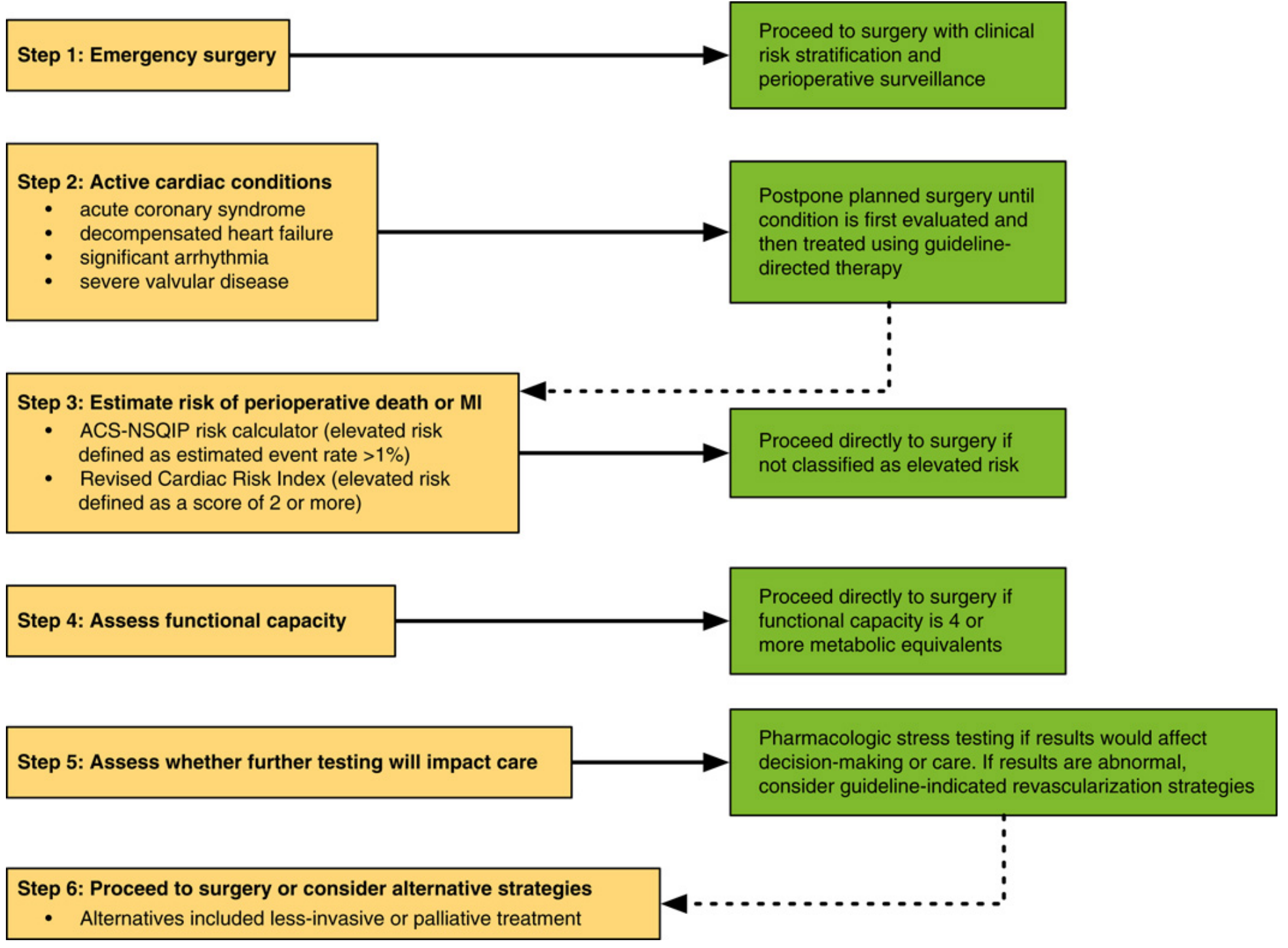
- Step 1: Is it emergency? - No (elective HRA)
- Step 2: Active cardiac conditions? - Check for ACS, decompensated HF, severe arrhythmia, severe AS. If present - postpone and treat
- Step 3: Estimate MACE risk - Use RCRI (Revised Cardiac Risk Index) or ACS-NSQIP calculator. Total joint arthroplasty = intermediate risk (1-5% 30-day MACE). RCRI factors: high-risk surgery, IHD, CHF, CVD, insulin-dependent DM, Cr >2 mg/dL
- Step 4: Functional capacity - If ≥4 METs (e.g., climb a flight of stairs), proceed without further testing
- Step 5: If functional capacity poor/unknown - does further testing change management? If yes, consider pharmacological stress testing
- Step 6: Proceed or consider alternatives
ESC 2022 Classification: Major orthopedic surgery (joint replacement) = Intermediate Cardiac Risk
GSCRI (Geriatric-Sensitive Perioperative Cardiac Risk Index): better predictor than RCRI/Gupta score in elderly. Key variables: stroke history, ASA class, surgical category, HF, DM. OR for MI/arrest in orthopedic patients = 2.99 (95% CI 2.22-4.02) - Miller's Anesthesia 10e
1.3 Preoperative Investigations
| Investigation | Rationale |
|---|---|
| 12-lead ECG | Baseline; detect residual ischemia, arrhythmia, LV hypertrophy |
| Echocardiography | Assess LVEF, wall motion abnormalities, valvular disease |
| Chest X-ray | Cardiac size, pulmonary edema, comorbidities |
| Stress test (pharmacological) | If functional capacity <4 METs and result will change management |
| CBC | Anemia increases perioperative cardiac risk |
| Serum creatinine | CKD = independent risk factor for perioperative MACE |
| BNP / NT-proBNP | CCS 2017 and ESC 2022 recommend; elevated = increased perioperative risk |
| High-sensitivity troponin | ESC 2022: baseline + postoperative monitoring for MINS (Myocardial Injury after Non-cardiac Surgery) |
| Coagulation profile | If on anticoagulants/antiplatelet agents |
| Blood sugar | Hyperglycemia increases infective and cardiac risk |
| Blood grouping and cross-match | For blood loss management |
1.4 Medication Management
| Drug | Management |
|---|---|
| Aspirin (low-dose) | Continue perioperatively - do NOT stop in recent MI/stent patients |
| P2Y12 inhibitors (clopidogrel/ticagrelor) | If on DAPT post-PCI: delay surgery. After bare-metal stent: minimum 30 days; drug-eluting stent: minimum 6 months (ideally 12 months) |
| Beta-blockers | Continue - do NOT stop; abrupt cessation causes rebound tachycardia/ischemia |
| Statins | Continue - cardioprotective perioperatively |
| ACE inhibitors/ARBs | Hold morning of surgery (risk of intraoperative hypotension); restart when hemodynamically stable |
| Anticoagulants (LMWH, NOAC) | Bridge/hold as per protocol; timing for neuraxial anaesthesia is critical |
PART 2 - CHOICE OF ANAESTHETIC TECHNIQUE
2.1 Central Debate: Neuraxial vs. General Anaesthesia
For Total HRA, neuraxial anaesthesia (spinal ± epidural) is preferred, especially in the elderly with cardiac comorbidity.
Advantages of Neuraxial (Spinal/CSE) anaesthesia in this patient:
- Lower incidence of DVT/PE - reduced by sympathetically-mediated vasodilation and reduced hypercoagulability
- Reduced blood loss - lower arterial pressure, venous pooling
- Better pain control - opioid-sparing, reduced stress response
- Avoids GA hazards - no airway manipulation, no volatile agent depression, no opioid-heavy technique
- Reduced postoperative delirium - avoids GA and centrally-acting drugs (though evidence is mixed)
- Miller's Anesthesia 10e (Ch. 60): General anesthesia compared with epidural/spinal/regional anesthesia was an independent risk factor for serious adverse events in patients ≥80 years undergoing THA (RR 1.90; 95% CI 1.29-2.79)
Disadvantages/Precautions with Neuraxial in this patient:
- Hypotension on induction - critical in post-MI patient with potentially compromised LV function
- Managed by: judicious pre-loading with crystalloid, vasopressors (phenylephrine, ephedrine), slow titration
- Antiplatelet/anticoagulant status must be assessed for timing (ASRA guidelines)
- Spinal hypotension can precipitate myocardial ischemia in post-MI patient
2025 Network Meta-Analysis (Br J Anaesth, PMID 40483183): Comprehensive regional anaesthesia modalities for total hip arthroplasty - spinal anaesthesia with adjuncts remains preferred.
PENG Block (pericapsular nerve group block) - Systematic review (Clin J Pain, PMID 38268183): provides superior analgesia for THA, significantly reduces opioid consumption.
2.2 Recommended Anaesthetic Plan
Technique of choice: Spinal anaesthesia (or CSE) + PENG block
Spinal Anaesthesia Protocol:
- Position: Lateral decubitus (operative side down) or sitting
- Level: L3-L4 or L4-L5 interspace
- Drugs:
- Hyperbaric bupivacaine 8-10 mg (0.5%) - reduced dose in elderly (decreased CSF, increased sensitivity)
- Intrathecal fentanyl 20-25 mcg (adjuvant - prolongs block, reduces bupivacaine dose)
- Intrathecal morphine 100-150 mcg (postoperative analgesia - use with caution in elderly; monitor for respiratory depression)
- Level aimed: T10 (covers hip)
- Avoid: High blocks, excessive CSF spread in elderly (decreased spinal cord volume, exaggerated spread)
CSE (Combined Spinal-Epidural):
- Useful if surgery anticipated >2 hours or for postoperative epidural analgesia
- Epidural catheter at L2-L3; spinal at L3-L4
PENG Block (Pericapsular Nerve Group Block):
- Targets articular branches of femoral nerve, obturator nerve, accessory obturator nerve
- Ultrasound-guided injection between anterior inferior iliac spine and iliopsoas tendon
- 20-25 mL of 0.25% bupivacaine or ropivacaine
- Opioid-sparing; reduces PONV; safe in elderly
If General Anaesthesia is Required (patient refusal, coagulopathy, technical failure):
- TIVA (propofol + remifentanil) preferred over volatile agent in post-MI patient
- BIS monitoring - target 40-60
- Avoid: tachycardia (triggers ischemia), hypotension (MAP <65 mmHg), anemia (Hb <8 g/dL)
- Laryngoscopy: attenuate pressor response - lidocaine 1.5 mg/kg IV, fentanyl 2 mcg/kg, beta-blocker
PART 3 - INTRAOPERATIVE MANAGEMENT
3.1 Monitoring (Standard + Enhanced)
| Monitor | Justification |
|---|---|
| ECG (5-lead, ST analysis leads II + V5) | Detect ST changes = early ischemia detection |
| SpO2 | Continuous |
| NIBP (2-minute intervals) | Post-MI patients sensitive to hypotension |
| Invasive arterial line (IBP) | Recommended in high-cardiac-risk patients; beat-to-beat BP |
| CVP / TOE | If LV dysfunction, consider transesophageal echocardiography |
| Temperature | Hypothermia triggers catecholamine surge → ischemia |
| Urine output | Hourly catheterization |
| BIS | If GA used |
| NMT (nerve stimulator) | If muscle relaxants used |
3.2 Hemodynamic Goals in Post-MI Patient
| Parameter | Target |
|---|---|
| Heart rate | 50-70 bpm (bradycardia better than tachycardia in IHD) |
| MAP | ≥65 mmHg (protect coronary perfusion pressure) |
| SpO2 | ≥95% |
| Temperature | Normothermia ≥36°C |
| Hemoglobin | ≥8 g/dL (anemia = ischemia trigger) |
| Blood sugar | 140-180 mg/dL |
3.3 Cement Implantation Syndrome (BCIS - Bone Cement Implantation Syndrome)
Especially important in elderly patients with cardiac disease
- Mechanism: Bone cement (PMMA) monomer causes vasodilation + fat/air microemboli cause pulmonary hypertension → acute RV dysfunction → hypotension, hypoxia, arrhythmia, cardiac arrest
- Timing: Occurs at moment of cemented prosthesis implantation
- Clinical features: Hypoxia, hypotension, arrhythmia, loss of consciousness, cardiac arrest
- Risk factors for severe BCIS: Age >70 years, osteoporosis, pre-existing cardiorespiratory disease, intertrochanteric fractures, long-stem prostheses, intramedullary instrumentation
- Grades:
- Grade 1: SpO2 <94% or hypotension >20% MAP decline
- Grade 2: SpO2 <88% or hypotension >40% MAP decline or unexpected loss of consciousness
- Grade 3: Cardiovascular collapse requiring CPR
- Prevention:
- Inform surgeon before cementing
- FiO2 100% for 2-3 minutes before cement insertion
- Ensure adequate volume status
- Pulse lavage and canal venting (surgical technique)
- Management: Aggressive fluid resuscitation, vasopressors (norepinephrine preferred), inotropes (dobutamine), manage hypoxia (FiO2 100%, PEEP), defibrillation if VF
3.4 Fat Embolism Syndrome (FES)
- Risk at reaming of femoral canal
- Classic triad: Hypoxia + Petechiae + CNS dysfunction
- Manage: supportive; PEEP, FiO2, methylprednisolone controversial
3.5 DVT/PE Prophylaxis
- Pharmacological: LMWH (enoxaparin) or fondaparinux (timing coordinated with neuraxial block removal)
- Mechanical: Intermittent pneumatic compression, TED stockings
- Early mobilization
3.6 Blood Loss Management
- Average blood loss in THA: 300-500 mL
- Tranexamic acid 1 g IV (antifibrinolytic) - reduces blood loss and transfusion requirement
- Cell salvage if anticipated high loss
- Transfusion trigger: Hb <8 g/dL in cardiac patient (higher threshold than general population)
PART 4 - POSTOPERATIVE MANAGEMENT
4.1 Analgesia (Multimodal)
| Component | Drug/Dose |
|---|---|
| Neuraxial opioid | Intrathecal morphine 100-150 mcg (monitor for respiratory depression 12-24h) |
| PENG block | 0.25% bupivacaine 20 mL - lasts 12-18 hours |
| Paracetamol | 1 g IV/oral Q6H (scheduled, not PRN) |
| NSAIDs | Use with caution post-MI (COX-2 and non-selective NSAIDs increase cardiovascular risk); short course if needed |
| Opioids PCA | Morphine or fentanyl PCA as rescue; opioid-sparing strategy |
| Avoid | Ketorolac, diclofenac in recent MI (COX-2 inhibition increases thrombotic risk) |
4.2 Postoperative Monitoring
- HDU or cardiac monitored bed (not routine ward) for minimum 24-48 hours
- Serial ECGs at 24 and 48 hours postoperatively
- Serial high-sensitivity troponin (0h, 24h, 48h) - detect MINS (Myocardial Injury after Non-cardiac Surgery)
- BNP if dyspnea develops
- SpO2 monitoring (hypoxia triggers ischemia)
- Early detection of delirium (CAM score)
4.3 Postoperative Cognitive Dysfunction (POCD) and Delirium
- Delirium incidence: 5-50% in elderly post-surgery; 4x more common in hip fracture vs. elective arthroplasty
- Risk factors in this patient: Age 75, recent MI, potential intraoperative hypotension, opioids
- Prevention: Minimize anticholinergics, benzodiazepines, opioids; early mobilization; sleep hygiene; non-pharmacological interventions
- Kalisaart model (validated in hip surgery ≥70 yrs): cognitive function, visual impairment, acute physiology score, BUN:creatinine ratio
PART 5 - SPECIFIC PHYSIOLOGICAL CHANGES IN ELDERLY (75 YEARS)
| System | Change | Anaesthetic Implication |
|---|---|---|
| Cardiovascular | Reduced cardiac reserve, stiff ventricles, blunted baroreceptor reflex | Exaggerated hypotension with spinal; slow induction |
| Respiratory | Reduced FRC, closing capacity >FRC (supine), reduced PaO2 | Pre-oxygenation critical; prone to atelectasis |
| Renal | GFR reduces by 1 mL/min/year after 40 | Drug accumulation; avoid nephrotoxic drugs |
| Hepatic | Reduced hepatic blood flow and enzyme activity | Prolonged drug half-life |
| CNS | Reduced MAC, reduced drug requirements | 30-40% reduction in inhaled and IV anaesthetic doses |
| Pharmacokinetics | Reduced albumin (increased free drug), increased body fat | Drug redistribution altered |
PART 6 - EXAM-STYLE NEET SS QUESTIONS AND ANSWERS
Q1. A 75-year-old patient is scheduled for total hip arthroplasty. He had an MI 3 months ago. According to ACC/AHA 2014 guidelines, the minimum recommended waiting period before elective noncardiac surgery after MI is:
- A. 30 days
- B. 60 days ✅
- C. 3 months
- D. 6 months
Ans: B - 60 days (ACC/AHA 2014). Note: ESC 2022 and Bailey & Love recommend 3-6 months for elective surgery.
Q2. Total hip replacement arthroplasty (HRA) is classified as which surgical risk category as per the ESC 2022 guidelines?
- A. Low risk (<1% 30-day MACE)
- B. Intermediate risk (1-5% 30-day MACE) ✅
- C. High risk (>5% 30-day MACE)
- D. Very high risk (>10% 30-day MACE)
Ans: B - Intermediate risk. Major orthopedic surgery (joint replacement, spine) = Intermediate Cardiac Risk per ESC 2022.
Q3. Bone Cement Implantation Syndrome (BCIS) in total hip arthroplasty is MOST likely to occur at which time?
- A. At induction of anaesthesia
- B. During femoral reaming
- C. At the time of cement insertion and prosthesis impaction ✅
- D. During recovery in PACU
Ans: C. BCIS is precipitated by fat, air, and PMMA monomer emboli released at cement implantation. Pre-emptive FiO2 100% before cementing is mandatory.
Q4. In a 75-year-old patient with recent MI undergoing total hip arthroplasty, which anaesthetic technique has been shown to reduce the risk of serious adverse events (RR 1.90 for general anaesthesia in one large study)?
- A. General anaesthesia with volatile agent
- B. Total intravenous anaesthesia (TIVA)
- C. Neuraxial (spinal/epidural/regional) anaesthesia ✅
- D. Monitored anaesthesia care alone
Ans: C. Miller's Anesthesia 10e cites a study showing general anesthesia was an independent risk factor for serious adverse events in patients ≥80 years undergoing THA (RR 1.90; 95% CI 1.29-2.79) compared with neuraxial/regional techniques.
Q5. The PENG (Pericapsular Nerve Group) block for hip arthroplasty targets articular branches of which nerve(s)?
- A. Sciatic nerve and lateral femoral cutaneous nerve
- B. Femoral nerve, obturator nerve, and accessory obturator nerve ✅
- C. Femoral nerve and sciatic nerve only
- D. Superior gluteal nerve and inferior gluteal nerve
Ans: B. PENG block targets articular branches of femoral, obturator, and accessory obturator nerves. It is motor-sparing and opioid-sparing. (Systematic review, Clin J Pain, PMID 38268183)
Q6. The most common surgical complication in elderly patients (>65 years) after total joint arthroplasty is:
- A. Wound infection
- B. Pulmonary embolism
- C. Postoperative delirium ✅
- D. Cardiac arrhythmia
Ans: C. Postoperative delirium occurs in 5-50% of elderly patients after surgery and is the most common complication. (Miller's Anesthesia 10e, Ch. 60)
Q7. In a post-MI patient undergoing non-cardiac surgery, which ECG lead combination is most sensitive for detecting perioperative myocardial ischemia?
- A. Lead II and aVF
- B. Leads II and V5 ✅
- C. Lead I and V1
- D. Leads V1 and V2
Ans: B. Lead II monitors inferior wall (RCA territory) and right atrial rhythm; V5 monitors the lateral wall (LAD/LCX territory). Together they detect ~95% of ischemic events.
Q8. In the RCRI (Revised Cardiac Risk Index), which of the following is NOT one of the six original risk factors?
- A. History of ischemic heart disease
- B. History of congestive heart failure
- C. Age >70 years ✅
- D. Diabetes mellitus on insulin therapy
Ans: C. RCRI factors: (1) High-risk surgery, (2) IHD, (3) CHF, (4) CVD/TIA, (5) Insulin-dependent DM, (6) Serum Cr >2 mg/dL. Age is NOT in RCRI (it is in GSCRI).
Q9. During spinal anaesthesia for hip arthroplasty in a 75-year-old patient, which factor is most responsible for increased cephalad spread of intrathecal bupivacaine compared to a younger patient?
- A. Decreased cardiac output
- B. Decreased CSF volume and reduced compliance ✅
- C. Decreased plasma protein binding
- D. Increased spinal cord blood flow
Ans: B. In elderly patients, CSF volume decreases, kyphosis narrows the subarachnoid space, and CSF compliance is reduced - all leading to greater and more unpredictable cephalad spread, requiring lower doses (8-10 mg vs. 12-15 mg in younger adults).
Q10. Myocardial Injury after Non-cardiac Surgery (MINS) is diagnosed by:
- A. Postoperative chest pain with ST elevation
- B. Asymptomatic elevation of high-sensitivity troponin in first 30 days postoperatively ✅
- C. New Q waves on postoperative ECG
- D. Postoperative BNP elevation >100 pg/mL
Ans: B. MINS is defined as postoperative troponin elevation meeting criteria for myocardial injury (threshold depends on assay) occurring within 30 days of non-cardiac surgery, regardless of symptoms. It carries significant 30-day and 1-year mortality. ESC 2022 recommends hs-troponin monitoring at 24h and 48h postoperatively in high-risk patients.
QUICK SUMMARY TABLE - EXAM KEY POINTS
| Topic | Key Fact |
|---|---|
| Timing of surgery after MI | ACC/AHA 2014: minimum 60 days; ESC 2022: 3 months |
| Surgical risk of THA | Intermediate (1-5% 30-day MACE) per ESC 2022 |
| Preferred anaesthesia | Spinal ± PENG block |
| BCIS prevention | FiO2 100% before cement, adequate volume, vasopressors ready |
| Spinal dose in elderly | Reduce by 30-40% (hyperbaric bupivacaine 8-10 mg) |
| Antiplatelet management | Continue aspirin; P2Y12 inhibitors: coordinate with ASRA guidelines |
| POCD / Delirium | Most common surgical complication in elderly; avoid anticholinergics |
| Monitoring must | 5-lead ECG with ST analysis, IBP, serial hs-troponin postop |
| Transfusion trigger | Hb <8 g/dL in cardiac patient |
| MINS | hs-troponin at 24h and 48h postoperatively |
Sources:
- Miller's Anesthesia, 10th Edition - Chapters 28 (Preoperative Assessment) and 60 (Anaesthesia for Orthopaedic Surgery)
- Harrison's Principles of Internal Medicine, 22nd Edition - Chapter 492 (Preoperative Cardiac Risk Assessment)
- Bailey & Love's Short Practice of Surgery, 28th Edition
- ESC 2022 Guidelines on Cardiovascular Assessment for Non-cardiac Surgery
- ACC/AHA 2014 Guideline on Perioperative Cardiovascular Evaluation
- Regional anaesthesia for THA: 2025 Network Meta-Analysis, Br J Anaesth (PMID 40483183)
- PENG block: 2024 Systematic Review, Clin J Pain (PMID 38268183)
This is a shared conversation. Sign in to Orris to start your own chat.